Alex Colville
Blue-chip#90


Egon Investment Scores
Liquidity
7/10
How easily works can be bought and sold at auction
Institutional
10/10
Museum collections, biennials, and institutional recognition
Momentum
8/10
Recent price trends, gallery moves, and market buzz
Discovery
2/10
Undervaluation opportunity relative to peer artists
Risk
4/10
Investment risk factors — higher means more volatile
Market Position
Recent Sales Highlights
| Work | Price | Venue & Date |
|---|---|---|
| June Noon (1963) | $1,500,000 | Heffel, May 25, 2023 |
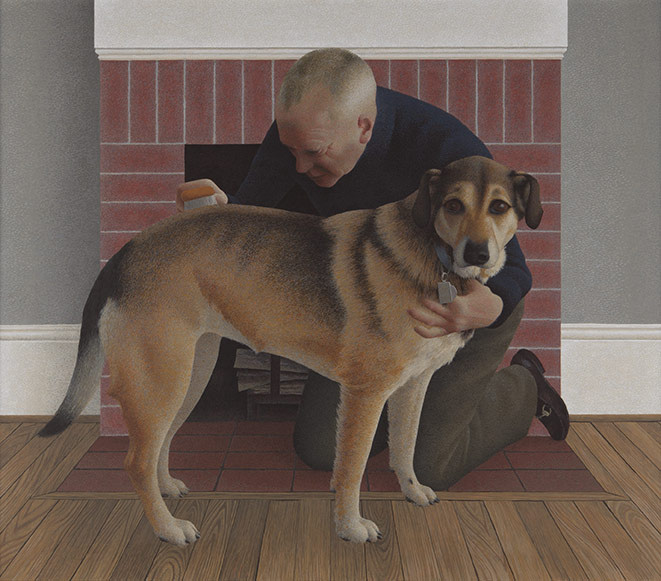
| Dog and Priest (1978) | — | Sotheby's, November 20, 2024 |
| Man on Verandah (1953) | — | Heffel, November 25, 2010 |
- Pricing
- Overall Range
- $22 USD (low-end multiples) to $1,775,884 USD (auction record)
- Paintings Major
- Notes
- Major paintings with exhibition history command highest prices
- Current Market Tier
- Blue-chip Canadian
- Historical 2010 2023
- $1,200,000-2,400,000 USD
- Prints Serigraphs
- Range
- $800-8,000 CAD
- Examples
- Three Sheep ($800-1,200 CAD), Sleeper ($4,000-6,000 CAD), Willow ($6,000-8,000 CAD)
- Recent 12 Months
- Average $4,703 USD
- Liquidity
- Market Activity
- Recent Activity
- Active market with works appearing regularly at Canadian auctions 2024-2025
- Geographic Focus
- Canadian market dominance (Toronto, Vancouver, Montreal, Ottawa)
- Total Auction Lots
- 307+ artworks at auction since 2007
- Primary Auction Venues
- Heffel Fine Art Auction House (primary), Sotheby's, Waddington's
- Auction History
- Date
- July 15, 2020
- Work
- Dog and Bridge (1976)
- Notes
- Doubled estimate; had never appeared at auction before; privately owned for decades
- Estimate
- $800,000-1,200,000 CAD
- Location
- Toronto
- Price Cad
- $2,401,250
- Price USD
- $1,775,884
- Auction House
- Heffel Fine Art Auction House
- Recent Major Sales
Work Date Price Cad Auction House Location June Noon (1963) May 25, 2023 $2,100,000 Heffel Toronto Dog and Priest (1978) November 20, 2024 Sotheby's New York Man on Verandah (1953) November 25, 2010 $1,287,000 Heffel —
- Market Position
- Liquidity
- Strong for Canadian art; estate-managed with selective release
- Collector Base
- Primarily Canadian institutions and private collectors; some international interest (Germany, Asia)
- Market Position
- Highest echelon of Canadian post-war art; compared favorably to Group of Seven members
- Price Trajectory
- Stable to rising; major works have doubled estimates in recent years
Institutional Presence
Museum of Modern Art (MoMA)
New York, USANational Gallery of Canada
Ottawa, CanadaArt Gallery of Ontario (AGO)
Toronto, CanadaMusée National d'Art Moderne / Centre Georges Pompidou
Paris, FranceTate Gallery
London, UKArt Gallery of Nova Scotia
Halifax, CanadaMontreal Museum of Fine Arts
Montreal, CanadaArt Gallery of Hamilton
Hamilton, CanadaOwens Art Gallery / Colville House
Mount Allison University, Sackville, NBCanadian War Museum
Ottawa, CanadaMetropolitan Museum of Art
New York, USAArt Institute of Chicago
Chicago, USASmithsonian Institution
Washington DC, USAAdditional collections
- Exhibitions
Year Venue Type 1951 New Brunswick Museum First solo show 1952-1955 Hewitt Gallery, New York Early commercial exhibitions 1963 Tate Gallery, London — 1966 Venice Biennale — 1967 Museum of Modern Art, New York — 1983-1985 Art Gallery of Ontario + touring Major retrospective 1994-1995 Montreal Museum of Fine Arts Major exhibition of post-1984 work 2000 National Gallery of Canada — 2003-2005 Art Gallery of Nova Scotia Touring 2014-2015 Art Gallery of Ontario / National Gallery of Canada Largest retrospective (posthumous) 2024-2025 Beaverbrook Art Gallery — - Museum Collections
- Academic Positions
- Role
- Visiting Professor
- Year
- 1967-68
- Institution
- University of California, Santa Cruz
- Role
- Visiting Artist
- Period
- 6 months in 1971
- Location
- Berlin, Germany
- Awards and Recognition
Year Award 1967 Officer of the Order of Canada 1967 — 1974 Canada Council Molson Prize 1978 — 1982 Companion of the Order of Canada (highest level) 2003 Governor General's Visual and Media Arts Award 2003 Order of Nova Scotia 2020 —
Career & Biography
- Career
- Working Method
- Meticulous process involving extensive sketches, geometric drafting, mathematical proportioning (golden section, Fibonacci series, Le Corbusier's Modulor), thin layered brushstrokes sealed with transparent lacquer; months-long execution per work
- Identity
- Birth
- Date
- August 24, 1920
- Location
- Toronto, Ontario, Canada
- Death
- Age
- 92
- Date
- July 16, 2013
- Location
- Wolfville, Nova Scotia, Canada
- Known As
- Alex Colville
- Personal Life
- Spouse
- Rhoda Wright (married 1942, died December 29, 2012)
- Children
- Four children: Graham, Charles, Ann, and John (died February 22, 2012)
- Family Significance
- Rhoda served as primary model throughout career; wife was also artist and poet
- Artistic Context
- Rejected landscape trends in favor of figurative work; explored 'myths of mundanity'—complex themes lurking behind ordinary scenes; influenced by Edward Hopper, American Luminists, and Precisionists
Artistic Profile
- Style
- Lighting
- Minimal shadows; atmospheric clarity; objects don't cast ambient shadows (creating CGI-like effect before CGI existed)
- Technique
- Meticulous hyperrealism with mathematical precision; thin layers of paint applied dot-by-dot; surfaces sealed with transparent lacquer
- Composition
- Rigorous geometric construction using golden section, Fibonacci series, Le Corbusier's Modulor system
- Perspective
- Carefully calculated viewer positioning; lack of atmospheric perspective
- Color Palette
- Muted, controlled colors; precise shading without dramatic contrasts
- Emotional Tone
- Disquieting tranquility, latent anxiety, melancholy laconism, underlying existential tension
- Execution Time
- Months per work; only 3-4 paintings or serigraphs produced annually since 1950s
- Unique Qualities
- Pre-CGI hyperrealism; bodies modeled piece-by-piece creating doll-like stillness; minimal object-environment interaction; suspended temporal quality
- Spatial Treatment
- Objects appear weightless; distance ambiguous; viewer positioned as participant rather than observer
- Narrative Approach
- Brief, concise plots without clear resolution; suggest stories beyond the frame
- Evolution
- Late Period
- 1970s-2013 - continued refinement; updated subjects (Kiss with Honda, 1989) while maintaining distinctive approach
- Early Period
- 1940s war art - impressionistic, muted colors, reportage style (e.g., Infantry, London Bridge)
- Transitional
- 1950 Nude and Dummy - shift from war reportage to personal creative direction
- Mature Period
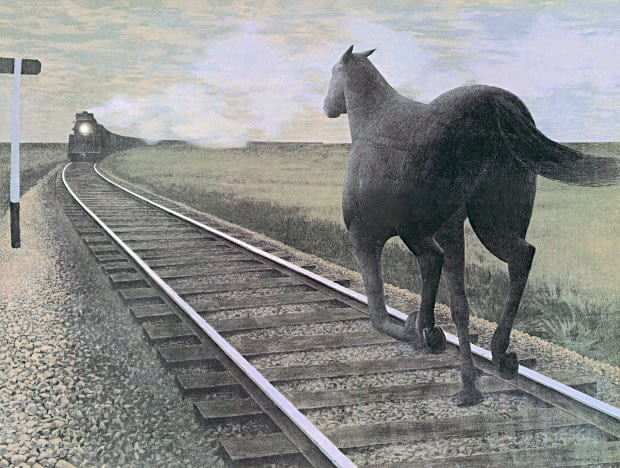
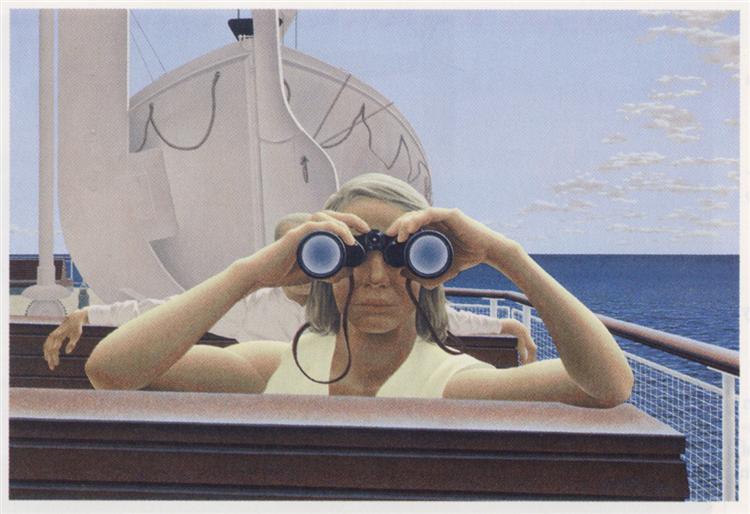
- 1950s-1960s - development of signature style; major works like Horse and Train (1954), To Prince Edward Island (1965)
- Medium Changes
- Oil → tempera → oil and synthetic resin → acrylic polymer emulsion (after 1963)
- Influences
- Primary
- Edward Hopper (American Precisionism), American Luminists, Stanley Royle and Sarah Hart (teachers, Post-Impressionists)
- Rejected
- Abstract Expressionism, Pop Art, Conceptual Art; maintained independence from modernist trends
- Acknowledged
- Ancient Egyptian art (frontal/profile compositions), European Old Masters (intensive Louvre study), Norman Rockwell (quotidian realism)
- Philosophical
- Martin Heidegger's Being and Time; existentialism; concepts of temporality and presence
- Themes and Subjects
- Primary Themes
- Everyday life, domestic scenes, human-animal relationships, maritime landscapes, existential anxiety
- Recurring Motifs
- Animals (particularly dogs, horses, crows), family members as models, vehicles (trains, cars, boats), bodies of water, nude figures
- Symbolic Elements
- Nature vs. technology conflicts, ordinary moments imbued with mystery, frozen narratives suggesting 'what if' scenarios
- Psychological Content
- Latent tension, suspended time, ambiguous narratives, 'myths of mundanity', isolation, mortality, danger
- Movements and Periods
- Primary
- Magic Realism / Maritime Realism
- Related
- Precisionism, Contemporary Realism
- Position
- Counter to mid-20th century abstraction; maintained realist tradition through modernist era
- Influenced Artists
- Broader Impact
- Established legitimacy of realist figurative painting during abstract expressionism's dominance; influenced Canadian and international contemporary realists
- Maritime Realism School
- Tom Forrestall (class of 1958), Christopher Pratt (class of 1961), Mary Pratt (class of 1961), Norman Eastman (class of 1952), Hugh Mackenzie (class of 1953)
- Canadian Significance
- Helped establish Canadian cultural identity through art; compared to Group of Seven in national importance
- Contemporary Relevance
- Work resonates with current interest in figurative painting and psychological realism; influence on cinema ongoing
- International Standing
- Respected internationally despite swimming against prevailing currents; exhibited globally
- Philosophical Underpinnings
- Stated Beliefs
- Art should render visible mysteries of supernatural world; ordinary life contains mythical aspects; realism can analyze rather than merely reflect reality
- Artistic Mission
- Discover 'myths of mundanity' in everyday settings; explore fundamental human situations (loneliness, isolation, love, work, leisure)
- Existential Focus
- Being and time as central concerns; anxiety as normality; life as inherently dangerous
- Conservative Aesthetics
- Rejected 'free verse' approach; worked within existing forms; valued order and structure
Critical Reception
- Critical Reception
- Detractors
Year Context Critic Publication 1983 AGO retrospective review John Bentley Mays Globe and Mail 1985 Questioned his canonical status Richard Perry Canadian Forum - Supporters
Year Assessment Critic — Declared Colville 'the most prominent realist painter in the Western world' Heinz Ohff (German art critic) 2004 Called Colville 'the best Canadian artist of his time'; compared to John Constable Martin Kemp (art historian) 2000 Praised his 'powerful sense of self' and independence 'beyond category' Robert Fulford - Cultural Impact
- Film Influence
- Works featured in Stanley Kubrick's The Shining (1980); influenced Coen Brothers (No Country for Old Men); discussed by film critics
- Popular Culture
- Horse and Train on Bruce Cockburn album Night Vision (1973)
- Literary Connections
- Iris Murdoch correspondence; compared to Alice Munro; dedicated work by philosopher George Grant
- Documentary Attention
- Multiple films and video installations in exhibitions
- Catalogue Raisonne
- No comprehensive catalogue raisonné published; extensive documentation through exhibition catalogues and monographs
- Critical Discourse
- Key Issues
- Realism vs. abstraction debate; figurative work during height of abstract expressionism; perceived conservatism
- Controversy
- Divided critics: popular with public and establishment but challenged by modernist/abstract art advocates
- Current Consensus
- Recognized as major Canadian artist despite earlier critical divisions; posthumous reputation solidified
- Scholarly Attention
- Extensive academic study; compared to Edward Hopper, American Precisionists, Magic Realists, Andrew Wyeth
- Publications and Media
- Major Publications
Title Year Author Publisher The Art of Alex Colville 1972 Helen J. Dow McGraw-Hill Ryerson Limited The Magic Realism of Alex Colville Summer 1965 Helen J. Dow — Colville 1983 David Burnett Art Gallery of Ontario Alex Colville: The Observer Observed 1994 Mark Cheetham — Alex Colville: Paintings, Prints and Processes 1983-1994 1994 Philip Fry Montreal Museum of Fine Arts Alex Colville - The Splendour of Order 1984 — —
Gallery & Representation
- Fair Presence
- Historical participation in Canadian art fairs; estate maintains selective presence
- Representation
- Secondary Market
- Availability
- Regular auction appearances; estate controls primary market supply
- Auction Houses
- Heffel Fine Art Auction House (primary Canadian), Sotheby's, Waddington's, Phillips
- Market Structure
- Well-established secondary market with institutional support
- Primary Galleries
- Name
- Mira Godard Gallery
- Locations
- Toronto, Montreal
- Relationship
- Long-standing relationship; represented artist since 1978
- Significance
- Primary Canadian gallery for estate works
- Recent Exhibitions
- Atlantic Light (Nov 2024-Jan 2025), Alex Colville/Henry Moore (Oct-Dec 2023), Alex Colville: The Early Years (April 2021 - first estate exhibition)
- Estate Representation
- Name
- Colville Estate
- Notes
- Estate managed by A.C. Fine Art Inc.; selective release of works
- Active
- 2013-present
- Historical Representation
- Name
- Hewitt Gallery
- Period
- 1952-1955
- Location
- New York
- Significance
- Earliest commercial exhibitions
- Geographic Reach
- Current Availability
- Works available through estate via Mira Godard Gallery; regular auction appearances of prints and occasional paintings; prices by inquiry for major works
This is what the market knows about Alex Colville. What Egon can also tell you: whether Alex Colville fits your portfolio — based on your existing holdings, budget, and investment timeline.
Get Personalized AnalysisActive Market Signals
Signal Timeline & Strength Analysis
Gallery moves, auction records, institutional acquisitions, price milestones — tracked over 90 days
Collector Demographics & Buyer Analysis
Geographic distribution, institutional vs. private buyers, collector profiles, and secondary market activity
Personalized Acquisition Strategy
Optimal entry points, comparable pricing analysis, timing recommendations, and portfolio fit assessment
Go Deeper with Personalized Intelligence
You now have Egon's market assessment of Alex Colville. The next question is personal: does this artist belong in your collection? Egon analyzes collection fit based on your aesthetic thesis, existing holdings, budget, and investment goals — delivering acquisition strategies no public index can provide.