Utagawa Hiroshige
Blue-chip#31





Egon Investment Scores
Liquidity
9/10
How easily works can be bought and sold at auction
Institutional
10/10
Museum collections, biennials, and institutional recognition
Momentum
9/10
Recent price trends, gallery moves, and market buzz
Discovery
1/10
Undervaluation opportunity relative to peer artists
Risk
1/10
Investment risk factors — higher means more volatile
Market Position
Auction Record
$2,412,320
The complete set of Famous Places in the Sixty-odd Provinces (Rokujūyoshū meisho zue) — 69 woodblock prints plus contents page
- Auction Record
- Sale
- Sotheby's Paris
- Work
- The complete set of Famous Places in the Sixty-odd Provinces (Rokujūyoshū meisho zue) — 69 woodblock prints plus contents page
- Year
- 2025
- Notes
- Each vertical ōban: approx. 37.2 x 25.5 cm. Complete sets command significantly higher prices than individual prints.
- Price EUR
- $2,116,500
- Price USD
- $2,412,320
- Provenance
- Gerhard Pulverer Collection (collector's seal to verso); published by Koshimuraya Heisuke, 1853–1859
- Market Dynamics
- Market Segments
- Entry Level
- Later impressions, minor series — $500–$5,000
- Mass Market
- Restrikes, reproductions — $50–$500 (not investment grade)
- Serious Collector
- Good quality lifetime or early impressions of major series — $5,000–$50,000
- Institutional Collector
- Complete sets, museum-quality first impressions — $100,000+
- Price Trajectory
- Robust and growing; 2025 record of $2.4M significantly surpassed previous benchmarks. Complete sets of major series increasingly attracting institutional and major private collector competition.
- Key Value Drivers
- Edition state: lifetime impressions vs. posthumous restrike — lifetime prints worth exponentially more
- Completeness: complete sets command enormous premiums (often 10x–50x individual prints)
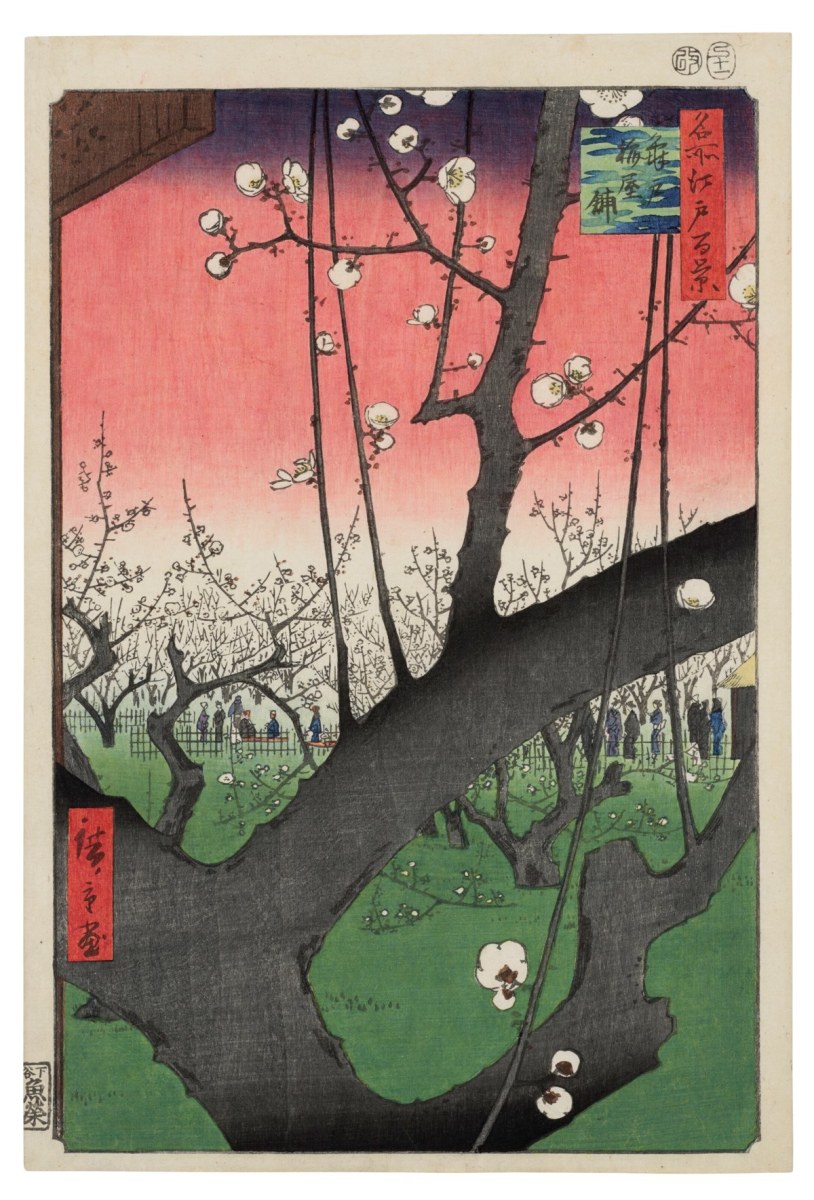
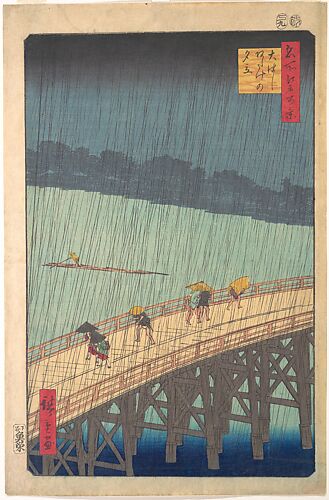
- Subject matter: iconic designs (Sudden Shower, Plum Garden, Naruto Whirlpools) carry substantial premiums
- Condition: extremely sensitive — light-sensitive colors fade; bright, saturated prints at premium
- Provenance: major collection provenance (e.g., Gerhard Pulverer Collection) adds significant value
- Market Liquidity
- Market Depth Notes
- One of the most actively traded Old Master print markets globally. Active across Christie's, Sotheby's, Bonhams, Phillips, and dozens of specialist/regional auction houses worldwide.
- Egon Sell Through Rate
- 84%
- Egon Database Lots 2025 Plus
- 20
- Recent Average Price Prints 12mo
- $4,570
- Recent Average Price Paintings 12mo
- $1,969
- Total Auction Lots Mutualart Since 1998
- 9078
- Sothebys 2024 Woodblock Sale Sellthrough
- 84% (38 of 45 lots sold)
- Auction Record Meta
- Added at
- 2026-03-15T03:12:14.494128+00:00
- Market Dynamics Meta
- Added at
- 2026-03-15T03:12:14.494128+00:00
- Notable Recent Sales
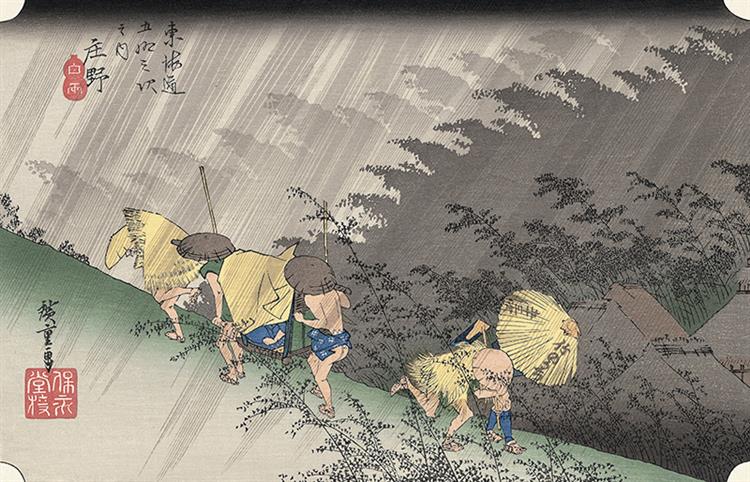
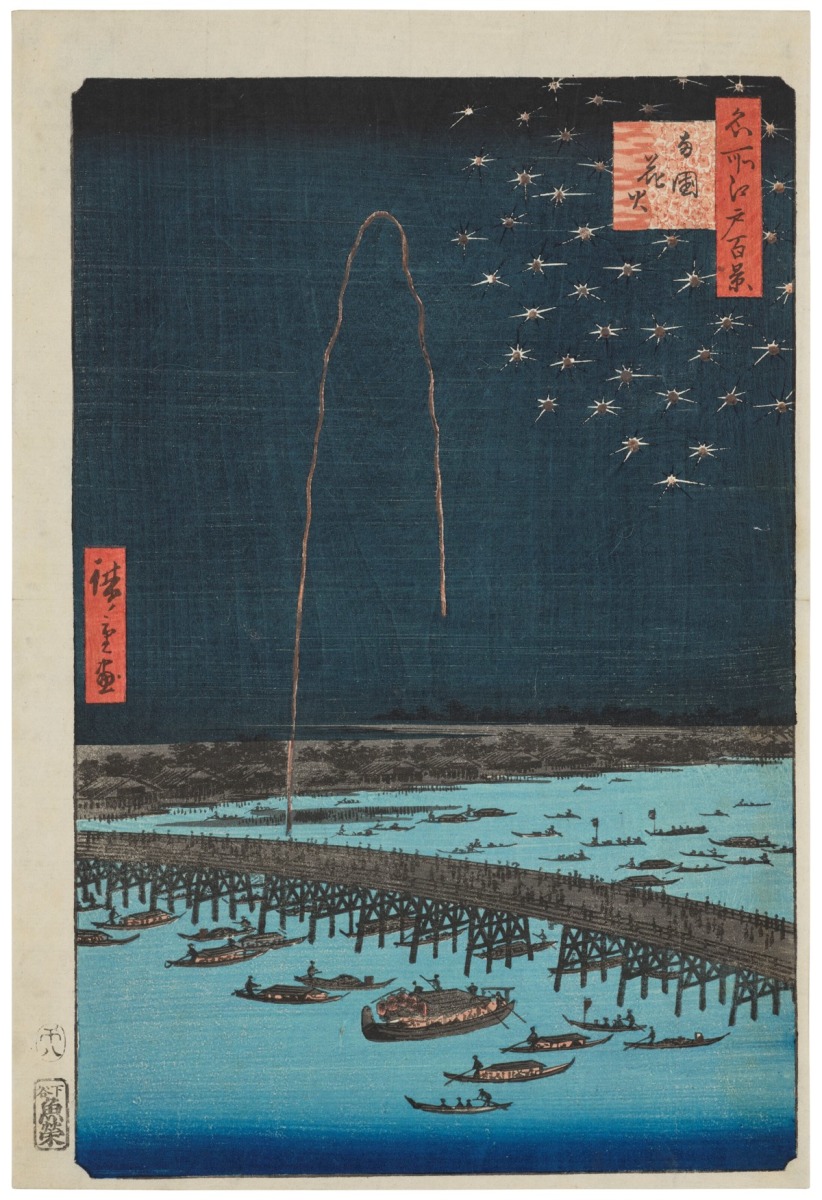
Work Date Price USD Sale Vs Estimate The complete set of One Hundred Famous Views of Edo — 120 prints July 18, 2024 $405,400 Sotheby's Online, Japanese Woodblock Prints 162% above low estimate of $154,300 Azuma no mori Renri no azusa (Azuma Shrine) September 2025 $9,525 Christie's Exceeded high estimate Shono, hakuu (Shono: Driving Rain) September 2025 $8,255 Christie's Above estimate No. 17 Yui September 2025 $2,794 Christie's Above estimate No. 15 Yoshiwara September 2025 $2,540 Christie's Above estimate No. 7 Fujisawa September 2025 $1,905 Christie's Below estimate - Market Liquidity Meta
- Added at
- 2026-03-15T03:12:14.494128+00:00
- Collector Intelligence
- Collector Base
- Global — strong demand from US, European, and Japanese collectors and institutions. Growing East Asian collector interest. Accessible entry points ($200–$2,500) attract broad base; top-tier complete sets appeal to major institutions and ultra-high-net-worth collectors.
- Known Major Collectors
Name Notes Alan Medaugh Leading US collector; owns one of the largest private collections of Hiroshige outside Japan (500+ works documented in Chrysler Museum catalogue). Gifted 35 prized prints to the British Museum in 2025. Has collected Hiroshige for over 50 years. Gerhard Pulverer (deceased) German collector whose complete Rokujūyoshū meisho zue set sold for the $2.4M record at Sotheby's Paris 2025
- Upcoming Opportunities
Date Notes Event March 2026 Includes a complete set of One Hundred Views of Famous Places in Edo. Preview: March 20–24, 2026. Christie's Asia Week New York — Japanese Art Sale January–March 2026 Multiple individual Hiroshige lots active (Kameyama yukibare, Bats under the Moon, etc.) Christie's Japanese Art Sales — Ongoing - Price Ranges by Category
- Lower Tier
- Notes
- Modern reprints, heavily worn impressions. Not investment-grade.
- Range
- Under $500
- Strong Individual Prints
- Notes
- Good-quality impressions of desirable designs from major series, lifetime or early posthumous
- Range
- $2,000–$15,000
- Complete Sets Major Series
- Notes
- Complete sets of major series command top-tier premiums. Sotheby's 2024: $405,400 for Hyakkei set; Sotheby's Paris 2025: $2.4M for Rokujūyoshū set.
- Range
- $200,000–$2,400,000+
- Standard Individual Prints
- Notes
- Later posthumous impressions, less-desirable subjects, or prints from minor series
- Range
- $200–$2,500
- Premium Individual Prints First Edition
- Notes
- First-edition, lifetime impressions of iconic designs from One Hundred Famous Views of Edo or original Tōkaidō series
- Range
- $10,000–$100,000+
- Notable Recent Sales Meta
- Added at
- 2026-03-15T03:12:14.494128+00:00
- Collector Intelligence Meta
- Added at
- 2026-03-15T03:12:14.494128+00:00
- Upcoming Opportunities Meta
- Added at
- 2026-03-15T03:12:14.494128+00:00
- Price Ranges by Category Meta
- Added at
- 2026-03-15T03:12:14.494128+00:00
Institutional Presence
- Museums
Name Location Holdings Tier Metropolitan Museum of Art New York, USA Extensive — hundreds of prints. Acquisition history dates to 1911 (Francis Lathrop Collection, Frederick C. Hewitt Fund). 1 Art Institute of Chicago Chicago, USA Extensive — major collection of ukiyo-e prints including hundreds of Hiroshige works. Currently displaying works as of 2025. 1 Smithsonian Institution (National Museum of Asian Art) Washington D.C., USA Significant collection across Freer Gallery of Art and Arthur M. Sackler Gallery 1 Cleveland Museum of Art Cleveland, USA Confirmed collection holdings per primary museum database 1 Victoria & Albert Museum London, UK Confirmed collection holdings per primary museum database 1 British Museum London, UK Major collection; landmark 2025 solo retrospective (first at BM, first in London in 25+ years). Accepted major gift of 35 prints from Alan Medaugh. 1 Brooklyn Museum New York, USA Important collection; features early Edo-period impressions 1 Rijksmuseum Amsterdam, Netherlands Major Japanese print collection including Hiroshige works 1 Museum of Fine Arts, Boston Boston, USA Important Japanese print collection; known for high-quality Hiroshige impressions 1 Chrysler Museum of Art Norfolk, Virginia, USA Hosted major Alan Medaugh Collection exhibition; published 500-entry catalogue Hiroshige: Nature and the City 2 Hiroshige Museum of Art, Ōba Shizuoka Prefecture, Japan Dedicated museum to Hiroshige's life and work 2 Ōta Memorial Museum of Art (Ukiyo-e Ōta Kinen Bijutsukan) Tokyo, Japan Major ukiyo-e collection including extensive Hiroshige holdings 2 Europeana (European Museums aggregate) Multiple European institutions Confirmed presence across European museum members per primary database 2 - Exhibitions
Title Dates Venue Location Significance Type Hiroshige: Artist of the Open Road May 1 – September 7, 2025 British Museum, Joseph Hotung Great Court Gallery London, UK First Hiroshige exhibition at the British Museum; first major London show in 25+ years. Features prints, drawings, illustrated books, paintings from BM collection plus major loans from Alan Medaugh and international lenders. Major solo retrospective Hiroshige: Artist of the Open Road — Digital Extension May 14 – September 7, 2025 The Outernet, Charing Cross Road London, UK First time BM took exhibition to London streets; Fuji River view across 23,000 sq ft 16K wraparound screens at world's most advanced immersive space Immersive digital exhibition Hiroshige: Nature and the City — Chrysler Museum of Art Norfolk, Virginia, USA Based on Alan Medaugh Collection — one of the largest private collections outside Japan. 500-entry scholarly catalogue published. Major survey exhibition Japanese Woodblock Prints (Sotheby's) July 11–18, 2024 Sotheby's Online — Hiroshige I led the $1.17M total sale; complete Hyakkei set sold for $405,400 Auction / market exhibition - Museums Meta
- Added at
- 2026-03-15T03:12:14.494334+00:00
- Exhibitions Meta
- Added at
- 2026-03-15T03:12:14.494334+00:00
- Major Publications Catalogues
Title Year Author Publisher The Colour Prints of Hiroshige — Edward F. Strange — Hiroshige: Prints and Drawings 1997 Matthi Forrer Royal Academy of Arts, London Hiroshige's Journey in the 60-odd Provinces 2004 Marije Jansen — Rokujuyoshu meisho zue: Puruvera korekushon 1996 — Tokyo Hiroshige: Nature and the City — — — Hiroshige: artist of the open road 2025 — British Museum - Major Publications Catalogues Meta
- Added at
- 2026-03-15T03:12:14.494334+00:00
Career & Biography
- Identity
- Era
- Edo period (1603–1868)
- Gender
- Male
- Full Name
- Utagawa Hiroshige (歌川 広重)
- Birth Date
- 1797
- Birth Year
- 1797
- Death Date
- October 12, 1858
- Nationality
- Japanese
- Active Period
- c. 1811–1858
- Also Known As
- Andō Hiroshige (安藤 広重)Andō Tokutarō (安藤 徳太郎)Ichiryūsai HiroshigeIchiyūsai Hiroshige
- Birth Location
- Edo (present-day Tokyo), Japan
- Death Location
- Edo (present-day Tokyo), Japan
- Identity Meta
- Added at
- 2026-03-15T03:12:14.493835+00:00
- Personal Life
- Burial
- Zen Buddhist temple in Asakusa, Tokyo
- Death Poem
- I leave my brush in the East / And set forth on my journey / I shall see the famous places in the Western Land (dual reference to the Tōkaidō and to the paradise of Amida Buddha)
- Family Background
- Son of a low-ranking samurai family serving as fire wardens in Edo
- Career Timeline
Year Event 1797 Born as Andō Tokutarō into a low-ranking samurai family serving as fire wardens in Edo c. 1809–1811 Both parents died within months of each other; inherited father's fire warden position at age ~13; began painting shortly thereafter c. 1811 Began formal training under Utagawa Toyohiro; received art name 'Hiroshige' c. 1812–1820s Earliest prints followed ukiyo-e tradition of women and kabuki actors in Edo's pleasure districts c. 1820s–early 1830s Encountered Hokusai's work; began shifting toward landscapes. Changed signature to 'Ichiyūsai' 1829–1830 First landscape series: Eight Famous Views of Ōmi — first revelations of his true genius 1832 Passed fire warden duties to son Nakajirō; joined official procession along the Tōkaidō highway to Kyoto, sketching landscapes along the way 1833–1834 Published The Fifty-three Stations of the Tōkaidō — catapulted to contemporary fame 1834–1835 Followed with Illustrated Places of Naniwa, Famous Places of Kyoto, Eight Views of Ōmi 1840s–1850s Peak productivity: Famous Places of the Sixty-odd Provinces (1853–59), Sixty-nine Stations of Kiso Kaidō, Thirty-six Views of Mt. Fuji, and numerous other series 1856 Became a Buddhist monk ('retired from the world'); began One Hundred Famous Views of Edo 1856–1858 Created One Hundred Famous Views of Edo — 120 single-sheet prints — final masterwork October 12, 1858 Died aged 62 during the great Edo cholera epidemic; buried in a Zen Buddhist temple in Asakusa. Left a farewell poem. - Studio Practice
- Output
- Created over 8,000 woodblock print designs across his career, as well as hundreds of paintings and dozens of illustrated books; approximately 5,000+ designs for color woodblock prints alone.
- Working Method
- Print series typically developed from sketches made during travels; did not always visit locations personally (later series relied on maps and others' accounts). Collaborated with publishers, block carvers, and printers in the traditional ukiyo-e production chain.
- Financial Situation
- Despite enormous productivity and popularity, Hiroshige was not wealthy — his commissions were less than those of other in-demand artists, earning approximately twice the wages of a day laborer.
- Personal Life Meta
- Added at
- 2026-03-15T03:12:14.493835+00:00
- Career Timeline Meta
- Added at
- 2026-03-15T03:12:14.493835+00:00
- Studio Practice Meta
- Added at
- 2026-03-15T03:12:14.493835+00:00
- Education and Training
- Notes
- Initially rejected by Utagawa Toyokuni — the more prominent Utagawa master — before being accepted by Toyohiro. Also studied the Chinese-influenced Nanga painting style under Ōoka Umpō and absorbed Shijō school ink wash techniques. Received the art name 'Hiroshige' from Toyohiro in recognition of his talent.
- School
- Utagawa school of ukiyo-e
- Primary Master
- Utagawa Toyohiro (Utagawa school), c. 1811 onward
- Education and Training Meta
- Added at
- 2026-03-15T03:12:14.493835+00:00
- Artistic Influences and Context
- Contemporaries
- Katsushika HokusaiUtagawa KuniyoshiUtagawa Kunisada
- Artistic School
- Utagawa school of ukiyo-e
- Primary Influence
- Katsushika Hokusai (whose Thirty-Six Views of Mount Fuji, 1830–32, inspired Hiroshige to focus on landscapes)
- Historical Position
- Considered the last great master of the ukiyo-e tradition; his death in 1858 marked the beginning of a rapid decline in the genre in the face of Meiji-era Westernization
- Additional Influences
- Chinese Nanga painting traditionShijō school ink wash techniquesJippensha Ikku's Tōkaidōchū Hizakurige (travel comedy)
- Artistic Influences and Context Meta
- Added at
- 2026-03-15T03:12:14.493835+00:00
Artistic Profile
- Artistic Style
- Summary
- Hiroshige is the supreme master of atmospheric Japanese landscape — poetic, ambient, deeply felt. His prints capture ephemeral weather conditions, seasons, and mood with unparalleled subtlety. His approach is fundamentally different from Hokusai's bold formalism — where Hokusai dramatizes, Hiroshige poeticizes.
- Distinctive Qualities
- Mastery of atmospheric conditions: mist, rain, snow, fog, moonlight, and seasonal change rendered with supreme delicacy
- Bokashi technique: graduated color printing through multiple impressions in the same area; creates luminous sky gradations and misty distances
- Unusual vantage points: bird's-eye views, dramatic foreground cropping, diagonal compositions
- Kiri (cut) compositional device: creates expansive sense of space and depth
- Subtle, saturated color palette: often dominated by blues, greens, and grays with strategic accents
- Integration of poetry (haiku and waka) into compositions
- Human figures appear small against vast landscapes, emphasizing nature's power
- Primary Themes
- Meisho-e (pictures of famous places) — topographic landscape poetry in visual form
- Travel and the road — the Tōkaidō highway as metaphor for life's journey
- Seasons and weather — Japanese aesthetic of mono no aware (pathos of impermanence)
- Everyday life in Edo — merchants, pilgrims, laborers, pleasure-seekers
- Nature: mountains, rivers, rain, snow, moonlight, birds, and flowers
- Urban Edo (Tokyo): canals, bridges, festivals, markets, shrines, temples
- Signature Series
Title Dates Description Notes Publisher The Fifty-three Stations of the Tōkaidō 1833–1834 55 horizontal ōban prints depicting 53 post stations plus endpoints. Hiroshige's magnum opus and breakthrough work. Followed by 20+ additional Tōkaidō series (~700 total Tōkaidō prints). — Hōeidō and Senkakudō One Hundred Famous Views of Edo (Meisho Edo hyakkei) 1856–1858 120 vertical ōban prints in radical vertical format with bold close-up cropping. Final masterwork; most directly influential on Western Impressionism. Complete sets: $405,400 at Sotheby's 2024. — Uoya Eikichi Famous Places in the Sixty-odd Provinces (Rokujūyoshū meisho zue) 1853–1859 69 vertical ōban prints plus contents page; one per province of Japan. Complete Pulverer Collection set: $2,412,320 at Sotheby's Paris 2025 — artist auction record. — Koshimuraya Heisuke Sixty-nine Stations of the Kiso Kaidō 1835–1842 — Collaborative series with Keisai Eisen; depicts alternate Edo-Kyoto mountain route — Thirty-six Views of Mount Fuji 1852–1858 — Hiroshige's response to Hokusai's famous Fuji series — Eight Famous Views of Ōmi 1829–1830 — First landscape series; pivotal shift away from figure subjects — - Artistic Style Meta
- Added at
- 2026-03-15T03:12:14.494894+00:00
- Primary Themes Meta
- Added at
- 2026-03-15T03:12:14.494894+00:00
- Stylistic Evolution
- Late Period 1848 to 1858
- Vertical format experimentation; One Hundred Famous Views of Edo shows radical compositional innovation — extreme close-ups, unexpected vantage points, bold color. Final transcendent period.
- Early Career 1811 to 1830
- Conventional ukiyo-e subjects — bijinga (beautiful women), yakusha-e (kabuki actors). Working within Utagawa school conventions.
- Mature Period 1833 to 1848
- Fifty-three Stations of the Tōkaidō and follow-up series; horizontal format, warm palette, narrative vignettes. Peak commercial success.
- Pivotal Transition 1829 to 1833
- Shift to landscape; Eight Famous Views of Ōmi shows first breakthrough. Hokusai's Fuji series visible influence.
- Movements and Periods
- Primary
- Ukiyo-e (pictures of the floating world), 17th–19th century Japan
- Sub Genres
- Meisho-e (topographic/landscape prints), kacho-ga (bird-and-flower prints)
- Historical Period
- Late Edo period (1830–1858) — final flowering of ukiyo-e
- Western Resonance
- Japonisme — profound influence on Western Impressionism and Post-Impressionism
- Signature Series Meta
- Added at
- 2026-03-15T03:12:14.494894+00:00
- Stylistic Evolution Meta
- Added at
- 2026-03-15T03:12:14.494894+00:00
- Techniques and Materials
- Painting
- Also produced scroll paintings in ink and mineral pigments
- Key Technique
- Bokashi (color gradation): labor-intensive technique applying uneven ink to the block before printing to create graduated tones — used extensively for sky, water, and atmospheric effects
- Primary Medium
- Polychrome woodblock printing (nishiki-e) — Edo-period technique using multiple carved wooden blocks (one per color) with registration marks
- Other Techniques
- Multiple color impressions over same area for depthBlind embossing (karazuri) for textureMica printing (kirara-zuri) for luminous effectsMetallic pigments
- Illustrated Books
- Dozens of illustrated books (ehon) across career
- Movements and Periods Meta
- Added at
- 2026-03-15T03:12:14.494894+00:00
- Key Influences on Western Art
- Claude Monet — atmospheric color and light
- Vincent van Gogh — directly copied Hiroshige prints in oil paint
- Edgar Degas — asymmetrical composition and unusual viewpoints
- Paul Gauguin — bold color and decorative flatness
- James McNeill Whistler — nocturnal atmosphere and economy of means
- Georges Seurat — color theory and atmosphere
- Henri de Toulouse-Lautrec — poster design and bold outline
- Frank Lloyd Wright — organic integration of structure and nature
- Hayao Miyazaki / Studio Ghibli — compositional language, scale relationships, atmospheric landscapes
- Techniques and Materials Meta
- Added at
- 2026-03-15T03:12:14.494894+00:00
- Key Influences on Western Art Meta
- Added at
- 2026-03-15T03:12:14.494894+00:00
Critical Reception
- Critical Consensus
- Utagawa Hiroshige is universally recognized as one of the greatest printmakers in art history and 'the last great master of the ukiyo-e tradition.' His work fundamentally transformed Western art through the Japonisme movement of the late 19th century.
- Scholarly Recognition
- Japonisme
- Hiroshige's work is a central case study in Japonisme — the influence of Japanese aesthetics on 19th-century European art — studied across art history curricula globally.
- Academic Consensus
- Foundational figure in the study of Japanese art history, Japonisme, and the art-historical relationship between East and West. Subject of extensive scholarly monographs and catalogues raisonnés.
- Art Historical Position
- Positioned alongside Katsushika Hokusai as the defining figures of late ukiyo-e; generally considered complementary — Hokusai bold and formal, Hiroshige poetic and atmospheric.
- Publications and Media
- Recent Coverage
- Telegraph featured Hiroshige in Best Art Exhibitions of 2025; Artnet News: 'Who Was Hiroshige, the Artist Behind Japan's Most Iconic Prints?' (2025); HENI reported Sotheby's 2024 sale led by Hiroshige I
- Feature Articles
- Daily Art MagazineForbesFAD MagazineThe Telegraph (Best Art Exhibitions of 2025, November 2025)Artnet News
- Critical Consensus Meta
- Added at
- 2026-03-15T03:12:14.494743+00:00
- Scholarly Recognition Meta
- Added at
- 2026-03-15T03:12:14.494743+00:00
- Western Critical Reception
- Architecture
- Frank Lloyd Wright cited Hiroshige as an influence
- Monet Connection
- Monet became an eager collector of Japanese woodblock prints; Hiroshige's bokashi gradient technique visibly influenced Monet's treatment of atmosphere and light
- Historical Impact
- Hiroshige's prints arrived in Europe primarily after his death, where they became enormously influential on Impressionism and Post-Impressionism. Artists who collected and were directly influenced include Claude Monet, Edgar Degas, Édouard Manet, Paul Gauguin, Vincent van Gogh, Georges Seurat, Henri de Toulouse-Lautrec, and James McNeill Whistler.
- Van Gogh Connection
- Van Gogh copied two prints from One Hundred Famous Views of Edo directly in oil paint; Japanese prints are visible in the background of his Portrait of Père Tanguy (1887)
- Contemporary Culture
- Sotheby's: 'His revolutionary use of perspective and cropping may even have foreshadowed animation styles such as those seen in the works of the widely acclaimed Studio Ghibli animator Hayao Miyazaki.'
- Japanese Critical Reception
- Contemporary Status
- Considered relatively modest in social standing during his lifetime — not recognized by Japan's cultured elite. Fame grew internationally first, then Japan re-appraised his work.
- Quote Edward Strange
- 'Outside his own little circle of friends and customers Hiroshige was a man of small importance in Japan. The cultured classes knew him not; and it is only since his work has begun to gain its great and growing reputation in Europe and America, that he is beginning to be appreciated in his own country.' — Edward F. Strange
- Publications and Media Meta
- Added at
- 2026-03-15T03:12:14.494743+00:00
- Western Critical Reception Meta
- Added at
- 2026-03-15T03:12:14.494743+00:00
- Japanese Critical Reception Meta
- Added at
- 2026-03-15T03:12:14.494743+00:00
Gallery & Representation
- Art Fair Presence
- Historical works appear at Asian art fairs globally (Asia Week New York, Fine Art Asia Hong Kong).
- Major Auction Houses
Name Notes Sotheby's Lead seller of premium Hiroshige lots; 2025 Paris record $2.4M, 2024 Online Hyakkei set $405,400; dedicated Japanese woodblock print sales Christie's Active Hiroshige seller; Asia Week New York March 2026 includes Hiroshige complete set; regular Japanese art sales globally Bonhams Active in Japanese prints; regular Hiroshige lots including 2025 Kanbara Night Snow Phillips Occasional Japanese print sales - Market Structure Note
- As a historical artist (1797–1858), Hiroshige has no living artist gallery representation. The market is served by specialist print dealers, Japanese art dealers, and the secondary auction market.
- Art Fair Presence Meta
- Added at
- 2026-03-15T03:12:14.494564+00:00
- Geographic Market Reach
- Global — strongest in USA, UK, Japan, France, Germany, Netherlands, Australia, Hong Kong. Growing East Asian collector demand.
- Major Auction Houses Meta
- Added at
- 2026-03-15T03:12:14.494564+00:00
- Market Structure Note Meta
- Added at
- 2026-03-15T03:12:14.494564+00:00
- Primary Specialist Dealers
Name Location Notes Tier Url Egenolf Gallery Japanese Prints USA Established 1975; buys and sells original museum-quality Japanese woodblock prints; specifically lists Hiroshige as a featured artist. Specialist https://egenolfgallery.com Mie Gallery USA Curates and sells original Japanese woodblock prints; maintains extensive Hiroshige collection and scholarly articles. Specialist https://miegallery.com Japanese Gallery (japanesegallery.com) UK Specialist in Japanese woodblock prints including Hiroshige I works Specialist — Artelino Online (international) Online auction platform and archive specifically for Japanese woodblock prints; 76,000+ sold items in archive; major Hiroshige market resource Specialist — - Geographic Market Reach Meta
- Added at
- 2026-03-15T03:12:14.494564+00:00
- Primary Specialist Dealers Meta
- Added at
- 2026-03-15T03:12:14.494564+00:00
This is what the market knows about Utagawa Hiroshige. What Egon can also tell you: whether Utagawa Hiroshige fits your portfolio — based on your existing holdings, budget, and investment timeline.
Get Personalized AnalysisActive Market Signals
Signal Timeline & Strength Analysis
Gallery moves, auction records, institutional acquisitions, price milestones — tracked over 90 days
Collector Demographics & Buyer Analysis
Geographic distribution, institutional vs. private buyers, collector profiles, and secondary market activity
Personalized Acquisition Strategy
Optimal entry points, comparable pricing analysis, timing recommendations, and portfolio fit assessment
Go Deeper with Personalized Intelligence
You now have Egon's market assessment of Utagawa Hiroshige. The next question is personal: does this artist belong in your collection? Egon analyzes collection fit based on your aesthetic thesis, existing holdings, budget, and investment goals — delivering acquisition strategies no public index can provide.