Bernard Buffet
Blue-chipEgon research · Artist market profile
The market, in context.
Explore Bernard Buffet’s auction history alongside the exhibitions, collections and gallery relationships behind the market.
Auction record
$2,111,306
Les clowns musiciens, le saxophoniste (1991)
View the sale and market context →Institutional research
Collections & exhibitions
Read holdings, exhibition history and their qualifications in context.
Read the institutional research →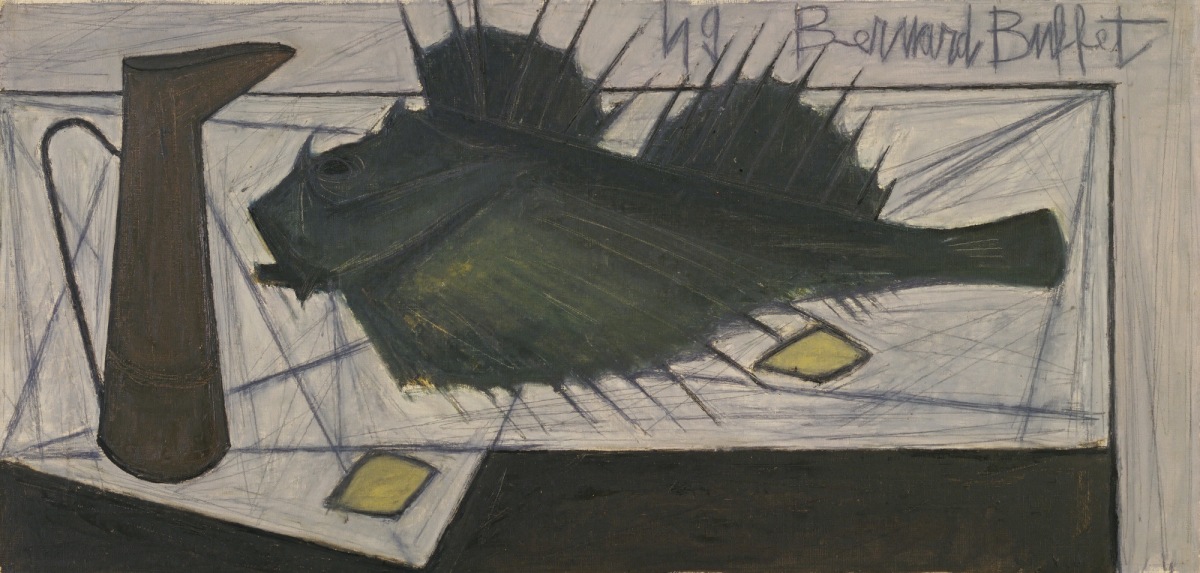

































Egon investment scores
Market position
Research updated
Auction record
Circus and clown subjects command Buffet's strongest prices.
Auction highlights
Scroll horizontally if needed →
| Work | Result | Venue and date |
|---|---|---|
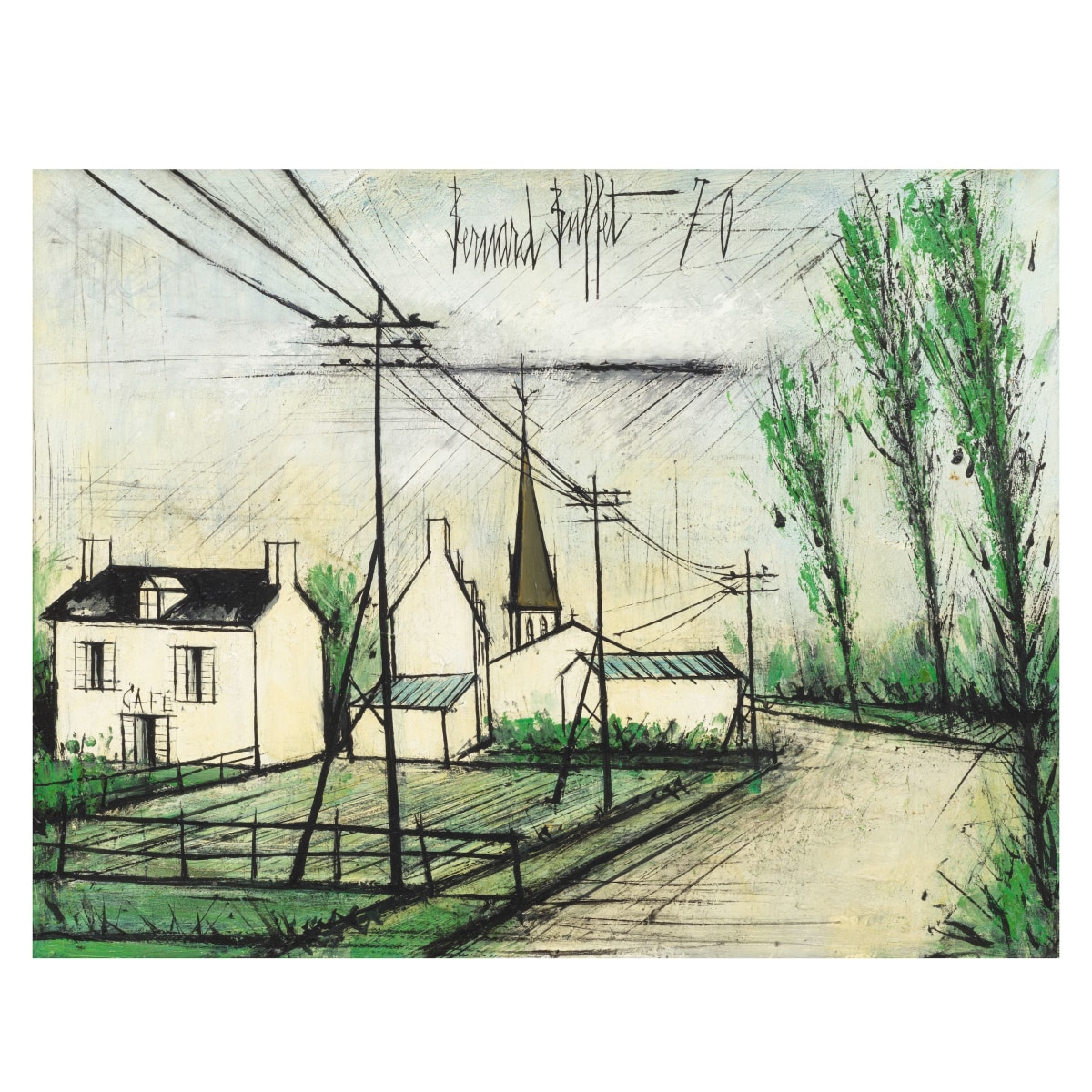
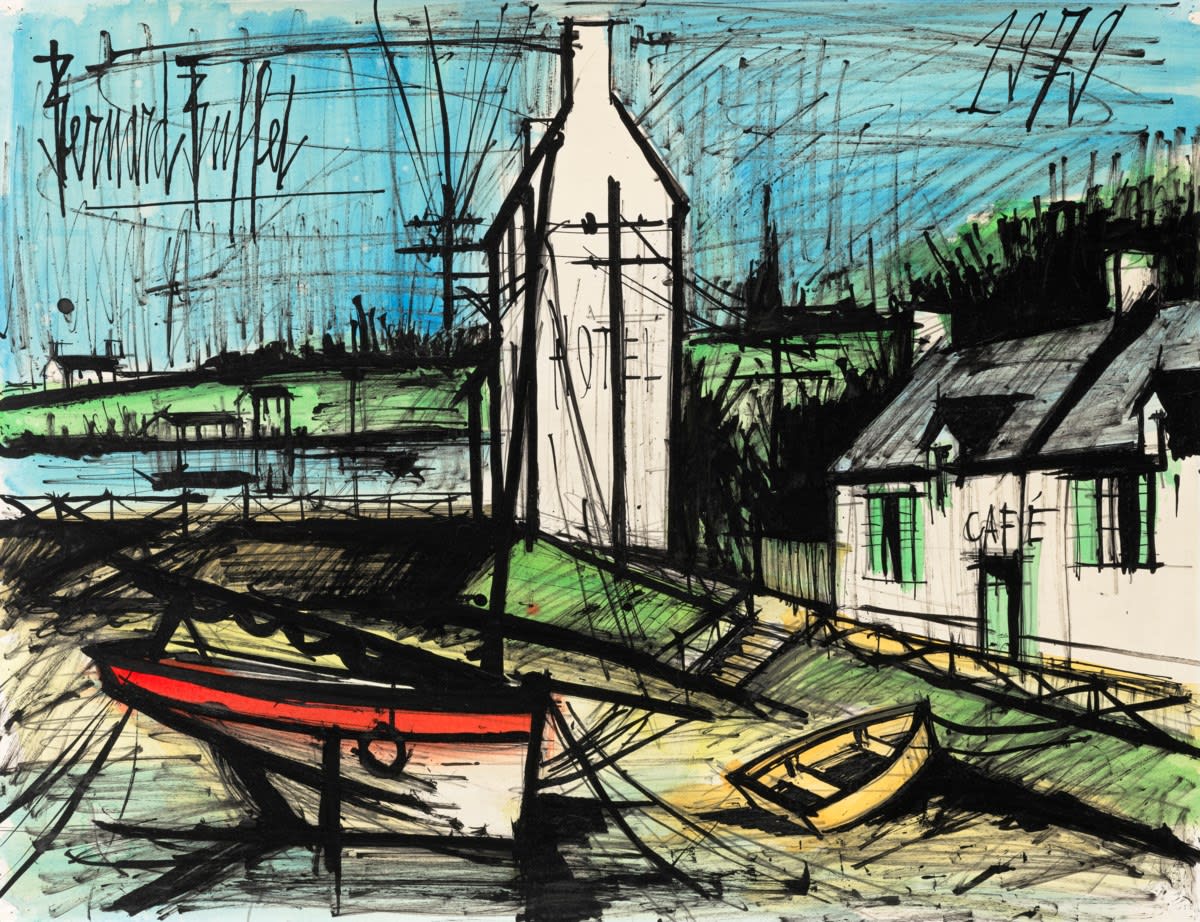
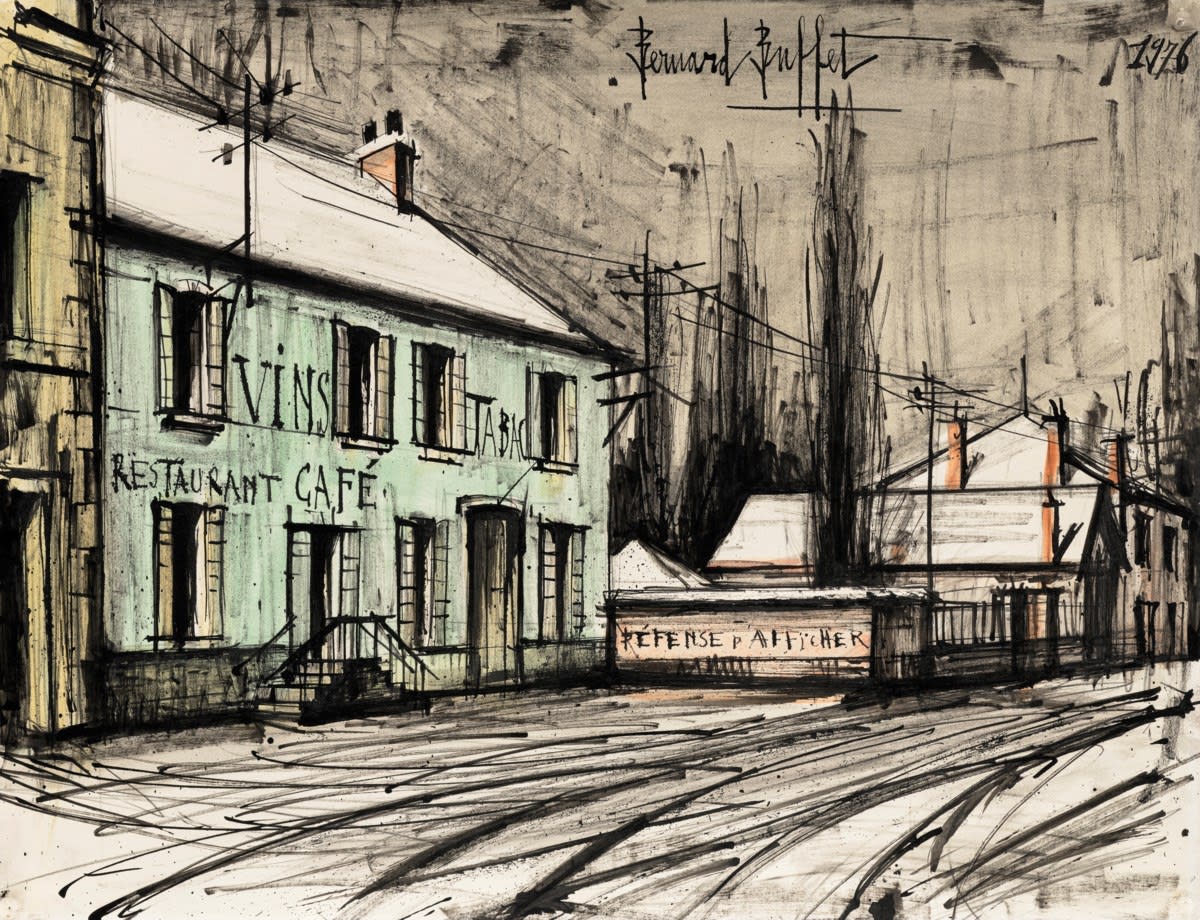
| Café de campagne | $20,000 | Bonhams, March 2026 |
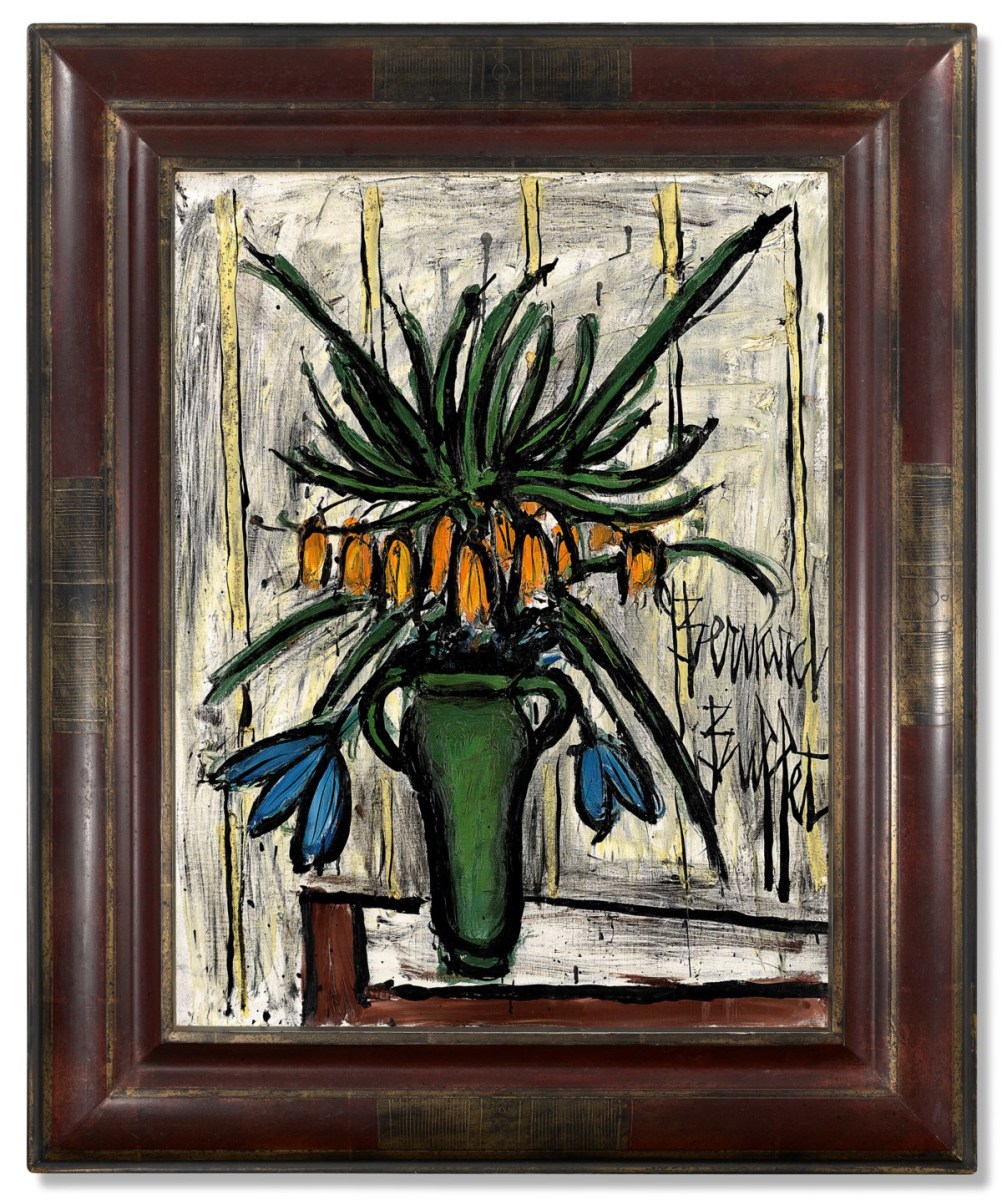
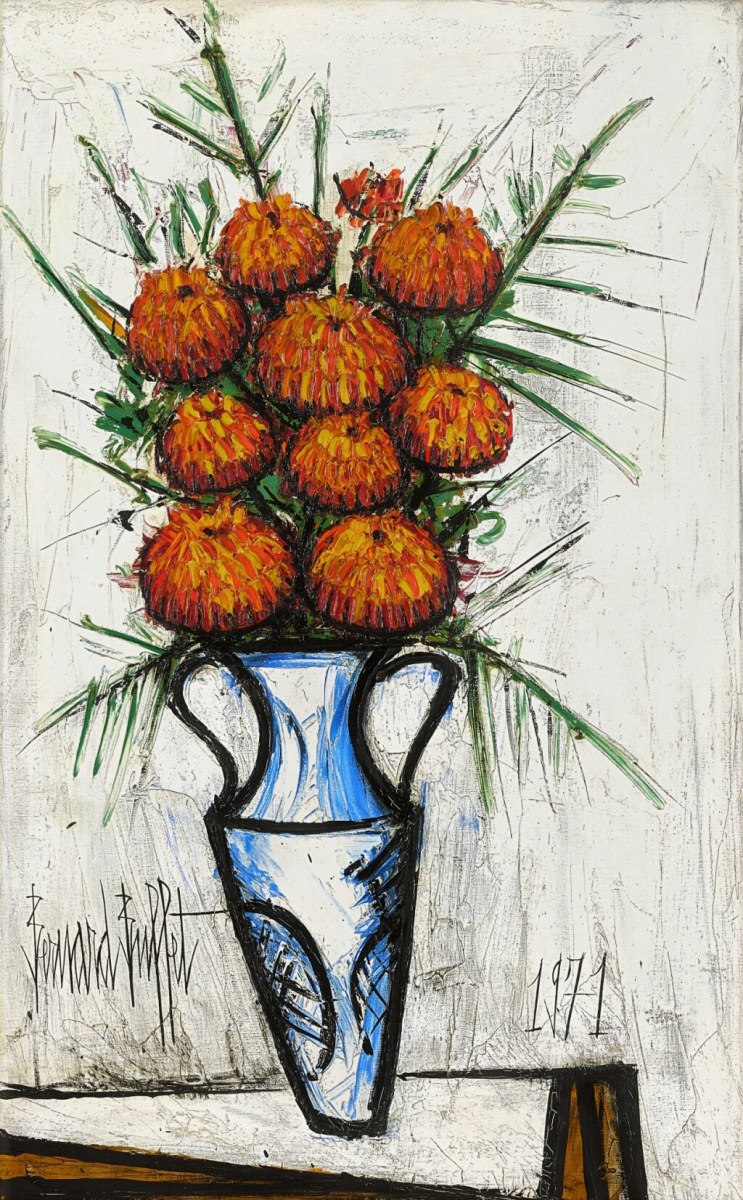
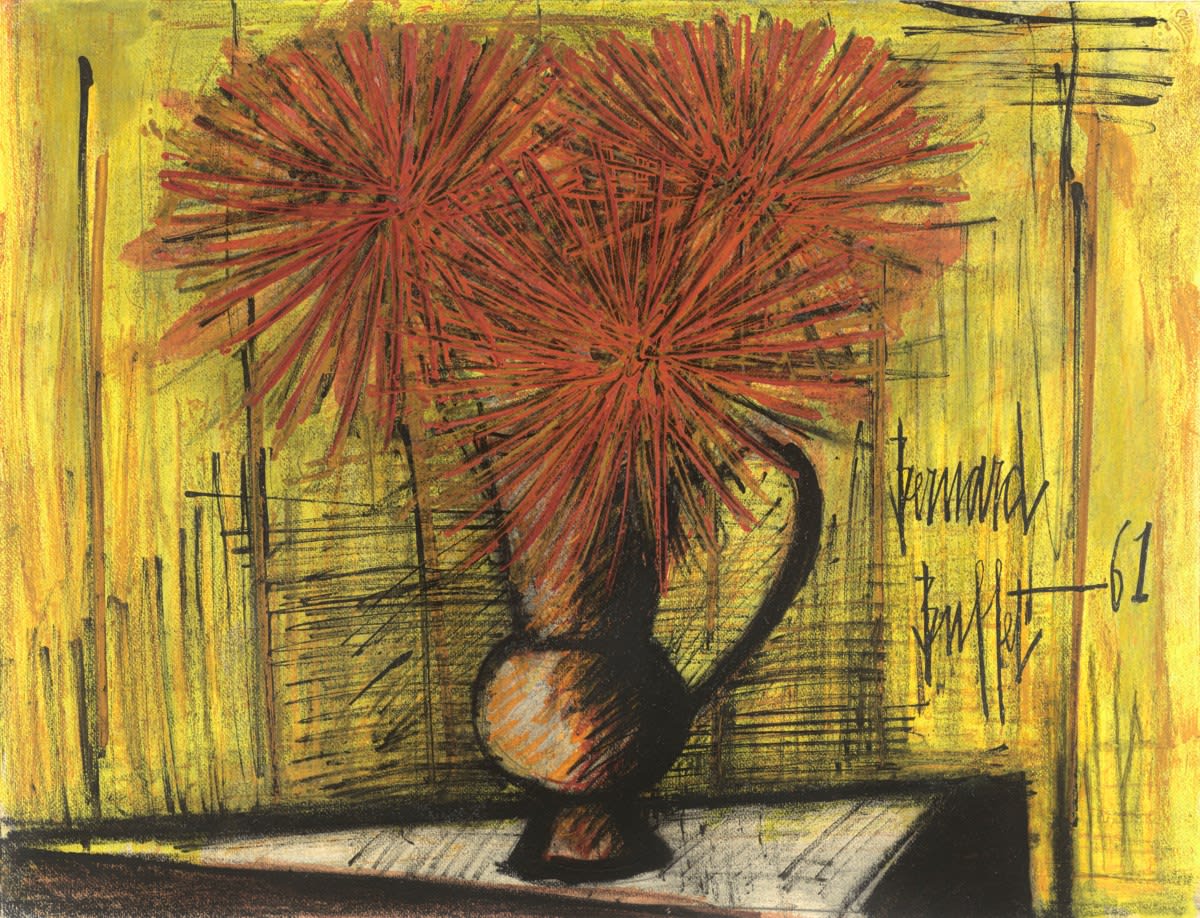
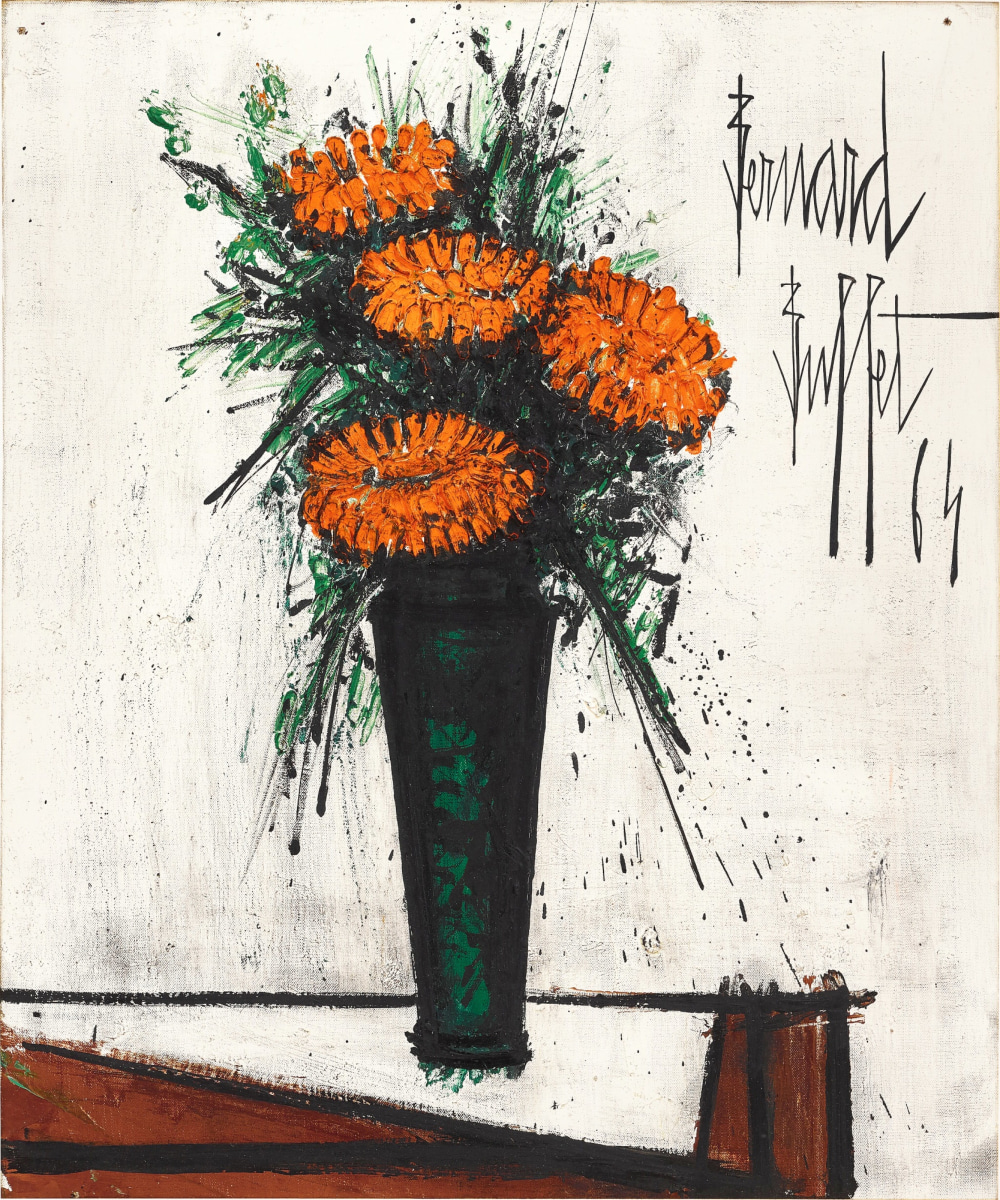
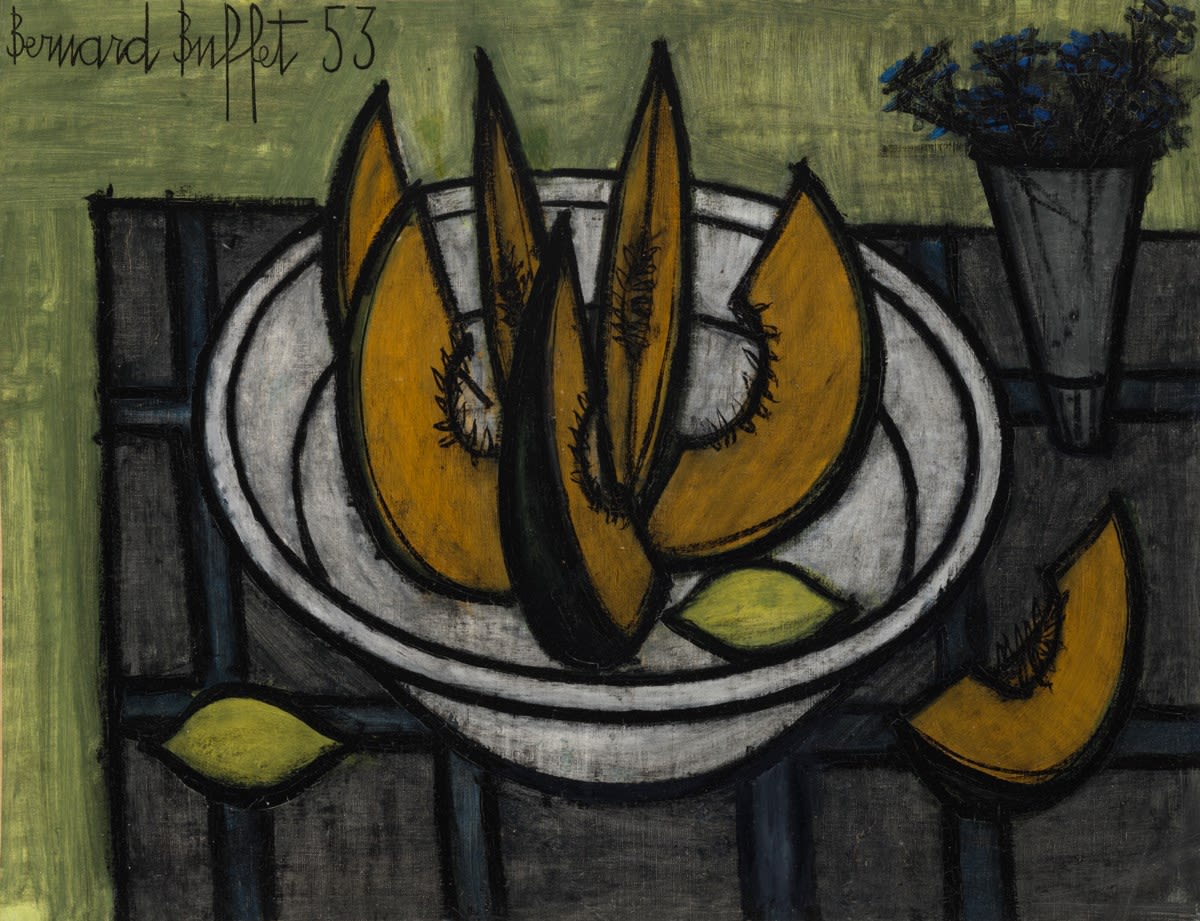
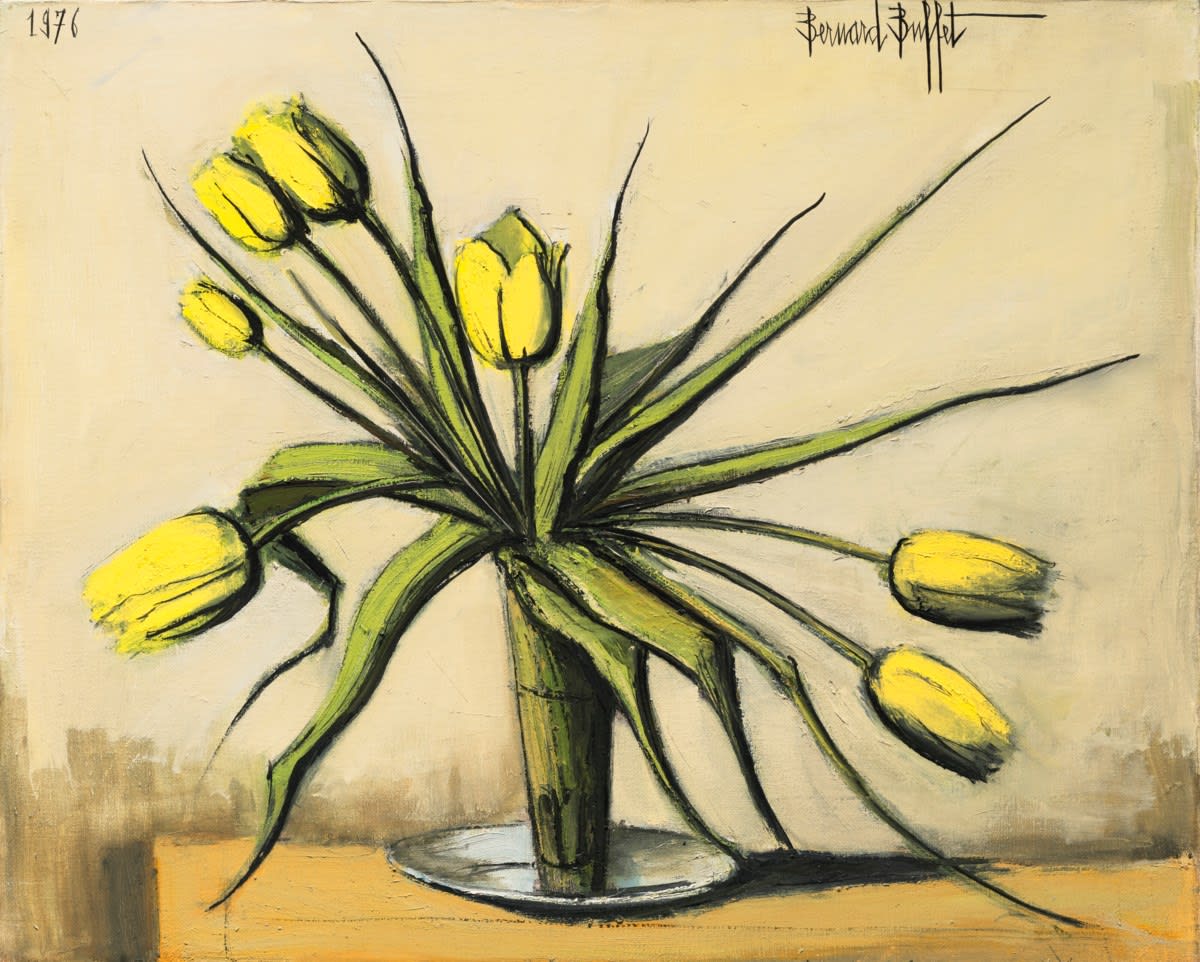
| Fleurs dans un vase | $57,150 | Sotheby's, February 2026 |
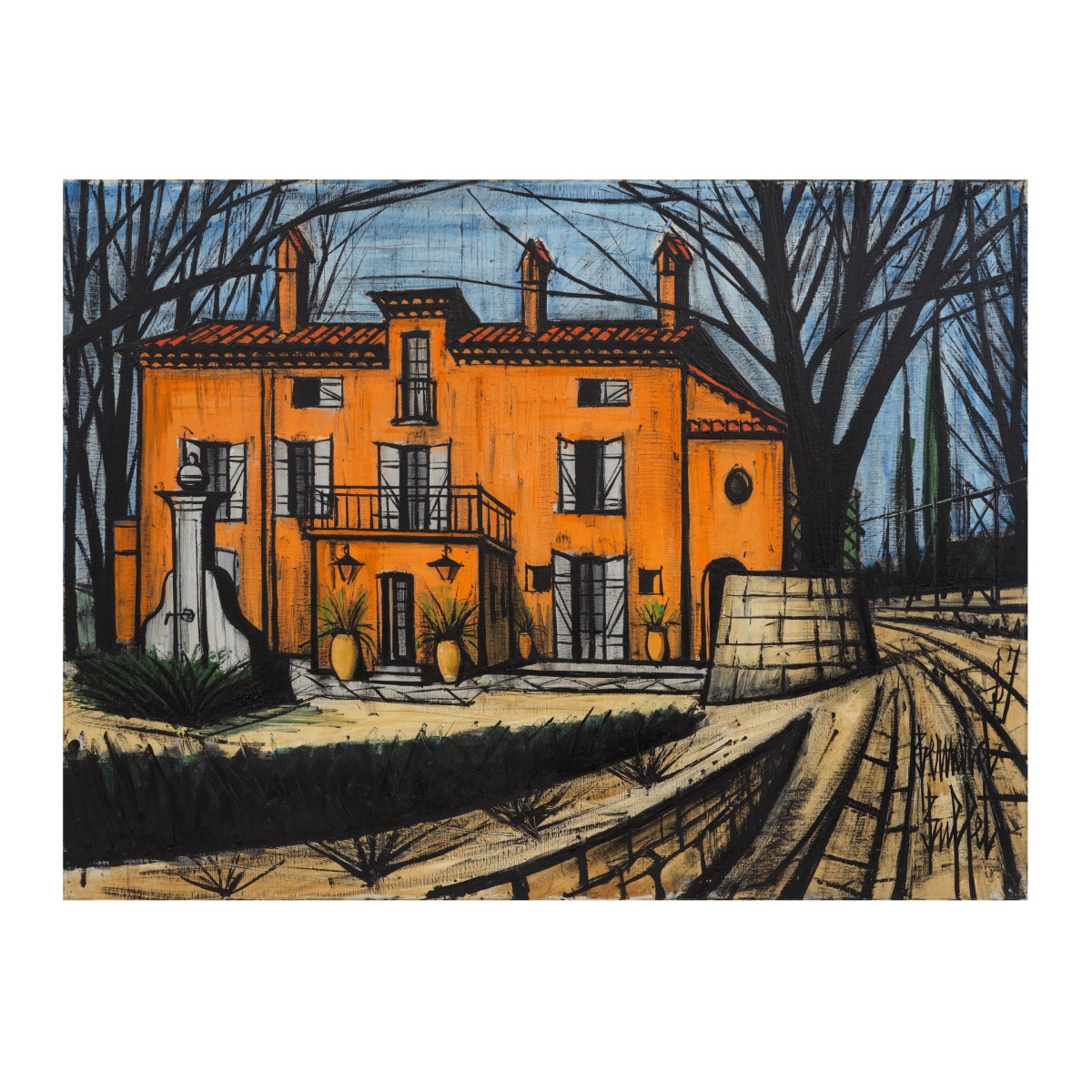
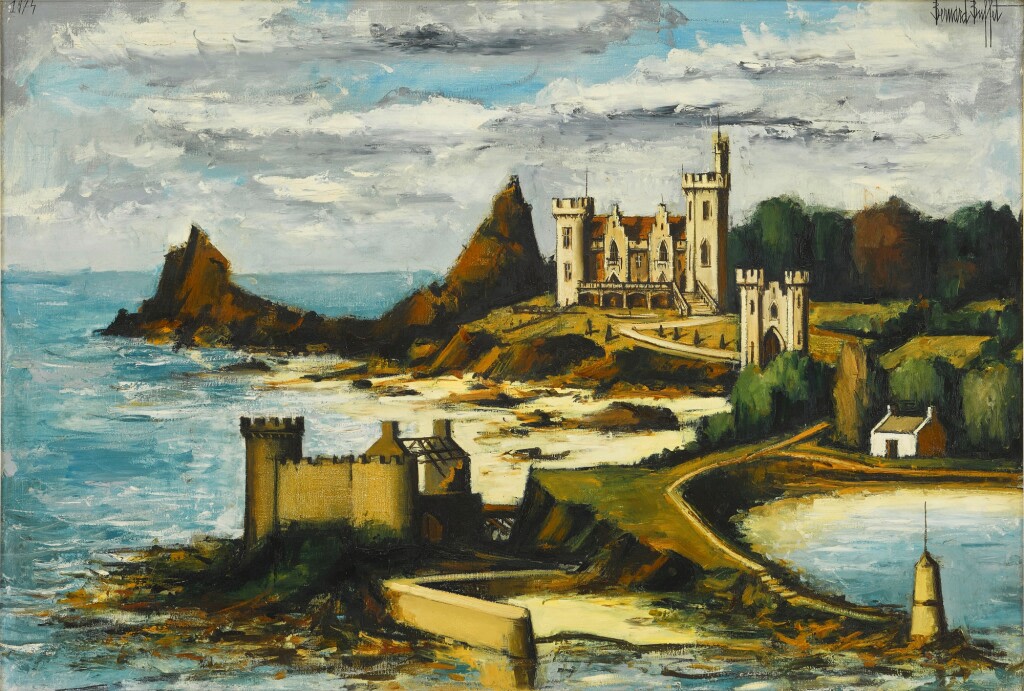
| Le Pontel | $40,640 | Sotheby's, February 2026 |
7 further auction entries on record for Bernard Buffet — inside Egon.
Auction record
- Date
- December 2021
Note
Hammer HK$16,450,000; USD figure per MutualArt. Corrected 2026-08-26: an earlier stored figure of $2,457,000 traced to an unconverted-HKD lot for a different work in Egon's own database and was removed. The same work previously sold for £850,000 (~$1.5M) at Christie's London, June 2016.
- Work
- Les clowns musiciens, le saxophoniste (1991)
- Venue
- Christie's Hong Kong
- Price USD
- $2,111,306
- Significance
- Circus and clown subjects command Buffet's strongest prices.
Market liquidity
- Print market
- Highly liquid; hundreds of lots annually at all price levels; MyArtBroker operates specialist Buffet print exchange
- Primary market
- Contact Galerie Maurice Garnier (Paris) for estate/authentication; Opera Gallery for commercial primary access
- Geographic demand
- Strong across France, UK, USA, Japan, Hong Kong/China — genuinely global collector base
- Sell through rate recent
- 79% (EGON 2025)
- Annual transaction volume
- 67+ lots tracked in 2025 EGON (partial); well over 100 lots expected annually across global auction houses including regional and Asian sales
Peer comparables
Closest market peers include post-war French figurative artists — Balthus, Zao Wou-Ki, Nicolas de Staël. Buffet's market has historically underperformed relative to his institutional presence, but the post-2016 reappraisal and 2021 record suggest continued convergence toward peers of equivalent institutional stature.
Price trajectory
- 1990s
- Strong early market; $797,500 for Scene De Rue (1956) at Sotheby's New York in 1990 demonstrates pre-revival depth
- 2021 peak
- All-time record set December 2021 at Christie's Hong Kong — £1.3M / ~$2.1–2.5M
- 2025 2026
- Continued above-estimate sales; multiple gallery exhibitions; 79% sell-through; 9 upcoming lots signals sustained demand
- 2000s 2010s
- Modest recovery; growing Asian collector demand; Japan museum exhibitions driving print market spikes
- 2019 present
- Seven of top 10 all-time auction results achieved since 2019 — dramatic market acceleration
- 2016 catalyst
- Musée d'Art Moderne de Paris retrospective — widely cited as the pivotal market turning point; critical rehabilitation accelerates
Investment outlook
Blue-chip with sustained upward trajectory. Seven of top 10 results achieved post-2019. Asian market (especially Japan, Hong Kong) driving premium prices, particularly for circus/clown subjects. Annual major gallery exhibitions maintaining visibility. 79% sell-through indicates healthy demand-supply balance. Key risk: prolific output (8,000+ works) creates supply pressure at lower price tiers; premium quality reserved for large-scale, iconic-subject oils with Garnier authentication certificates.
Market averages recent
- Annual lots 2025
- 67+ (EGON partial; 100+ expected across all global auction houses)
- Paintings avg 12 months
- $120,898 (MutualArt)
- Works on paper avg 12 months
- $18,837 (MutualArt)
Recent sales 2025 2026
- Sold
- 41
- Total lots
- 67
- Price range
- $750 — $185,166
- Upcoming lots
- 9
- Average hammer
- $84,996
- Sell through rate
- 79%
- Highest in database
- $2,457,000
Current market pricing by tier
- Note
- Buffet produced 8,000+ works across oils, prints, watercolors, drawings — wide price band reflects output diversity
Top tier
- Range
- $300,000 — $2.5M+
- Works
- Major oil paintings (large-scale, iconic subjects — clowns, Paris, religious)
Mid range
- Range
- $5,000 — $50,000
- Works
- Signed lithographs, small-to-medium works on paper, minor oil studies
Entry level
- Range
- $750 — $5,000
- Works
- Unsigned prints, minor lithographs, small works on paper
Main market
- Range
- $50,000 — $300,000
- Works
- Significant oil paintings (Paris scenes, flowers, landscapes), major lithographs
- Print record
- £86,080 for Circus Dancer print (2012) — vastly exceeded estimate of under £4,000; demonstrates subject-specific demand spikes
Institutional presence
Research updated
Awards and honors
Scroll horizontally if needed →
| Year | Award | Shared with | Institution |
|---|---|---|---|
| 1948 | Prix de la Critique | Bernard Lorjou | Not supplied |
| 1955 | Named best post-war French artist | Not supplied | Connaissance des Arts magazine |
| 1973 | Chevalier de la Légion d'Honneur | Not supplied | French State |
| 1974 | Elected Member, Académie des Beaux-Arts | Not supplied | Institut de France |
| 1978 | Commissioned for French postal stamp design | Not supplied | French postal administration |
| 1993 | Officer of the Légion d'Honneur | Not supplied | French State |
Exhibition history
Exhibition practice
Held at least one major solo thematic exhibition per year throughout career — an unprecedented annual rhythm organized around central themes (circus, religious subjects, landscapes, Japan, etc.)
Solo exhibitions selected
First exhibition
- Year
- 1947
- Venue
- Paris
First major commercial show
- Year
- 1949
- Venue
- Galerie Drouant-David, Paris
First career retrospective
- Year
- 1958
- Venue
- Galerie Charpentier, Paris
Post Museum Retrospective
- Year
- 1978
- Venue
- Post Museum, Paris
Major retrospective (Japan museum)
- Year
- 2012
- Venue
- Bernard Buffet Museum, Surugadaira, Japan — sparked record Asian print sales
View 4 more records
Landmark posthumous retrospective
- Year
- 2016
- Venue
- Musée d'Art Moderne de Paris — pivotal critical and market rehabilitation event
Bernard Buffet retrospective
- Year
- 2025
- Venue
- Bailly Gallery, Geneva (March – May 2025)
La France de Bernard Buffet
- Year
- 2025
- Venue
- Opera Gallery London, Oct 3 – Nov 2, 2025 — described as most significant London exhibition in 50+ years; 20+ paintings spanning five decades
Ongoing exhibition
- Year
- 2025–2026
- Venue
- Bernard Buffet Museum, Japan (Aug 2, 2025 – March 24, 2026)
Museum collections
Dedicated museum
- Name
- Bernard Buffet Museum
- Founded
- November 23, 1973
- Founder
- Kiichiro Okano (private collector)
- Location
- Surugadaira, Shizuoka Prefecture, Japan
- Significance
- First museum dedicated to a living European artist in Japan; holds world's largest Buffet collection; active with ongoing exhibitions
- Current exhibition
- August 2, 2025 – March 24, 2026
Tier 1 international
Scroll horizontally if needed →
| Note | Museum | Location |
|---|---|---|
| Confirmed by Sotheby's and multiple sources | Museum of Modern Art (MoMA) | New York, USA |
| Confirmed via primary museum API and multiple sources | Tate Modern / Tate Gallery | London, UK |
| Confirmed by Opera Gallery and Invaluable sources | Centre Georges Pompidou / Musée National d'Art Moderne | Paris, France |
| Confirmed via museum API (59-work verified set) | Metropolitan Museum of Art | New York, USA |
| Confirmed via museum API | Art Institute of Chicago | Chicago, USA |
| Confirmed via museum API | Smithsonian Institution | Washington DC, USA |
| Confirmed via museum API | Victoria & Albert Museum | London, UK |
| Confirmed via museum API | Cleveland Museum of Art | Cleveland, USA |
| Confirmed by Invaluable source | San Francisco Museum of Modern Art (SFMOMA) | San Francisco, USA |
| Confirmed by Opera Gallery source | National Museum of Western Art | Tokyo, Japan |
| Confirmed via museum API | Europeana (European Museum Network) | Europe |
French regional museums
Musée d'Art Moderne de la Ville de Paris
- Location
- Paris, France
Musée d'Art Moderne de Troyes
- Location
- Troyes, France
Various French provincial fine arts museums
- Note
- Extensive regional French institutional presence
Career & Biography
Research updated
Identity
- Gender
- Male
- Full name
- Bernard Léon Edmond Buffet
- Birth date
- July 10, 1928
- Death date
- October 4, 1999
- Birth place
- Paris, France
- Death place
- Tourtour, Département du Var, France
- Nationality
- French
- Getty ulan ID
- 500013970
- Cause of death
- Suicide by asphyxiation; suffering from Parkinson's disease and no longer able to paint
Career timeline
- Year
- 1943
- Event
- Enrolled at École Nationale Supérieure des Beaux-Arts, Paris
- Year
- 1945
- Event
- Mother Blanche died of breast cancer — a defining trauma that instilled lifelong melancholy
- Year
- 1947
- Event
- First exhibition
- Year
- 1948
Event
Won Prix de la Critique (jointly with Bernard Lorjou); met art dealer Emmanuel David and Maurice Garnier; signed exclusive contract with Emmanuel David, launching international career
- Year
- 1949
- Event
- First major exhibition at Galerie Drouant-David, Paris
View 14 more records
- Year
- 1952
- Event
- Illustrated Les Chants de Maldoror by Comte de Lautréamont — major literary collaboration
- Year
- 1955
Event
Named best post-war French artist by Connaissance des Arts magazine; described as having painted more works than Renoir's lifetime output by age 26
- Year
- 1957
- Event
- Maurice Garnier joins exclusive contract with Emmanuel David for Buffet's representation
- Year
- 1958
Event
First career retrospective at Galerie Charpentier; NYT names him one of 'Fabulous Five' cultural figures in France (with Bardot, Sagan, Vadim, YSL); married Annabel Schwob (singer, writer, actress)
- Year
- 1960
- Event
- Critical backlash begins as Abstract Expressionism and New Wave art dominate; Picasso publicly denigrates his work
- Year
- 1968
- Event
- Maurice Garnier takes exclusive representation from 1968 until Buffet's death
- Year
- 1973
Event
Named Chevalier de la Légion d'Honneur; Bernard Buffet Museum founded November 23 in Surugadaira, Japan by collector Kiichiro Okano — first museum dedicated to a living European artist in Japan
- Year
- 1974
- Event
- Elected to Académie des Beaux-Arts — France's most prestigious artistic institution
- Year
- 1977
- Event
- Galerie Maurice Garnier becomes solely and exclusively dedicated to Buffet's work
- Year
- 1978
- Event
- Designed French postal stamp depicting Institut et le Pont des Arts; Post Museum arranged retrospective
- Year
- 1980
- Event
- First Japan-themed annual series; visited Japan in 1980 and 1987
- Year
- 1986
- Event
- Moved with Annabel to Tourtour, Provence — a fresh start after struggles with alcohol addiction
- Year
- 1993
- Event
- Promoted to Officer of the Légion d'Honneur
- Year
- 1999
- Event
- Died October 4, unable to continue painting due to advanced Parkinson's disease; produced 8,000+ works in his lifetime
Artistic influences
Direct teachers
- Eugène Narbonne (Beaux-Arts studio master)
- Marie-Thérèse Auffray (early influence)
- Early childhood
- Mother took him regularly to the Louvre where he encountered Realist painters, particularly Courbet
Noted comparisons
- Pablo Picasso (frequently compared in 1950s)
- Andy Warhol (noted by Maurice Garnier)
Broader inspirations
- Van Gogh (expressionistic intensity)
- Géricault
- Delacroix
- Degas
- Bernard arnault noted
- LVMH chairman described Buffet as 'the link between Picasso and Warhol'
Primary stylistic influences
- Francis Gruber (Miserabilist aesthetic)
- Gustave Courbet (Realism)
- Grünewald/Matthias Grünewald (religious intensity)
- Rembrandt (portraiture depth)
- Chardin (still life)
Education and training
- Studio master
- Studied under painter Eugène Narbonne at the Beaux-Arts
- Secondary school
- Lycée Carnot, Paris (during Nazi occupation of WWII; attended drawing courses in evenings despite curfew)
- Fine arts training
- École Nationale Supérieure des Beaux-Arts (National School of Fine Arts), Paris — enrolled 1943
Notable classmates
- Maurice Boitel
- Louis Vuillermoz
- Early influence teacher
- Marie-Thérèse Auffray — French painter who directly influenced Buffet's early development
Personal life and activism
- Marriage
- Married Annabel Schwob in 1958 — singer, writer, actress; she represented him at the Japan museum opening in 1973
- Early trauma
- Mother's death in 1945 (age 17) instilled lifelong melancholy that pervades his work
- Anti abstraction
- Co-founding/active member of L'homme Témoin (The Witness-Man) — manifesto group arguing for representational art against dominant abstraction
- Celebrity status
- Owned château in Loire Valley, house in Saint-Tropez area; one of the most photographed cultural figures in 1950s France
- Alcohol struggles
- Both Bernard and Annabel struggled with alcohol addiction; move to Tourtour in 1986 marked a period of recovery
- Parkinson disease
- Diagnosed late 1990s; continued painting as long as physically possible before death
Studio practice and methods
- Productivity
- Estimated 8,000+ works across career; annual major thematic exhibitions
- Daily routine
- Painted 4–5 hours per day, every day of his life
- Thematic series
- Organized output into annual themed series (e.g., Japan, Circus, Paris, Landscapes, Religious subjects)
- Preparatory work
- No preparatory sketches — painted directly onto canvas
- Signature technique
- Applied paint sparingly (partly due to cost early in career), contributing to lean, tense, graphic quality
Artistic Profile
Research updated
Signature series
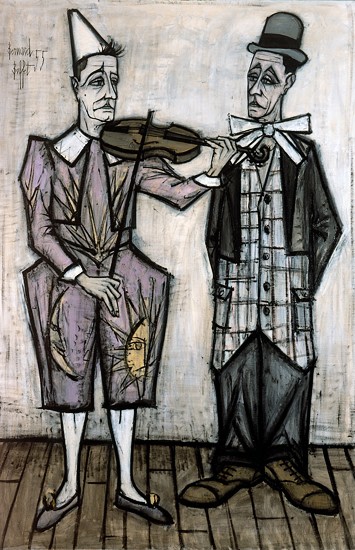
- Clowns / Circus (career-spanning; most commercially valuable — drives 5–10× premium)
- Paris cityscapes (Notre-Dame, Sacré-Cœur, Eiffel Tower — consistently strong at auction)
- Religious paintings (Crucifixion cycles — scholarly and institutional interest)
- Brittany and Provence landscapes (annual thematic)
- Japan series (1980, 1987 — resonates specifically with Japanese collectors)
- Annual themed exhibition series (from late 1940s onward — unprecedented practice)
Stylistic evolution
Early 1947 1955
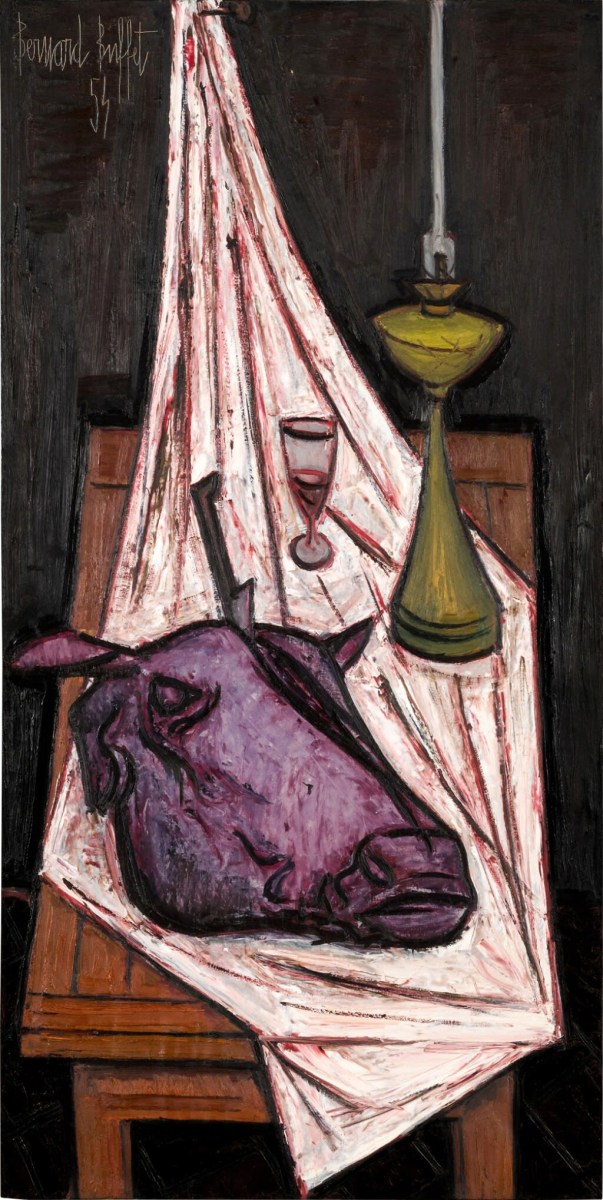
Raw, spare Miserabilist style; very dark palette; post-war anxiety and despair; depictions of poverty, suffering, stark interiors; most critically celebrated phase
Late 1980s 1999
Continued output despite personal struggles with alcohol then Parkinson's; circus and clown themes resurge with personal significance; final works maintain technical commitment
Mature 1970s 1980s
Japan series, religious cycles, increasingly bold color within black-line framework; Légion d'Honneur and Académie membership; art world hostility peaks
- Peak fame 1955 1960
- Expanding subject matter while maintaining stark linear identity; increased color experimentation; circus and Paris themes emerge
Commercial 1960s 1970s
More varied subjects; annual thematic exhibition format established; critics accuse of over-production; lifestyle divergence from early aesthetic provokes backlash
Techniques and mediums
- Primary
- Oil on canvas — large-scale works most commercially significant
- Sculpture
- Later career — confirmed by Getty ULAN professional roles
- Watercolor
- Getty ULAN confirms watercolorist role; used for landscape studies
Printmaking
Lithography (extensive output), drypoint engraving — Galerie Maurice Garnier sold these alongside paintings; significant secondary print market with hundreds of lots annually
- Illustration
- Illustrated Les Chants de Maldoror (1952) and other literary works
- Graphic design
- French postal stamp (1978); theatrical painting (Getty ULAN confirms theatrical painter role)
- Works on paper
- Drawings and mixed media — active secondary market ($5,000–$50,000 range)
Style and visual language
- Primary classification
- Figurative Expressionism / Miserabilism
Defining characteristics
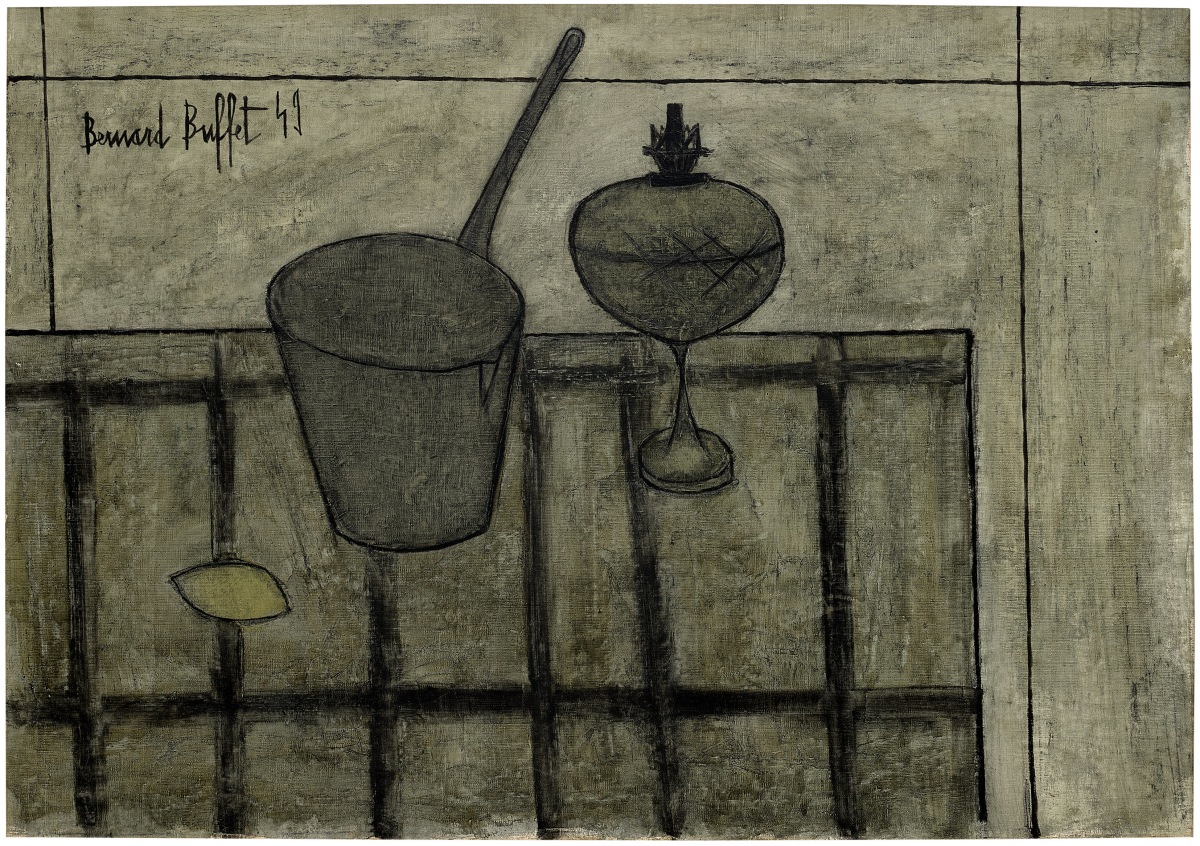
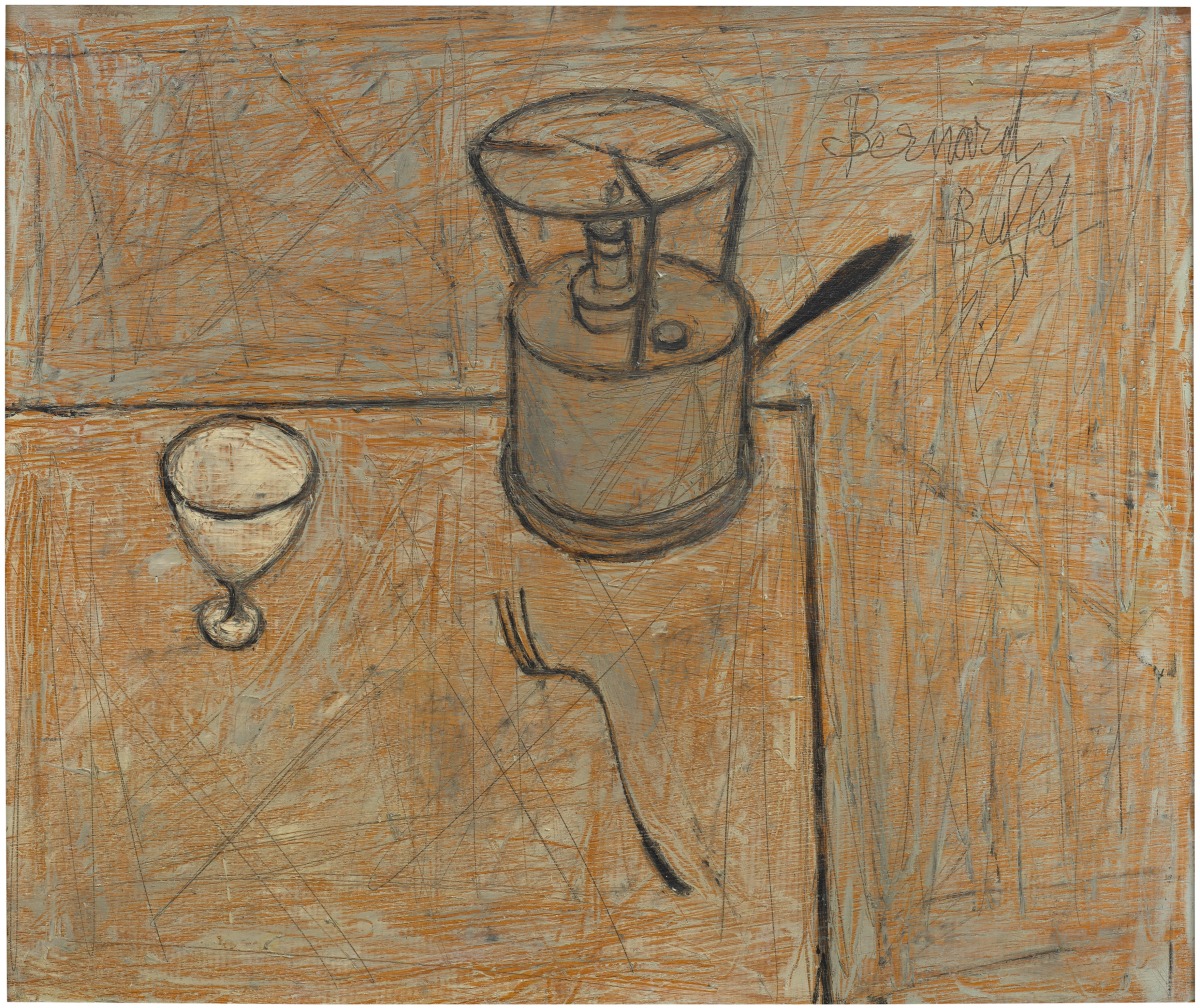
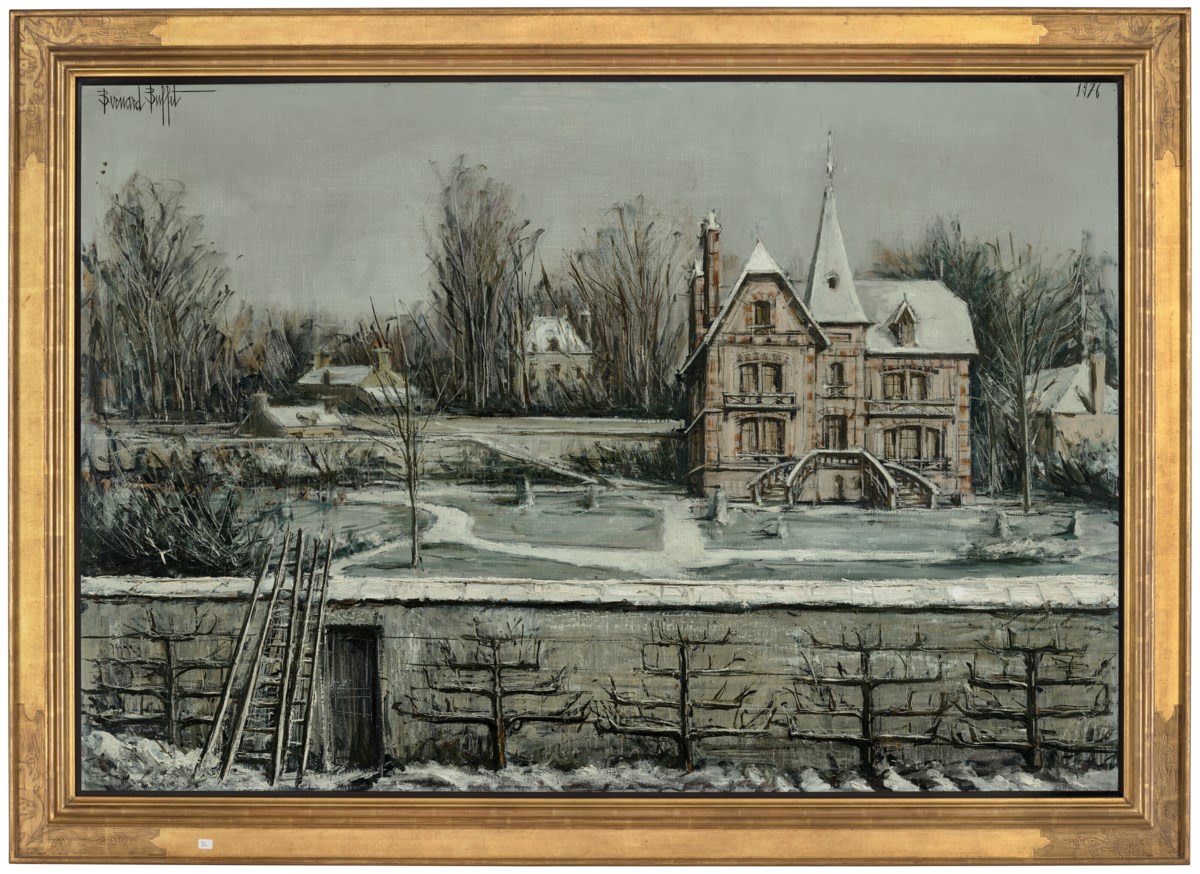
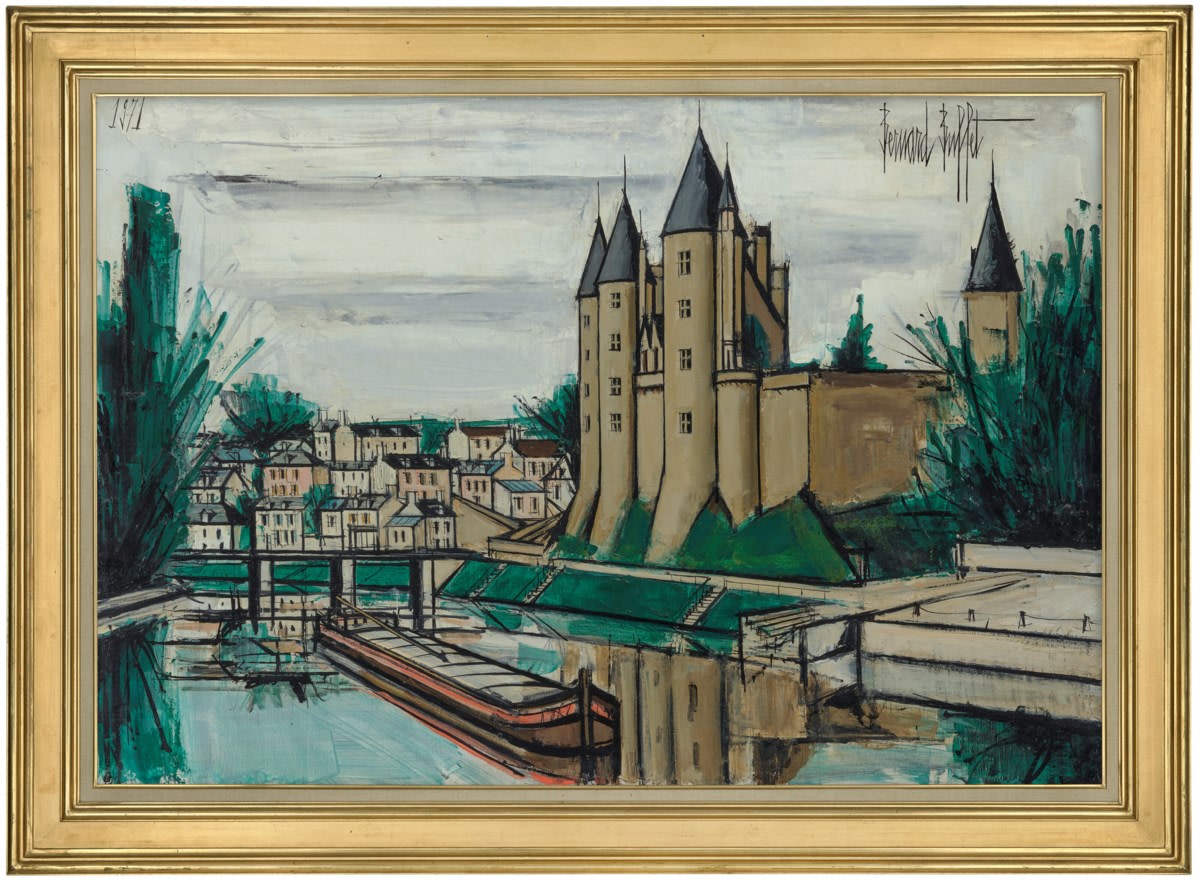
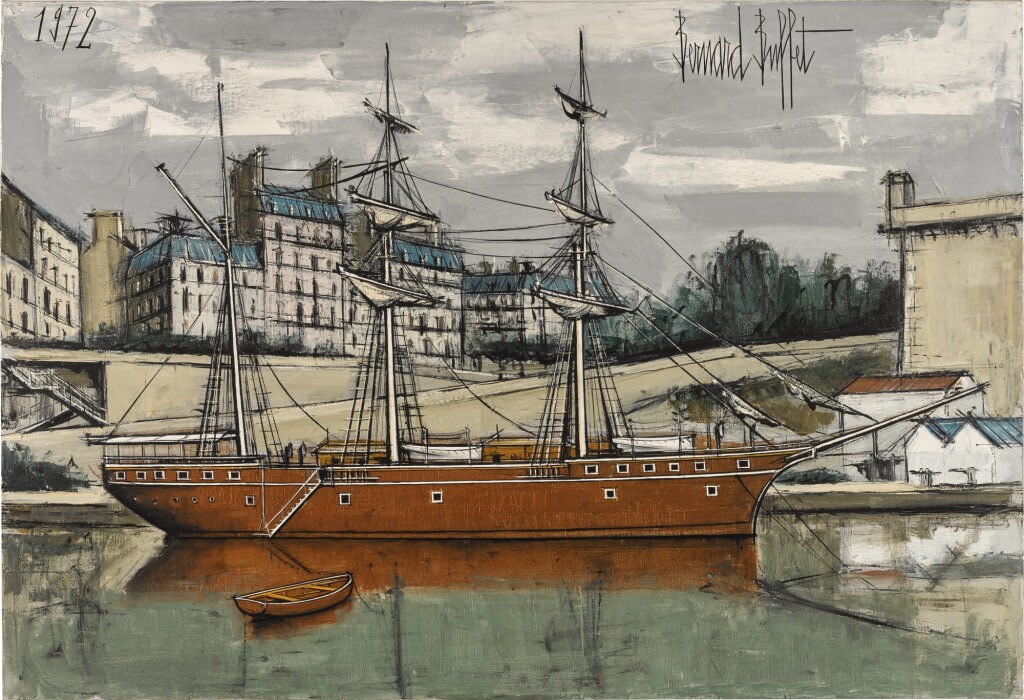
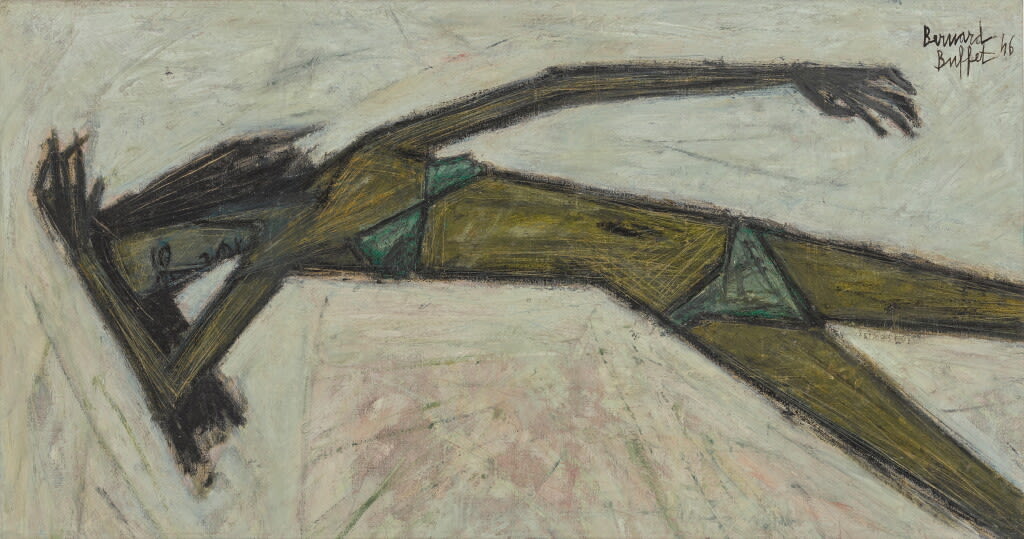
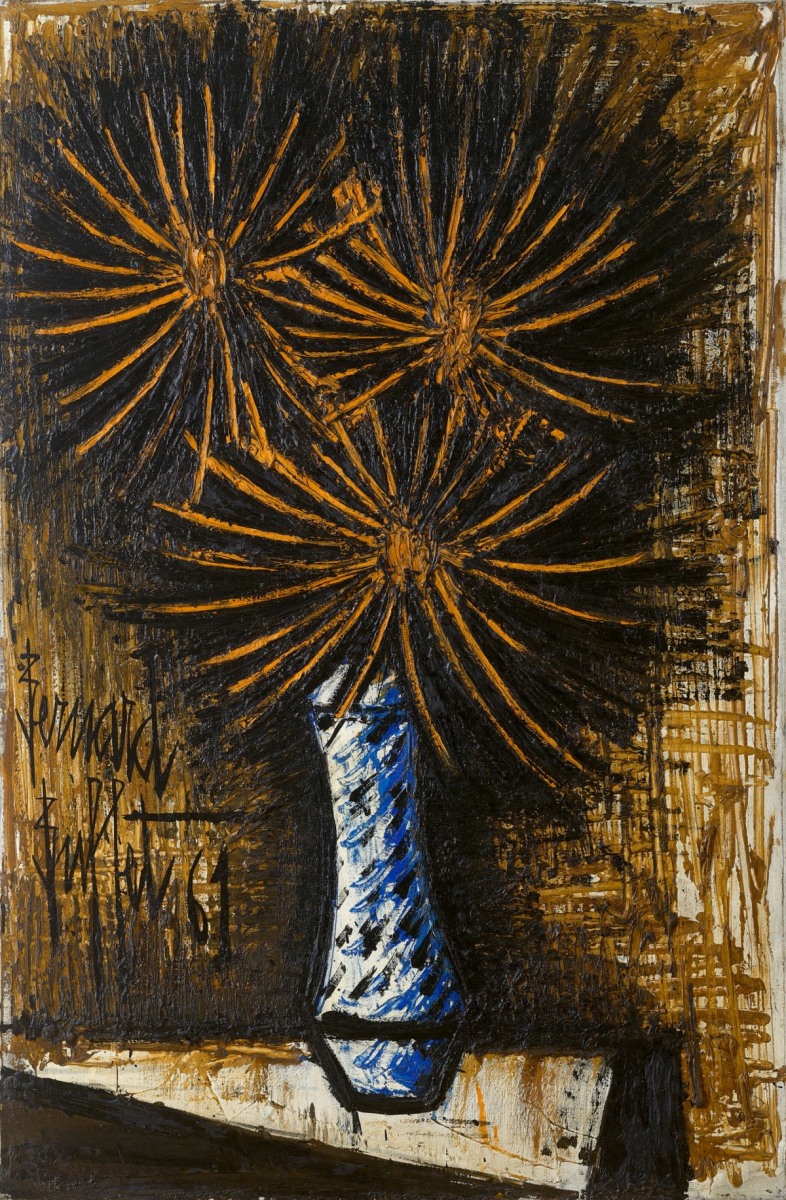
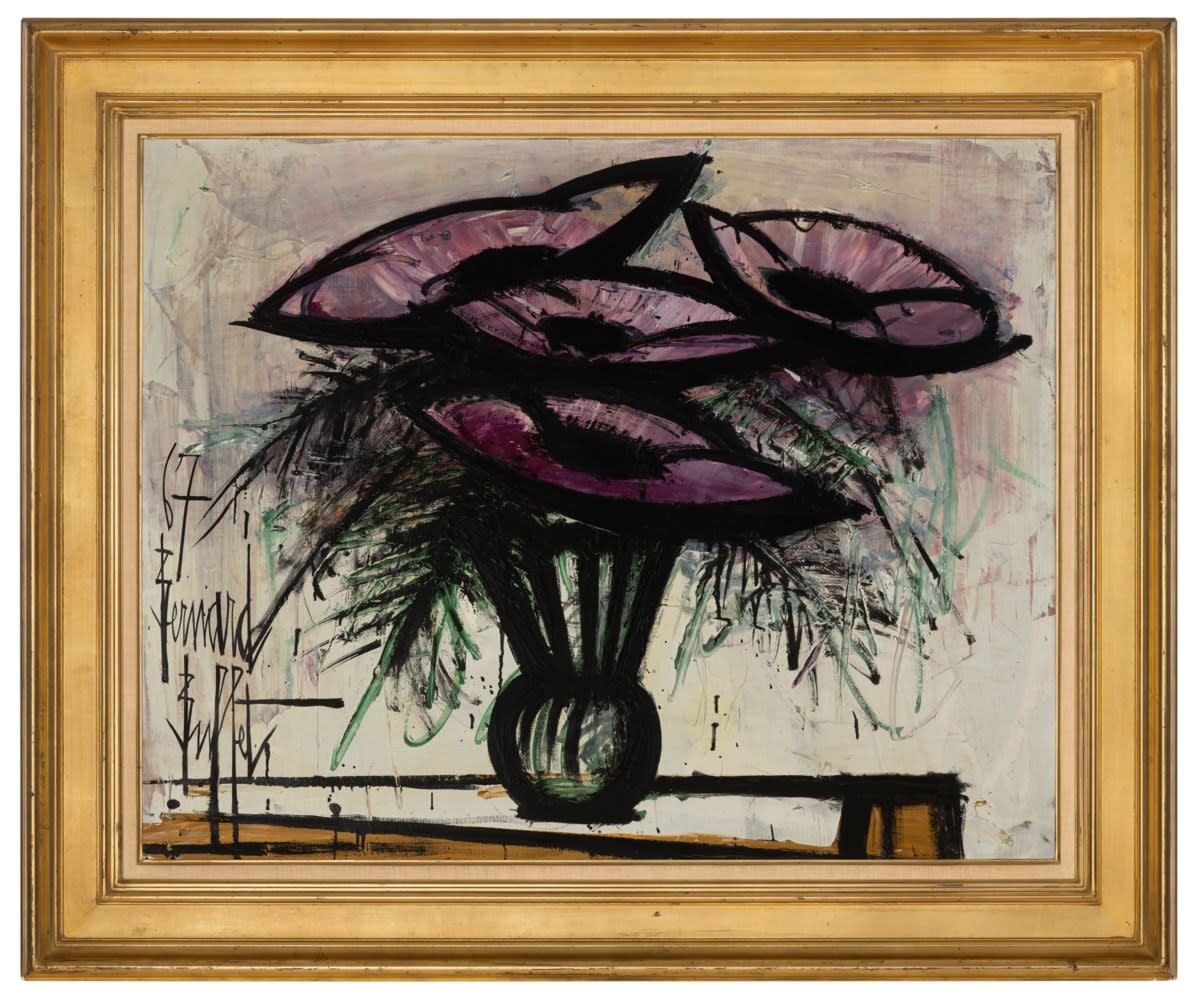
- Heavy, bold black outlines — the defining visual signature; outlines that recall drypoint engraving applied to painting
- Spiky, angular, elongated forms — figures stretched into gaunt, almost gothic silhouettes
- Sparse, restrained color palette — earth tones, grays, and muted colors punctuated by occasional vivid accents
- High contrast between linear structure and color areas
- Lean, taut compositions with little decorative excess
- Pervasive atmosphere of existential melancholy, isolation, and post-war anxiety
- Immediately recognizable graphic quality — described across all sources as 'unmistakable'
- Bernard arnault formulation
- Described as 'the link between Picasso and Warhol' — combining Picasso's structural boldness with Warhol's commercial/cultural ubiquity
Movements and associations
- Post-war French Expressionism
- Miserabilism (with Francis Gruber, Bernard Lorjou)
- L'homme Témoin (The Witness-Man) — anti-abstraction manifesto group, active member and champion
- Figurative resistance movement — against Abstract Expressionism dominance
Primary themes and subjects
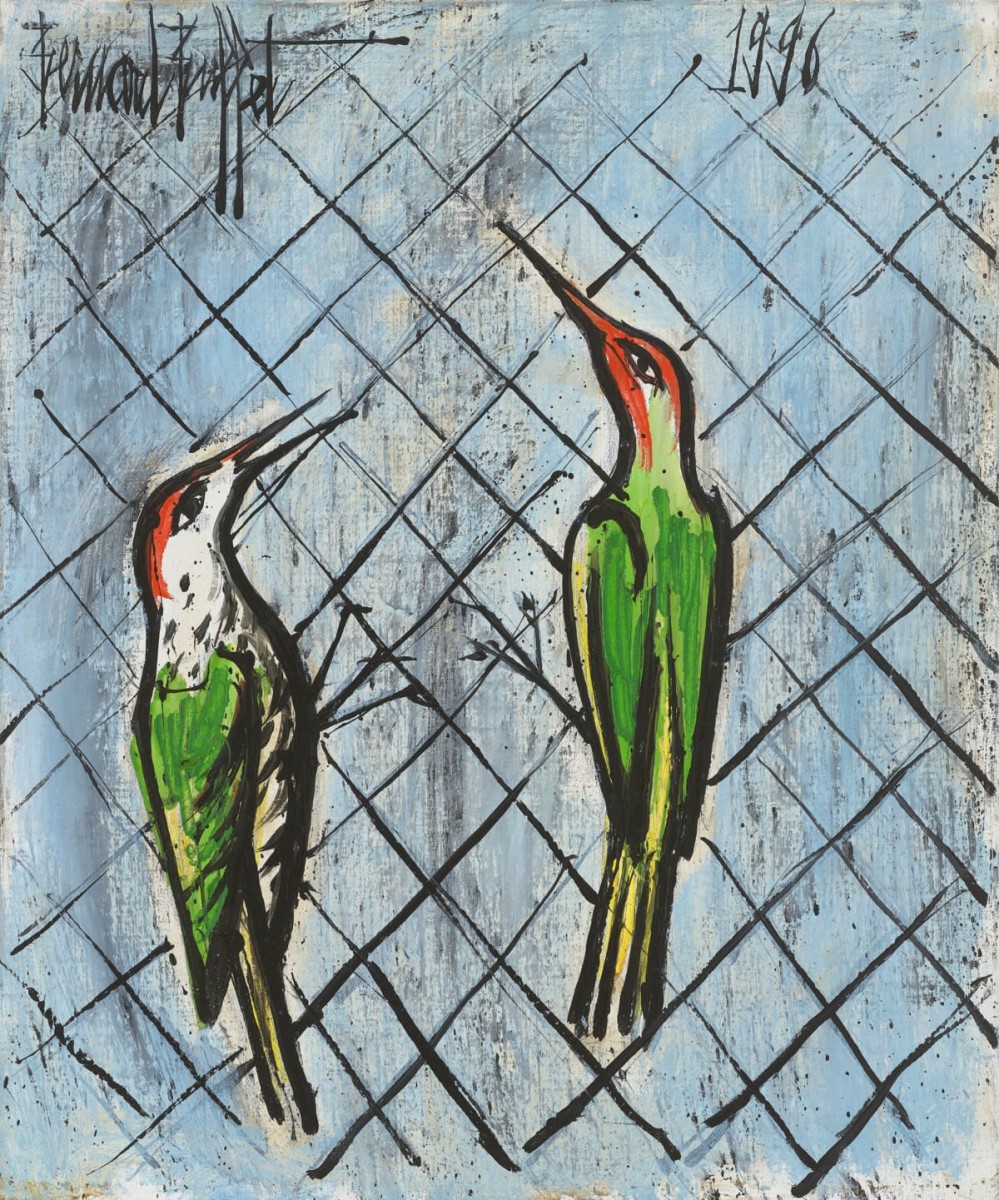
- Animals
- Chickens, hens, bulls — recurring motifs; early Picasso comparisons drawn from this thematic overlap
- Portraits
- Formal and informal portraiture including self-portraits
- Still lifes
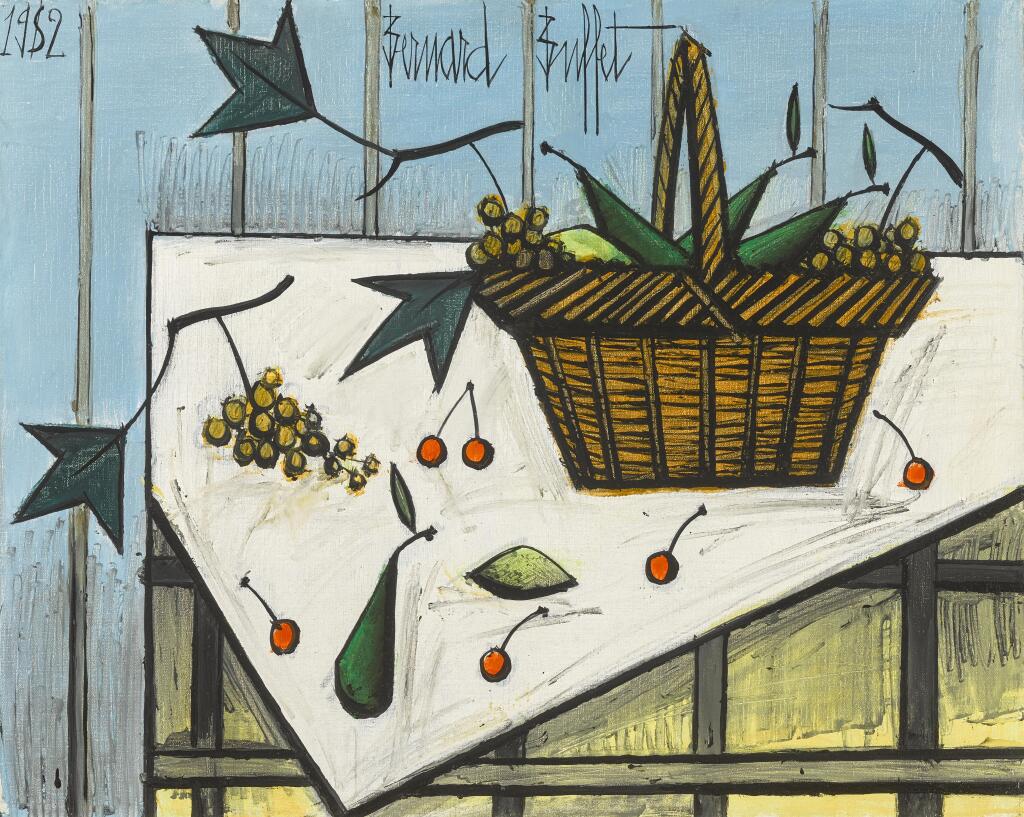
- Flowers, everyday objects (ashtrays, table lamps, eggs), food — broad price range accessibility
- Japan series
- Annual thematic tribute to Japan in 1980 and 1987 — especially resonant with Japanese collectors driving Asian market
Circus and clowns
Most commercially successful series; career-spanning; clowns depicted as melancholic, solitary performers; vehicle for mental health themes and existential reflection on performance and the human condition
- Social commentary
- Early Miserabilist works depicting Holocaust victims, poverty, post-war suffering
- Religious subjects
- Crucifixions, saints, religious narratives — executed with stark, almost medieval gravity; scholarly interest
Parisian cityscapes
Notre-Dame, Sacré-Cœur, Eiffel Tower, street scenes — highly collectible; linked to national identity themes; strong bidding from French and international collectors
- Landscapes and seascapes
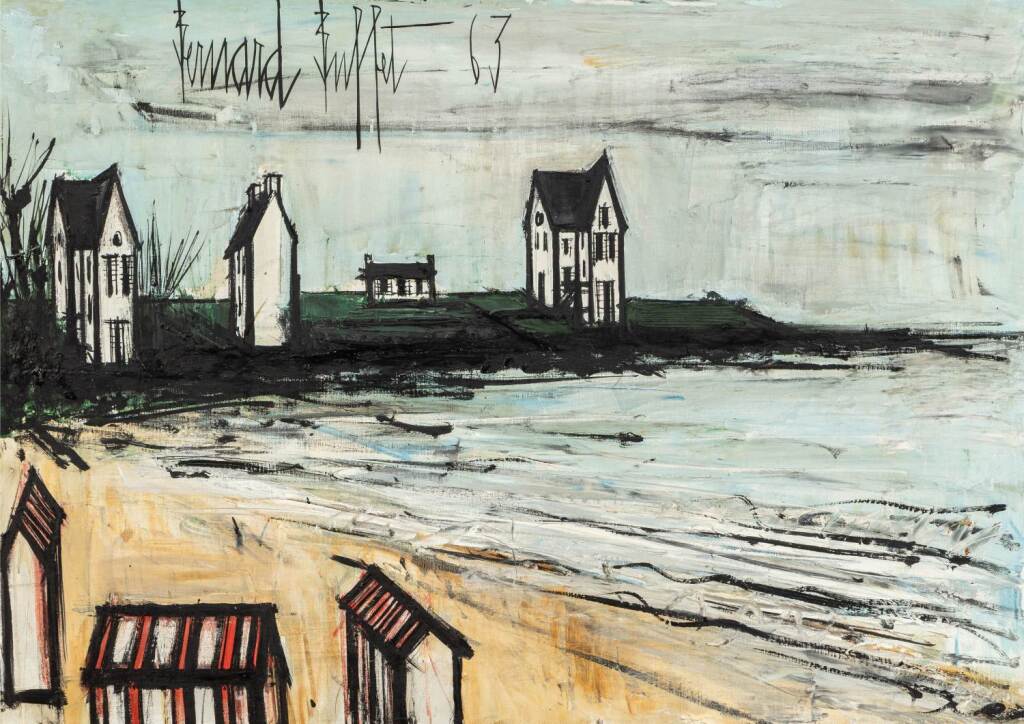
- Brittany coastlines, Provence countryside, Saint-Tropez — annual thematic series; broad collector accessibility
Critical Reception
Research updated
Early acclaim
- Period
- 1948–1958
Key moments
- Won Prix de la Critique in 1948 at age 20
- Named best post-war French artist by Connaissance des Arts in 1955
- New York Times (1958) named him one of 'Fabulous Five' cultural figures in France alongside Brigitte Bardot, Françoise Sagan, Roger Vadim, and Yves Saint Laurent
- By age 21, voted one of the world's two most important artists by Parisian critics (alongside Picasso)
- Supporters included poet Louis Aragon and Jean Cocteau — both of whom had also championed Picasso
Critical backlash
Causes
- Abstraction became the dominant critical paradigm; Buffet's figurative stance dismissed as reactionary
- Pablo Picasso publicly denigrated his work — catastrophic to institutional reputation
- André Malraux, French Minister of Culture, was openly hostile
- Lavish celebrity lifestyle seen as incompatible with early 'miserabilist' aesthetic — accused of betraying his art
- Prolific output led to accusations of indiscriminate production; some works described as 'unequivocally bad' by one art historian
- Maurice Garnier noted: 'What was good for Andy Warhol 20 years later was very bad for Bernard Buffet' — celebrity artist archetype incompatible with 1960s critical values
- Period
- Late 1950s – 1990s
Critical vs collector split
Critical rejection was never matched by market rejection — collectors in France, Japan, and internationally continued purchasing actively throughout the backlash period
Scholarly context
Buffet is increasingly studied as an archetype of the conflict between critical taste-makers and popular/collector taste in post-war art. His trajectory parallels the rehabilitation of Norman Rockwell and Andrew Wyeth in the American context — figurative artists long dismissed by critics, sustained by collectors, and now fully reassessed by art history.
Publications and media
- Coverage
- Named top French post-war artist (1955); ongoing coverage throughout career
- Publication
- Connaissance des Arts
- Coverage
- 1958 'Fabulous Five' designation
- Publication
- The New York Times
- Coverage
- Feature articles on works and market positioning
- Publication
- Christie's Daily
- Coverage
- Feature coverage (confirmed by MutualArt)
- Publication
- ArtDependence Magazine
- Coverage
- Feature coverage (confirmed by MutualArt)
- Publication
- Artmajeur Magazine
- Coverage
- Major critical reappraisal feature — detailed analysis of career arc, critical backlash causes, and market revival
- Publication
- Hashtag Legend
- Coverage
- The Clown series deep-dive (2024)
- Publication
- Singulart
- Coverage
- Opera Gallery NYC space opening (October 2025)
- Publication
- ArtDaily
Reappraisal and legacy
- Period
- 2000s – present
Key moments
- 2016 Musée d'Art Moderne de Paris retrospective — pivotal critical rehabilitation; 'reaffirmed his place at the heart of French cultural history' (Opera Gallery)
- Bernard Arnault (LVMH chairman) described Buffet as 'the link between Picasso and Warhol'
- Critical consensus now positions Buffet as key figure in post-war figurative resistance to abstraction
- Growing scholarly interest in his L'homme Témoin advocacy and its art-historical significance
- Seven of his top 10 auction results achieved since 2019 — market now fully aligned with critical reappraisal
Art historical positioning
Positioned as the foremost French practitioner of post-war Expressionist figuration and Miserabilism; his L'homme Témoin advocacy is studied as a significant ideological counterpoint to the Abstract Expressionist hegemony of the 1950s–1970s.
Critical reception overview
Bernard Buffet is one of the most critically complex figures in 20th-century French art — celebrated as a prodigy in the late 1940s–50s, vilified during the ascendancy of abstraction, and now subject to a major posthumous reappraisal that has fully realigned his critical and market standing.
Gallery & Representation
Research updated
Art fair presence
Through Opera Gallery's international network, Buffet works appear regularly at major art fairs (TEFAF, Art Basel, Frieze, and regional equivalents).
Auction house presence
Primary houses
- Christie's (London, Paris, Hong Kong — all active; set all-time record)
- Sotheby's (New York, Paris, London)
- Bonhams
- Artcurial (Paris)
- Hôtel Drouot (Paris)
- Asian auction activity
- Christie's Hong Kong key venue — set all-time record in 2021; strong ongoing Japanese and Chinese collector demand
- Regional auction activity
- Active in Israeli market (Matsart), Swedish market, and multiple European regional auction houses
Representation history
- 1948 1957
- Emmanuel David (Galerie Drouant-David) — launched Buffet's international career
- 1957 1968
- Shared contract: Emmanuel David and Maurice Garnier
- 1968 1999
- Maurice Garnier — total exclusive representation until death
- 1999 present
- Galerie Maurice Garnier (estate/authentication); Opera Gallery (primary commercial)
Estate and authentication
- Tier
- Estate gallery / authentication authority — unique institutional authority over market; not a commercial Tier 1 gallery by contemporary standards
- Gallery
- Galerie Maurice Garnier
- Location
- Paris, France
Services
Sells oil paintings, mixed techniques, lithographs, drypoint engravings; issues certificates of authenticity required for high-value auction sales
Relationship
Exclusively dedicated to Bernard Buffet's work since 1977; sole authentication authority; managed Buffet exclusively from 1968 until 1999; continues to manage the estate posthumously
Primary commercial gallery
- Tier
- Tier 2 international commercial gallery with strong global network
- Gallery
- Opera Gallery
- Locations
- Paris, London, Geneva, New York (827 Madison Ave temp space, Oct 2025), Singapore, Dubai, Hong Kong, and additional international network
Relationship
Primary commercial champion of Buffet's work since early 2000s; organizes major solo exhibitions globally; instrumental in introducing Buffet to new international audiences
Recent activity
Presented 'La France de Bernard Buffet' at Opera Gallery London, Oct 3 – Nov 2, 2025 (described as 'most significant exhibition of the French master's work in London for more than fifty years'). Opened temporary NYC space at 827 Madison Avenue in October 2025.
Secondary market galleries
Bailly Gallery
- Activity
- Mounted major retrospective March–May 2025
- Location
- Geneva, Switzerland
MyArtBroker
- Location
- Online/UK-based
- Specialty
- Specialist print resale platform; dedicated Buffet print market index tracking 48,500+ auction histories
Goldmark Art
- Location
- UK
- Specialty
- Sells Buffet lithographic prints
Mourlot Editions
- Location
- International
- Specialty
- Historical Buffet lithographic posters
Sources & research notes
Egon’s artist research combines historical auction records, recent sales, institutional history, critical reception and gallery information. Researched auction records and auction highlights are identified separately.
Read prices with their work, sale date, currency and stated basis. Egon’s market assessments are distinct from reported auction results.
Reference: Egon, “Bernard Buffet: Market Intelligence & Investment Profile.”
Research bibliography · 17 sources
Sources recorded for this artist’s research. This bibliography does not assign every source to an individual claim.
- Bernard Buffet - Wikipedia
- Bernard Buffet | Art for Sale, Results & Biography | Sotheby's
- Bernard Buffet Value: Top Prices Paid at Auction | MyArtBroker
- A Seller's Guide to Bernard Buffet | MyArtBroker
- Bernard Buffet - Opera Gallery
- 'La France de Bernard Buffet' October 2025 | Opera Gallery London
- Bernard Buffet Paintings & Artwork for Sale | Invaluable
- Bernard Buffet | 16,502 Artworks at Auction | MutualArt
- Bernard Buffet's Global Reappraisal | Hashtag Legend
- Exploring The Clown by Bernard Buffet | Singulart
- Bernard Buffet Official Website — Life
- Biography of Bernard Buffet | Estades Gallery
- Bernard Buffet Mar–May 2025 | Bailly Gallery Geneva
- Bernard Buffet Museum Japan
- Galerie Maurice Garnier | Comité Professionnel des Galeries d'Art
- Auction price results for Bernard Buffet | Barnebys
- Bernard Buffet | Artnet
Research updates by section
These dates show when Egon’s research sections were updated. Source retrieval dates, where supplied above, refer to individual evidence notes.
Ranking updated . Research sections follow their own update dates.
This is what the market knows about Bernard Buffet. What Egon can also tell you: whether Bernard Buffet fits your portfolio — based on your existing holdings, budget, and investment timeline.
Get personalized analysisActive market signals
Inside Egon
Signal timeline & strength analysis
Gallery moves, auction records, institutional acquisitions, price milestones — tracked over 90 days
Full signal timeline, strength analysis, and alert configuration for Bernard Buffet.
Collector demographics & buyer analysis
Geographic distribution, institutional vs. private buyers, collector profiles, and secondary market activity
Who is collecting Bernard Buffet? Geographic distribution, institutional vs. private buyers, and collector profile analysis.
Personalized acquisition strategy
Optimal entry points, comparable pricing analysis, timing recommendations, and portfolio fit assessment
Personalized acquisition strategy for Bernard Buffet based on your budget, timeline, and collection goals.
Go deeper with personalized intelligence
You now have Egon's market assessment of Bernard Buffet. The next question is personal: does this artist belong in your collection? Egon analyzes collection fit based on your aesthetic thesis, existing holdings, budget, and investment goals — delivering acquisition strategies no public index can provide.