Gulam Rasool Santosh
GrowthEgon research · Artist market profile
The market, in context.
Explore Gulam Rasool Santosh’s auction history alongside the exhibitions, collections and gallery relationships behind the market.
Institutional research
Collections & exhibitions
Read holdings, exhibition history and their qualifications in context.
Read the institutional research →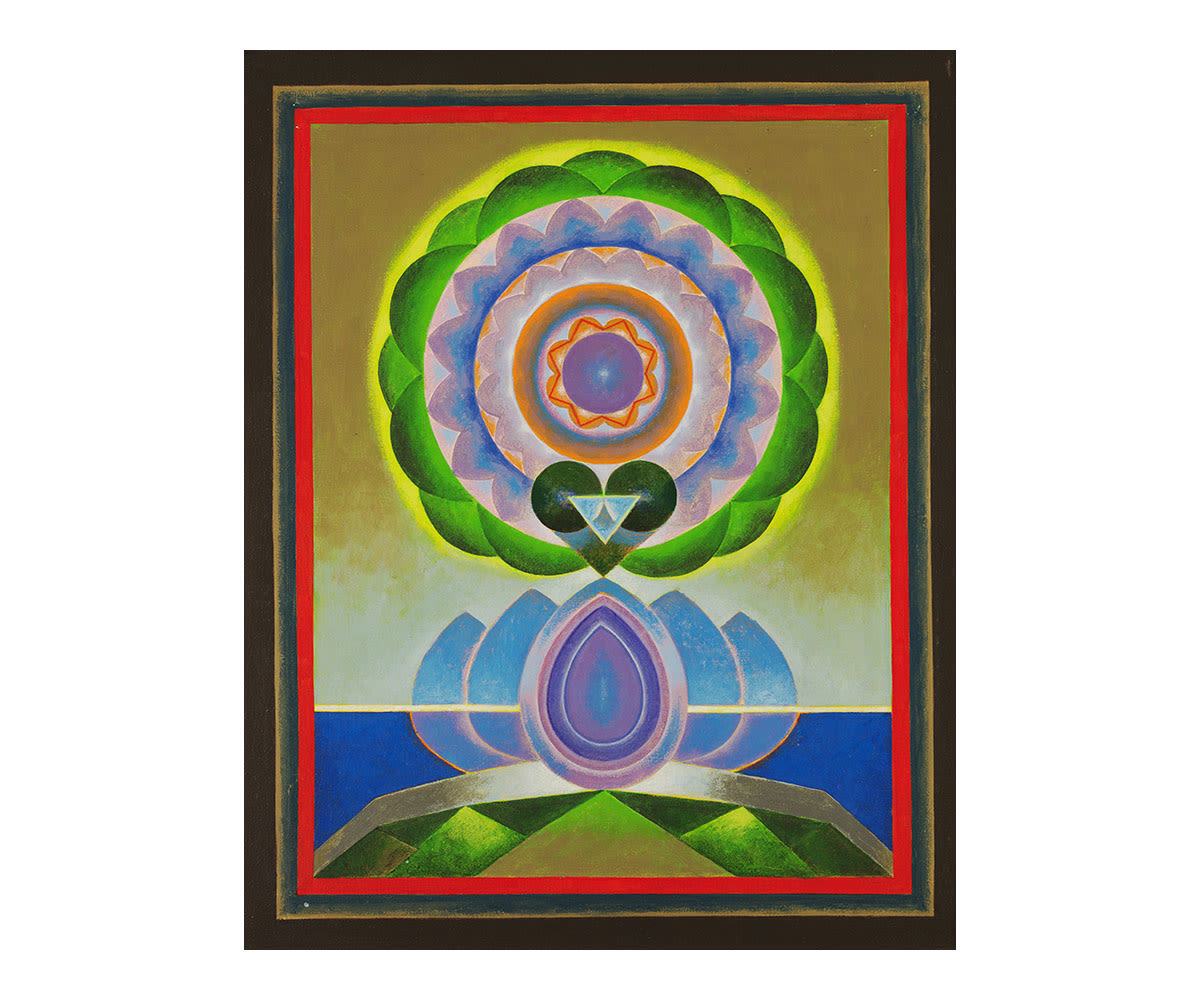




Egon investment scores
Market position
Research updated
Recent auction highlight
A result from Egon’s tracked auction sales; historical auction records are researched separately. Price including buyer’s premium.
Auction highlights
Scroll horizontally if needed →
| Work | Result | Venue and date |
|---|---|---|
| Untitled | $102,400 premium-inclusive | Christie's, 2026-09 |
| Untitled | $95,250 premium-inclusive | Christie's, 2026-03 |
| Untitled | $38,100 premium-inclusive | Christie's, 2026-03 |
5 further auction entries on record for Gulam Rasool Santosh — inside Egon.
Pricing
Primary market
None — artist deceased 1997. No gallery-controlled primary pricing exists. Dealer/private-sale pricing at DAG and Aicon is not published; prices on request.
Pricing caveats
- Internal prices are premium-inclusive; quoted estimates are hammer-basis — do not compute over-estimate percentages across the two bases.
- Works on paper and oils differ by an order of magnitude; do not blend them.
- Exclude 'attributed to' regional-house lots from any comparable set.
Historical context
2014
Sotheby's New York estimated a monumental 203 x 154 cm Herwitz-provenance canvas at $120,000-$180,000, indicating top-end estimates a decade ago already sat in the range where the market now transacts. Result unverified.
Trend reading
The mature-canvas band appears to have firmed rather than transformed. 2025-2026 Christie's results repeatedly exceeded hammer-basis estimates, suggesting conservative estimating against live demand — but because the realised figures are premium-inclusive and the estimates are hammer-basis, the apparent multiples overstate true over-performance.
Current 2025 2026 international
- Mid size oils
- roughly $38,000 - $105,000 premium-inclusive for canvases around 50 x 40 in. and smaller board-laid works
- Works on paper
- approximately $6,000 - $10,000 — anchored by the documented Saffronart Dec 2025 watercolour at Rs 8,40,000 / $9,438 incl. premium
Regional us houses
Materially lower, often four figures, and frequently catalogued 'attributed to'. Attribution and condition risk concentrates here; these are not comparables for major-house material.
- Oils on canvas major houses
- $33,000 - $290,000 premium-inclusive (internal database, 8 Christie's lots, Mar 2025 - Sep 2026); sample average $111,311
- Large mature tantric canvases
- $95,000 - $290,000 premium-inclusive at the top of the observed range
Liquidity
Depth
Thin but consistent. Christie's New York dominates recorded international volume; loss of that channel would materially reduce liquidity. Works on paper trade more often at low values; large mature canvases are scarce.
Sell through
100% across 7 settled lots in the internal record (2025 onward, major houses only). A small, recent, house-restricted sample — not an all-market or historical sell-through rate.
- Time to liquidate
- Realistically tied to the March and September Asia Week selling seasons — 6-12 months for a good canvas to reach the right sale.
Annual volume estimate
Roughly 8-15 lots per year across all houses; the internal record shows 8 sold major-house lots across about 20 months (Mar 2025 - Sep 2026), supplemented by Saffronart and regional consignments.
Collector base
Current demand
Indian and diaspora collectors buying through Christie's and Sotheby's New York and Saffronart, plus a smaller Western following for tantric/spiritual abstraction generated by the 1970s-80s Tantra exhibitions and sustained by Aicon's New York programming.
Historical patrons
Chester and Davida Herwitz collected Santosh prodigiously; Sotheby's catalogue notes describe him as one of the two most collected artists in the Herwitz personal collection, and state the bulk of the Herwitz holdings passed to the Peabody Essex Museum in 2001 (attributed account).
- Provenance premium
- Herwitz provenance and illustration in the DAG 'Awakening' catalogue are the clearest value and authentication markers.
Auction history
Buy ins
No bought-in lots were identified in the sources checked. Aggregators surface sold lots and the internal database covers 2025 onward at four houses only, so the absence of recorded buy-ins reflects source coverage — it is not evidence that no lot has failed to sell.
Coverage note
Figures below separate (a) lots recorded in our internal auction database (Christie's/Sotheby's/Phillips/Bonhams, 2025 onward) and (b) externally sourced records. These are NOT merged; an internal figure and a web-sourced figure are never reconciled into a single event.
Internal database summary
- Scope
- Internal database, 2025 onward, major four houses only — partial
- Highest recorded
- $289,800 premium-inclusive — Untitled, Christie's, March 2025
- Lot count cached
- 8
- Sold count cached
- 8
- Recent sample range
- $33,020 - $289,800 premium-inclusive (8 sold lots)
- Recent sample average
- $111,311 premium-inclusive (8 priced lots)
- Canonical sell through
- 100% across 7 settled lots (all catalogued lots at least 90 days old; 100% settled)
Additional activity observed
Aggregator listings show steady 2024-2026 activity beyond the internal record: Sotheby's 25 Mar 2026 (oil, 127.3 x 101.9 cm, Property from a Private Collection, Pennsylvania); Christie's 25 Mar 2026 and 12 Feb 2026; Christie's, Greenwich Auction and WA Art Auctions in Jul and Sep 2025; Saffronart summer online sales Jun 2024 and Jun 2025. LiveAuctioneers records 45 price results in total, several catalogued as 'attributed to' at small US houses.
Market overview
Secondary-market only (artist died 1997). Trades principally in the dedicated South Asian Modern + Contemporary sales at Christie's and Sotheby's New York, at Saffronart (Mumbai/online), and at Indian and US regional houses. A recognised name and the leading figure of the neo-Tantra segment, but priced well below the Indian modernist blue-chip tier (Gaitonde, Souza, Husain, Raza).
Market position
- Segment
- Mid-market within Indian/South Asian modernism; the leading name of the neo-Tantra sub-segment alongside Biren De and Sohan Qadri.
Sector tailwind
The South Asian category is in a strong phase: Artnet News reported a record Christie's South Asian sale in London, and Christie's South Asian Modern + Contemporary Art Online (18 March - 1 April 2026) totalled $2.02m with 96% of lots selling above low estimate (HENI). Santosh rides that tide rather than an artist-specific catalyst.
Investment outlook
Base case
Continued firm mid-market pricing for authenticated mature tantric canvases in the $50k-$150k band, with exceptional large works reaching $200k-$300k when supply allows — driven by sector-wide South Asian expansion rather than by a Santosh-specific institutional catalyst.
Downside risks
- Single-channel dependence: most recorded international volume is Christie's New York.
- Visible attribution risk: multiple 'attributed to' lots circulate at regional US houses; unverified works may be unsellable at international houses.
- Sector beta — prices are riding a broad South Asian upswing and would likely retrace with it.
- The 100% sell-through is measured on 7 settled lots from 2025 onward at major houses only and does not establish durable all-market liquidity.
Entry guidance
ANALYST JUDGMENT. Prefer post-1970 signed tantric oils on canvas with documented provenance (Herwitz chain, DAG 'Awakening' catalogue illustration, or an established gallery chain) at $50,000-$120,000. Treat anything above $200,000 as requiring an exceptional scale/date/provenance case, since only two figures in our record clear that level. Works on paper at $5,000-$12,000 are low-risk entry but have the thinnest resale depth. Avoid regional-house 'attributed to' material unless independently examined — a low price does not de-risk an attribution, and the DAG catalogue is a provenance aid, not an authentication authority.
Upside scenario
ANALYST SCENARIO, not observed return: a monographic retrospective at a museum (as opposed to the 2011 commercial-gallery retrospective) or a verified first-rank Western museum acquisition would be the plausible repricing trigger. No such event is announced in the sources checked.
Institutional presence
Research updated
Exhibitions
Solo
Awakening: A Retrospective of G. R. Santosh
- Type
- Posthumous retrospective at a COMMERCIAL GALLERY — not a museum retrospective
- Year
- 2011 (catalogue 2011; a 2012 imprint is also cited)
- Venue
- Delhi Art Gallery (DAG), New Delhi
Solo exhibitions across his career
- Type
- Artsy states Santosh held over 30 solo exhibitions; individual venues and dates were not enumerated in the sources checked
- Year
- c.1950s-1990s
- Venue
- Various, principally in India
Exhibition at the National Gallery of Modern Art
- Type
- Listed among his exhibitions by Impart; solo vs group status not specified by the source
- Year
- 1984
- Venue
- National Gallery of Modern Art, New Delhi
Group
Paris Biennale
Sao Paulo Biennale
- Type
- Biennale (per Impart)
- Year
- 1963
- Venue
- Sao Paulo, Brazil
10th Sao Paulo Art Biennial
- Type
- Biennale — Wikipedia cites the 1969 Bienal catalogue
- Year
- 1969
- Venue
- Sao Paulo, Brazil
Sao Paulo Biennale
- Type
- Biennale (per Impart)
- Year
- 1972
- Venue
- Sao Paulo, Brazil
Tantra Art
- Type
- International thematic group exhibition
- Year
- 1971
- Venue
- Montreal, Canada
View 6 more records
Exhibition at the Royal Academy of Arts
- Type
- International group exhibition; the Royal Academy is a non-collecting exhibiting institution
- Year
- 1982
- Venue
- Royal Academy of Arts, London
Neo-Tantra: Contemporary Indian Art Inspired by Tradition
- Type
- University group exhibition; reviewed in the Los Angeles Times, 25 December 1985 (Jane Greenstein)
- Year
- 1985
- Venue
- University of California, Los Angeles
Midnight to the Boom: Painting in India after Independence
- Type
- Museum group exhibition; three Santosh paintings from the Herwitz collection included per a Sotheby's catalogue note (attributed)
- Year
- 2013
- Dates
- early 2013
- Venue
- Peabody Essex Museum, Salem, Massachusetts
Tantric: The Corporeal and the Cosmic
- Type
- Commercial gallery thematic group exhibition
- Venue
- Aicon Art, New York
Tantra + Sufism
- Type
- Commercial gallery group exhibition with Lancelot Ribeiro, Prafulla Mohanti, Biren De, Sohan Qadri, Rachid Koraichi, Safdar Ali Qureshi
- Venue
- Aicon Art, New York
Decadent December: From Gade to Hashmi
- Type
- Commercial group exhibition, recorded in the exhibition history of the Saffronart Dec 2025 lot 59 watercolour
- Year
- 2023-24
- Dates
- 10 December 2023 - 15 January 2024
- Venue
- Art Pilgrim, New Delhi
Upcoming
No forthcoming museum exhibition, retrospective or dedicated gallery show was identified in the sources checked. The recurring calendar events relevant to his market are the Christie's and Sotheby's Asia Week New York South Asian sales each March and September; Christie's South Asian Modern + Contemporary Art was scheduled for 16 September 2026. Scope: this reflects the sources checked, not a confirmed empty calendar.
Publications
Records
Awakening: A Retrospective of G. R. Santosh
Type
Retrospective catalogue — the standard reference, cited in Christie's and Sotheby's catalogue notes and used to illustrate individual works (pp. 39, 120)
- Year
- 2011 (also cited 2012)
- Editor
- Kishore Singh (ed.)
- Publisher
- Delhi Art Gallery, New Delhi
Seeking Oneness: G. R. Santosh's Political, Historical and Philosophical Syncretism
Type
Scholarly essay by an academic art historian — the most substantial art-historical treatment identified, though published within a gallery catalogue
- Year
- 2012
- Author
- Rebecca M. Brown
- Publisher
- In Awakening: A Retrospective of G. R. Santosh, New Delhi: Delhi Art Gallery
Gulam Rasool Santosh: A Lover of the Feminine Divine
- Type
- Graduate thesis — academic attention outside commercial sponsorship
- Year
- 2015-16
- Author
- Joyce Joy Higgins
- Publisher
- School of the Art Institute of Chicago
The Art of GR Santosh
- Type
- Regional press feature
- Year
- 2015-03-14
- Author
- Altaf Bashir
- Publisher
- Greater Kashmir
A View of India's Modern Tantric Art
- Type
- US mainstream press review of the UCLA Neo-Tantra exhibition
- Year
- 1985-12-25
- Author
- Jane Greenstein
- Publisher
- Los Angeles Times
Tantra Art
- Type
- Not about Santosh, but identified by DAG as the international publishing catalyst for the tantric-art moment in which his mature work emerged
- Year
- 1966 (context)
- Author
- Ajit Mookerjee
- Publisher
- n/a
- Source URL
- https://dagworld.com/g.r.santosh.html
Gulam Rasool Santosh (encyclopedia entry)
- Type
- Reference entry — source for awards, exhibition list and several museum captions
- Year
- 2022 (modified Feb 2026)
- Author
- Impart Encyclopedia of Art
- Publisher
- Impart
Summary
The scholarly and catalogue literature is real but modest, with its centre of gravity in the DAG retrospective catalogue rather than a museum monograph. No catalogue raisonne was identified.
Museum collections
Museum tier
Not assessed as Tier 1 or Tier 2 — documented holdings are at specialist and regional collecting institutions (Peabody Essex Museum, MAP Bengaluru, Kerala Museum). No holding at a named Tier 1 institution was established in the sources checked.
Coverage note
No works were returned by the museum APIs checked by our pipeline; that is a coverage limitation of those APIs (Indian public collections are largely absent), not evidence of absence. Credit lines were not retrieved for any holding — 'not retrieved', not 'not published'.
Other museums
Multiple works, including Untitled, c. 1974, watercolour on paper, 18.4 x 13.3 cm; Untitled, c. 1977, oil on canvas, 152.4 x 127 cm; Untitled, c. 1978, ink on paper, 75.6 x 55.9 cm
- Credit line
- credit line unknown
- Institution
- Peabody Essex Museum, Salem, Massachusetts
Status note
The deepest documented public holding. Works captioned to PEM via Impart / Google Arts and Culture. Sotheby's catalogue notes state (attributed) that PEM houses the largest collection of Indian contemporary art outside India, the majority acquired in 2001 from Chester and Davida Herwitz, and that three Santosh paintings from the Herwitz collection featured in PEM's 2013 'Midnight to the Boom'. PEM's own collection records were not retrieved; institution tier not formally assessed — PEM is a major US collecting museum but was not evaluated against the first-rank criterion here.
Holding not established
- Credit line
- credit line unknown
- Institution
- National Gallery of Modern Art, New Delhi
Status note
UNRESOLVED as a collection holding. Sources establish an EXHIBITION at NGMA New Delhi in 1984, not an accession. A holding is plausible given his national standing but is not verified; do not record as ownership.
Holding not established
- Credit line
- credit line unknown
- Institution
- Jehangir Nicholson Art Foundation (collection displayed at CSMVS, Mumbai)
Status note
UNRESOLVED. JNAF maintains an artist page for G. R. Santosh (cited in the Impart bibliography), suggestive of a holding, but the JNAF page was not retrieved in this pass and no work or accession was confirmed.
Tier 3 museums
Flower, c. 1989, watercolour on paper, 29 x 29 cm
- Credit line
- credit line unknown
- Institution
- Museum of Art & Photography (MAP), Bengaluru
Status note
Reported via the Impart Encyclopedia entry, which captions the work to MAP Bengaluru. Not verified against a MAP collection record; credit line not retrieved.
- Institution tier
- 3
Untitled, c. 1990, oil on canvas, 76 x 61 cm
- Credit line
- credit line unknown
- Institution
- Kerala Museum, Kochi
- Status note
- Reported via Impart, sourced to Google Arts and Culture. Not verified against a museum record.
- Institution tier
- 3
- Tier framework
- named-institutions-v1
Awards and recognition
Art prizes
- Lalit Kala Akademi National Award, three times
- Governor of Bombay Prize, 1955-56
- Bombay Art Society Award, 1956
- Kala Ratna Award, 1991
State honours
- Padma Shri, Government of India, 1977
- Sahitya Akademi Award (Kashmiri), 1979, for the poetry collection Be Soakh Rooh / Besukh-Ruh — Wikipedia cites the Sahitya Akademi's own awards list
Award year conflict
The three Lalit Kala Akademi award years are reported inconsistently: DAG gives 1957, 1964 and 1973; Impart gives 1957, 1963 and 1977; Artsy cites 1973. All sources agree on three awards and on 1957; the other two years are unresolved.
Institutional roles
- Assisted in designing the Lalit Kala Akademi galleries (1980s)
- Director, Garhi Studios, New Delhi
Career & Biography
Research updated
Identity
- Birth
- 1929, Chinkral Mohalla, Habba Kadal, old Srinagar, Kashmir
- Death
- 10 March 1997, New Delhi, India
- Gender
- Male
- Status
- Deceased — historical modern master; market is entirely secondary/estate-era
- Full name
- Ghulam Rasool Santosh (born Ghulam Rasool Dar; also published as Gulam Rasool Santosh, G. R. Santosh)
Name note
Born into a Kashmiri Muslim family; he married his childhood sweetheart Santosh, a Kashmiri Pandit, and adopted her name as his own — described in sources as unusual in the conservative Kashmiri society of the time.
- Nationality
- Indian (Kashmiri)
- Current location
- n/a (deceased 1997; worked in Srinagar and New Delhi)
Career timeline
- Year
- c.1940s
- Event
- Discovered as a young landscape painter in Kashmir by S. H. Raza
- Year
- 1950
- Event
- Joined the Progressive Artists' Association in Kashmir, formed with Raza's encouragement
- Year
- 1953/1954
- Event
- Government of India cultural scholarship to the Faculty of Fine Arts, MS University Baroda; studies Cubism under N. S. Bendre
- Year
- 1955-56
- Event
- Governor of Bombay Prize; Bombay Art Society Award (1956)
- Year
- 1957
- Event
- First Lalit Kala Akademi national award
View 17 more records
- Year
- mid/late 1950s
- Event
- Among the Baroda artists (with Shanti Dave, Triloke Kaul) whose joint exhibition contributed to the formation of the Baroda School
- Year
- 1961
- Event
- Paris Biennale participation
- Year
- 1963
- Event
- Sao Paulo Biennale participation (per Impart); portrait of Triloke Kaul painted this year
- Year
- 1964
Event
PIVOTAL: visit to the Amarnath cave in Kashmir produces a mystical experience; turns to Kashmir Shaivism and Tantra, spends roughly two years in study; begins the neo-Tantric idiom and the Shiva-Shakti series
- Year
- 1969
- Event
- 10th Sao Paulo Art Biennial
- Year
- 1971
- Event
- 'Tantra Art' exhibition, Montreal
- Year
- 1972
- Event
- Sao Paulo Biennale (per Impart)
- Year
- 1977
- Event
- Padma Shri conferred by the Government of India
- Year
- 1979
- Event
- Sahitya Akademi Award (Kashmiri) for the poetry collection Be Soakh Rooh / Besukh-Ruh
- Year
- 1982
- Event
- Exhibited at the Royal Academy of Arts, London
- Year
- 1984
- Event
- Exhibition at the National Gallery of Modern Art, New Delhi
- Year
- 1980s
- Event
- Assisted in designing the Lalit Kala Akademi galleries; served as director at Garhi Studios, New Delhi
- Year
- 1985
- Event
- Included in 'Neo-Tantra: Contemporary Indian Art Inspired by Tradition', UCLA, Los Angeles
- Year
- 1991
- Event
- Kala Ratna Award
- Year
- 1997
- Event
- Died in New Delhi, 10 March; survived by his wife, a son and a daughter
- Year
- 2011/2012
- Event
- Posthumous retrospective 'Awakening: A Retrospective of G. R. Santosh', Delhi Art Gallery (DAG), New Delhi, catalogue edited by Kishore Singh
- Year
- 2013
Event
Three Herwitz-collection Santosh paintings shown in 'Midnight to the Boom: Painting in India after Independence', Peabody Essex Museum, Salem MA (per Sotheby's catalogue note)
Education and training
Early
Largely self-taught initially; dropped out of school after his father's death and worked as a signboard painter, silk weaver, whitewasher and papier-mache craftsman. Learned watercolour landscape painting from Dina Nath Raina.
Formal
Faculty of Fine Arts, Maharaja Sayajirao University of Baroda (Vadodara), under N. S. Bendre, on a Government of India national cultural scholarship.
Date discrepancy
Wikipedia states he won the scholarship in 1954; the Impart Encyclopedia states he began study at Baroda in 1953. Both agree on Baroda/Bendre and the government cultural scholarship; the exact start year is unresolved.
- Family background
- His grandfather practised ornamental painting on papier-mache, cited by AstaGuru as an early spur to his interest in art.
Political social context
A Kashmiri Muslim who married a Kashmiri Pandit and drew his mature idiom from Hindu Shaivite metaphysics, Santosh is discussed by Rebecca M. Brown ('Seeking Oneness') as an artist of political, historical and philosophical syncretism across the religious fault lines of Kashmir.
Studio practice and philosophy
After 1964 Santosh treated painting as sadhana — a transformative spiritual discipline rather than picture-making; DAG describes him as a yogi as much as an artist from 1964 until his death. Sotheby's catalogue material quotes him rejecting the popular perception of tantra as magic. Worked in oil and acrylic on canvas and extensively in watercolour, gouache and ink on paper.
Artistic context and influences
- Movements
- Progressive Artists' Association (Kashmir); Baroda School; pioneer of Neo-Tantra in Indian modernism
Literary practice
Recognised poet in Kashmiri and Urdu; also wrote on tantric philosophy in English — a rare modern Indian painter carrying a parallel national literary honour (Sahitya Akademi Award, 1979)
Mentors and patrons
- S. H. Raza (early discovery and advocacy)
- N. S. Bendre (teacher at Baroda)
- Dina Nath Raina (early watercolour training)
Intellectual sources
Kashmir Shaivism; tantric philosophy and yantra/mandala traditions; the purusha-prakriti (Shiva-Shakti) cosmology; Ajit Mookerjee's 'Tantra Art' (1966), which DAG identifies as a worldwide publishing sensation coinciding with his early tantra works; Sufi mysticism coexisting in Kashmir; European Cubism absorbed at Baroda
Contemporaries and peers
- Biren De
- Sohan Qadri
- P. T. Reddy
- Mahirwan Mamtani
- K. C. S. Paniker
- S. H. Raza
- Prafulla Mohanti
- Shanti Dave
- Triloke Kaul
Artistic Profile
Research updated
Style
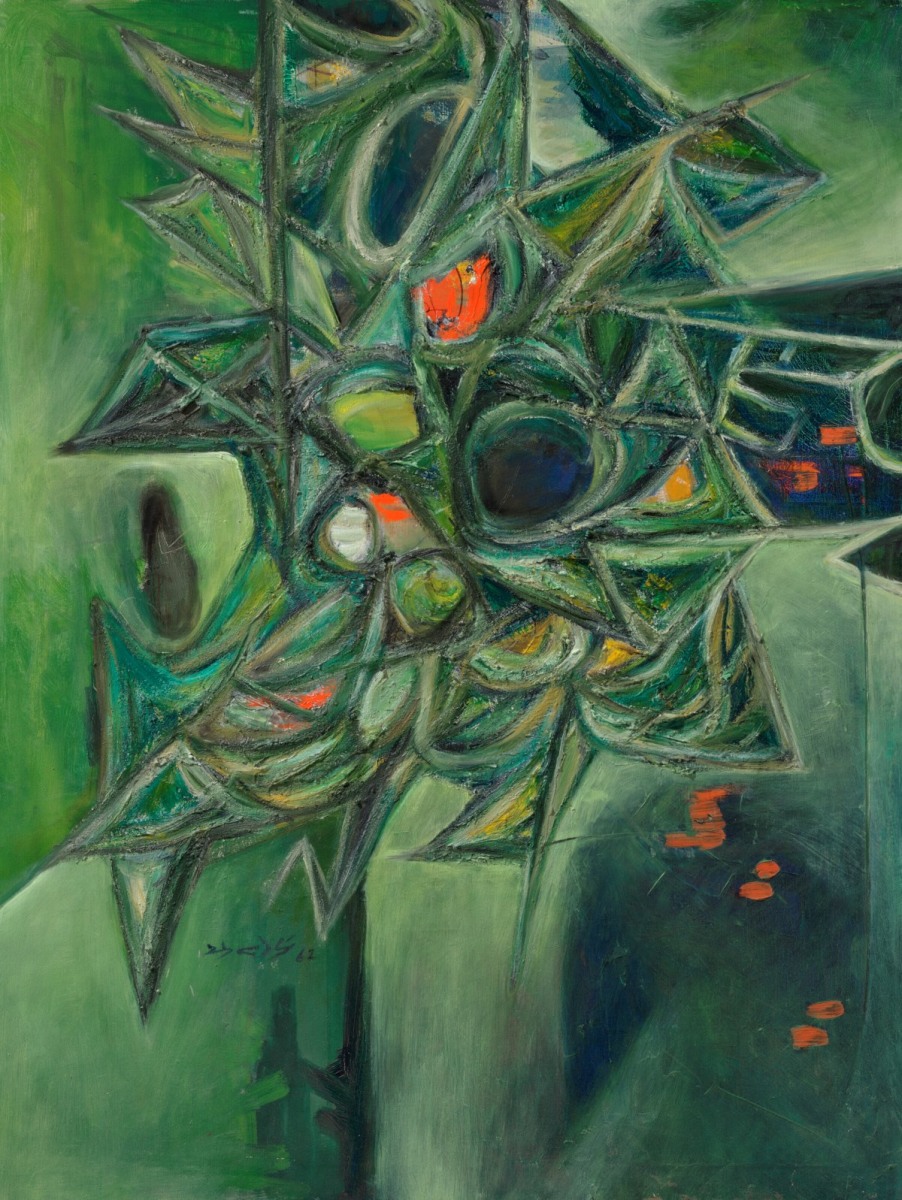
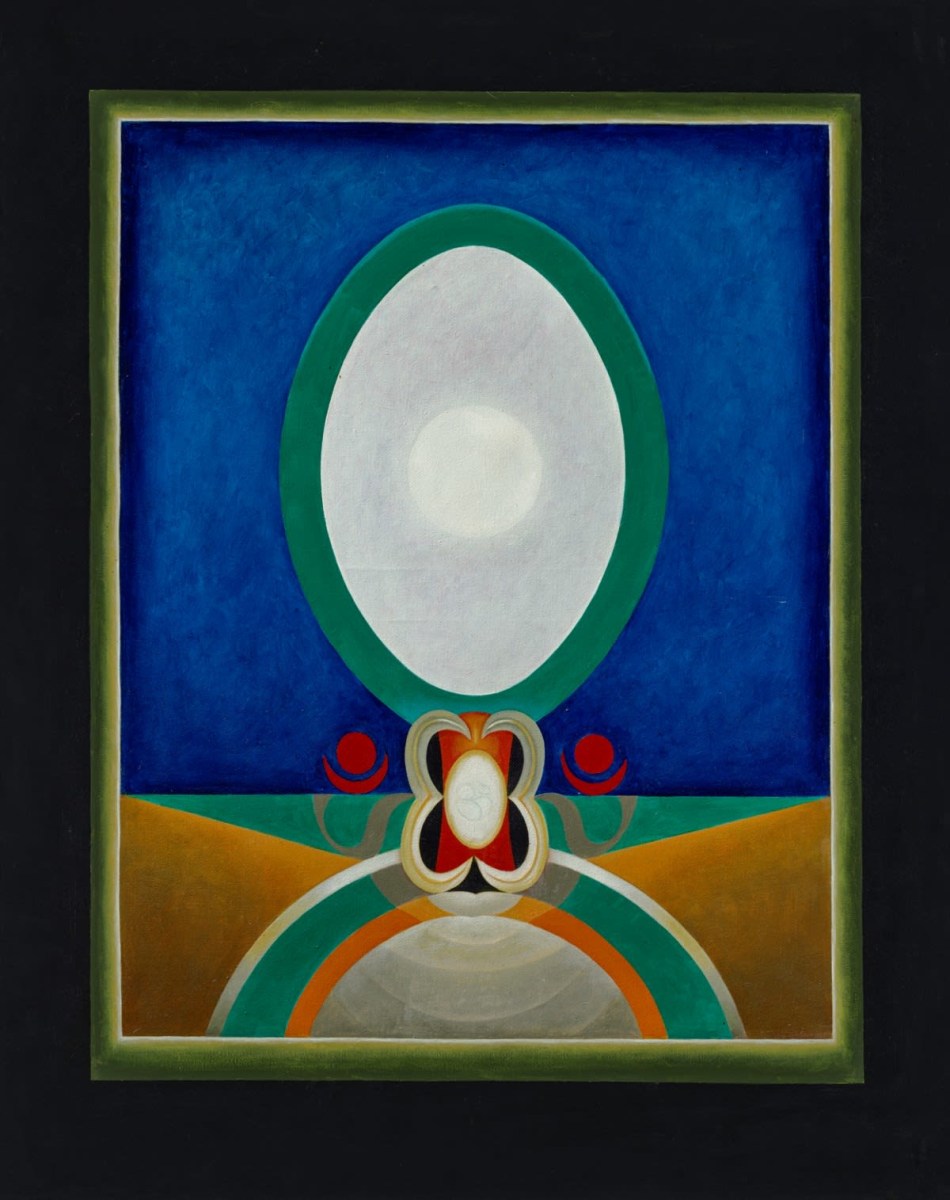
Two distinct styles across one career. (1) Pre-1964: Kashmiri landscapes, portraiture and semi-abstracted figuration with Cubist faceting learned at Baroda and passages of heavy impasto. (2) Post-1964 mature idiom: hard-edge, bilaterally symmetrical, centrally axial abstraction in vertical format — nested ovoids, circles, triangles and polygons composed into a yantra-like votive diagram in flat, saturated colour, frequently warm centres against cool grounds.
Evolution
- Phase
- c.1945-1953
- Description
- Self-taught Kashmiri landscapes in watercolour alongside commercial craft work; discovered by S. H. Raza.
- Phase
- 1953/54-1963
Description
Baroda years and after: Cubist-inflected figuration and abstraction in the Progressive mould; impasto experimentation; naturalistic portraits of contemporaries (Triloke Kaul, 1963).
- Phase
- 1964-1966
Description
Transition following the Amarnath cave experience: two years studying Shaivism and tantra; large drawings of merged male/female figures dissolving into geometry; biomorphic and angular lattices.
- Phase
- c.1966-1997
Description
Mature neo-Tantric idiom: symmetrical yantra compositions, the Shiva-Shakti series, vivid flat colour — sustained for three decades without major deviation.
Influences
- Kashmir Shaivism and tantric philosophy (studied intensively 1964-66)
- Yantra and mandala diagram traditions
- Ajit Mookerjee, Tantra Art (1966)
- N. S. Bendre and Baroda's teaching of Cubism
- S. H. Raza (early mentorship; parallel trajectory toward metaphysical abstraction)
- Dina Nath Raina (watercolour landscape)
- Kashmiri geography — the geometry of snow-clad mountains — and the valley's mysticism
- Kashmiri papier-mache ornamental craft
Visual language
A vertical devotional format functioning as a meditative device: the eye travels along a strict central axis into a luminous core. Concentric nesting, figure-ground reversal and warm chromatic centres against cool saturated grounds produce stillness rather than movement. Colour is symbolic rather than descriptive; there is no perspectival space.
Cataloguing note
Because virtually all works are 'Untitled', identification depends on date, dimensions, medium and provenance. Illustration in the DAG 'Awakening' catalogue (2011) is the most useful single provenance marker available, though a catalogue entry is a provenance and literature reference, not an authentication opinion.
Signature series
- Shiva-Shakti series
- The mature untitled tantric yantra paintings — almost all works at auction are 'Untitled', which complicates series-level attribution and the construction of comparables
Themes and subjects
- Shiva-Shakti, the fusion of male and female cosmic principles
- purusha-prakriti cosmology of creation
- shunya, the void
- the merging of the sexual and the transcendental; the abstracted copulating body
- Kashmir Shaivism and tantric metaphysics
- the feminine divine
- syncretism across Hindu tantra, Buddhist tantra and Kashmiri Sufism
Movements and periods
- Progressive Artists' Association, Kashmir (from 1950)
- Baroda School (mid-1950s onward)
- Indian modernism / post-Independence Indigenist turn
- Neo-Tantra (pioneer, from 1964) — the defining association
Techniques and mediums
Methods
Flat, matte, evenly brushed colour fields with controlled wet-over-dry layering and localised tonal modelling giving volume to spheres and ovoids; translucent glazing in earlier work; raised impasto ridgelines in the early-to-mid 1960s transitional paintings; hard-edge contour definition in the mature work
- Primary
- Oil on canvas; acrylic on canvas (including canvas laid on board in smaller works)
- Works on paper
- Watercolour, gouache and ink on paper — a consistent parallel practice across decades
Craft background
Papier-mache ornamental painting, signboard painting and silk weaving — trade skills from his youth that inform the flat decorative surface and precise linear control
Fingerprint verification
Confirmed by sources
- Centralized, symmetrical, frontal composition — Impart describes most later works as a vertical pictorial space with a centrally aligned, symmetrically balanced form of sacred geometric lines, triangles, circles, squares and polygons, corroborating the fingerprint's 'centralized composition', 'symmetrical balance', 'frontality' and 'planarity' signals.
- Hard-edge register and saturated palette — corroborated by descriptions of vibrant colour and neat lines (Wikipedia) and vivid colours (Impart).
- Oil on canvas as dominant medium — consistent with the canvas-based auction record; Impart separately confirms earlier impasto experimentation, supporting the fingerprint's impasto observations in the transitional works.
- Contemplative/reverent mood and the ritual, sacred and pure-abstraction themes — corroborated by the sadhana framing and the shunya (void) / Shiva-Shakti content.
- The yantra reading is correct: Impart explicitly describes symmetrical votive diagrams.
Disagreements and corrections
- The fingerprint's stylistic narrative invokes Hilma af Klint, Roberto Matta, Wifredo Lam and Art Informel. These are analyst visual analogies, not documented influences. Every source consulted roots the work in Kashmir Shaivism, tantric yantra traditions, Ajit Mookerjee's Tantra Art (1966), Kashmiri landscape and papier-mache craft heritage, and Cubism absorbed at Baroda under N. S. Bendre. The Cubist strand IS documented; the Surrealist/Informel and af Klint strands are not.
- The fingerprint is oil-only. Santosh worked substantially in watercolour, gouache and ink on paper — PEM holds a c.1974 watercolour and a c.1978 ink drawing and MAP a c.1989 watercolour; works on paper form a distinct, much cheaper market segment the fingerprint under-represents.
- The fingerprint carries no figurative signal. Documented: naturalistic portraits of contemporaries including Triloke Kaul (1963) and J. Sultan Ali (1969), plus early Kashmir landscapes, and (per Aicon) large transitional drawings of merged male/female figures. An early-period Santosh can be figurative.
- The 'thorned biomorphic lattice' green-field work in the tier-1 narrative fits the transitional early-to-mid-1960s Cubist/biomorphic phase rather than the mature tantric idiom; the two phases should be dated, catalogued and priced separately and are not interchangeable comparables.
Critical Reception
Research updated
Critical reception
Gaps
No Artforum, frieze, Art in America, e-flux or Brooklyn Rail review was located. Scope: this reflects the searches performed, not proof that none exists; most of his exhibition activity predates the digitised archives of those publications.
Summary
Santosh's critical standing rests on his position as the acknowledged pioneer of Neo-Tantra in Indian modernism rather than on a large body of contemporary Western art criticism. DAG and Aicon both describe him as the most important artist of the neo-tantra movement, alongside Biren De and Sohan Qadri. Serious art-historical engagement exists but is concentrated in the DAG retrospective catalogue and specialist South Asian scholarship.
Mainstream press
The Los Angeles Times reviewed the UCLA 'Neo-Tantra' exhibition on 25 December 1985 (Jane Greenstein, 'A View of India's Modern Tantric Art') — the clearest instance of US mainstream critical attention identified. Regional coverage includes Greater Kashmir's 2015 feature by Altaf Bashir.
- Artists to watch lists
- Not applicable — historical artist (d. 1997); no 'ones to watch' or new-talent list inclusions, and none would be expected.
Key critical positions
- DAG frames the 1964 Amarnath cave experience as the decisive rupture from Progressive-style figuration and abstraction to tantra, describing him thereafter as a yogi as much as an artist.
- Aicon Art positions Santosh and Biren De as the founding figures of the 1960s revitalisation of neo-tantric modernism, stressing that both emerged from semi-abstracted figural work — an argument against reading the tantric paintings as pure geometry.
- Rebecca M. Brown's essay 'Seeking Oneness' reads the work through political, historical and philosophical syncretism: a Kashmiri Muslim artist working through Hindu Shaivite metaphysics.
- Sotheby's catalogue notes emphasise his deliberate turn away from derivative European styles toward a distinctly Indian modern idiom — the Indigenist argument central to post-Independence Indian art history.
- Santosh himself resisted the reading of tantra as magic, arguing that this perception has wrongly informed the reception of tantric art (quoted in Sotheby's catalogue material).
Publications and media
Press
- Los Angeles Times, 25 Dec 1985 (UCLA Neo-Tantra review)
- Greater Kashmir, 14 March 2015, 'The art of G. R. Santosh'
- AstaGuru profile, 'Prominent Artist from Kashmir Valley: Gulam Rasool Santosh'
Scholarly
- Rebecca M. Brown, 'Seeking Oneness: G. R. Santosh's Political, Historical and Philosophical Syncretism', in Awakening (DAG, 2012)
- Joyce Joy Higgins, 'Gulam Rasool Santosh: A Lover of the Feminine Divine', School of the Art Institute of Chicago, 2015-16
- Impart Encyclopedia of Art entry (2022, updated Feb 2026)
Catalogues
- Awakening: A Retrospective of G. R. Santosh, ed. Kishore Singh, Delhi Art Gallery, 2011
- Catalogo da 10a Bienal de Sao Paulo, 1969
- Literary output
- Poetry in Kashmiri and Urdu, including the Sahitya Akademi-awarded Be Soakh Rooh (1979); prose on tantric philosophy in English.
Art historical positioning
A secure but specialised place: a Baroda School-trained modernist who broke from European-derived abstraction to found, with Biren De, the neo-Tantric current in Indian painting. He is a standard reference point in accounts of post-Independence Indian art's turn to indigenous sources, and other neo-Tantric artists (e.g. P. T. Reddy) are routinely positioned relative to him. He is not embedded in Western survey literature of twentieth-century modernism.
Gallery & Representation
Research updated
Fair presence
No dedicated Santosh booth presentation was identified. DAG and Aicon Contemporary are both listed participants at India Art Fair, New Delhi (2025 and 2026 editions) — the most likely fair-level venue for his work.
Representation
Galleries
DAG (Delhi Art Gallery)
Note
The most important commercial custodian of the legacy: organised and published the 2011 'Awakening' retrospective and catalogue and deals in modern Indian masters on the secondary market. No source retrieved states that DAG represents the estate; treat as a leading secondary dealer unless estate representation is confirmed. Exhibits at India Art Fair.
- Tier
- 1
- Since
- unknown
- Status
- secondary
- Location
- New Delhi, Mumbai and New York
- Institution tier
- 3
Aicon Art / Aicon Contemporary
Note
Principal New York secondary channel for neo-Tantric material; staged 'Tantric: The Corporeal and the Cosmic' and 'Tantra + Sufism' featuring Santosh, and appears in the provenance chain of the Herwitz canvas offered at Sotheby's in 2014. Exhibits at India Art Fair.
- Tier
- 1
- Since
- unknown
- Status
- secondary
- Location
- New York
- Institution tier
- 3
Saffronart
- Note
- Auction house and dealer; regular venue for Santosh works on paper and canvases, with a documented December 2025 sale.
- Tier
- 1
- Since
- unknown
- Status
- secondary
- Location
- Mumbai, New Delhi, New York
- Institution tier
- 3
Art Pilgrim
Note
Exhibited a Santosh watercolour in 'Decadent December: From Gade to Hashmi' (Dec 2023 - Jan 2024) per the Saffronart lot provenance. A group exhibition does not establish representation.
- Tier
- 0
- Since
- unknown
- Status
- secondary
- Location
- New Delhi
- Primary market
- Closed. There is no primary market; all transactions are secondary.
Representation note
Santosh died in 1997 and no gallery is documented as holding current or estate representation. The work trades on the secondary market: dedicated South Asian sales at Christie's and Sotheby's New York each March and September, Saffronart's online auctions, and private dealing through DAG and Aicon in New Delhi, Mumbai and New York. Dealer pricing is not published; provenance documentation drives price, and a long tail of US regional houses carries 'attributed to' material at much lower levels.
Primary representation
None — deceased artist with no identified estate gallery. DAG's retrospective and catalogue should not be read as formal estate representation absent confirmation.
Geographic reach
Two principal commercial geographies: India (New Delhi/Mumbai — DAG, Saffronart, Art Pilgrim) and the United States (New York — Aicon, Christie's, Sotheby's, plus regional houses reflecting the historical dispersal of American collections including Herwitz material). Little documented European or East Asian gallery activity.
Representation history
During his lifetime Santosh worked within the Indian state-supported and academy system (Lalit Kala Akademi, Garhi Studios, NGMA) rather than under a single dealer. The posthumous commercial narrative was built largely by DAG's 2011 retrospective and catalogue and by Aicon's New York neo-Tantra programming.
Sources & research notes
Egon’s artist research combines historical auction records, recent sales, institutional history, critical reception and gallery information. Researched auction records and auction highlights are identified separately.
Read prices with their work, sale date, currency and stated basis. Egon’s market assessments are distinct from reported auction results.
Reference: Egon, “Gulam Rasool Santosh: Market Intelligence & Investment Profile.”
Evidence & qualifications
These notes preserve the sources, status and qualifications recorded in the research.
Saffronart Winter Online Auction, 10-11 December 2025, lot 59, G R Santosh, Untitled, watercolour on paper 22 x 16 cm: winning bid Rs 8,40,000 / $9,438 inclusive of buyer's premium, against an estimate of Rs 5,00,000-7,00,000.
Market · Documented · Event: 2025-12-10/11 · Source retrieved: 2026-09-21
The lot page states the winning bid explicitly and identifies it as premium-inclusive. Establishes the works-on-paper band only; not comparable to oils on canvas.
https://www.saffronart.com/auctions/postwork.aspx?l=53000&eid=4884&lotno=59&n=59Sotheby's New York, March 2014, lot 289: Gulam Rasool Santosh, Untitled, oil on canvas 203.2 x 153.7 cm, ex-Chester and Davida Herwitz Collection, estimate $120,000-$180,000.
Market · Unresolved · Event: 2014-03 · Source retrieved: 2026-09-21
Estimate, dimensions, provenance and literature reference are published on the lot page. The result is gated behind 'Log in to view results'; the page shows only that bidding is closed, which does not establish that the lot sold.
https://www.sothebys.com/en/auctions/ecatalogue/2014/modern-contemporary-south-asian-art-n09119/lot.289.htmlThe highest figure in our internal auction record is $289,800 premium-inclusive for an Untitled work at Christie's, March 2025.
Market · Reported · Event: 2025-03
Internal database figure, not an external source; the database begins in 2025. NOT verified as the all-time auction record — pre-2025 Christie's, Sotheby's and Saffronart results were not exhaustively retrieved.
Christie's South Asian Modern + Contemporary Art, New York, was scheduled for 16 September 2026, with Souza's Woman with Lamp (1949) estimated US$400,000-600,000.
Market · Documented · Event: 2026-09-16 · Source retrieved: 2026-09-21
Confirms the existence and date of the sale channel matching our database's September 2026 Santosh lot; the listing does not name a Santosh lot or any result.
https://asiaweekny.com/christies-asia-week-new-york-autumn-2026-auctions/Christie's 'South Asian Modern + Contemporary Art Online' (New York, 18 March - 1 April 2026) totalled $2.02m, with 96% of lots selling above low estimate.
Market · Reported · Event: 2026-04-01 · Source retrieved: 2026-09-21
Sector context from a HENI news report, not Santosh-specific; the article highlights Mohan Samant and Ganesh Pyne.
https://heni.com/news/article/christie-s-south-asian-modern-contemporary-art-online-auction-in-new-york-2026-04-01V. S. Gaitonde's Untitled (1971) realised GBP 2.3 million (~$3 million) at Christie's London, and K. K. Hebbar's Ajanta (1974) sold for $768,000 at Sotheby's New York.
Market · Reported · Source retrieved: 2026-09-21
Artnet News report used only for peer benchmarking; precise lot dates were not extracted.
https://news.artnet.com/market/christies-record-sale-south-asian-market-2780652Peabody Essex Museum holds multiple works by Santosh, including an oil on canvas c.1977 (152.4 x 127 cm) and works on paper c.1974 and c.1978.
Institutional · Reported · Source retrieved: 2026-09-21
Captions in the Impart Encyclopedia entry credited to PEM via Google Arts and Culture. PEM's own collection database was not retrieved, so accession numbers and credit lines are unknown (not retrieved — not established as unpublished). Acquisition route and date for these specific works are not established.
https://imp-art.org/articles/gulam-rasool-santosh/Sotheby's catalogue note states PEM houses the largest collection of Indian contemporary art outside India, the majority acquired in 2001 from Chester and Davida Herwitz, and that three Santosh paintings from the Herwitz collection were shown in PEM's 2013 exhibition 'Midnight to the Boom'.
Institutional · Reported · Event: 2001 (reported acquisition); 2013 (exhibition) · Source retrieved: 2026-09-21
An auction-house catalogue note written to support a lot — an attributed, commercially interested account, not a museum record. It does not state whether the three exhibited paintings were PEM-owned or loans. No independent PEM confirmation obtained.
https://www.sothebys.com/en/auctions/ecatalogue/2013/modern-contemporary-south-asian-art/lot.33.htmlSantosh exhibited at the National Gallery of Modern Art, New Delhi in 1984.
Institutional · Reported · Event: 1984 · Source retrieved: 2026-09-21
An exhibition, not an acquisition. No NGMA collection holding was established; the venue mention must not be converted into ownership.
https://imp-art.org/articles/gulam-rasool-santosh/Participation in the 10th Sao Paulo Art Biennial, 1969.
Institutional · Documented · Event: 1969 · Source retrieved: 2026-09-04
Wikipedia cites the 1969 Bienal de Sao Paulo catalogue. The 1963 and 1972 Sao Paulo participations rest on Impart alone. Biennale inclusion is exhibition evidence, not a collection holding.
https://en.wikipedia.org/wiki/G._R._SantoshPadma Shri (1977), three Lalit Kala Akademi national awards, Governor of Bombay Prize (1955-56), Bombay Art Society Award (1956), Kala Ratna (1991) and the Sahitya Akademi Award (1979).
Institutional · Documented · Event: 1955-1991 · Source retrieved: 2026-09-21
The Sahitya Akademi Award is separately corroborated by Wikipedia's citation of the Akademi's awards list. The three LKA award YEARS conflict between DAG (1957/1964/1973) and Impart (1957/1963/1977) — unresolved. Prizes and honours are strong national-recognition signals but are not collection holdings.
https://imp-art.org/articles/gulam-rasool-santosh/The 2011 'Awakening' retrospective was staged by Delhi Art Gallery (DAG), a commercial gallery, not a museum.
Institutional · Documented · Event: 2011 · Source retrieved: 2026-09-21
Decisive for scoring: the artist's principal retrospective is not a first-rank museum monographic retrospective. The catalogue nonetheless carries genuine scholarship (Rebecca M. Brown).
https://dagworld.com/awakening-a-retrospective-of-g-r-santosh.htmlDAG describes Santosh as the most important artist of the neo-tantra movement in Indian art, alongside Biren De and Sohan Qadri; the same formulation is reproduced in auction listings.
Critical · Reported · Source retrieved: 2026-09-21
A dealer's framing, repeated verbatim in third-party auction listings — commercially interested language, though consistent with independent accounts of the movement's origins.
https://dagworld.com/awakening-a-retrospective-of-g-r-santosh.htmlAicon Art identifies Santosh and Biren De as widely acknowledged founding figures in modern Indian Tantric painting and traces Santosh's idiom from cubist-influenced abstracted landscapes and figures to merged male/female geometric forms.
Critical · Reported · Source retrieved: 2026-09-21
Gallery exhibition text — attributed and commercially interested, but substantively aligned with the Impart Encyclopedia's independent account of his development.
https://www.aicon.art/exhibitions/tantricThe Los Angeles Times published 'A View of India's Modern Tantric Art' by Jane Greenstein on 25 December 1985 in connection with the UCLA Neo-Tantra exhibition.
Critical · Reported · Event: 1985-12-25 · Source retrieved: 2026-09-04
Cited as a Wikipedia reference; the article itself was not retrieved, so its specific treatment of Santosh is unverified.
https://en.wikipedia.org/wiki/G._R._SantoshRebecca M. Brown's scholarly essay on Santosh's syncretism appears in the DAG retrospective catalogue.
Critical · Reported · Event: 2012 · Source retrieved: 2026-09-21
Listed in the Impart bibliography. Relevant to scoring: genuine academic authorship, but published under commercial gallery sponsorship — not independent museum or university-press scholarship.
https://imp-art.org/articles/gulam-rasool-santosh/
Research bibliography · 26 sources
Sources recorded for this artist’s research. This bibliography does not assign every source to an individual claim.
- G. R. Santosh — Wikipedia
- Ghulam Rasool Santosh — Wikipedia
- Gulam Rasool Santosh | People, Modern & Contemporary Art | Impart Encyclopedia of Art
- G. R. Santosh — DAG
- Awakening: A Retrospective of G. R. Santosh — DAG
- Saffronart Winter Online Auction, 10-11 Dec 2025, Lot 59 — G R Santosh, Untitled
- (#289) Gulam Rasool Santosh (1929-1997) — Sotheby's Modern & Contemporary South Asian Art, 2014
- (#33) Gulam Rasool Santosh — Sotheby's, 2013
- (#1362) G. R. Santosh — Sotheby's, 2015
- Gulam Rasool Santosh — sold at auction prices, Invaluable
- Gulam Rasool Santosh Prices — 45 Auction Price Results, LiveAuctioneers
- Gulam Rasool Santosh — Artsy
- Gulam Rasool Santosh — Artnet
- Tantric: The Corporeal and the Cosmic — Aicon Art
- Tantra + Sufism — Aicon Art
- Christie's Asia Week New York Autumn 2026 Auctions — Asia Week New York
- Christie's South Asian Modern + Contemporary Art Online Auction Totals $2.02m — HENI
- Christie's London Sale Confirms Growing Appetite for South Asian Art — Artnet News
- Prominent Artist from Kashmir Valley: Gulam Rasool Santosh — AstaGuru
- Ghulam Rasool Santosh 1929-1997, Meditation — Oriental Art Auctions
- India Art Fair Delhi Announces 2025 Exhibitors — Arts & Collections
- News — Aicon Contemporary
- Delhi Art Gallery (DAG) — Wikipedia
- Pakhal Tirumal Reddy — Wikipedia (neo-Tantric peer context)
- Joyce Joy Higgins, 'Gulam Rasool Santosh: A Lover of the Feminine Divine' — SAIC (cited via Impart bibliography; not directly retrieved)
- The art of G. R. Santosh — Greater Kashmir (cited via Wikipedia/Impart; not directly retrieved)
Research updates by section
These dates show when Egon’s research sections were updated. Source retrieval dates, where supplied above, refer to individual evidence notes.
Ranking updated . Research sections follow their own update dates.
You've seen Gulam Rasool Santosh's trajectory. The question isn't the data — it's what it means for you. Egon provides acquisition strategies calibrated to your collection and budget.
Get personalized analysisActive market signals
Inside Egon
Signal timeline & strength analysis
Gallery moves, auction records, institutional acquisitions, price milestones — tracked over 90 days
Full signal timeline, strength analysis, and alert configuration for Gulam Rasool Santosh.
Collector demographics & buyer analysis
Geographic distribution, institutional vs. private buyers, collector profiles, and secondary market activity
Who is collecting Gulam Rasool Santosh? Geographic distribution, institutional vs. private buyers, and collector profile analysis.
Personalized acquisition strategy
Optimal entry points, comparable pricing analysis, timing recommendations, and portfolio fit assessment
Personalized acquisition strategy for Gulam Rasool Santosh based on your budget, timeline, and collection goals.
Go deeper with personalized intelligence
You now have Egon's market assessment of Gulam Rasool Santosh. The next question is personal: does this artist belong in your collection? Egon analyzes collection fit based on your aesthetic thesis, existing holdings, budget, and investment goals — delivering acquisition strategies no public index can provide.