Yoshitomo Nara
Blue-chipEgon research · Artist market profile
The market, in context.
Explore Yoshitomo Nara’s auction history alongside the exhibitions, collections and gallery relationships behind the market.
Institutional research
Collections & exhibitions
Read holdings, exhibition history and their qualifications in context.
Read the institutional research →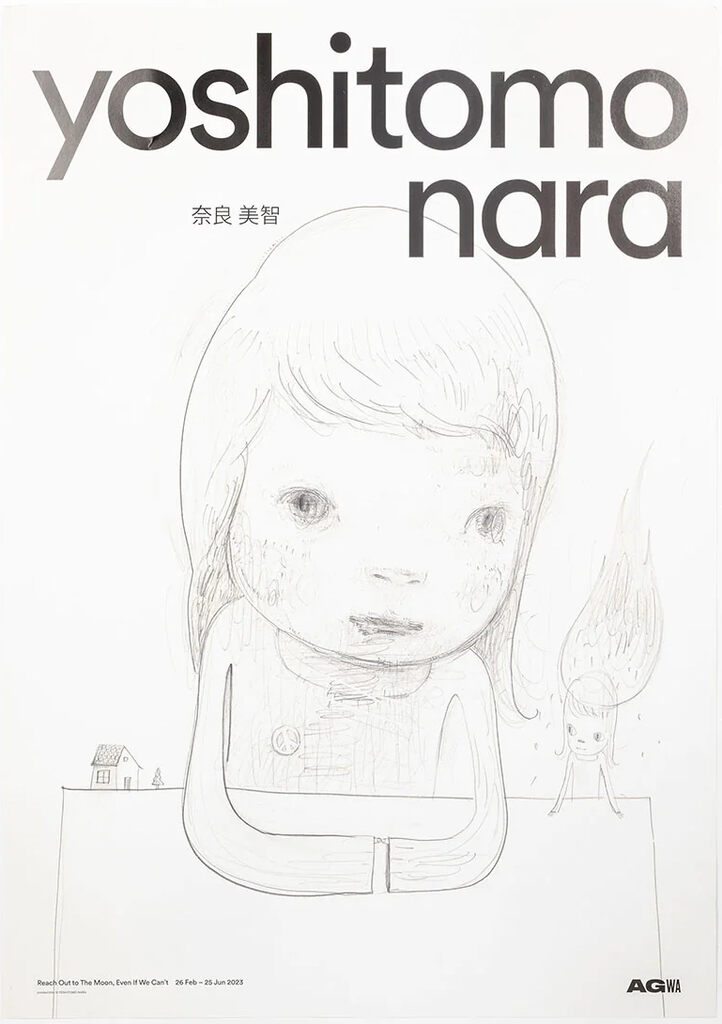




















Egon investment scores
Market position
Research updated
Auction record context
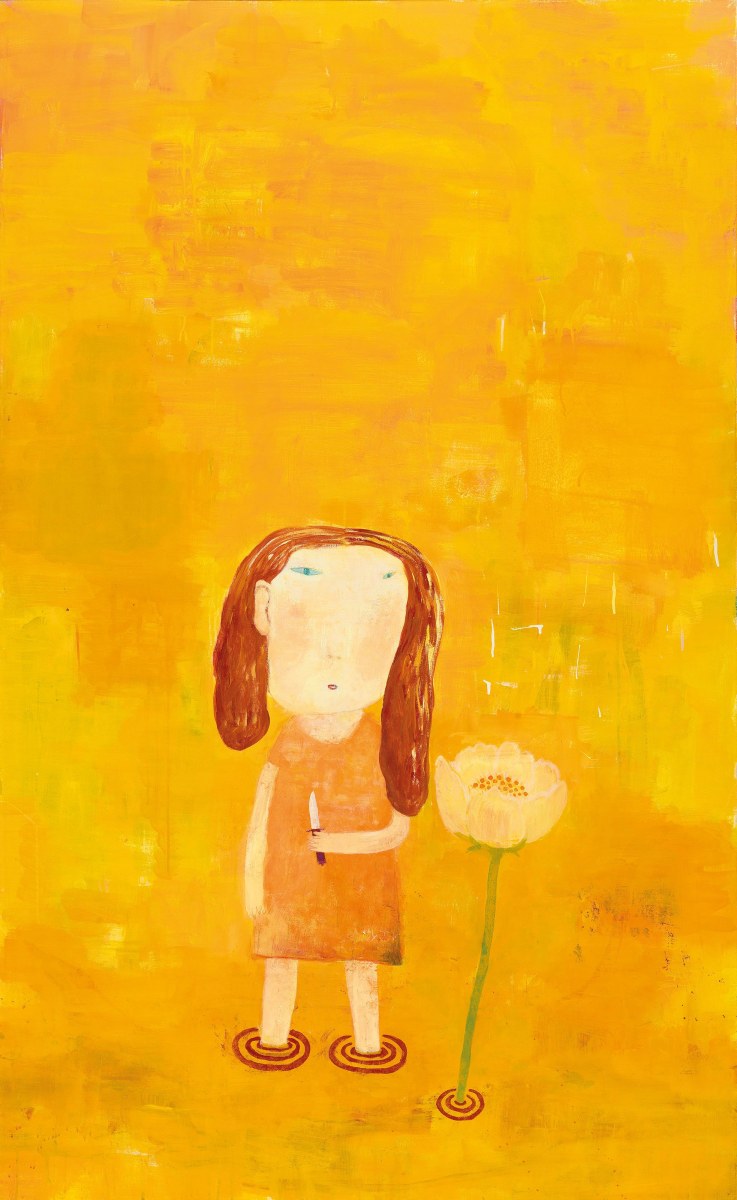
'Knife Behind Back' (2000), acrylic on canvas, 234 x 208 cm - HK$195,696,000 / US$24.94m, Sotheby's Hong Kong Contemporary Art Evening Sale, 6 October 2019. Six bidders competed over roughly ten minutes; the result made Nara the most expensive Japanese artist at auction. The work had previously sold at Phillips London in 2015 from the estate of Miami collector Frederic Brandt for $2.8m - then itself a record - an approximately 8.9x gain in four years.
Pricing
By work type
Prints and multiples
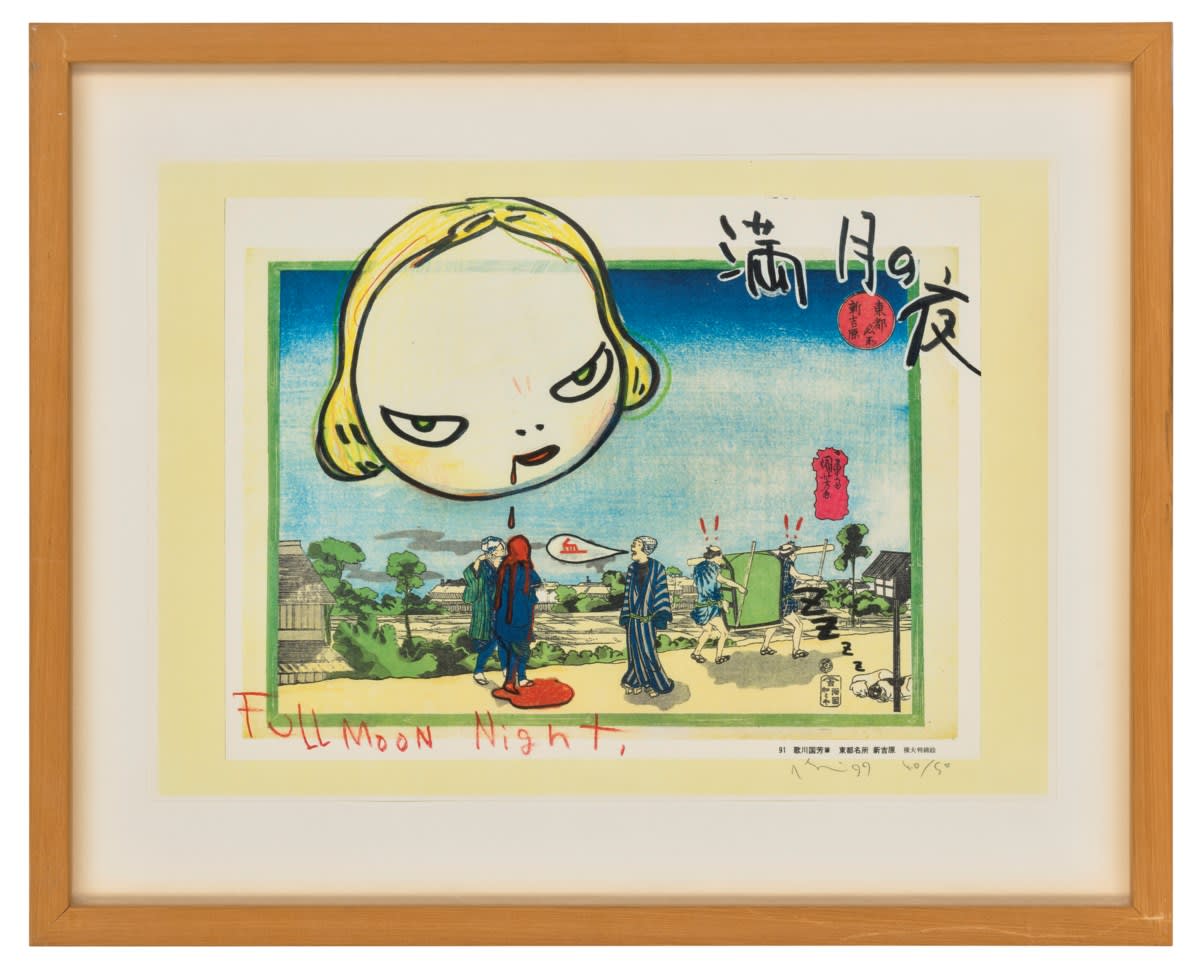
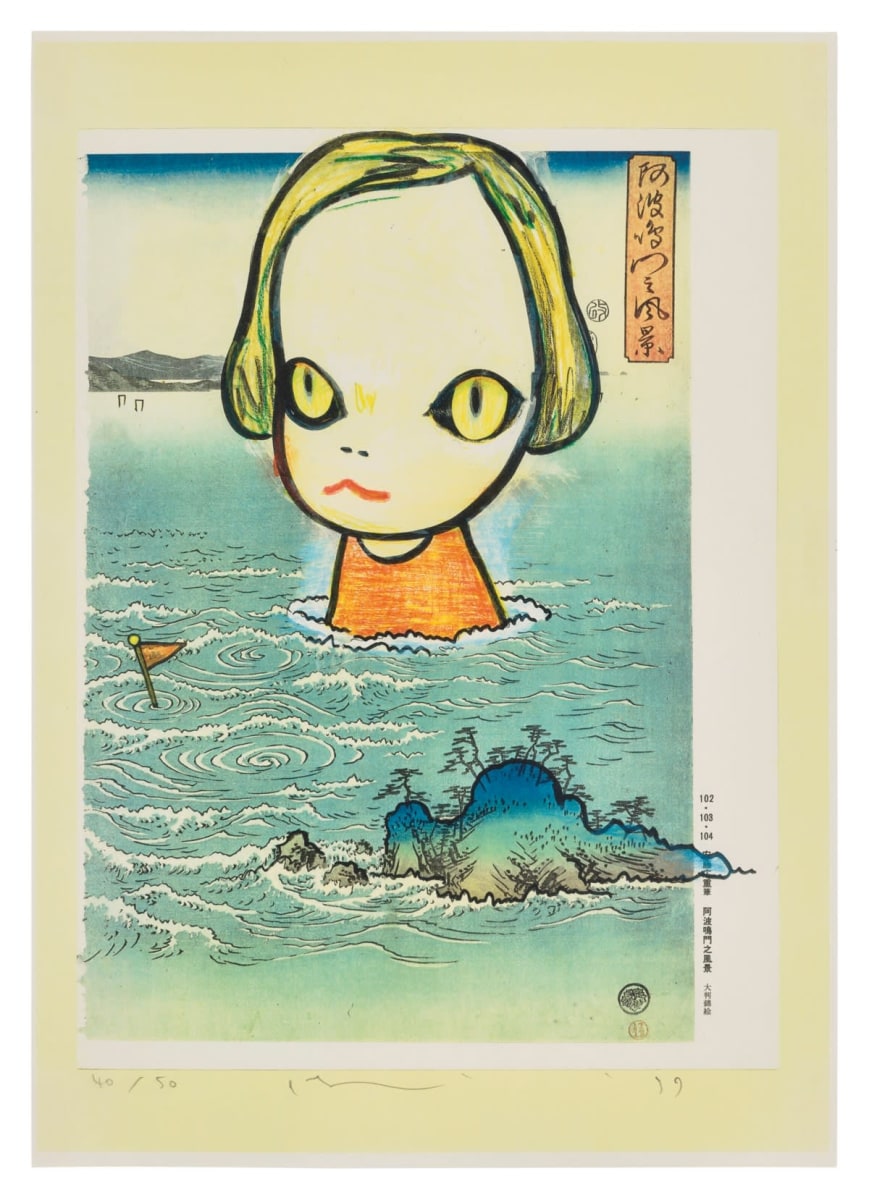
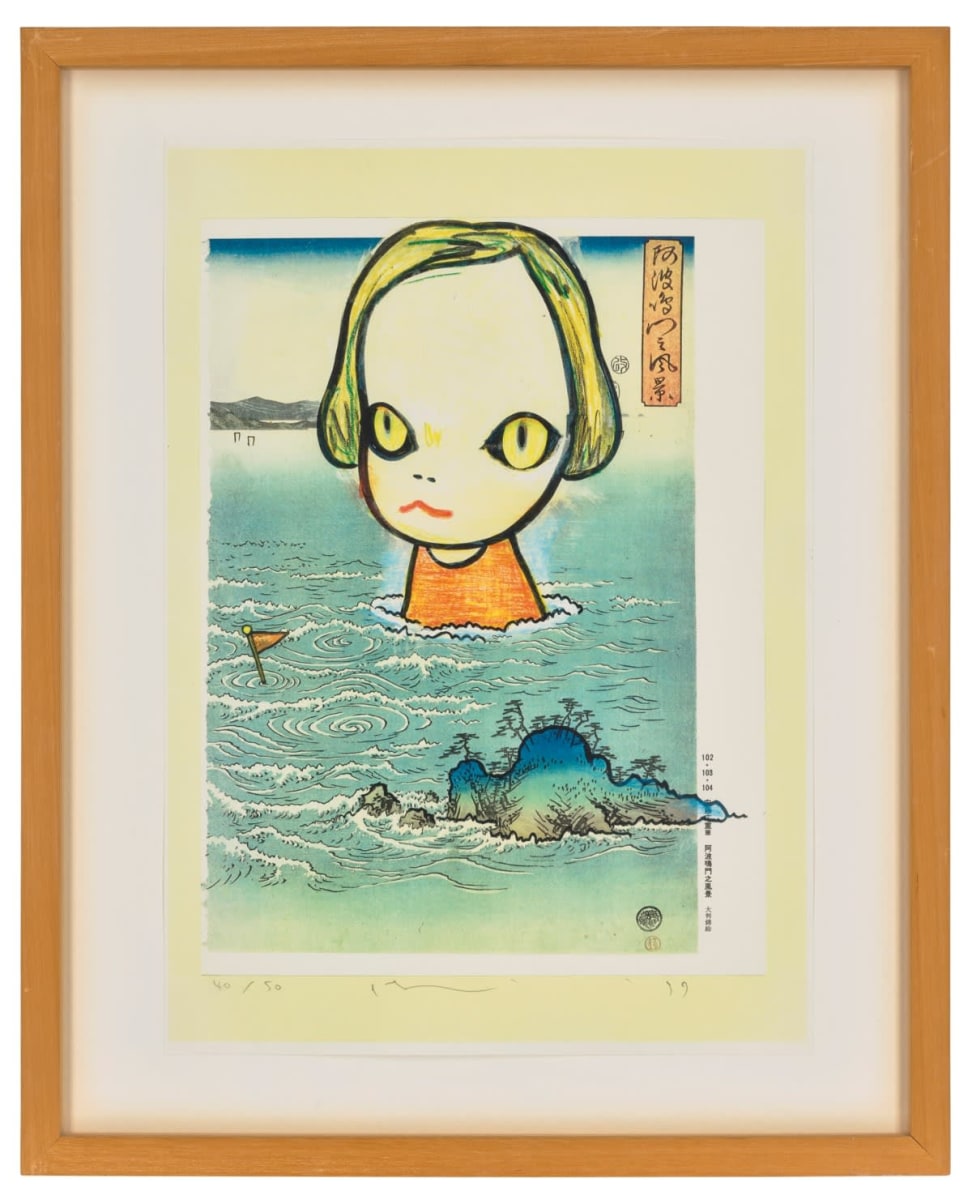
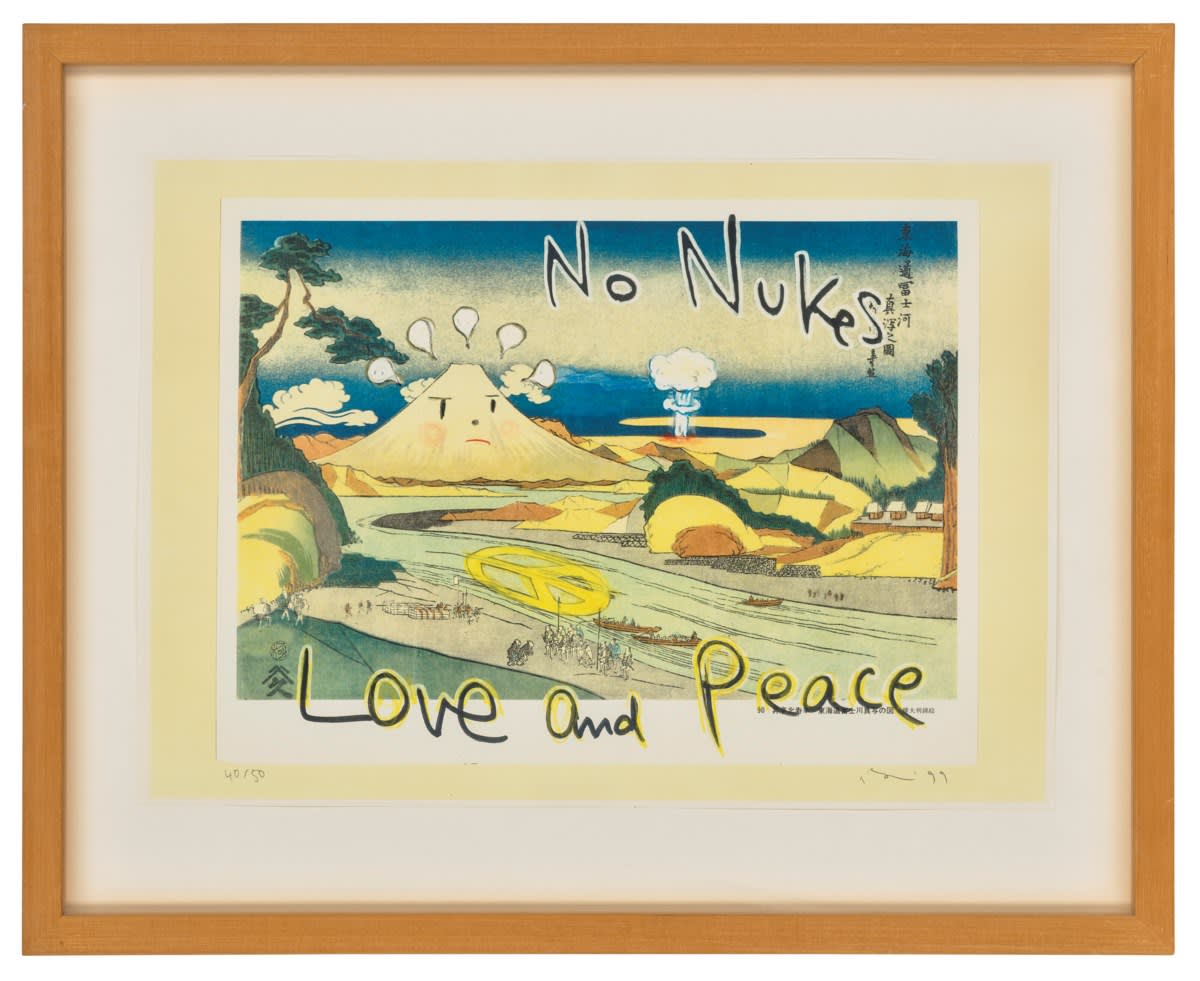
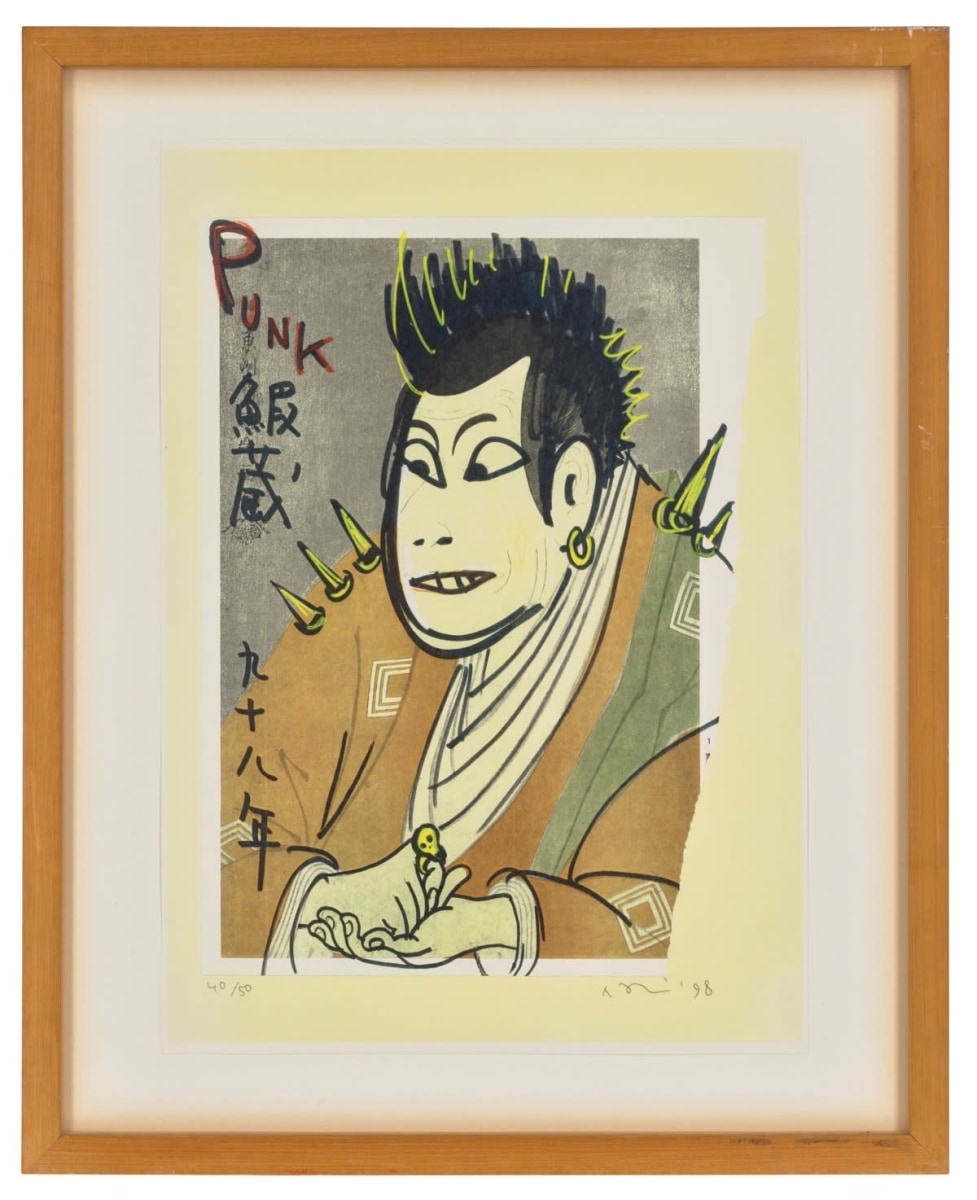
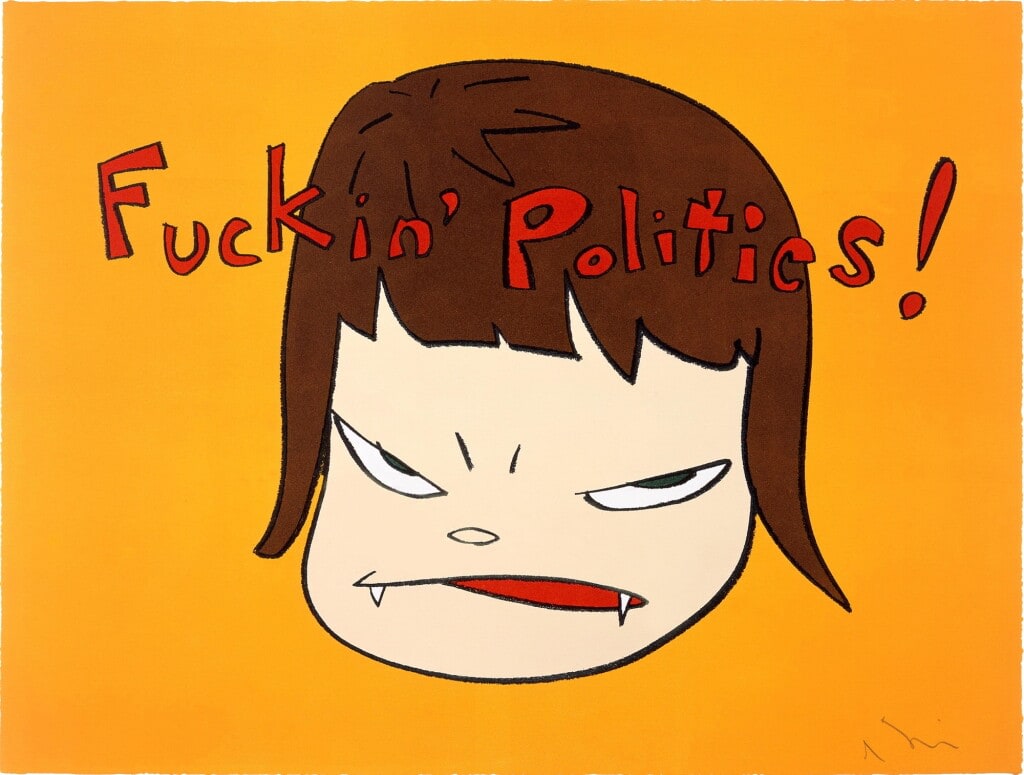
Under $1,000 for common posters and multiples, up to GBP 10,000-50,000 for individual sheets from the 2010 'Untitled' set of ten ukiyo-e woodcuts; complete sets several hundred thousand pounds (GBP 445,704, Christie's, July 2022). Prints and multiples are a structurally different market from unique works and must never be blended into unique-work averages.
- Drawings and works on paper
- $20k-$250k; large finished sheets higher
- Sculpture (fibreglass, ceramic, bronze)
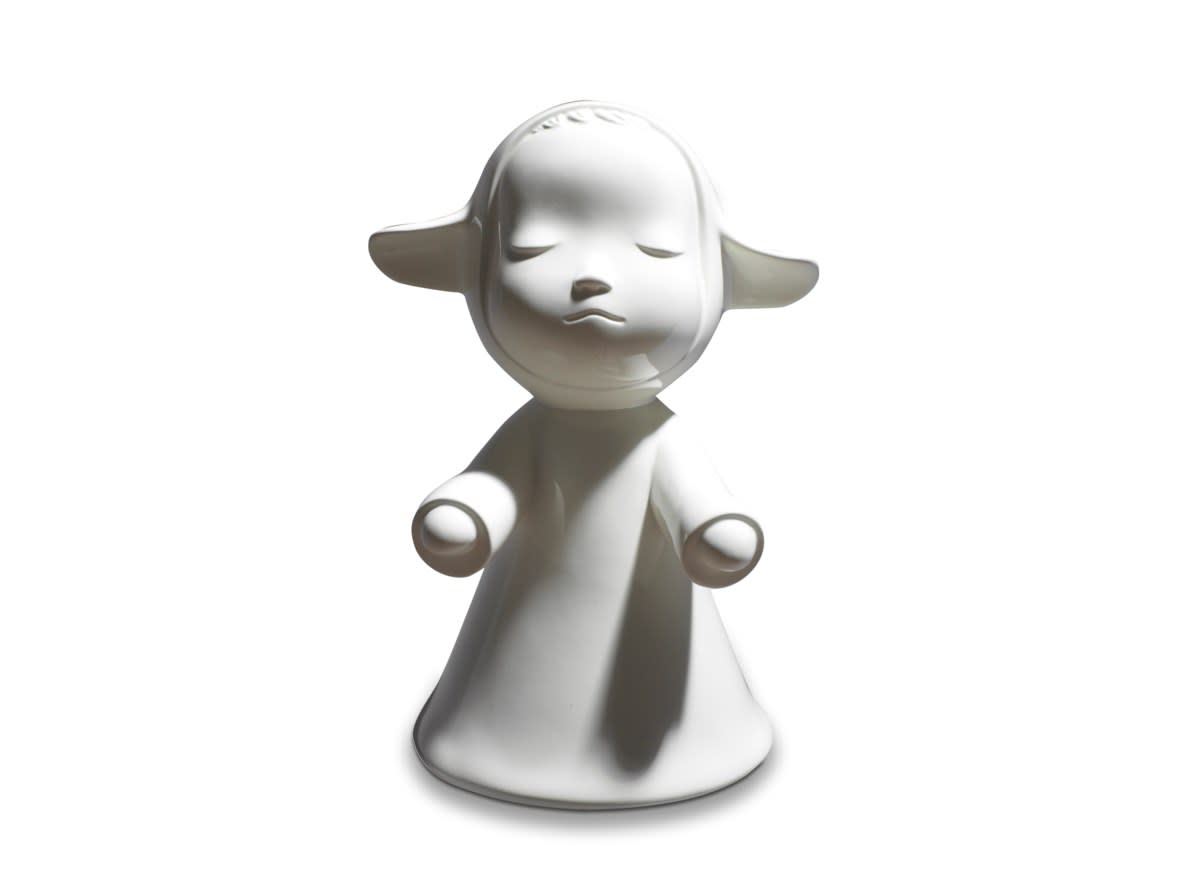
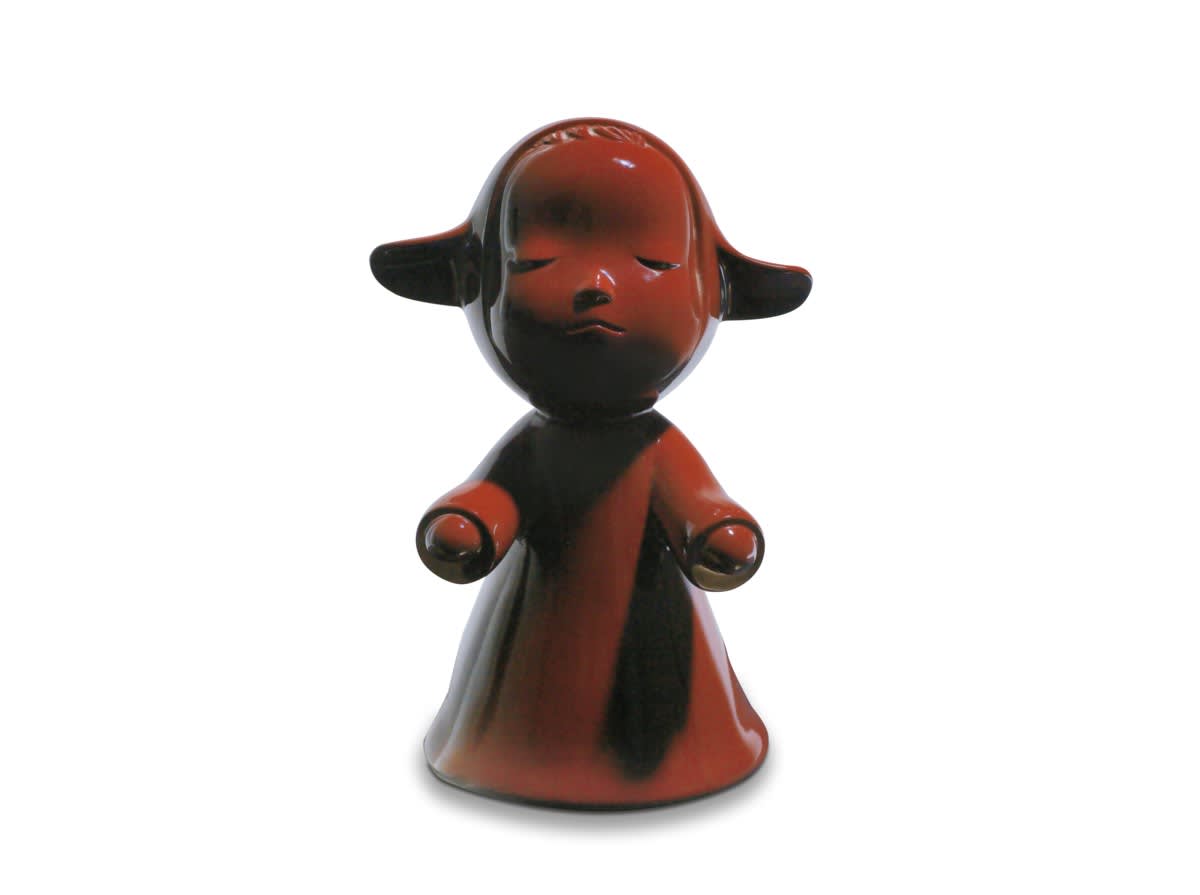
- small bronzes and ceramics mid-five to low-seven figures; major fibreglass groups have reached HK$10.95m
- Mid-scale unique paintings (2007-present)
- roughly $700k-$4m depending on date, scale and subject
- Trophy canvases (large, c.1995-2006, frontal girl, iconic eyes)
- $8m-$25m
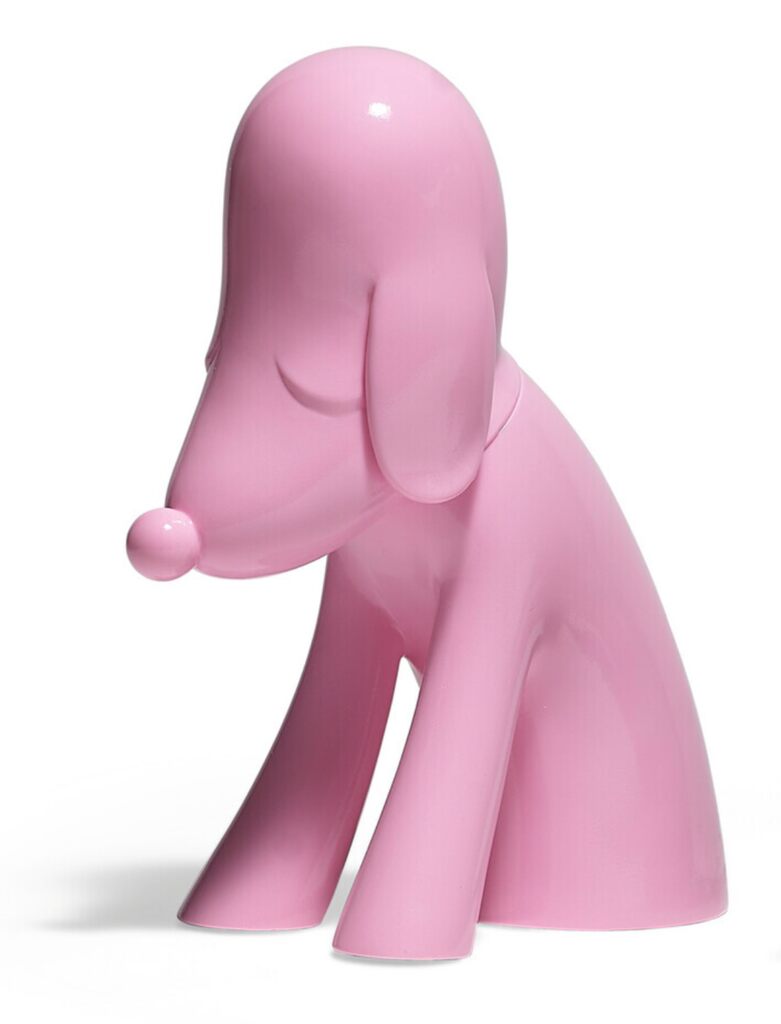
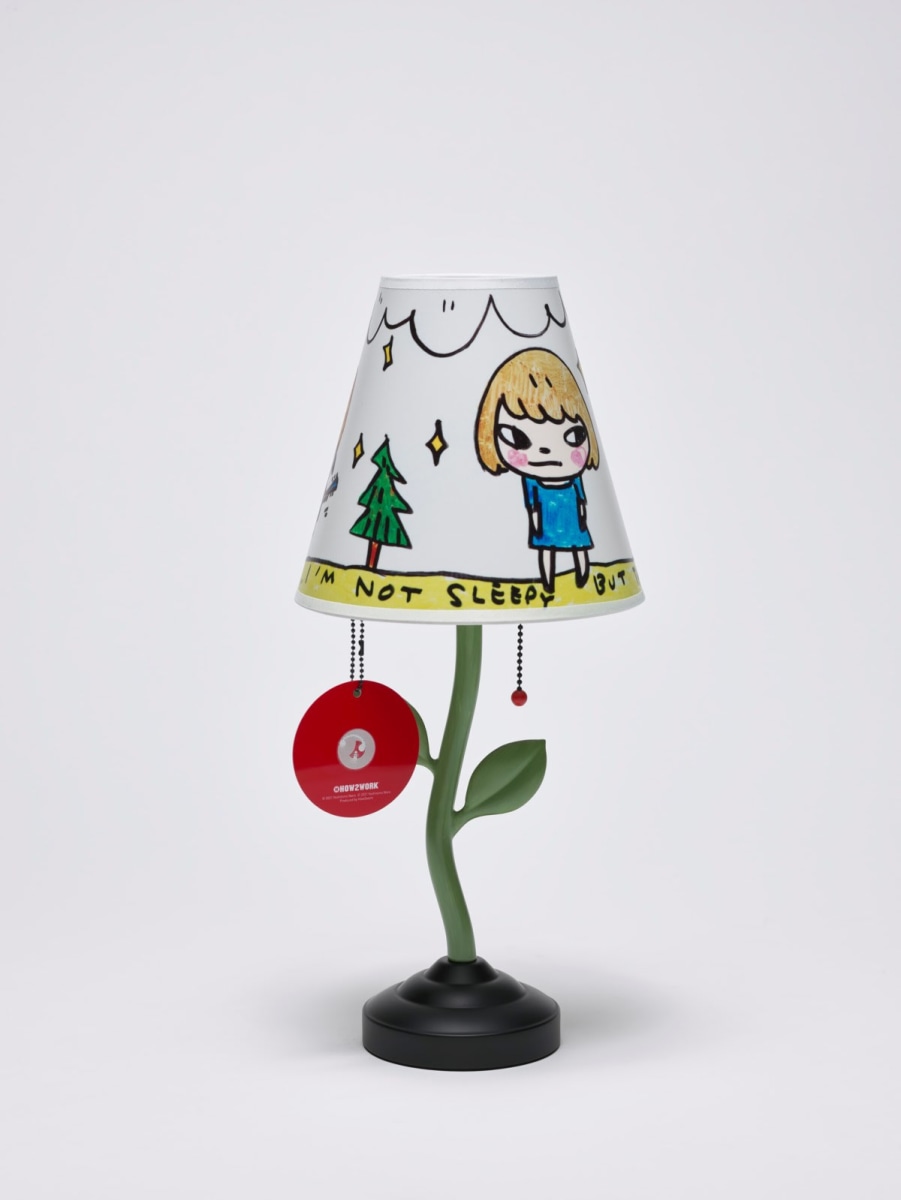
- Designer/functional objects (dog radio, 'Pup Cup' type multiples)
- hundreds to low tens of thousands
- Small paintings and painted objects (envelopes, cardboard, found supports)
- $100k-$600k
Primary market
Gallery pricing is not published - 'price not disclosed' is the norm, indicating a gallery-controlled primary market. Now controlled by David Zwirner, with Pace retaining a relationship. Contact David Zwirner for current primary pricing. Historic primary demand at BLUM and Pace ran to waiting lists at levels well below secondary comparables; the October 2026 Zwirner show is the most likely occasion for that structural discount to narrow.
Temporal context
- Pre 2015
- Auction record under $3m; major canvases typically low to mid six figures
- 2015-2018
- Record $2.8m (Phillips London, 2015); Asian bidding depth builds
2019-2021 (peak)
Record $24.94m (2019); multiple eight-figure results in 2021 ($15.4m New York; HK$68.7m Hong Kong). Print turnover peaked at GBP 4.08m across 262 lots in 2021 (Artprice data cited by Mark Littler)
2025-2026 (current)
Bifurcated. Best-in-class late-1990s to mid-2000s frontal girl portraits still clear eight figures (Cosmic Eyes, c.$11.4m, March 2025). Mid-market canvases, works on paper and sculpture transact largely in a $250k-$1.25m band; our 2025-26 sample runs $29.7k-$1.216m with an average of about $439k, and above-estimate results are roughly as frequent as below-estimate ones.
2022-2024 (correction)
Average prices -32% year-on-year and -56% from peak by late 2024 (Artnet). Print turnover halved to GBP 1.93m in 2023 and fell to GBP 1.02m in 2024 across 183 lots
Liquidity
Depth
Deep and genuinely global - New York, London, Hong Kong, Tokyo and Taipei, with Poly and other Asian houses alongside the Western majors. Multiple price tiers (prints, drawings, small paintings, trophy canvases) mean the market clears at almost any budget.
Assessment
Among the most liquid living-artist markets in Asia. Exit risk is low at the low and mid tiers and materially higher at the eight-figure tier, where the buyer pool is a handful of collectors.
Annual volume
Very high for a living artist. 183 print lots alone in 2024 (Artprice); LiveAuctioneers indexes 500+ lifetime results including third-tier houses; 45 lots at the top four houses in a partial 2025-onward sample. MyArtBroker records 79 works having sold above US$1m.
Comparables
- KAWS
- Overlapping crossover collector base and comparable editions ecosystem, with markedly lower institutional depth than Nara.
Positioning
Nara sits in the small cohort of living Asian artists combining a proven eight-figure market with a first-rank museum record - a narrower group than the 'neo-pop' framing implies.
Yayoi Kusama
The other Japanese blue-chip benchmark - broader museum penetration and higher aggregate turnover; Nara trades at a similar top-lot level on fewer eight-figure works.
- Takashi Murakami
- Closest art-historical peer. Nara's top end is materially higher (US$24.9m versus roughly $8m) while Murakami's editions volume is larger.
Collector base
International with an Asian centre of gravity - Japan, Greater China, South Korea, Southeast Asia, plus the US and Europe. The 2019 record sale drew buyers from nearly 40 countries and Sotheby's noted that a quarter of buyers across that series were 40 or under. Institutional and private-museum buyers include the Rubell Museum (Miami/Washington DC), Long Museum (Shanghai) and Leeum Museum of Art (Seoul); the Guggenheim Museum Bilbao holds 'Midnight Tears' (2023). Named private holdings surfacing in exhibition credits include Andrew Xue (lender of 'Peace of Mind', 2019, to LACMA) and the estate of Frederic Brandt, Miami, as an earlier source of trophy material. Persistent crossover demand from music, fashion and streetwear collectors overlaps the KAWS and Murakami buyer pools.
Auction history
Record
'Knife Behind Back' (2000), acrylic on canvas, 234 x 208 cm - HK$195,696,000 / US$24.94m, Sotheby's Hong Kong Contemporary Art Evening Sale, 6 October 2019. Six bidders competed over roughly ten minutes; the result made Nara the most expensive Japanese artist at auction. The work had previously sold at Phillips London in 2015 from the estate of Miami collector Frederic Brandt for $2.8m - then itself a record - an approximately 8.9x gain in four years.
Other top results
- 'Nice to See You Again' - US$15,430,800, Sotheby's New York, November 2021 (estimate US$8-12m)
- 'Under the Hazy Sky' (2012) - HK$68,708,000, Sotheby's Hong Kong, October 2021
- 'Not Everything but / Green House' (installation) - HK$40.12m / US$5.12m, Poly Auction Hong Kong, October 2019 - a record that stood only hours before Knife Behind Back
- 'The Little Pilgrims (Night Walking)', five fibreglass/cotton/acrylic figures - HK$10.95m, Hong Kong, May 2019
- 'Baby Blue' (1999) - HK$42m / US$5.8m, Phillips Hong Kong Modern & Contemporary evening sale, 25 November 2024, top lot of the sale
- 'Cosmic Eyes (in the Milky Lake)' (2005) - c. US$11.4m, Sotheby's London evening sale, 4 March 2025, sold above estimate after sustained bidding (reported by a dealer/secondary source; treat as indicative pending auction-house confirmation)
- Complete ten-sheet set of the 2010 'Untitled' ukiyo-e woodcuts - GBP 445,704, Christie's, July 2022
Bought in and softness
Buy-in and downside risk is documented rather than speculative. Artnet analytics reported in December 2024 that average prices were down 32% year-on-year and 56% from the 2021 peak, against a 29.5% contraction in global auction turnover in H1 2024. Individual 2026 lots in our sample sold below estimate ('Crated Room No. 4'). Complete lot-level buy-in data for pre-2025 sales was not retrievable within this research budget.
Egon database 2025 onward
- Sold
- 32
- Coverage
- Christie's, Sotheby's, Phillips, Bonhams; 2025 onward; partial
- Upcoming
- 1
- Total lots
- 45
Recent lots
- 'Your Dog' - $1,036,218, Christie's, June 2026
- 'Crated Room No. 4' - $350,977, Christie's, June 2026 (below estimate)
- 'Over the Topper' - $1,216,000, Sotheby's, May 2026 (above estimate)
- 'No. 2' - $281,600, Sotheby's, May 2026 (exceeded high estimate)
- 'No. 1' - $307,200, Sotheby's, May 2026 (exceeded high estimate)
- Recent range
- $29,722 - $1,216,000; recent average hammer approximately $438,685
Sell through note
Not stated by the database: about 90% of lots have settled and unsettled lots skew toward passes, so any computed rate would be inflated. Directionally the 32/45 sold-to-offered ratio is consistent with a market softened from the 2021 peak that still clears the majority of material.
Highest recorded flagged
$23,970,000 - NOT corroborated by any public report of a 2025-26 sale. The only comparable public figure is the October 2019 Knife Behind Back result of $24.94m. Flagged as a probable legacy record-field artefact rather than a transaction inside the database window.
Market position
A mature, internationally distributed blue-chip market that peaked in 2021, corrected sharply through 2024, and stabilised in 2025-26 with a clear bifurcation between museum-grade trophy canvases, which still set strong prices, and generic mid-market material, which is estimate-dependent.
Investment outlook
View
Structurally sound blue-chip with a documented cyclical drawdown. The Zwirner and Hirshhorn conjunction in Q4 2026 is the most concentrated set of positive catalysts since 2021. Quality and provenance discrimination - 1995-2006 canvases, exhibited and published works, catalogue raisonne references - matters far more here than category exposure.
Risks
- Prices remain well below the 2021 peak; the correction is documented, not sentiment
- Heavy dependence on Asian, particularly Greater China, liquidity
- Very large supply of prints, multiples and merchandise dilutes scarcity and creates a noisy low end; 'attributed to' Nara lots are common at third-tier houses, an authentication and reputational risk
- The eight-figure tier depends on a very small pool of buyers
Positive catalysts
- David Zwirner representation from 3 November 2025 - mega-gallery distribution, price discipline and US institutional placement capability
- First major New York solo in nearly a decade, 29 October-12 December 2026, across two Zwirner Chelsea buildings
- Hirshhorn Museum and Sculpture Garden commission 'Yoshitomo Nara: Sentinels of Stillness', inaugurating the Annual West Lawn Series, 31 October 2026-7 November 2027 - a year-long public platform in Washington DC running concurrently with the gallery show
- The 2024-25 European and US retrospective circuit (Guggenheim Bilbao, Frieder Burda, Hayward, OCMA) has refreshed the catalogue citations that support resale value
Institutional presence
Research updated
Exhibitions
Upcoming
- Yoshitomo Nara, David Zwirner, 533 West 19th Street and 537 West 20th Street, New York, 29 October-12 December 2026 - new paintings and drawings, recent sculptures and early works selected by the artist, tracing four decades. Thirteen bronze heads of 2024, enlarged ten times from palm-sized clay prototypes, at 19th Street; new paintings at 20th Street reported to show a significant development in the palette.
- 'Yoshitomo Nara: Sentinels of Stillness', Hirshhorn Museum and Sculpture Garden, Washington DC, 31 October 2026-7 November 2027 - three monumental sculptures, sixteen-times enlargements of the artist's small clay heads, inaugurating the Hirshhorn's Annual West Lawn Series.
Biennials
No significant recurring biennale/triennale record was verified in this pass; Nara's institutional profile has been built through monographic museum exhibitions rather than biennials.
Earlier landmarks
- 'Nobody's Fool', Asia Society Museum, New York, 2010
- 'Yoshitomo Nara + graf: A to Z', Yoshii Brick Brew House, Hirosaki, 2006
- Touring Japanese museum survey circuit, 2001-02
- 'Modern Landscape: For the Pleasure of People and Scenery. Nara Yoshitomo Curates the MOMAT Collection', The National Museum of Modern Art, Tokyo, 24 May-13 November 2016, with catalogue - a curatorial invitation and an unusual form of institutional endorsement
- 'The Little Art Club in The Blue Woods', Towada Art Center, Aomori, 2012-13
- 'Thank You Memory: From Cidre to Contemporary Art', Hirosaki Museum of Contemporary Art, 2020
- 'Nara Yoshitomo and Children in Prints', Machida City Museum of Graphic Arts, Tokyo, 2021-22
Significant group
- 'STARS: Six Contemporary Artists from Japan to the World', Mori Art Museum, Tokyo, 2020-21
- 'Connecting Currents: LOL!', Museum of Fine Arts, Houston, 2020
- 'Hey! Ho! Let's Go: Ramones and the Birth of Punk', Queens Museum, New York, 2016
- 'Cool Japan', Museum Volkenkunde, Leiden, 2017
- 'Turn the Page: The First Ten Years of Hi-Fructose', Virginia Museum of Contemporary Art, 2016
- 'Immortal Present: Art and East Asia', Berkshire Museum, 2015
Recent major solo museum
- Yoshitomo Nara, Hayward Gallery, London, 10 June-31 August 2025 - the largest European retrospective to date and his first UK solo at a public gallery. Curated by Yung Ma; an expanded version of the touring show with additional early sculptures and new paintings. Co-organised by the Guggenheim Museum Bilbao, the Museum Frieder Burda and the Hayward Gallery. Note: the Hayward is a non-collecting kunsthalle, so it counts as exhibition validation, not acquisition.
- Guggenheim Museum Bilbao (curated by Lucia Agirre) and Museum Frieder Burda, Baden-Baden - travelling retrospective, 2024-25
- Orange County Museum of Art, California, 2025
- Albertina Modern, Vienna, 2023
- Aomori Museum of Art, 2023
- Los Angeles County Museum of Art retrospective, 2021, curated by Mika Yoshitake, with the companion project 'Wall of Sound: Music from the Collection of Yoshitomo Nara and the Art of Inspiration'. Installation was interrupted by LACMA's March 2020 COVID closure.
Publications
- 'Yoshitomo Nara: The Complete Works' (Chronicle Books, 2011) - two-volume catalogue raisonne covering paintings/sculpture and works on paper; the principal scholarly apparatus underpinning the market
- Exhibition catalogues for the Guggenheim Bilbao / Museum Frieder Burda / Hayward Gallery retrospective, 2024-25, and for LACMA, 2021
- yoshitomonara.org - the artist-authorised works and exhibition archive
- Extensive Japanese-language monographic literature and the artist's own memoir-style publications
- Caveat on independence: BLUM and Pace are both acknowledged supporters of the Hayward exhibition, so a share of the recent catalogue literature carries commercial sponsorship.
Museum collections
Holdings
The Museum of Modern Art, New York
- Tier
- First-rank
- Scope
- 130 works listed online, dominated by the 'Time of My Life' drawings group, 1992-2000
Acquisition reading
DONOR GIFT - a named individual with no fund or acquisitions committee cited; offered and accepted rather than curatorially purchased. The size of the holding therefore reflects one collector's commitment as much as MoMA's own initiation.
- Credit line verbatim
- Gift of David Teiger in honor of Agnes Gund
Aomori Museum of Art, Japan
- Tier
- Major regional/prefectural (the artist's home prefecture)
- Scope
- Began collecting Nara in 1998 and now holds over 170 works, rotated through the permanent collection display
- Acquisition reading
- A sustained institutional collecting programme over 25+ years - the deepest public holding of Nara anywhere.
- Credit line verbatim
- credit line not published
Art Institute of Chicago
- Tier
- First-rank
- Scope
- Holdings confirmed via museum public API name-match and the gallery's published collection list
- Credit line verbatim
- credit line not retrieved
Smithsonian Institution, including the Hirshhorn Museum and Sculpture Garden
- Tier
- First-rank
- Scope
- Holdings confirmed via public API name-match; the Hirshhorn is additionally presenting a commissioned monumental outdoor project in 2026-27
- Credit line verbatim
- credit line not retrieved
Museum of Fine Arts, Boston
- Tier
- First-rank
- Credit line verbatim
- credit line not retrieved
View 18 more records
The British Museum, London
- Tier
- First-rank
- Scope
- Prints and works on paper
- Credit line verbatim
- credit line not retrieved
Los Angeles County Museum of Art (LACMA)
- Tier
- First-rank
- Credit line verbatim
- credit line not retrieved
Museum of Contemporary Art, Los Angeles (MOCA)
- Tier
- First-rank modern/contemporary
- Credit line verbatim
- credit line not retrieved
San Francisco Museum of Modern Art
- Tier
- First-rank
- Scope
- 1 work recorded in Wikidata (community aggregate - a floor, not a holdings count); also listed by the gallery
- Credit line verbatim
- credit line not retrieved
Museum of Contemporary Art Tokyo (MOT)
- Tier
- First-rank contemporary
- Credit line verbatim
- credit line not retrieved
The National Museum of Art, Osaka
- Tier
- First-rank national
- Credit line verbatim
- credit line not retrieved
Guggenheim Museum Bilbao, Spain
- Tier
- First-rank
- Scope
- Includes 'Midnight Tears', 2023 - a recent acquisition of a current work made around the retrospective
- Credit line verbatim
- credit line not published; recorded by the gallery as 'Collection of the Guggenheim Museum Bilbao'
National Gallery of Australia, Canberra
- Tier
- First-rank national
- Credit line verbatim
- credit line not retrieved
Centre national des arts plastiques (CNAP), Paris
- Tier
- National state collection
- Credit line verbatim
- credit line not retrieved
Leeum Museum of Art, Seoul
- Tier
- Major private museum (Samsung Foundation)
- Credit line verbatim
- credit line not retrieved
Long Museum, Shanghai
- Tier
- Major private museum
- Credit line verbatim
- credit line not retrieved
Rockbund Art Museum, Shanghai
- Tier
- Kunsthalle-type, non-accessioning
- Credit line verbatim
- credit line not retrieved
Rubell Museum, Miami and Washington DC
- Tier
- Major private collection museum - not a public accessioning institution for scoring purposes
- Credit line verbatim
- credit line not published
Hiroshima City Museum of Contemporary Art
- Tier
- Municipal contemporary
- Credit line verbatim
- credit line not retrieved
Toyota Municipal Museum of Art, Aichi
- Tier
- Strong regional Japanese
- Credit line verbatim
- credit line not retrieved
Neues Museum, Nuremberg
- Tier
- Regional German state museum
- Credit line verbatim
- credit line not retrieved
Middelheim Museum, Antwerp
- Tier
- Municipal sculpture museum
- Scope
- 1 work recorded in Wikidata (floor, not a count)
- Credit line verbatim
- credit line not retrieved
Mori Art Museum, Tokyo
- Tier
- Major private contemporary museum
- Credit line verbatim
- credit line not retrieved
Note on credit lines
Credit lines are reproduced verbatim only where the museum publishes one and it was retrieved during this research. Where not retrieved, the entry says so explicitly. No credit line has been inferred, paraphrased or normalised.
Artist founded institution
N's Yard, Nasushiobara, Tochigi, opened 2018 - the artist's own museum and studio complex. Not an independent public accessioning institution and not counted as museum validation.
Awards and recognition
Verified
- Meisterschueler, Kunstakademie Dusseldorf, under A.R. Penck (completed 1993)
- Invited to curate the collection of The National Museum of Modern Art, Tokyo, 2016
- Selected for 'STARS', the Mori Art Museum's canon-setting survey of six Japanese artists of global significance, 2020-21
- Inaugural artist of the Hirshhorn's Annual West Lawn Series, 2026-27
- Not verified
- Japanese state honours, national prizes and honorary doctorates could not be confirmed within the search budget and are therefore not asserted.
Career & Biography
Research updated
Identity
- Birth
- 1959, Hirosaki, Aomori Prefecture, Japan (Getty ULAN: born 1959; ULAN ID 500033169)
- Gender
- male
- Living
- Yes
- Full name
- Yoshitomo Nara (奈良美智; Nara Yoshitomo)
Getty roles
- painter
- draftsman
- sculptor
- installation artist
- Nationality
- Japanese
Current base
Nasushiobara, Tochigi Prefecture, Japan (studio); deep continuing ties to Aomori/Tohoku. Lived in Germany 1988-2000 (Dusseldorf, then Cologne 1994-2000)
Education
- Musashino Art University, Tokyo - art classes 1979-81 (left before completing)
- Aichi Prefectural University of Fine Arts and Music, Nagoya - B.F.A. 1985 (oil painting), M.F.A. 1987
- Kunstakademie Dusseldorf, Germany - enrolled 1988, graduated 1993; taught by A.R. Penck and Michael Buthe; Meisterschueler status
- Note: sources differ slightly on the Aichi enrolment year (1981 per Aomori Museum of Art; 1979-81 at Musashino per Encyclopedia.com). Degree years are consistent across sources.
Career timeline
- 1978
- Graduates Aomori Prefectural Hirosaki High School; moves to Tokyo
- 1999
- 'Baby Blue' shown at Marianne Boesky, New York; early New York critical notice from Roberta Smith in the New York Times
- 2000
- Returns to Japan permanently after 12 years abroad; paints 'Knife Behind Back', later his auction record work
2011
Tohoku earthquake/tsunami and Fukushima - widely cited turning point toward ceramic and bronze sculpture, more meditative figures, and explicit anti-nuclear/pacifist content
- 2013
- Pace Gallery mounts its first Nara solo; a roughly 14-year relationship follows
- 2016
- Invited to curate the collection of The National Museum of Modern Art, Tokyo (MOMAT)
- 2018
- Opens N's Yard, his own museum/studio complex in Nasushiobara, Tochigi
- 2019
- 'Knife Behind Back' sells for US$24.94m at Sotheby's Hong Kong; becomes the most expensive Japanese artist at auction
- 2021
- LACMA retrospective (delayed from 2020 by the COVID closure), curated by Mika Yoshitake
- 2023
- Solo exhibitions at Albertina Modern, Vienna, and Aomori Museum of Art
Nov 2025
David Zwirner announces representation (3 Nov 2025), working with the artist's international agent Joe Baptista of Equivalence Art Agency, formerly a Pace partner. Pace retains a relationship; BLUM closed in 2025
- 1985-1987
- BFA then MFA, Aichi Prefectural University of Fine Arts and Music
- 1988-1993
- Kunstakademie Dusseldorf under A.R. Penck; formative European period
- 1994-2000
- Based in Cologne - described by the Aomori Museum of Art as a prolific period; the signature wide-eyed girl/dog imagery consolidates
- 2001-2002
- Major touring Japanese museum survey builds the domestic institutional base
- 2003-2010
- Collaborations with design collective graf ('A to Z', Hirosaki, 2006); 'Nobody's Fool', Asia Society Museum, New York, 2010
2024-2025
Touring European retrospective: Guggenheim Museum Bilbao, then Museum Frieder Burda, Baden-Baden, then Hayward Gallery, London (10 June-31 Aug 2025, expanded, curated by Yung Ma); Orange County Museum of Art (2025)
Mid-1990s
Begins exhibiting internationally; BLUM (then Blum & Poe, Los Angeles) works with him from the mid-1990s and introduces the work to the US - a roughly 30-year relationship
- Oct 2026 (forthcoming)
- First Zwirner solo across two Chelsea buildings, 29 Oct-12 Dec 2026, concurrent with a Hirshhorn Sculpture Garden commission
Studio practice
Solitary, hand-drawn practice. Works on paper made continuously on found supports (envelopes, graph paper, packaging). Paintings built from many thin translucent layers producing the luminous 'cosmic' eyes of the mid-2000s onward. Since 2011 substantial work in ceramic and bronze, including palm-sized clay heads later enlarged 10x-16x for casting. Music plays constantly in the studio and is treated as source material - LACMA's companion project drew directly on his record collection.
Personal life events
Solitary rural childhood with working parents; the 2000 return to Japan after 12 years in Germany; the 2011 disaster. Each is treated in the literature as a rupture visible in the work.
Influences and context
- Teachers
- A.R. Penck and Michael Buthe at Kunstakademie Dusseldorf - the German Neo-Expressionist drawing culture is a key and often under-read influence
Contemporaries
Takashi Murakami (Superflat), Aya Takano, Chiho Aoshima, Mr., Yayoi Kusama and KAWS as market peers. Nara is read alongside but distinct from Murakami's Superflat programme - hand-drawn, solitary and anti-corporate rather than factory-produced
Cultural sources
Punk and folk-protest record culture (the Ramones and 1970s-80s sleeve art), manga/anime and Japanese subculture (per Getty ULAN), children's fables and folklore, the rural solitude and postwar hardship of northern Japan, US Misawa Air Base radio broadcasts
- Art historical framing
- Consistently positioned as one of the two artists, with Murakami, who carried Japanese contemporary art into the global market in the 1990s-2000s
Political social engagement
Explicit anti-nuclear and pacifist content after 2011 Fukushima; protest-placard motifs; Zwirner's own statement frames the work around the right to resist. Sustained cultural engagement with Aomori and Tohoku reconstruction.
Artistic Profile
Research updated
Style
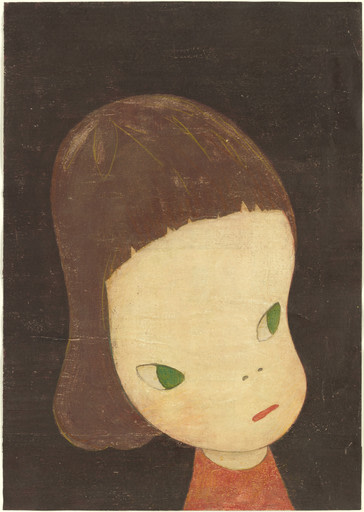
A solitary figure - a child, usually a girl, sometimes a dog or a sheep - placed frontally and centrally against a flat, atmospheric ground, with an oversized head, saucer eyes and a mouth set between pout and scowl. Scale is deliberately confrontational: the viewer is looked at rather than looking. The hand-drawn line is preserved even at monumental scale; there is no factory finish and no assistant-smoothed surface in the paintings.
Evolution
2021-2026 (late)
Monumental bronze heads; per reporting on the 2026 Zwirner show, a significant development in the palette of the new paintings; continued autobiographical framing.
- 1984-1988 (early)
- Student work in Aichi; loose expressive figuration. Examples are included in the October 2026 Zwirner show as a historical counterpoint.
1994-2000 (Cologne)
The most prolific consolidation of the icon - flat pale grounds, hard contour, sullen or aggressive affect. This is the market's highest-valued period ('Knife Behind Back', 'Baby Blue').
- 1988-1994 (Dusseldorf)
- Neo-Expressionist ground; the figure isolates against monochrome fields; the signature child emerges.
- 2011-2020 (post-Fukushima)
- Softer, more meditative faces; earthy iridescent chromatically layered surfaces; sustained turn to ceramic and bronze; explicit political text.
- 2000-2010 (return to Japan)
- Larger scale; introduction of the layered luminous eye; graf collaborations; installation and architecture.
Influences
- A.R. Penck and Michael Buthe, his Dusseldorf teachers
- Punk and 1960s-70s folk-protest record culture; the Ramones
- Manga, anime and Japanese subculture (per Getty ULAN)
- Northern European children's book illustration
- Japanese folk tale and Tohoku folklore
- Renaissance and medieval devotional portraiture - a recurring reference in recent curatorial literature for the frontal, iconic pose
Visual language
- Centralised single-figure composition, near-heraldic frontality
- Heavy enclosing contour over flat or layered fields
- Oversized eyes as the expressive fulcrum - the single most price-relevant formal element
- Flattened, shallow pictorial space with no perspective armature
- Small disruptive props: knives, bandages, flames, cigarettes, flowers, mugs
- Hand-lettered text and protest placards in the later work
Signature series
- 'Time of My Life' drawings, 1992-2000 (the core of MoMA's holding)
- 'Knife Behind Back' and the knife-bearing girls
- 'Cosmic Eyes' and the milky/iridescent-eye paintings from 2005 onward
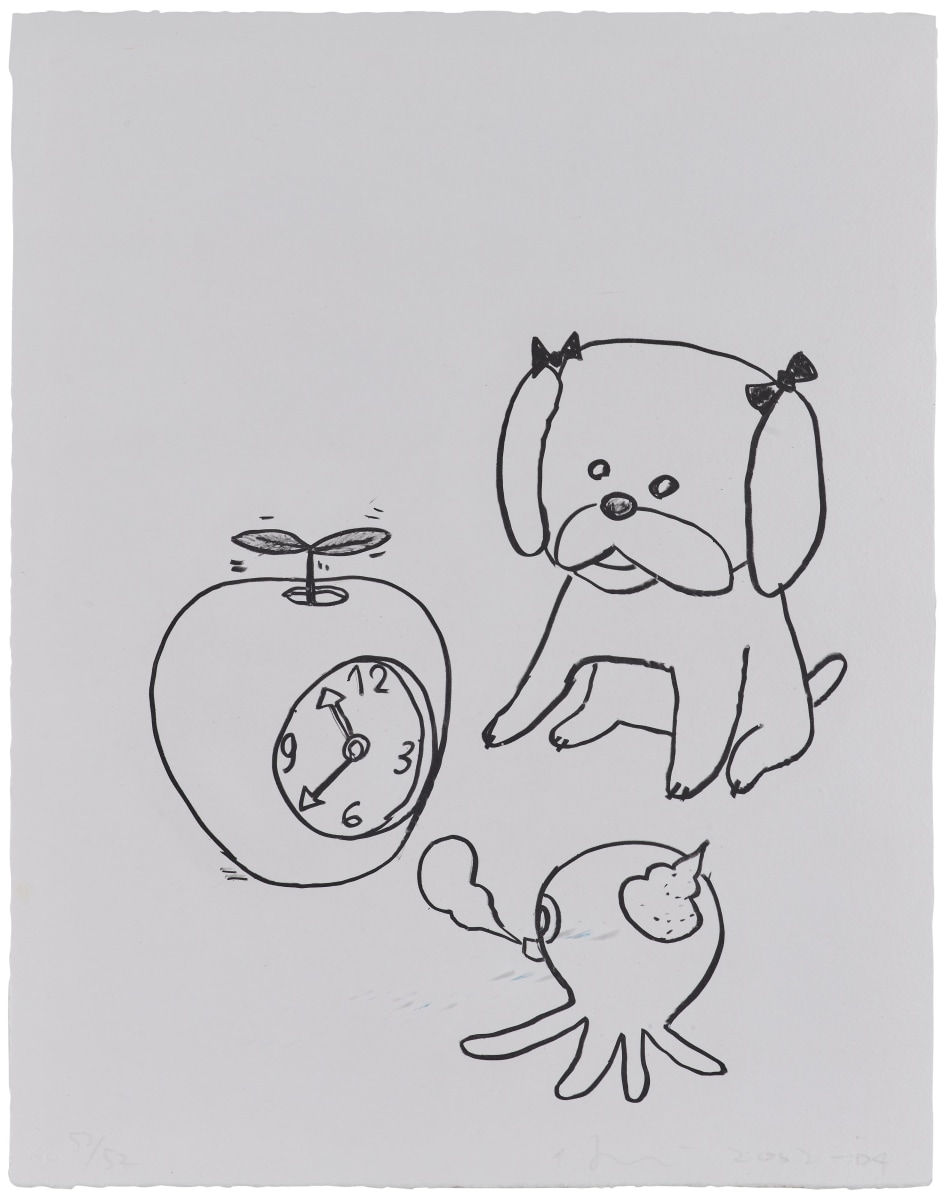
- The dog works, including 'Your Dog' and the Pup/dog multiples
- The 2010 set of ten 'Untitled' ukiyo-e woodcuts
- The clay-head bronzes of 2024 and 'Sentinels of Stillness', 2026
- 'Broken Treasures' and the numbered 'No. 1 / No. 2 / No. 3' works identified at Egon's visual centroid
Themes and subjects
- Solitude and childhood interiority
- The innocence/violence dialectic - knives and flames set beside flowers and toys
- Resistance and defiance; the right to refuse
- Music as emotional grammar - punk, folk and protest song
- Memory of rural northern Japan; folklore and fable
- Post-Fukushima anti-nuclear pacifism
- The gaze and the returned gaze
Movements and periods
- Japanese Neo-Pop
- Superflat orbit - adjacent, and frequently disputed by both artist and curators
- Contemporary, c.1984-present
- German Neo-Expressionist drawing lineage via A.R. Penck
- Kawaii-critical / post-subcultural figuration
Techniques and mediums
- Acrylic on canvas built in many thin translucent glazes
- Coloured pencil, felt-tip, ballpoint and ink on found paper - envelopes, graph paper, cardboard, packaging
- Colour woodcut and ukiyo-e technique printmaking, notably the 2010 set of ten
- Silkscreen and lithography
- Fibreglass and painted resin sculpture
- Ceramic, hand-built and kiln-fired, from around 2007 and intensively after 2011
- Bronze cast from small clay prototypes, enlarged 10x-16x
- Architectural installation and hut structures, historically with graf
Fingerprint verification
Extended
- 'Limited palette' and 'flat colour fills' describe the woodcut and object exemplars well but UNDER-DESCRIBE the mature paintings from about 2005 onward, which are built from many thin translucent layers producing iridescent, chromatically complex surfaces - the 'cosmic eyes'. This is precisely the material characteristic separating eight-figure canvases from mid-market ones, so the gap is commercially consequential, not merely descriptive.
- Missing sub-body: the ceramic and bronze heads of the post-2011 period, culminating in the 2024 bronzes for Zwirner (10x enlargements) and the Hirshhorn's 16x monumental heads. These have matte, tactile, hand-modelled surfaces that directly contradict the 'high-gloss, seamless, commodity-finish' character of the resin dog exemplar.
- Missing sub-body: works on paper made on found supports - envelopes, graph paper, cardboard, record sleeves - which constitute the bulk of MoMA's 130-work holding and are loose, diaristic and text-bearing rather than centralised and iconic.
- Missing sub-body: architectural and installation work, notably the hut and cabin structures made with the design collective graf ('A to Z', 2006), where the drawings become inhabitable environments.
- Missing theme: explicit political content after 2011 - protest placards, anti-nuclear and pacifist text - which the mood tags 'playful' and 'confrontational' do not capture.
Confirmed
Egon's existing read holds on the core signature: centralised oversized child figure, heavy black contour, flat colour fills, limited palette, figure-ground flatness, soft edges, the confrontational/playful mood pairing, the gaze as an explicit subject, the Pop/Superflat/Naive registers, and the Contemporary / 2010-present bracket for the sampled lots. The dog-radio exemplar correctly isolates the design-art crossover as a real and distinct sub-market with its own buyer pool.
Disagreement
The fingerprint's 'mixed media' medium tag and Superflat-dominant framing over-weight the print and object lots that dominate auction imagery. The artist's own institutional presentation, and the Hayward/Bilbao curatorial framing, foreground painting, drawing and sculpture as an introspective, music-driven, autobiographical practice and explicitly resist the Superflat/commercial-pop reading. The low coherence score (0.47) here genuinely reflects breadth across media rather than attribution noise, consistent with Egon's own usage guidance.
Critical Reception
Research updated
Critical reception
Summary
Nara enjoys unusually broad critical acceptance for an artist with a merchandising footprint. The recurring critical argument, sustained since Roberta Smith's 1999 New York Times notice, is that the cuteness is a delivery mechanism for menace, solitude and resistance rather than a decorative end in itself. The 2024-25 European retrospective tour converted a market reputation into a curatorial one for European critics who had previously treated him as a Superflat footnote.
Key notices
- Roberta Smith, The New York Times, 1999, on the Marianne Boesky show, describing a cast of cute but demonic cartoon toddlers that in her phrase "pack a potent visual punch"
- Artlyst, 'Yoshitomo Nara: A Wide-Eyed Rebellion', review of the Hayward retrospective, 2025 - reads the figures as occupying a disquieting space between childhood sweetness and something darker and more knowing
- Eileen Kinsella, Artnet News, 3 December 2024, 'Is Demand for Market Darling Yoshitomo Nara's Work Cooling?' - the most substantive sceptical market analysis on the artist
- David Zwirner publicly described the Hayward retrospective as "a true revelation" - a dealer statement rather than criticism, but a documented marker of how the show reset elite perception
- Extensive record-sale coverage across ARTnews, Artnet News, The Value and the auction trade press, 2019-2021
- ARTnews and Artsy coverage of the Zwirner representation (November 2025) and of the October 2026 exhibition (July-August 2026)
Scholarly attention
A two-volume catalogue raisonne (2011), museum monographs from LACMA, the Guggenheim Bilbao and the Hayward, and a substantial Japanese-language literature. Curatorial engagement runs to Mika Yoshitake (LACMA), Yung Ma (Hayward) and Lucia Agirre (Guggenheim Bilbao). Scholarship continues independently of the galleries, though it should be noted that BLUM and Pace were acknowledged supporters of the Hayward exhibition - a meaningful qualification when weighing how much of the recent literature is commercially independent.
Critiques and reservations
- The persistent critical reservation is repetition - essentially one motif produced over thirty years - and the blurred boundary between artwork and merchandise, the KAWS/Murakami 'designer toy' framing that some critics treat as a limit on art-historical seriousness.
- Market commentary increasingly separates 'museum-grade' Nara from generic Nara, an implicit acknowledgement that the volume of output is a critical as well as a commercial problem.
- Third-tier auction catalogues carry numerous 'attributed to' Nara lots, a reputational and authentication issue at the bottom of the market.
Publications and media
Popular culture
Album artwork, fashion and streetwear collaborations sustain a large non-art audience that materially widens the collector funnel - a genuine demand driver and simultaneously the source of the critical reservation above.
Tier1 art press
- ARTnews
- Artnet News
- Artsy
- The Art Newspaper
- The New York Times
- UK broadsheet coverage of the Hayward show, summer 2025
- Artlyst
Editorial signals
Nara is well past the 'artists to watch' or 'new talent' stage; no such list inclusions apply. The current editorial signals are retrospective reviews, market-cooling analyses and representation news, all in tier-1 outlets. The August 2026 Artsy and ARTnews pieces confirm continuing tier-1 editorial attention at the top of the news cycle.
Art historical positioning
Positioned with Takashi Murakami as one of the artists who globalised Japanese contemporary art in the 1990s-2000s; associated with, but not reducible to, Superflat and Japanese Neo-Pop. His German Neo-Expressionist training under A.R. Penck and his punk/folk music lineage are the two elements that separate him from the Superflat programme in serious accounts, and both are foregrounded in the 2024-25 retrospective literature.
Gallery & Representation
Research updated
Fair presence
Historically shown at Art Basel (Basel, Miami Beach, Hong Kong), Frieze and Art Basel Paris via Pace and BLUM; Zwirner can be expected to carry the work at the same fairs from 2026. Secondary-market Nara, particularly prints and drawings, is ubiquitous across Asian and Western fair booths.
Representation
Former
- BLUM (formerly Blum & Poe), Los Angeles / Tokyo / New York - worked with Nara for roughly 30 years and introduced the work to the US. Its final Nara show closed in March 2025 and Tim Blum closed the gallery entirely in 2025 - the proximate cause of the representation reshuffle.
- Stephen Friedman Gallery, London - long-standing European representation; included in the gallery's 20th anniversary exhibition, 2015
- Tomio Koyama Gallery, Tokyo - early Japanese representation from the 1990s
- Marianne Boesky Gallery, New York - early US shows, 1999
- Cologne-period German dealers during 1994-2000
Primary
- Tier
- Tier 1 mega-gallery
- Since
- Announced 3 November 2025
- Gallery
- David Zwirner
- Locations
- New York, London, Paris, Hong Kong, Los Angeles
Structure
Zwirner works in collaboration with the artist's international agent Joe Baptista, founder of Equivalence Art Agency, who was until 2025 a partner at Pace. This agent-led structure is unusual and means representation is artist-controlled rather than exclusively gallery-held.
- First show
- 29 October-12 December 2026, across two Chelsea buildings
- Verification
- Confirmed on davidzwirner.com (representation announcement and the 2026 exhibition page), and independently by ARTnews and The Art Newspaper.
Continuing
Note
Represented Nara for roughly 14 years from its first solo in 2013. Zwirner's release states Pace will continue to have a relationship with the artist; Marc Glimcher publicly acknowledged the change.
- Tier
- Tier 1
- Gallery
- Pace Gallery
Geographic reach
Genuinely global: Japan (home market and deepest institutional base), Greater China and Hong Kong (auction centre of gravity), Korea, Southeast Asia, the US (New York and Los Angeles) and Western Europe (London, Germany, Spain, Austria). The Zwirner move consolidates US and European distribution at precisely the moment Asian liquidity is softest - a deliberate diversification.
Note on egon news labels
CORRECTION TO EGON'S PROVISIONAL LABELS. Egon labelled the two Artsy items of 7 August 2026 'Gallery Move' and 'Retrospective'. Both are wrong on the evidence. (1) The gallery move happened on 3 November 2025 - independently confirmed by ARTnews, The Art Newspaper and David Zwirner's own release - so the August 2026 items are EXHIBITION ANNOUNCEMENTS, not a representation change; the quote itself says the show is his first with Zwirner 'since it took on representation of the artist last November'. (2) The second item is NOT a retrospective: it is a career-spanning commercial selling exhibition across two gallery buildings. The genuine retrospective was the 2024-25 Guggenheim Bilbao / Museum Frieder Burda / Hayward Gallery tour. A third significant event is absent from Egon's news record entirely: the Hirshhorn Sculpture Garden commission, 31 October 2026-7 November 2027, which is the more consequential institutional signal of the two.
Sources & research notes
Egon’s artist research combines historical auction records, recent sales, institutional history, critical reception and gallery information. Researched auction records and auction highlights are identified separately.
Read prices with their work, sale date, currency and stated basis. Egon’s market assessments are distinct from reported auction results.
Reference: Egon, “Yoshitomo Nara: Market Intelligence & Investment Profile.”
Research bibliography · 35 sources
Sources recorded for this artist’s research. This bibliography does not assign every source to an individual claim.
- Nara, Yoshitomo | Encyclopedia.com
- Yoshitomo Nara Biography - Japanese Modernism Across Media, Haverford
- NARA Yoshitomo | The Aomori Museum of Art
- Sotheby's Hong Kong 2019 Autumn Auctions Show Resilience With US$426 Million Sales
- The Painting With a Sharp Edge That Set Yoshitomo Nara's Auction Record | HENI
- The Most Expensive Yoshitomo Nara Works Ever to Sell at Auction | ARTnews
- Under The Hammer: Top Prices Paid For Yoshitomo Nara At Auction | MyArtBroker
- Yoshitomo Nara Becomes Most Expensive Japanese Artist as His Knife Behind Back Sells for HK$195m | The Value
- Is Demand for Market Darling Yoshitomo Nara's Work Cooling? | Artnet News
- Yoshitomo Nara: Collecting in 2025 | Guy Hepner
- A Guide to Yoshitomo Nara Prints and Their Value | Mark Littler
- Yoshitomo Nara Prices - Auction Price Results | LiveAuctioneers
- David Zwirner Now Represents Yoshitomo Nara | ARTnews
- After 14 years with Pace, Yoshitomo Nara's work now represented by David Zwirner | The Art Newspaper
- David Zwirner Now Represents the Work of Yoshitomo Nara | David Zwirner
- David Zwirner will represent Yoshitomo Nara | Artsy
- Yoshitomo Nara - Artworks & Biography | David Zwirner
- Yoshitomo Nara | New York: 19th & 20th Street | October 29-December 12, 2026 | David Zwirner
- Yoshitomo Nara to present two-gallery New York exhibition at David Zwirner in October 2026 | Artsy
- Yoshitomo Nara's First Show with David Zwirner Slated for October in New York | ARTnews
- David Zwirner to present first Yoshitomo Nara solo exhibition | FAD Magazine
- David Zwirner now represents the work of Yoshitomo Nara | FAD Magazine
- Yoshitomo Nara | Hayward Gallery, Southbank Centre
- Yoshitomo Nara: A Wide-Eyed Rebellion - Hayward Gallery | Artlyst
- Yoshitomo Nara at the Southbank Centre's Hayward Gallery | Pace Gallery
- Yoshitomo Nara | Pace Gallery
- Yoshitomo Nara | LACMA
- Yoshitomo Nara. Untitled (Girl in corner on black ground) from the series Time of My Life | MoMA
- Yoshitomo Nara. Untitled ('One ear and...') from the series Time of My Life | MoMA
- Selected Exhibitions | YOSHITOMO NARA The Works
- Yoshitomo Nara's First UK Solo Exhibition Lands at the Hayward Gallery
- From KAWS to Takashi Murakami: why collectors are deadly serious about designer art toys | SCMP
- KAWS, Murakami, and the Myriad Ways Merchandise Affects an Artist's Market | Artsy
- How Asian Collectors Are Redefining the Global Art Market | Artcentron
- 'Yoshitomo Nara' at David Zwirner, New York: 19th Street, 29 Oct-12 Dec 2026 | Ocula
Research updates by section
These dates show when Egon’s research sections were updated. Source retrieval dates, where supplied above, refer to individual evidence notes.
Ranking updated . Research sections follow their own update dates.
This is what the market knows about Yoshitomo Nara. What Egon can also tell you: whether Yoshitomo Nara fits your portfolio — based on your existing holdings, budget, and investment timeline.
Get personalized analysisActive market signals
Inside Egon
Signal timeline & strength analysis
Gallery moves, auction records, institutional acquisitions, price milestones — tracked over 90 days
Full signal timeline, strength analysis, and alert configuration for Yoshitomo Nara.
Collector demographics & buyer analysis
Geographic distribution, institutional vs. private buyers, collector profiles, and secondary market activity
Who is collecting Yoshitomo Nara? Geographic distribution, institutional vs. private buyers, and collector profile analysis.
Personalized acquisition strategy
Optimal entry points, comparable pricing analysis, timing recommendations, and portfolio fit assessment
Personalized acquisition strategy for Yoshitomo Nara based on your budget, timeline, and collection goals.
Go deeper with personalized intelligence
You now have Egon's market assessment of Yoshitomo Nara. The next question is personal: does this artist belong in your collection? Egon analyzes collection fit based on your aesthetic thesis, existing holdings, budget, and investment goals — delivering acquisition strategies no public index can provide.