Joan Miró
Blue-chipEgon research · Artist market profile
The market, in context.
Explore Joan Miró’s auction history alongside the exhibitions, collections and gallery relationships behind the market.
Institutional research
Collections & exhibitions
Read holdings, exhibition history and their qualifications in context.
Read the institutional research →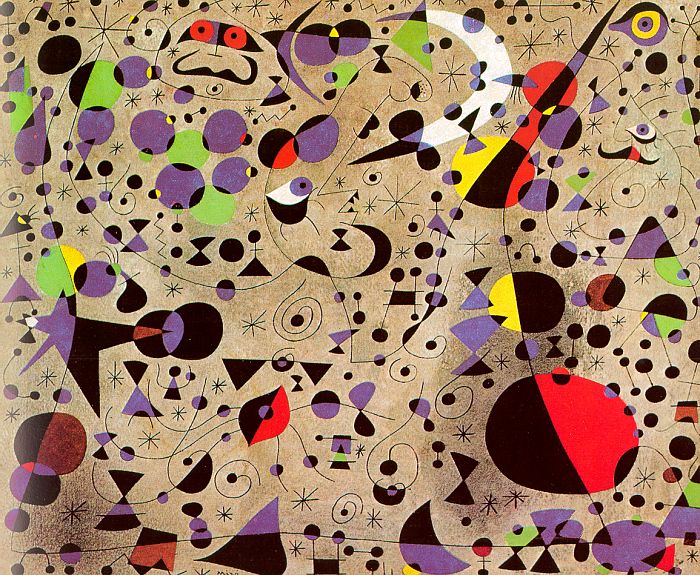























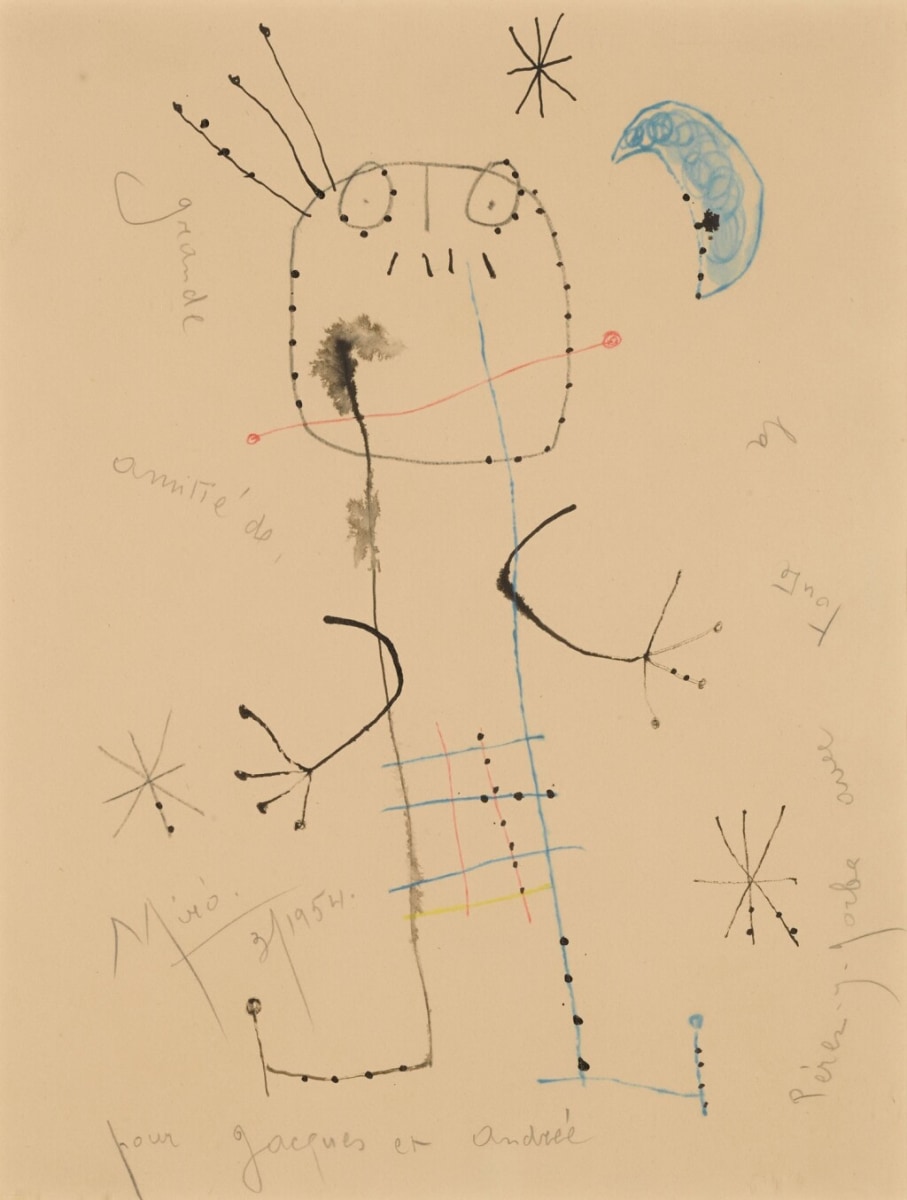


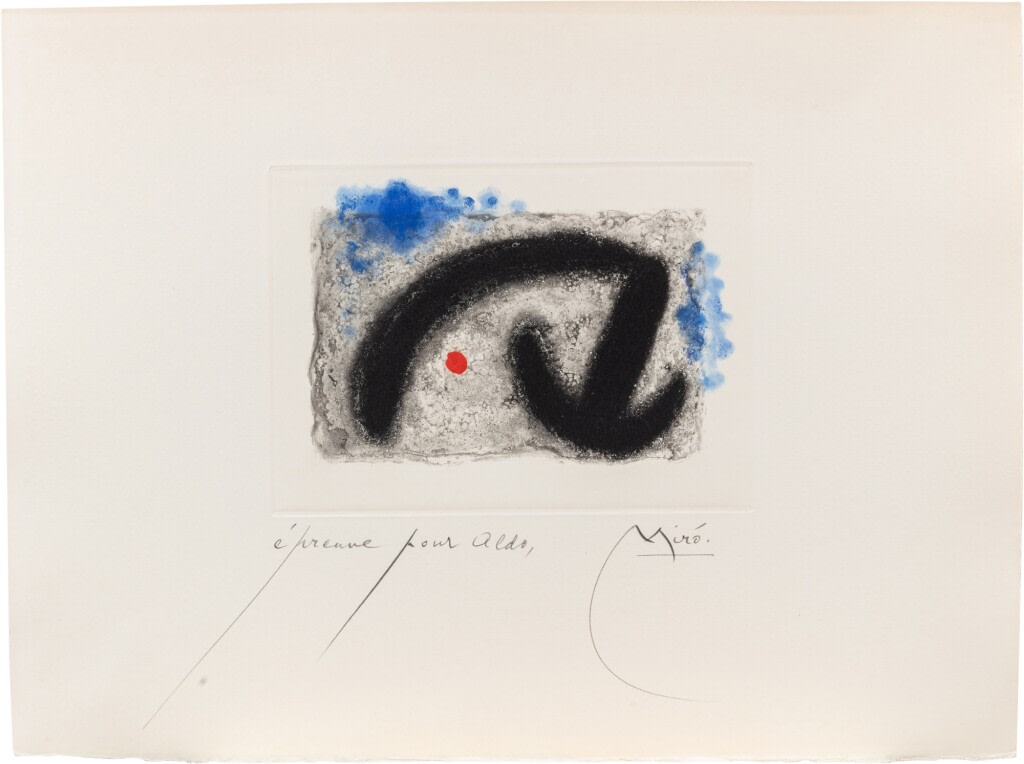


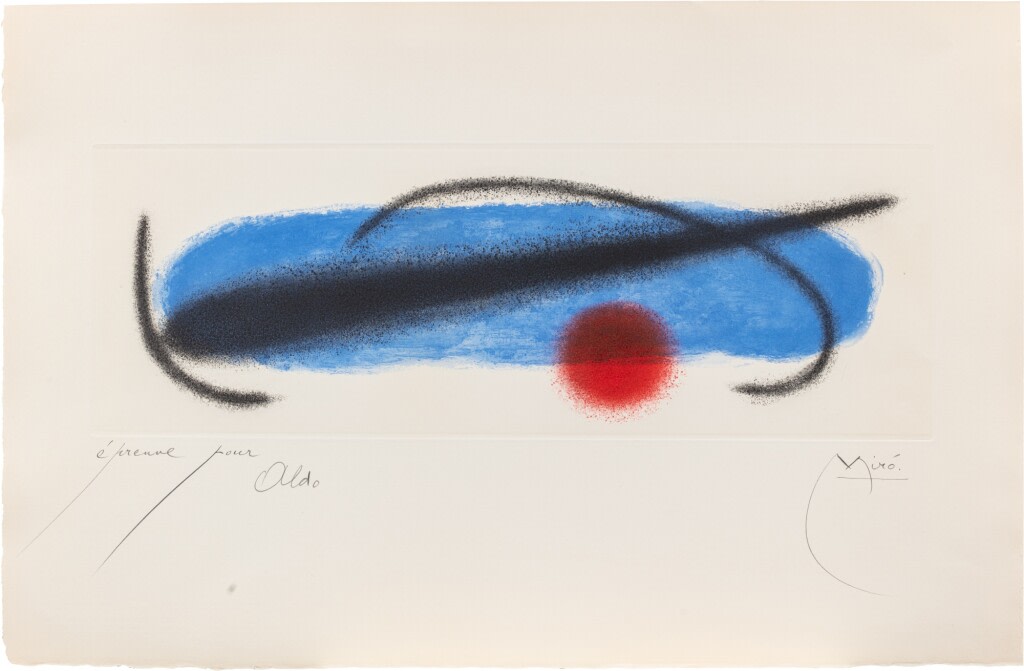

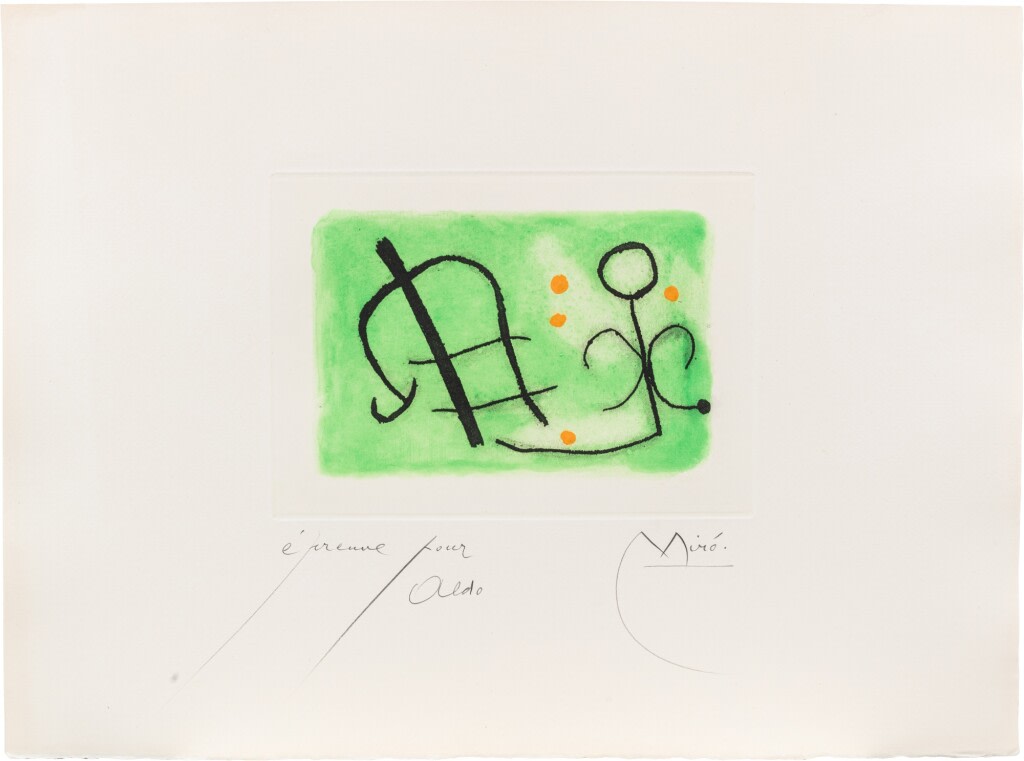






























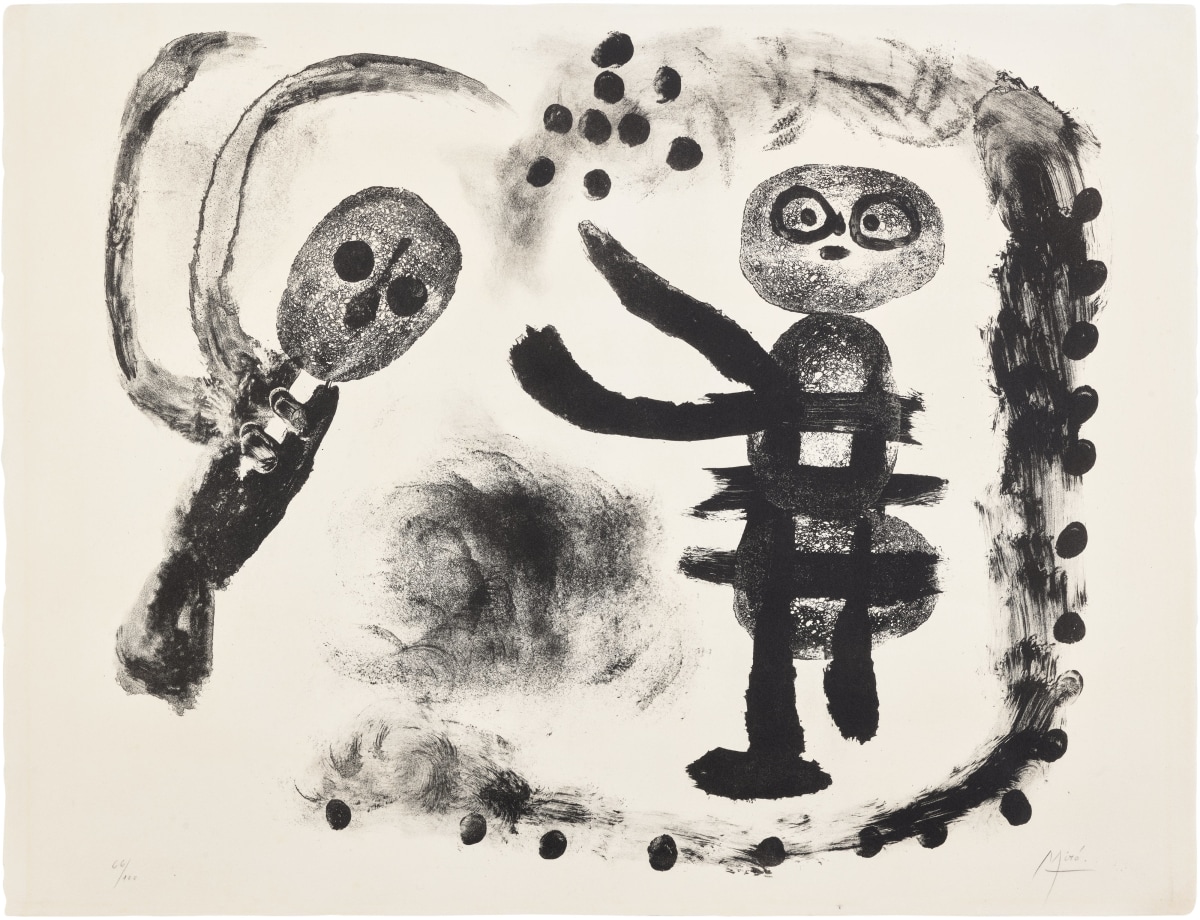


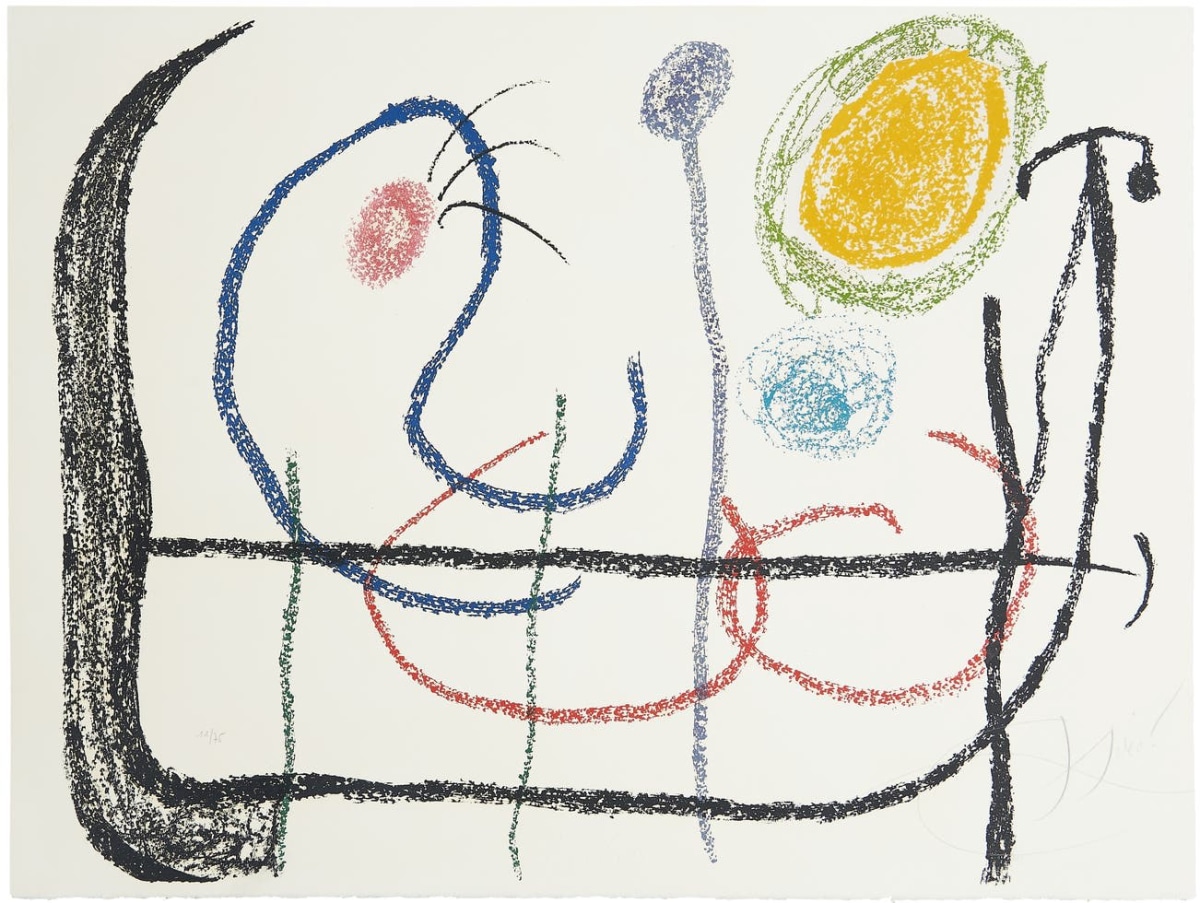


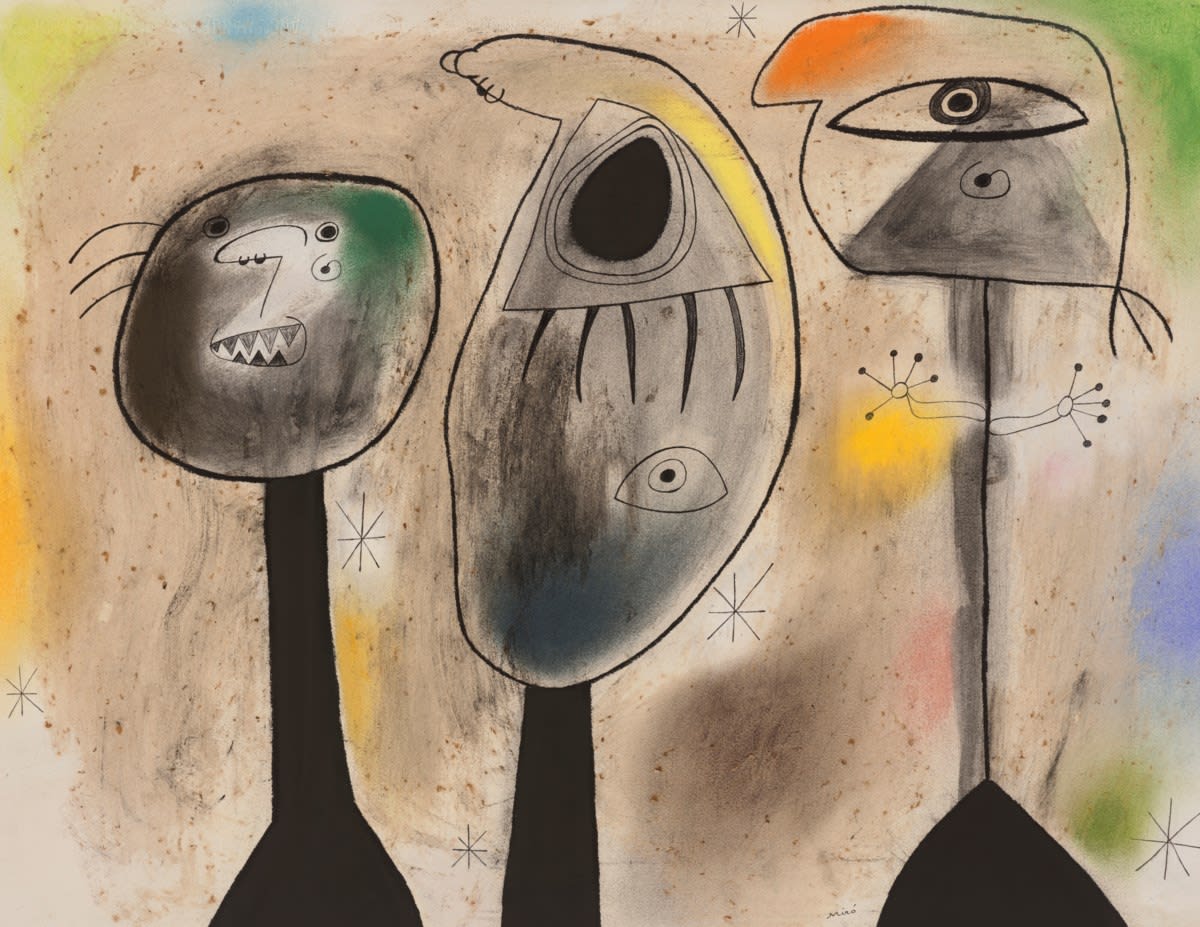
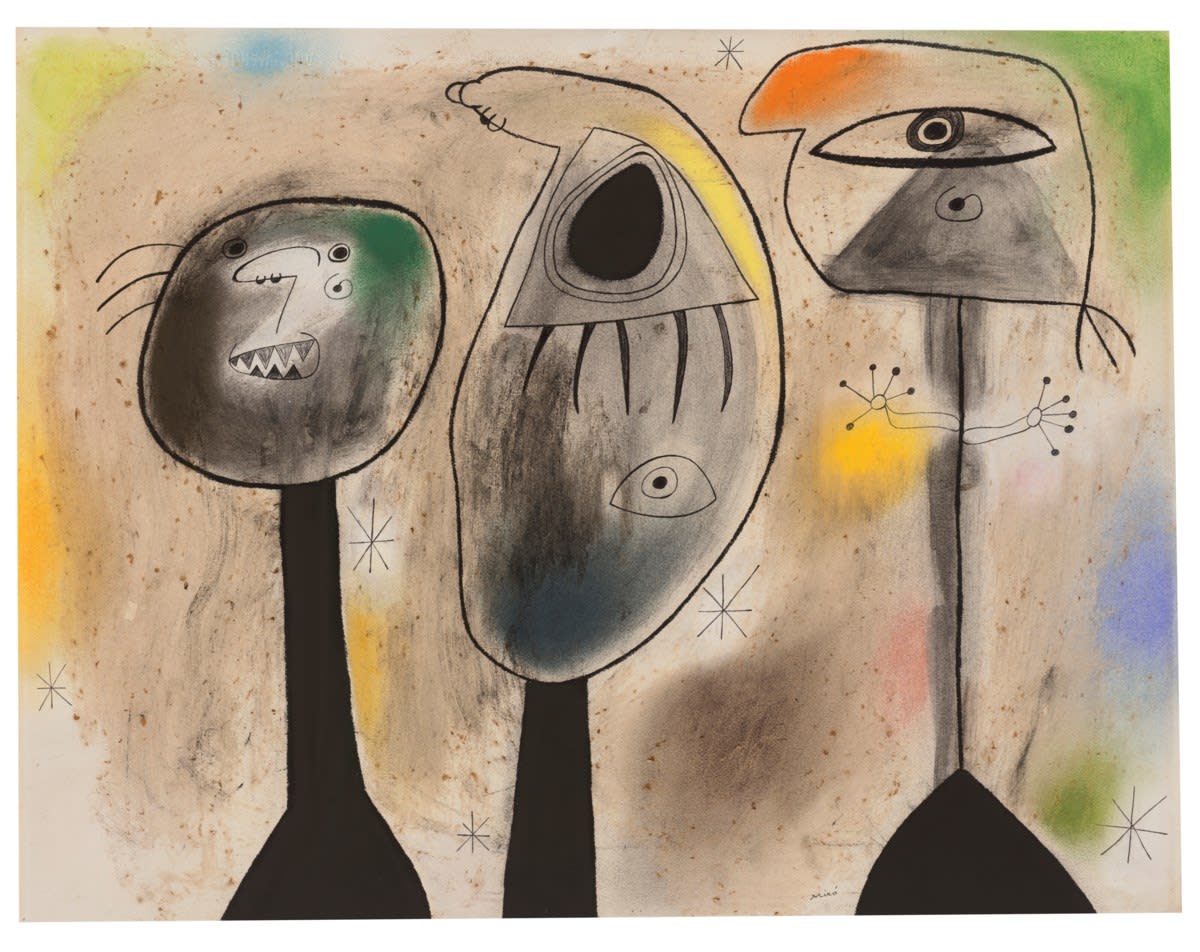






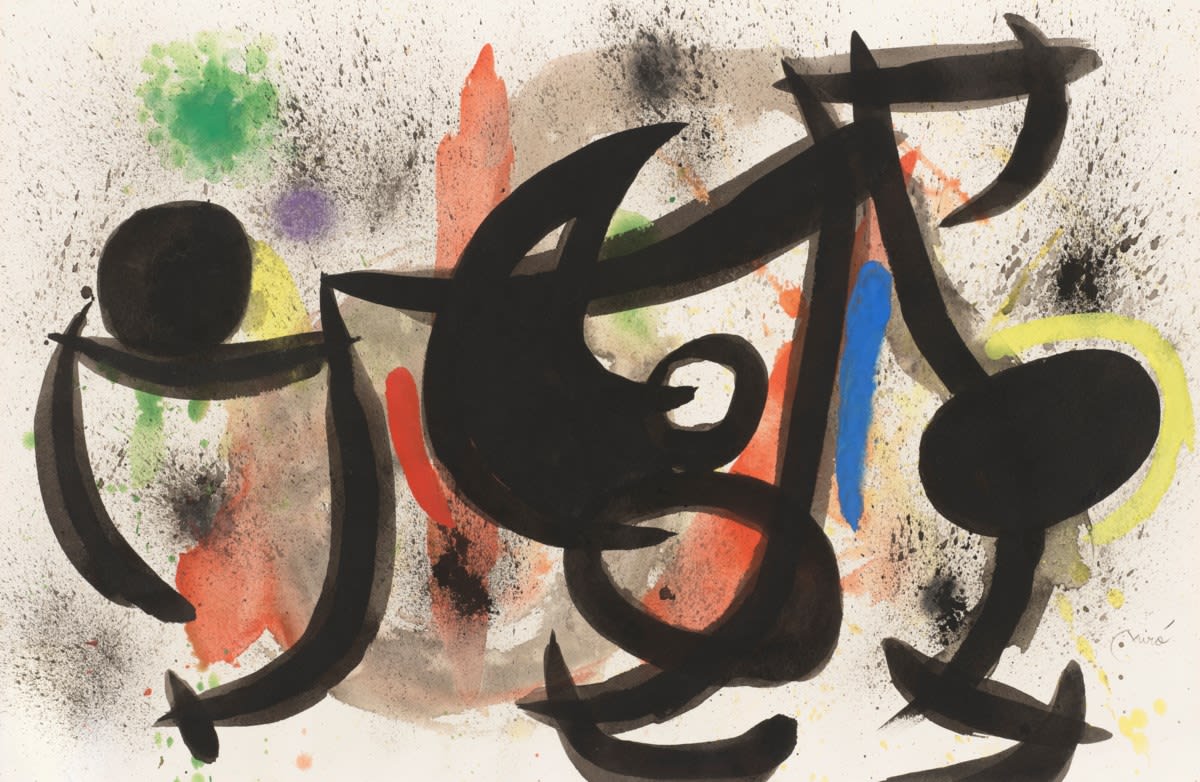


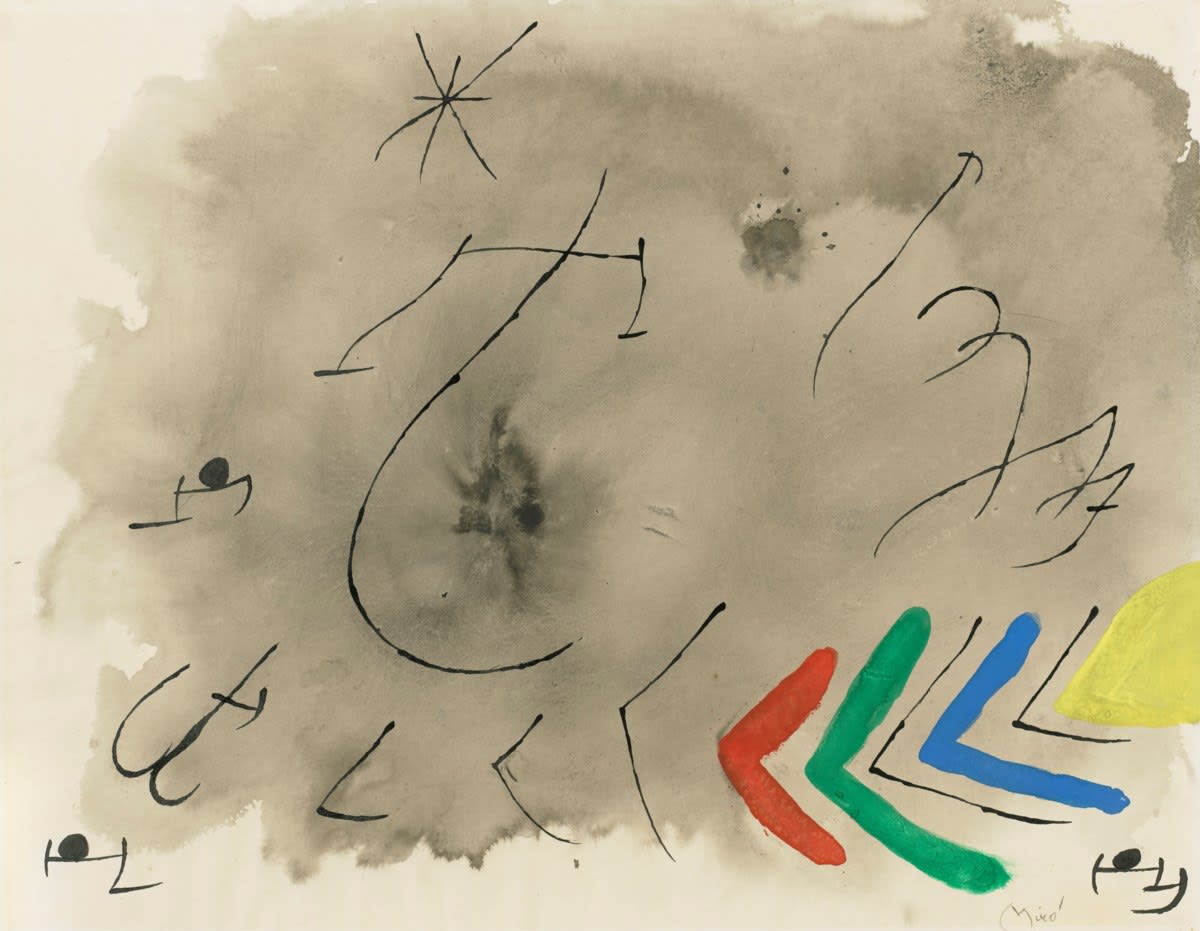
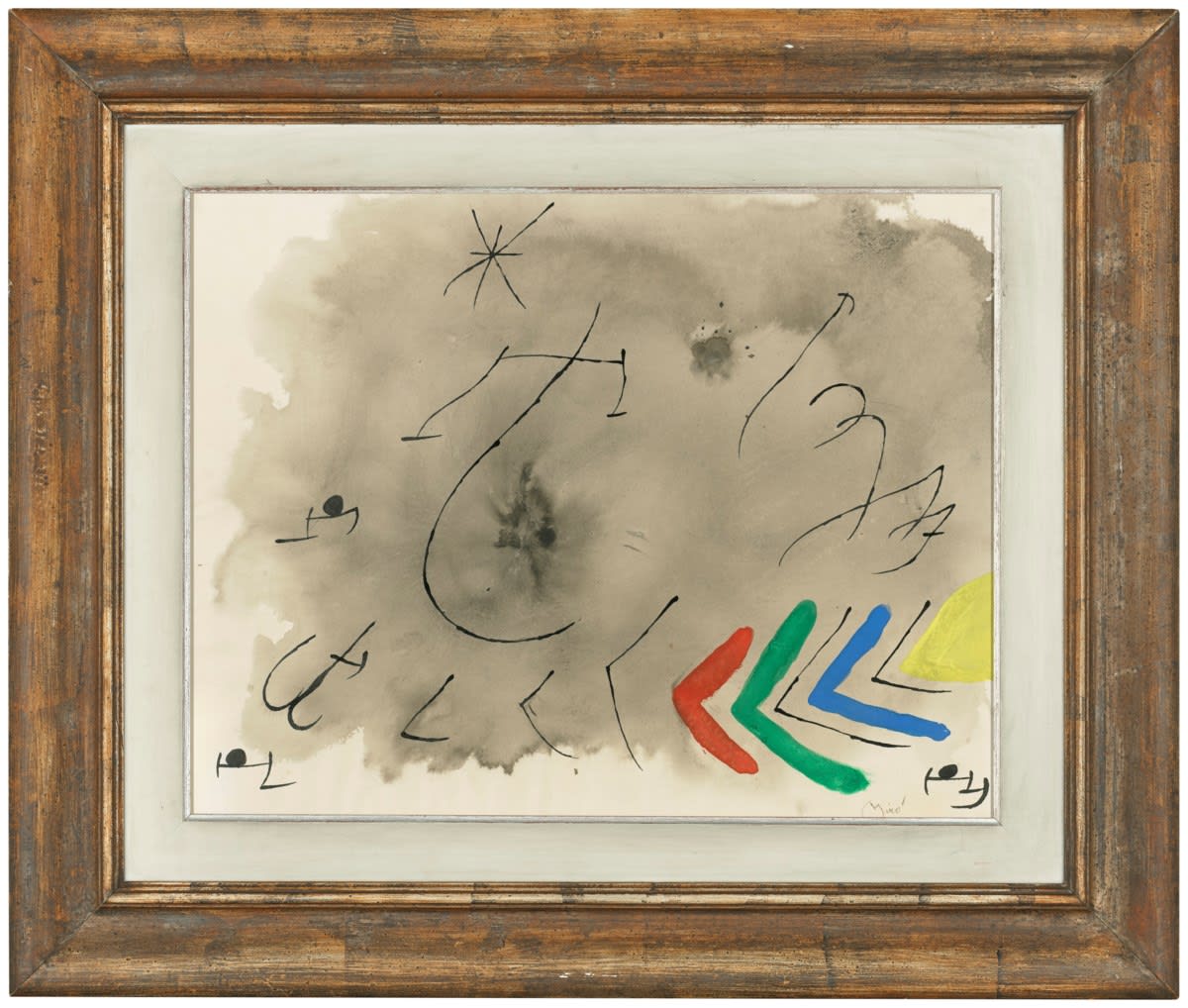


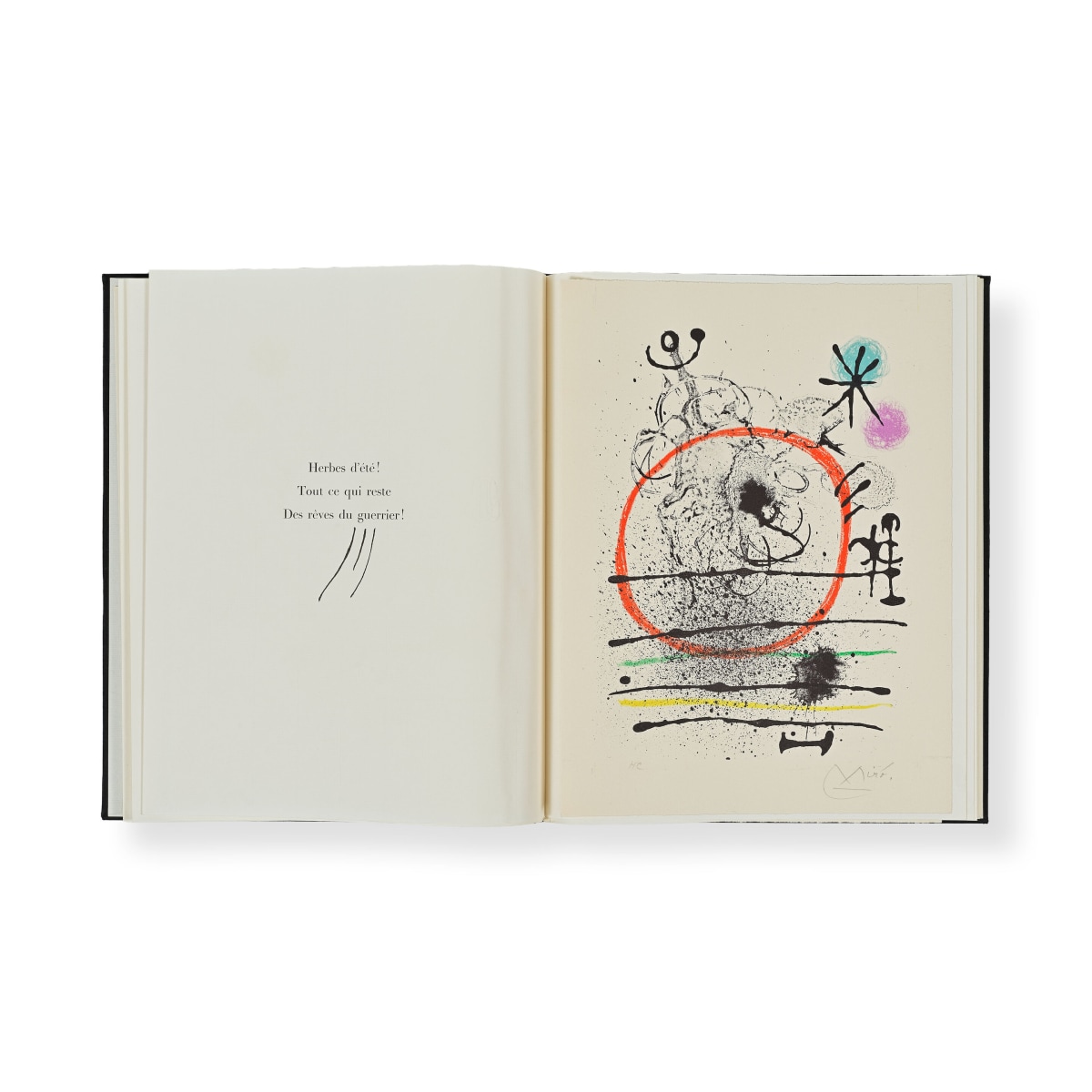








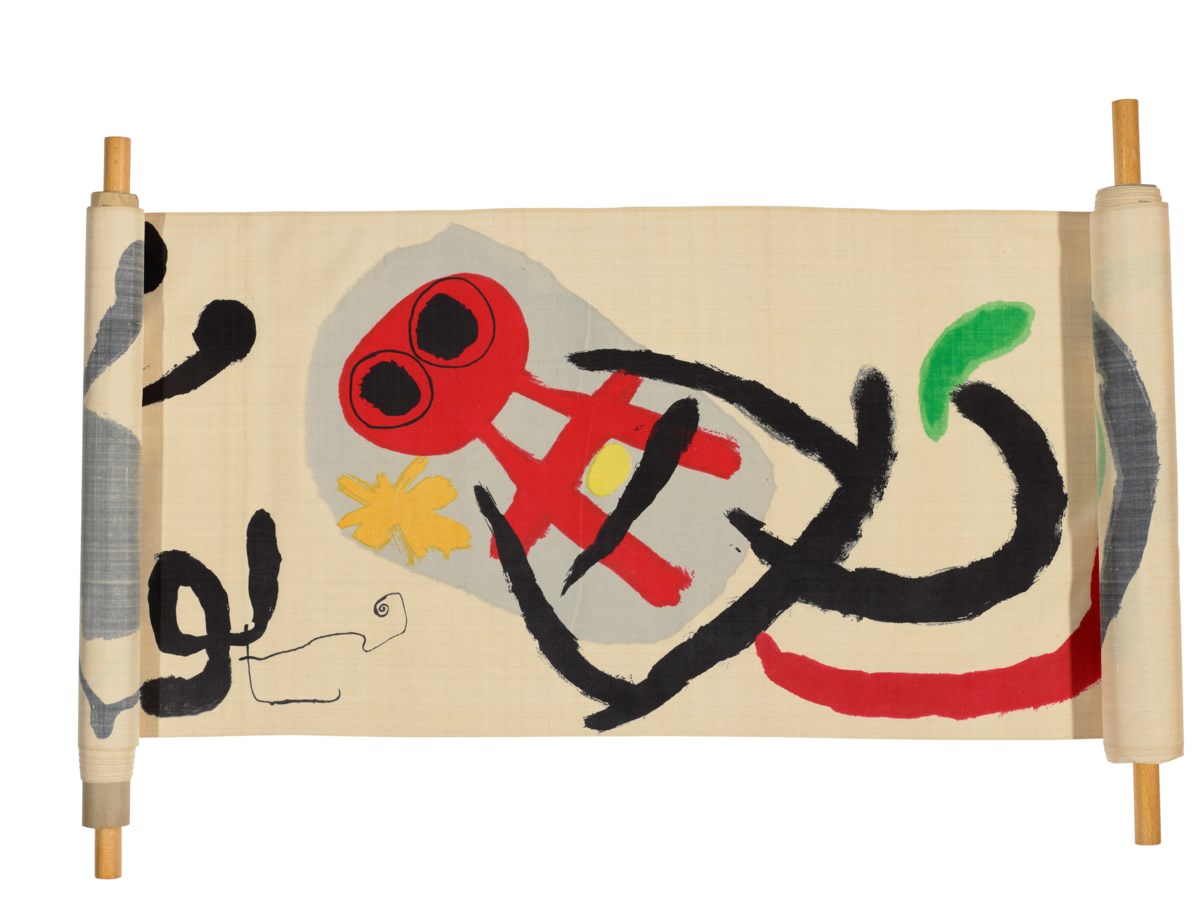


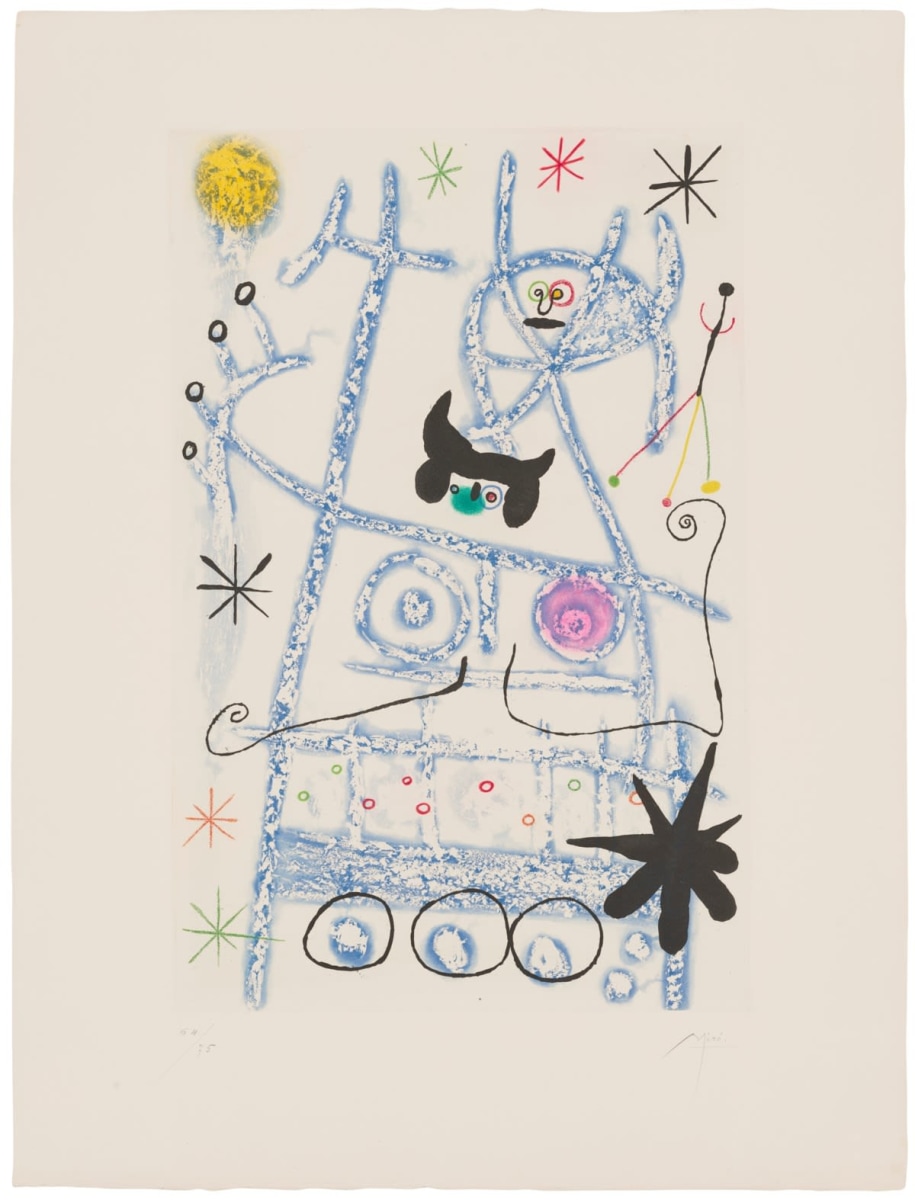
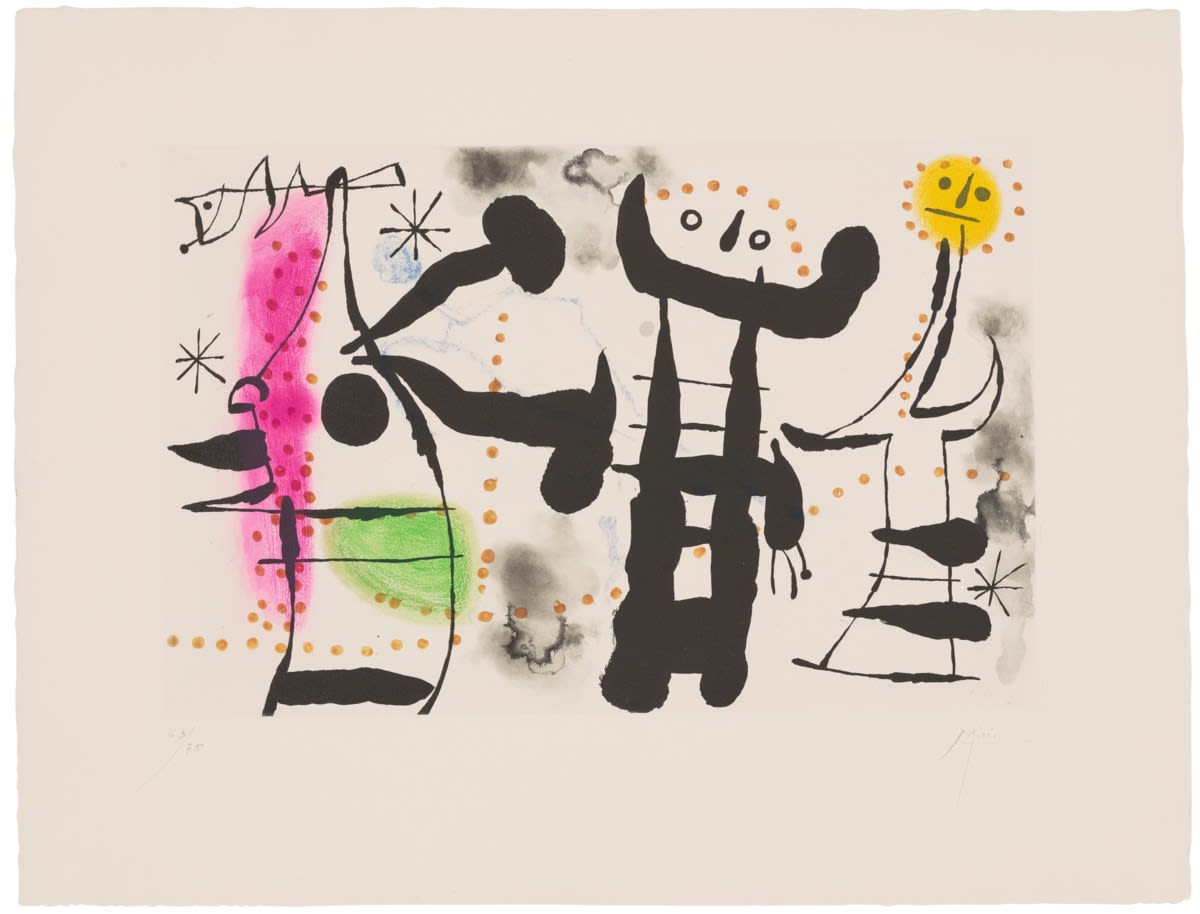
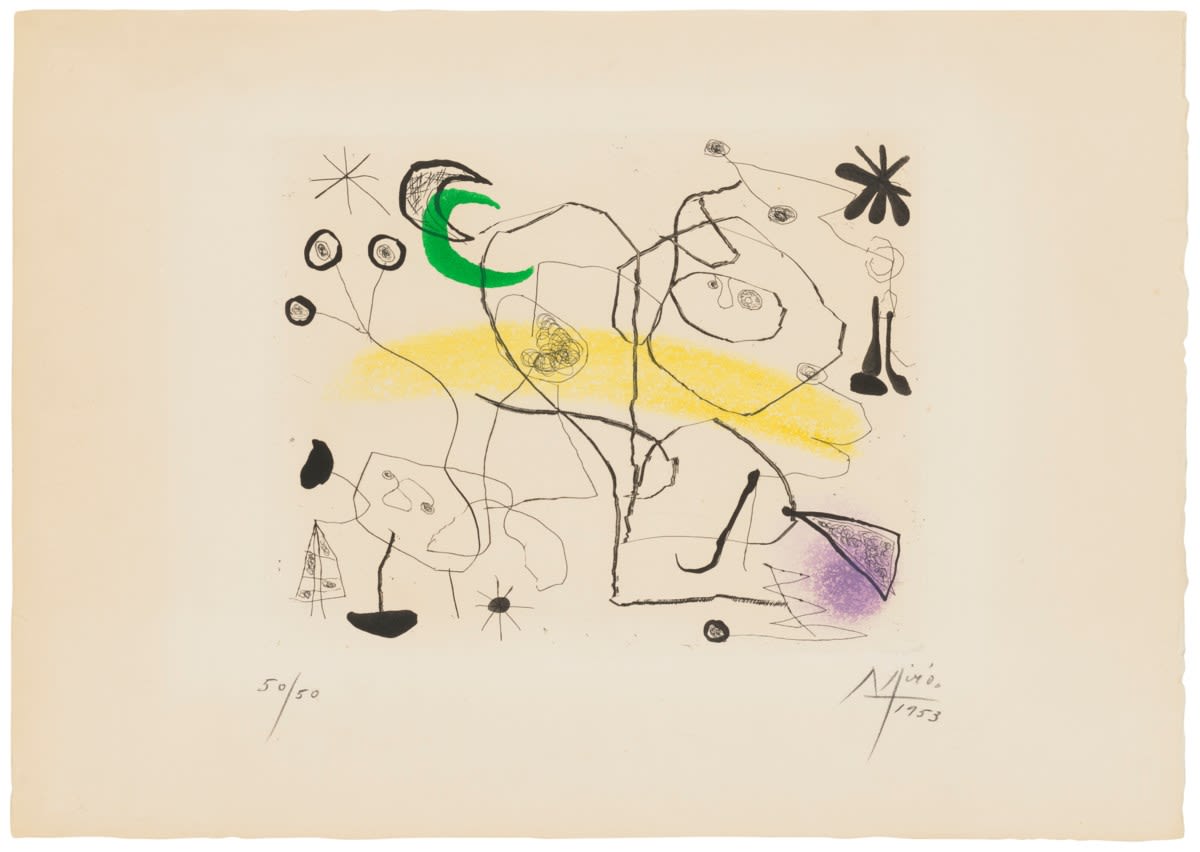










Egon investment scores
Market position
Research updated
Auction record context
$53,535,000 — Portrait de Madame K (1924), oil, charcoal and coloured wax crayon on canvas, Christie's New York, 18 May 2026, in 'Masterpieces: The Private Collection of S.I. Newhouse'. Christie's confirmed it as a new auction record for the artist; the price more than doubled the low estimate.
Pricing
Sculpture
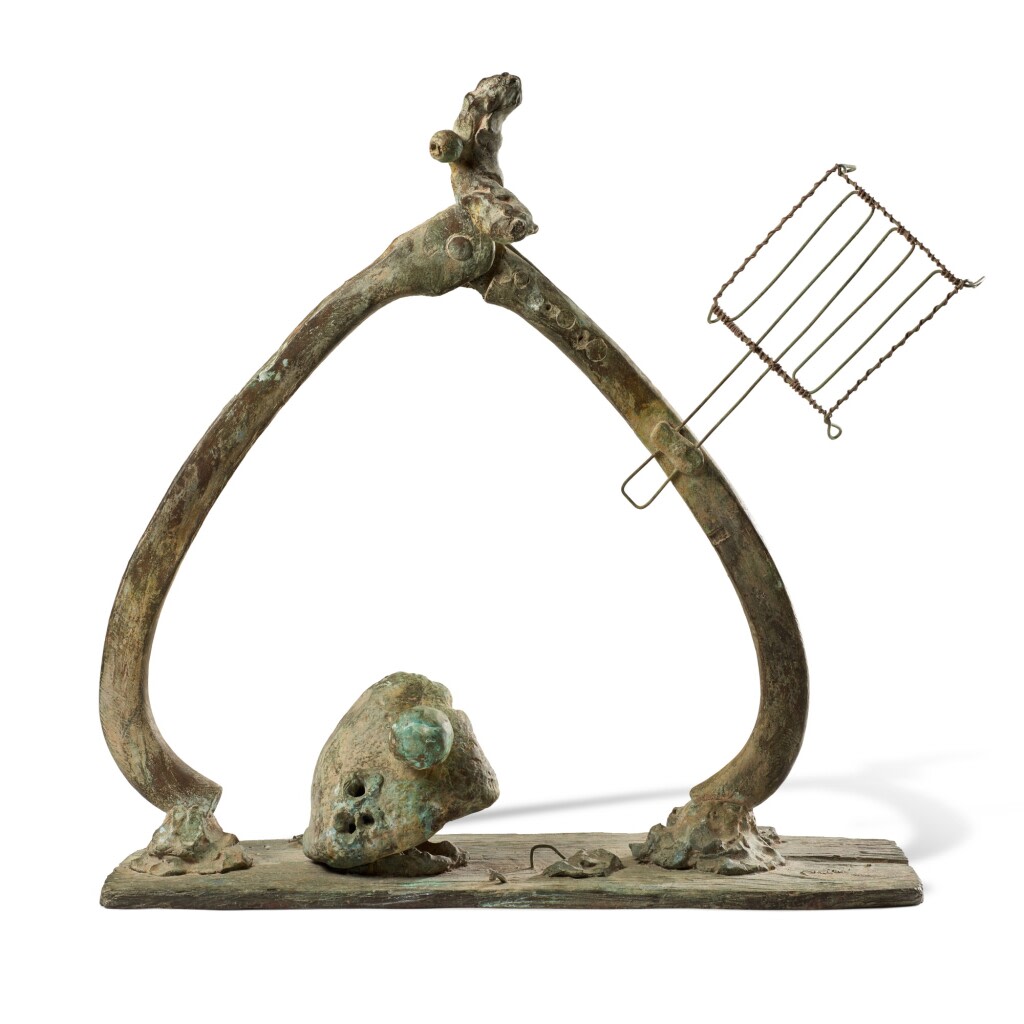
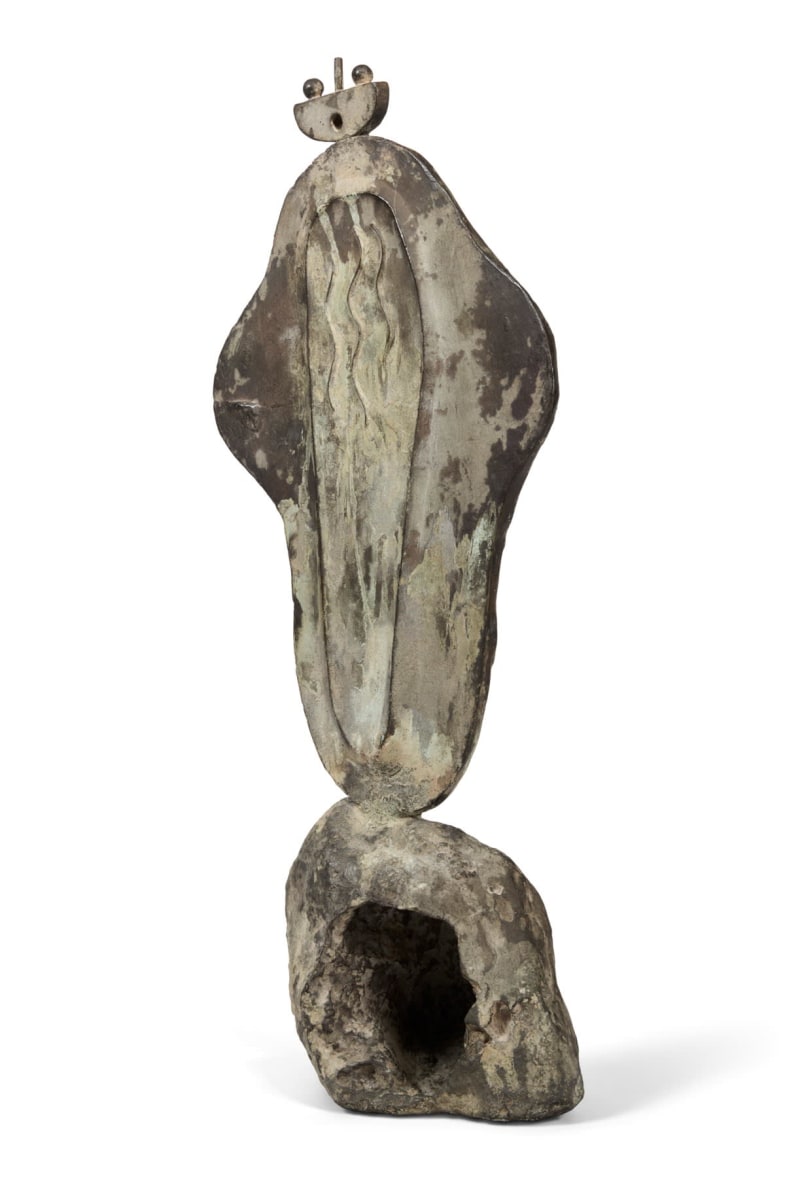
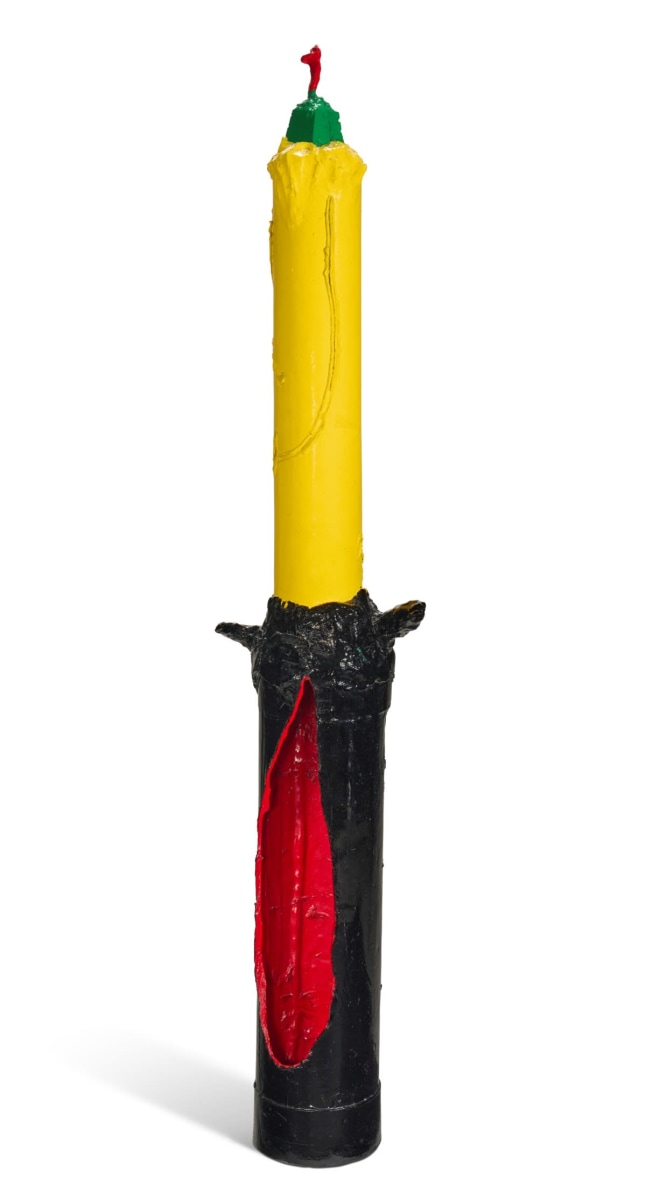
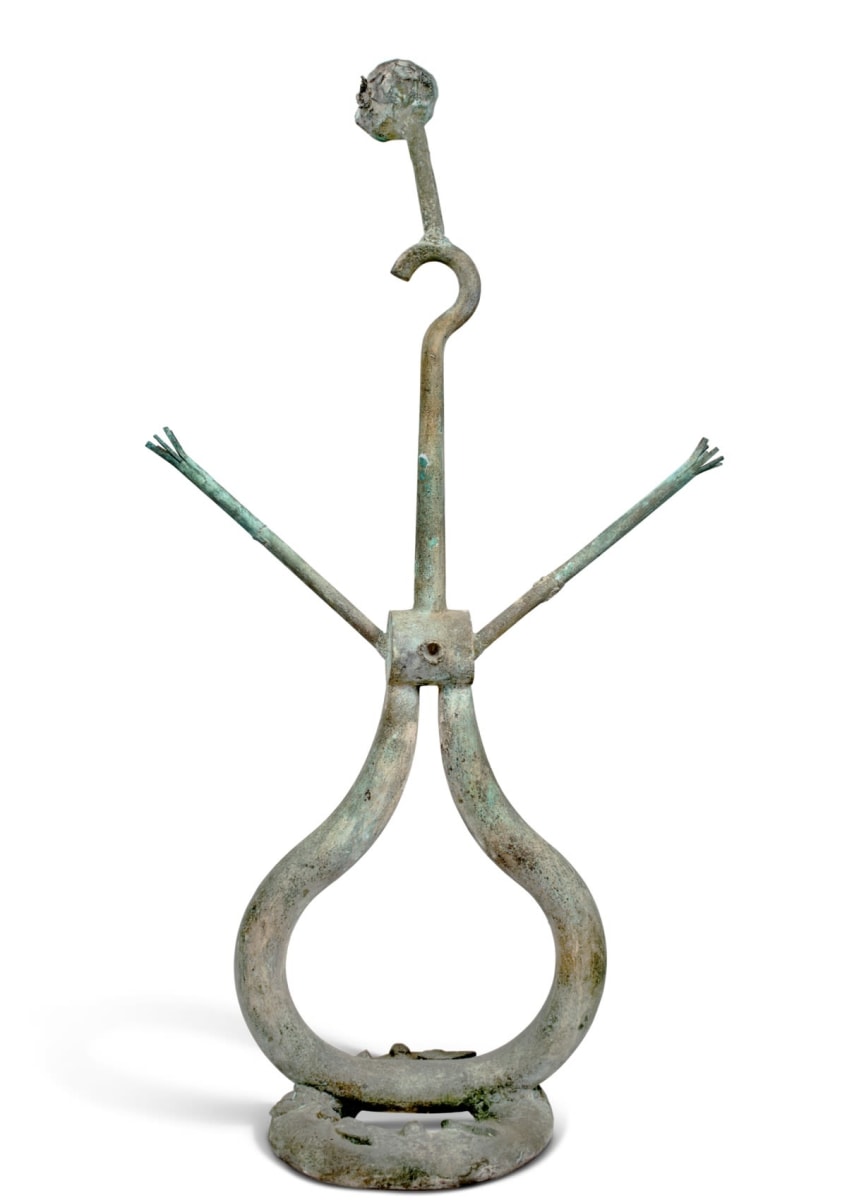
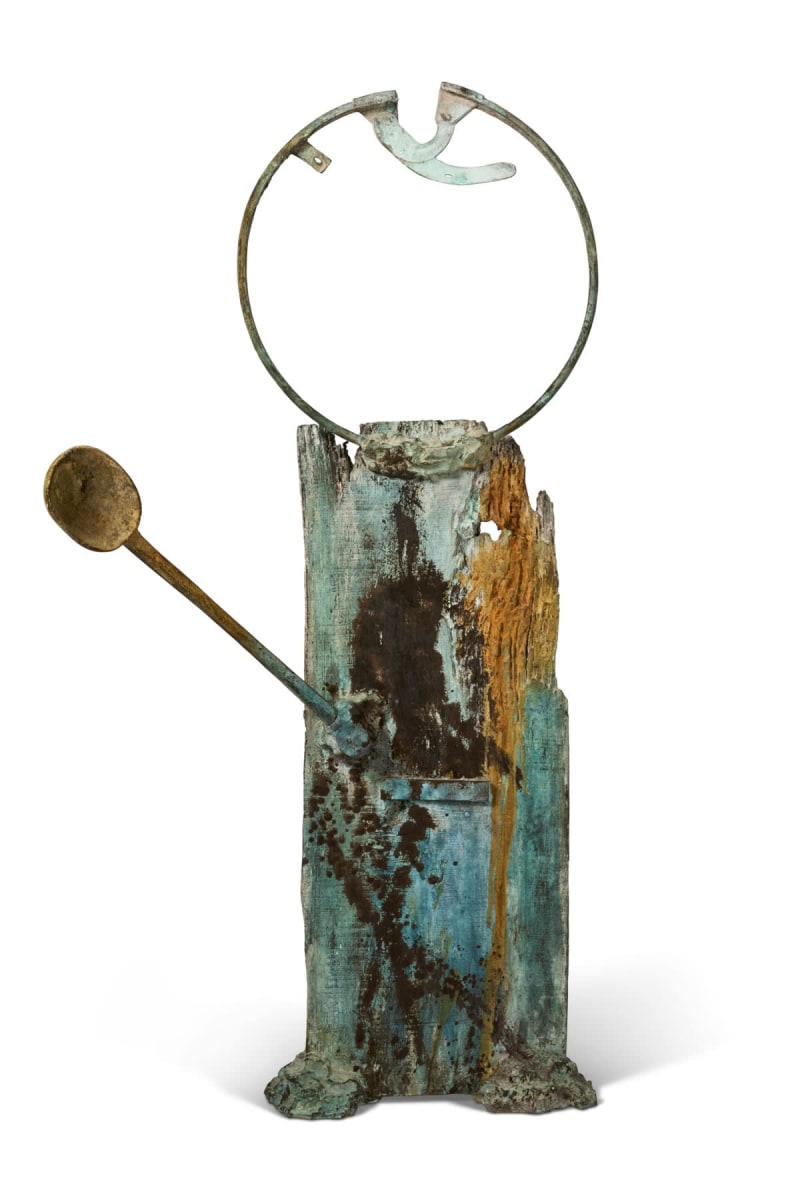
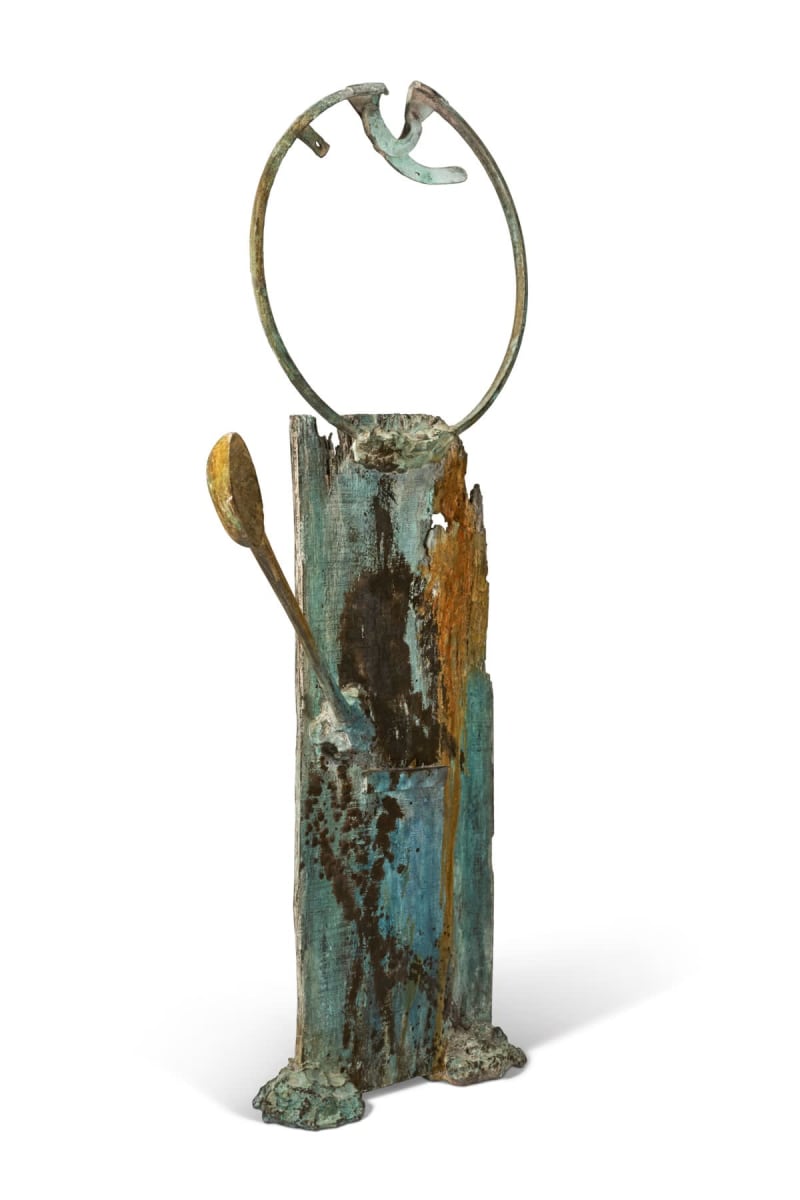
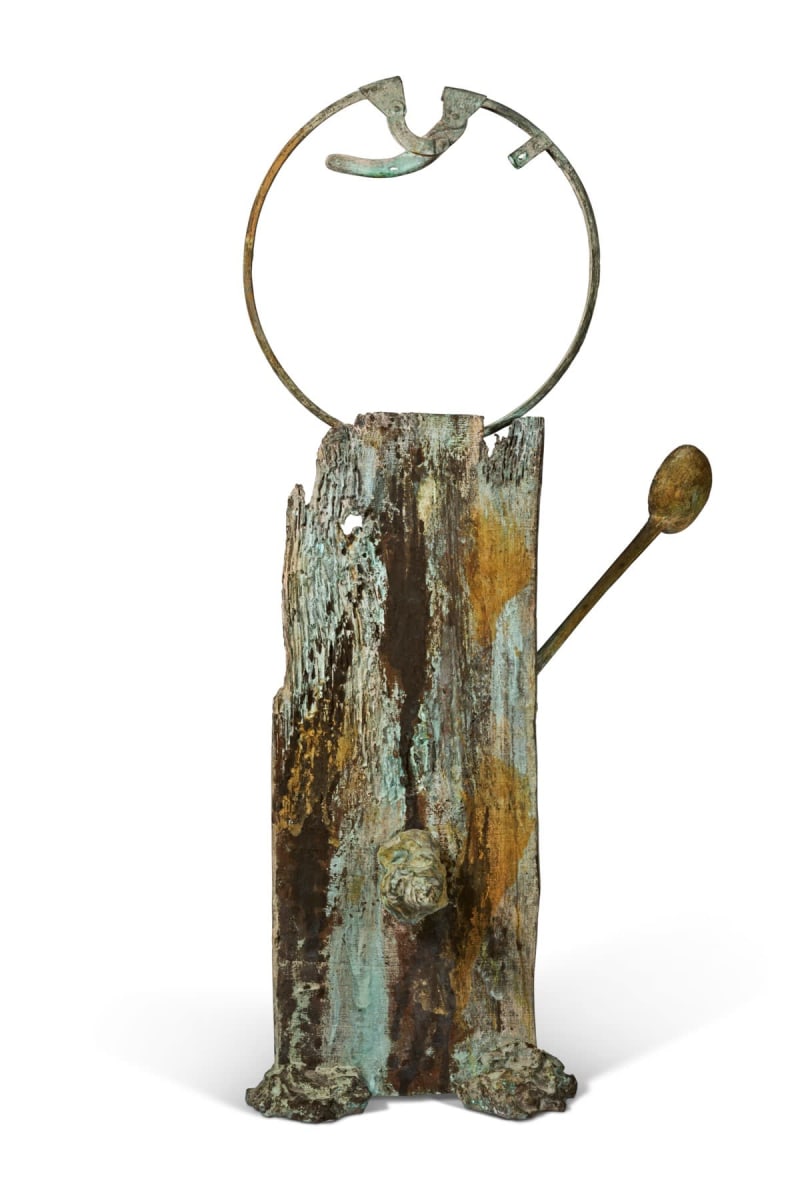
Average approximately $227,616 across the trailing 12 months (MutualArt aggregate). Patinated bronzes cast from found-object assemblages are the core category.
Works on paper
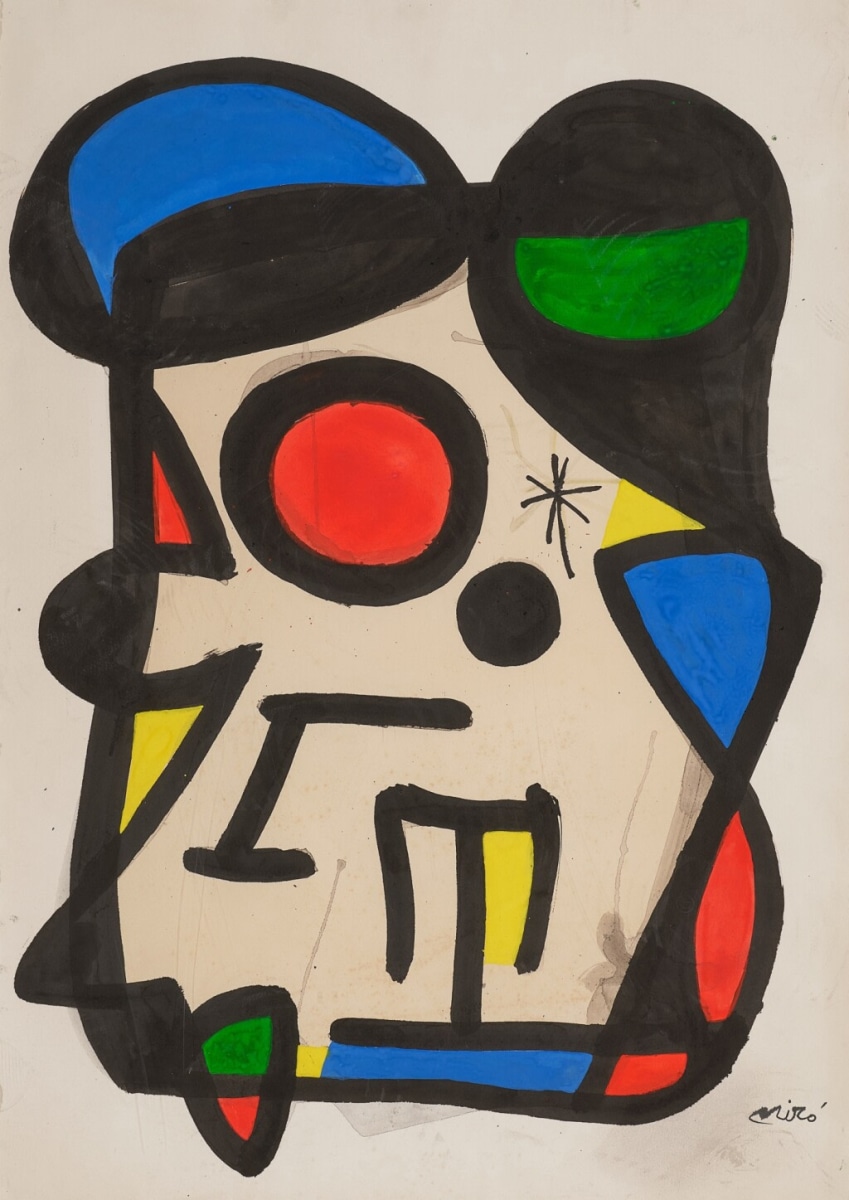
Wide band; record $10,401,000. Major large gouaches and drawings reach seven figures; newly discovered architectural design drawings carried estimates reaching €400,000 (Antibes, 2026).
Temporal framing
2012–2024: record static at approximately $37m, set in June 2012 and unbeaten for 14 years; print turnover grew from about £3.27m (2015) to about £4.11m (2024), +26% over the decade, with only a 4% increase across 2019–2024 (Artprice data cited by Mark Littler). 2025–2026: the record repriced +44% to $53.5m in a single evening (Christie's, 18 May 2026) — a step-change at the very top with NO corresponding step-change at the print or mid-market level, where the EGON 2025–26 slice averages $12,268 hammer.
Primary market note
No living-artist primary market. Gallery-level acquisition runs through estate-linked and secondary dealers. Gallery prices are generally not published — contact Acquavella Galleries (New York), Galerie Lelong & Co. (Paris/New York) or Mayoral (Barcelona) for current pricing on paintings and sculpture.
Prints and multiples
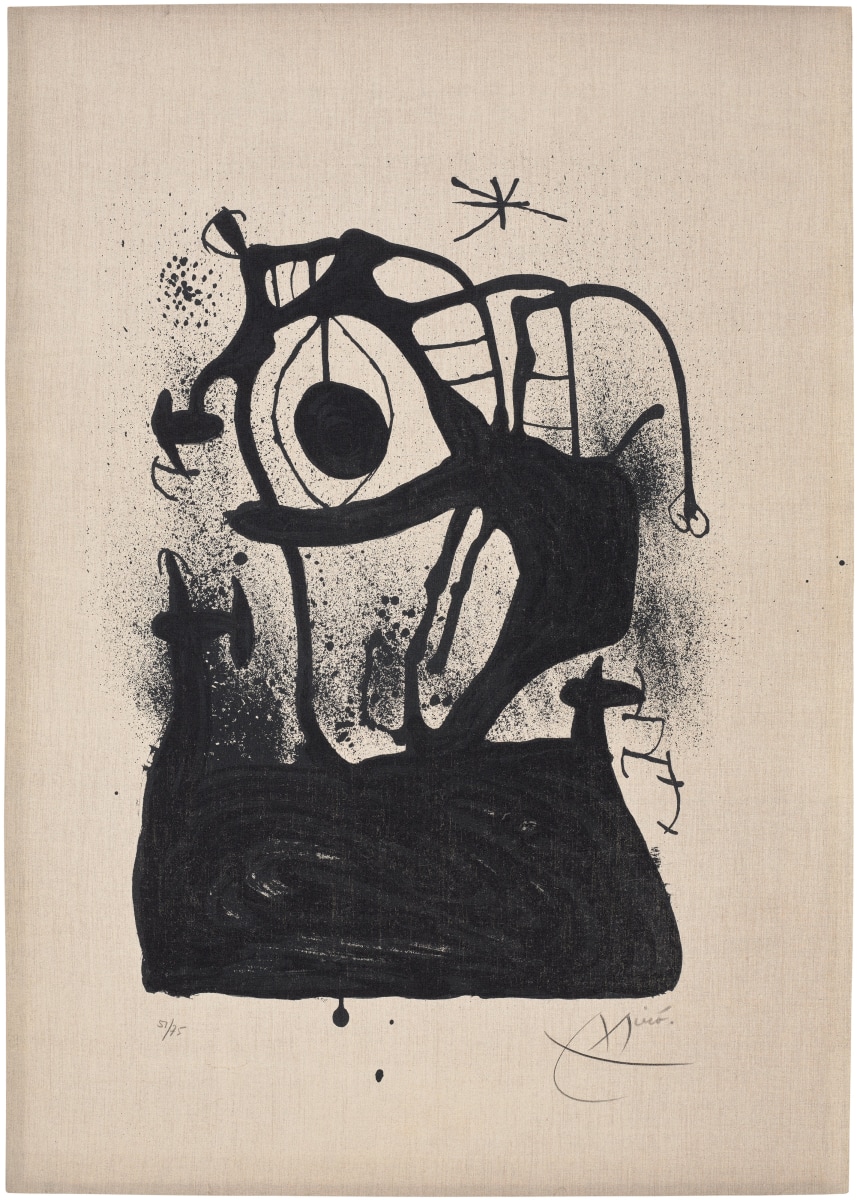
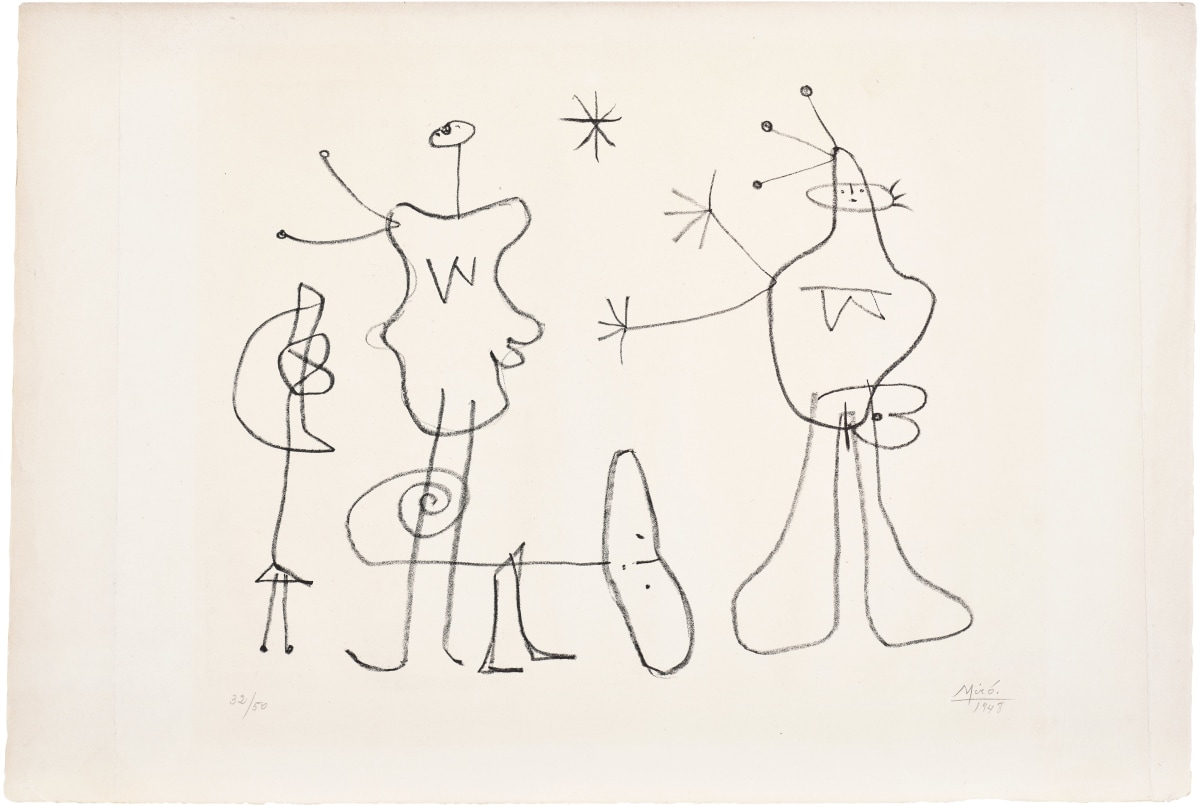
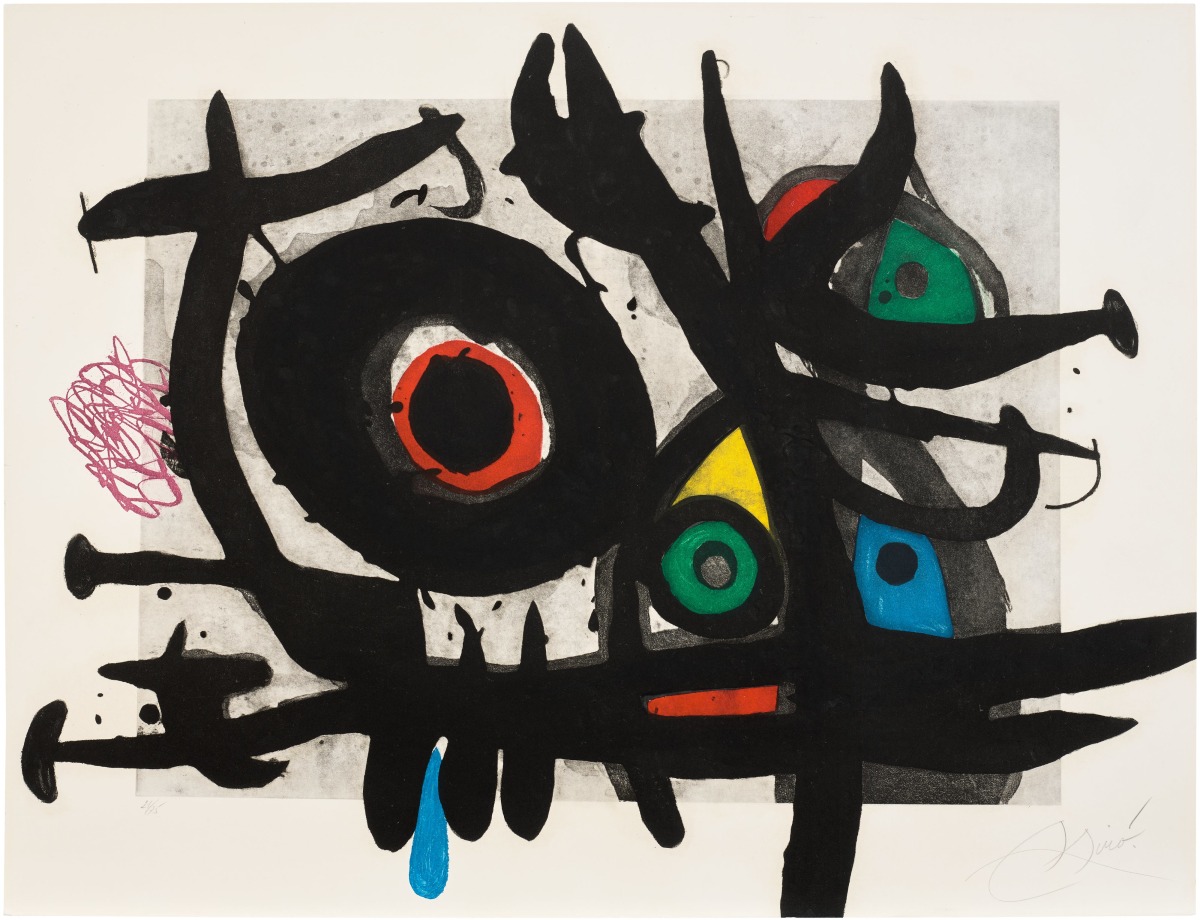
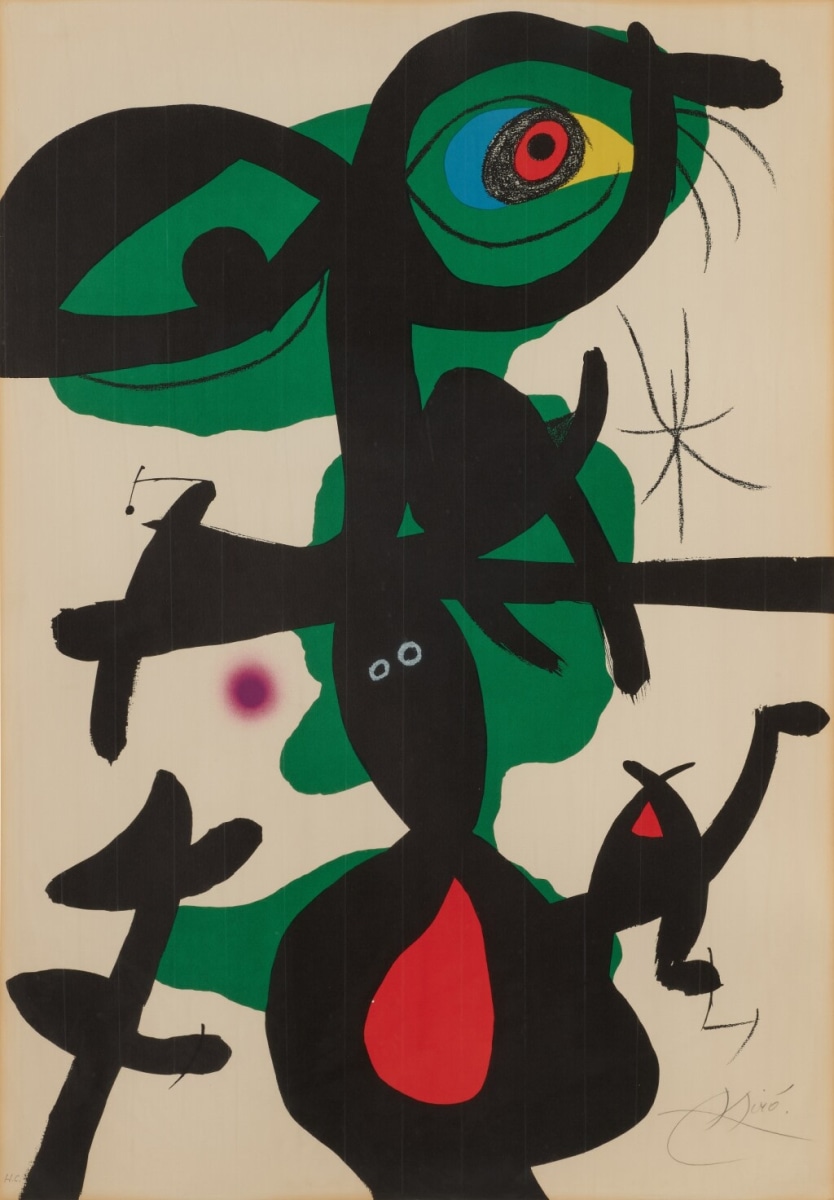
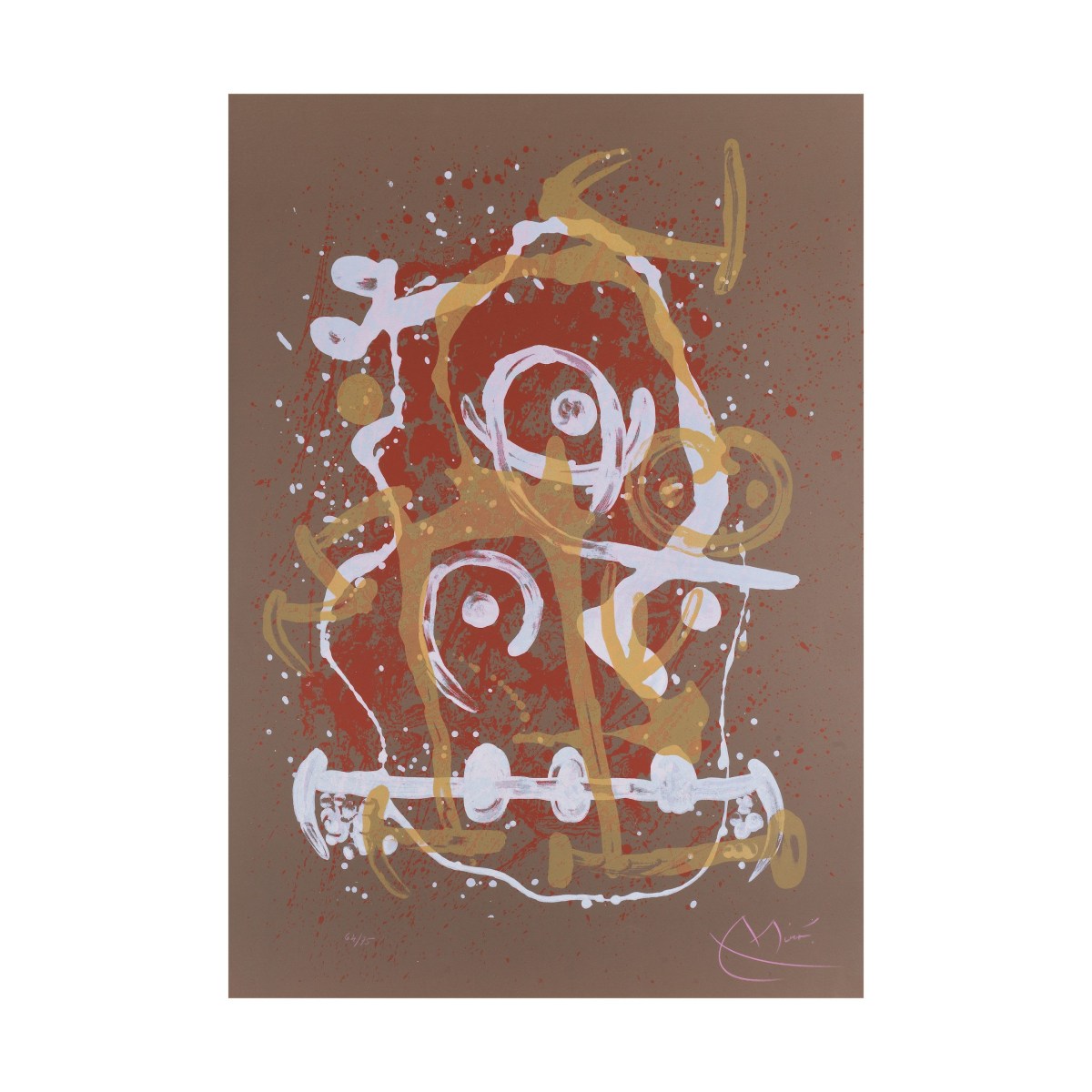
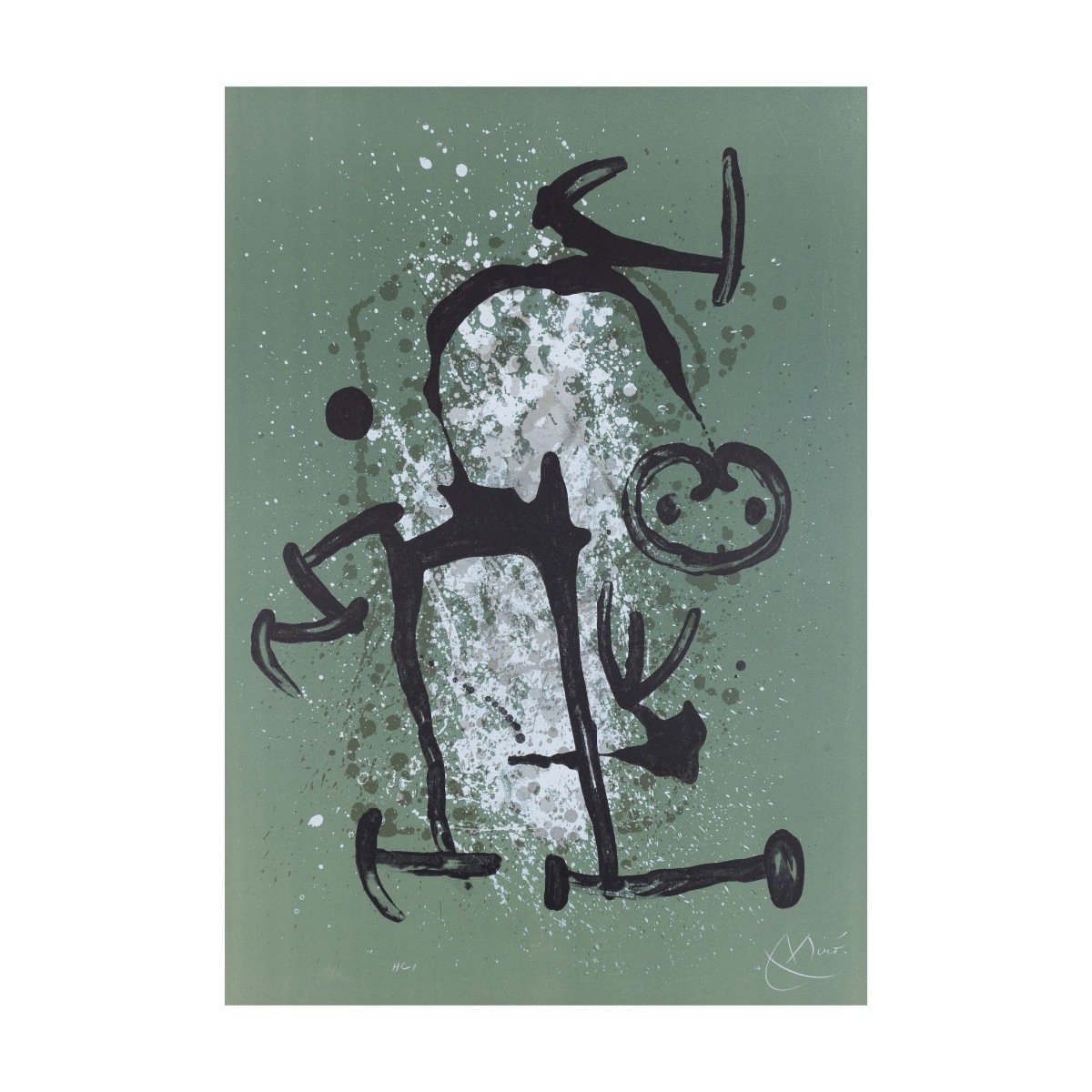
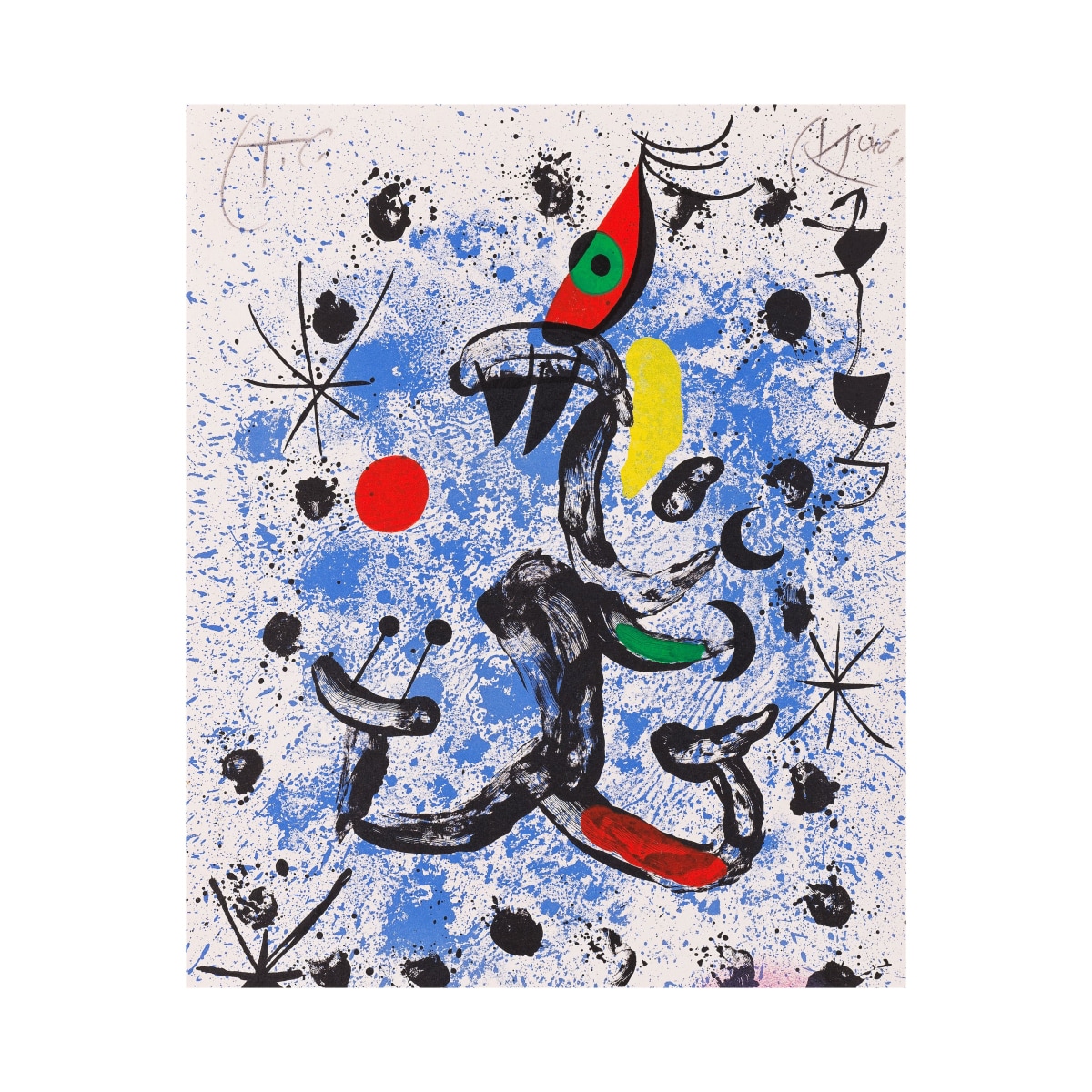
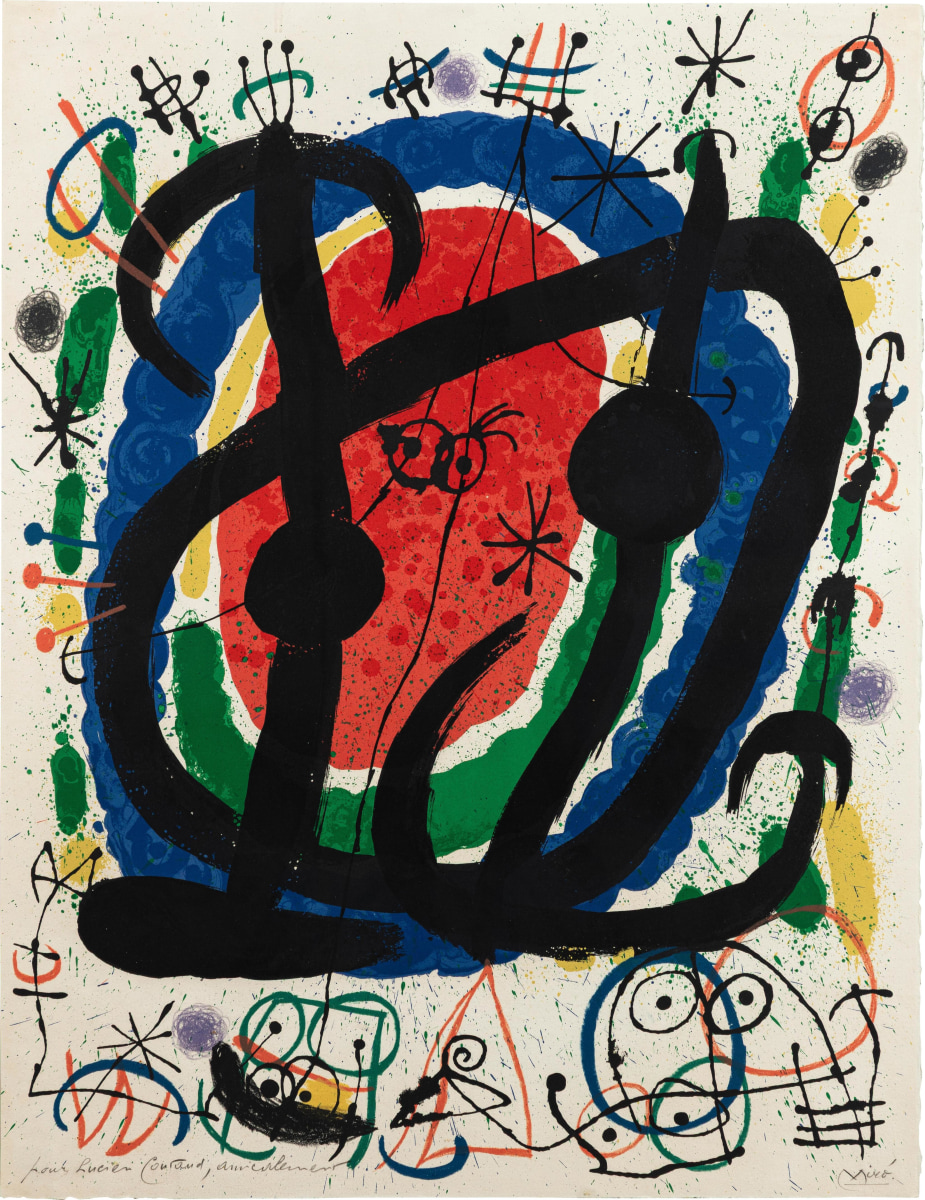
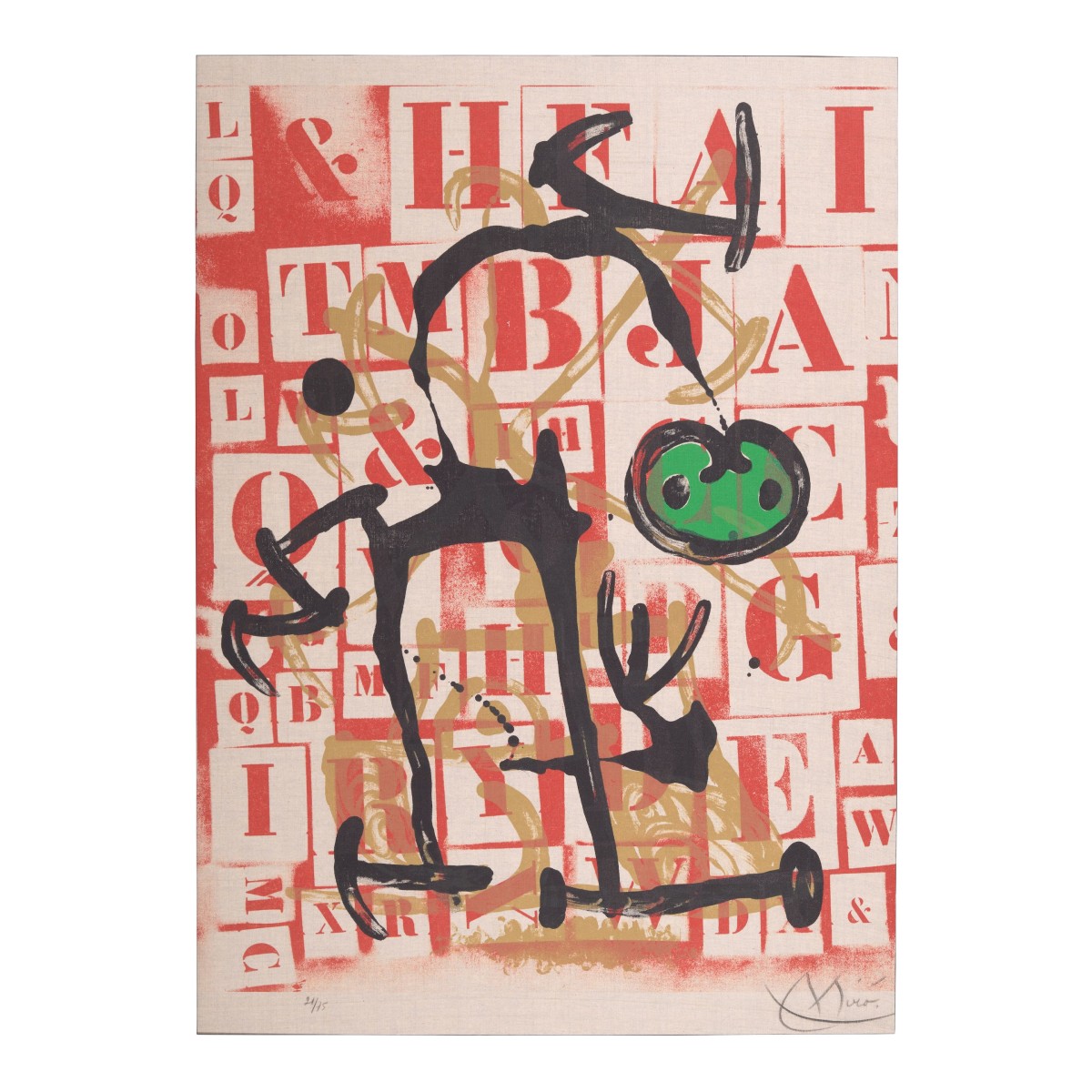
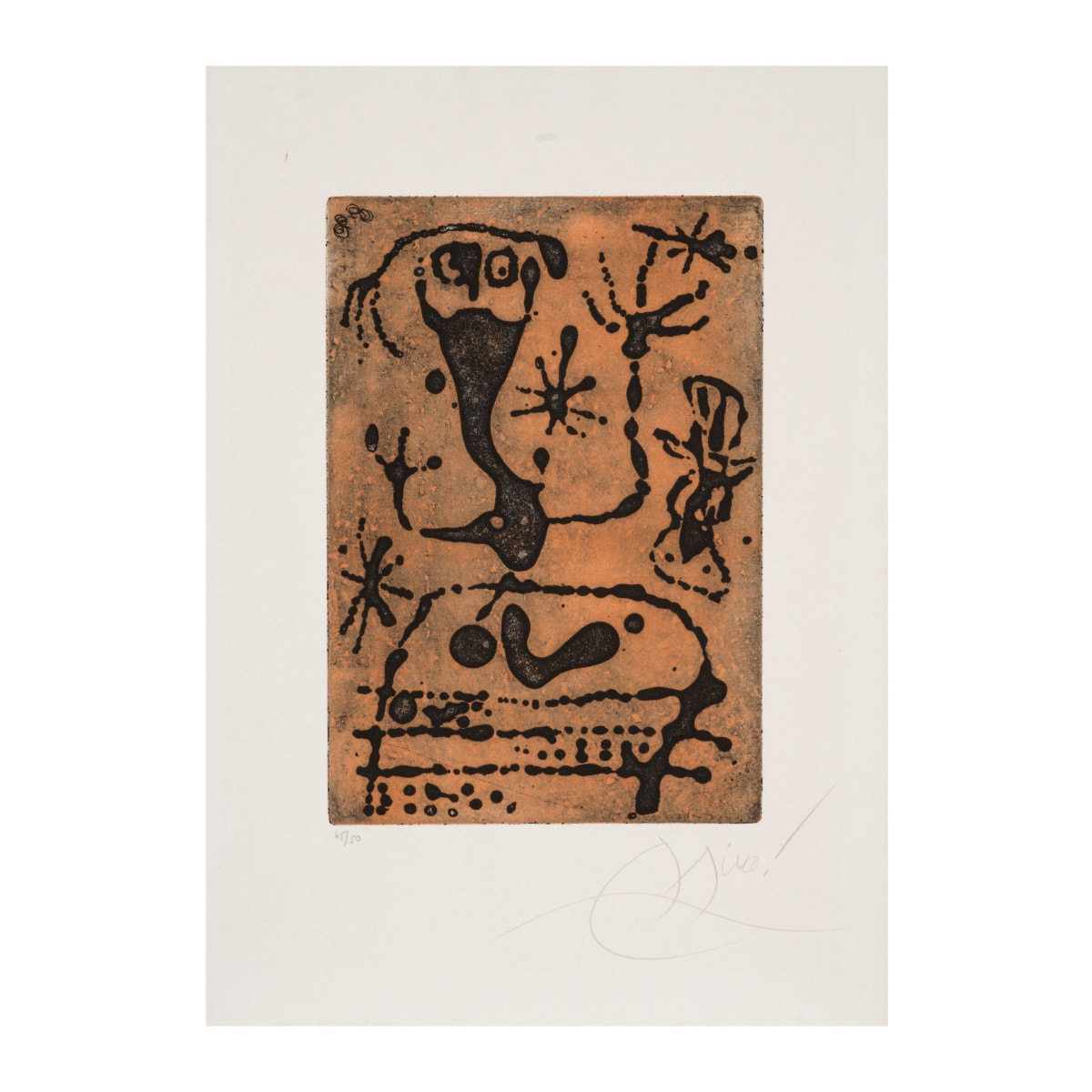
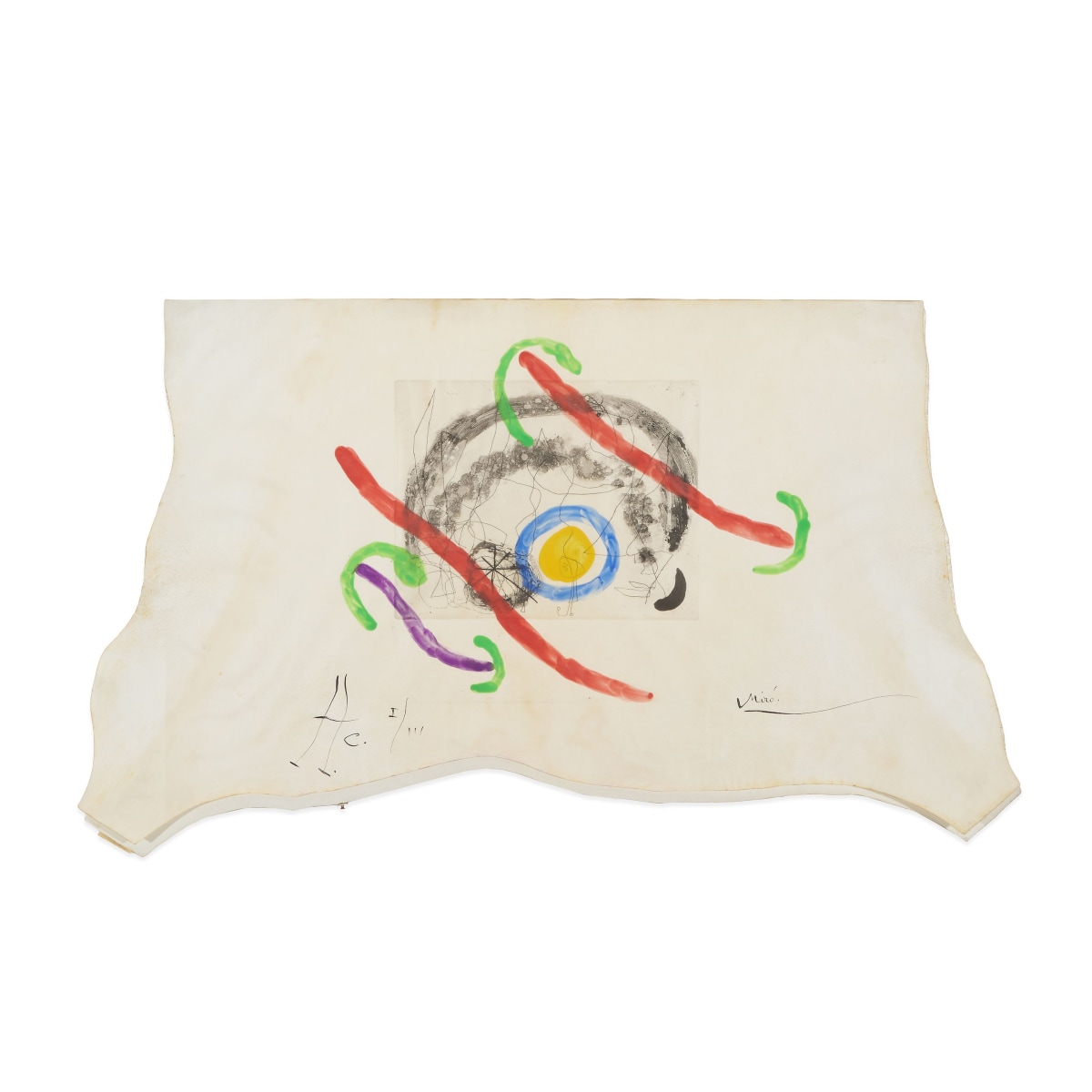
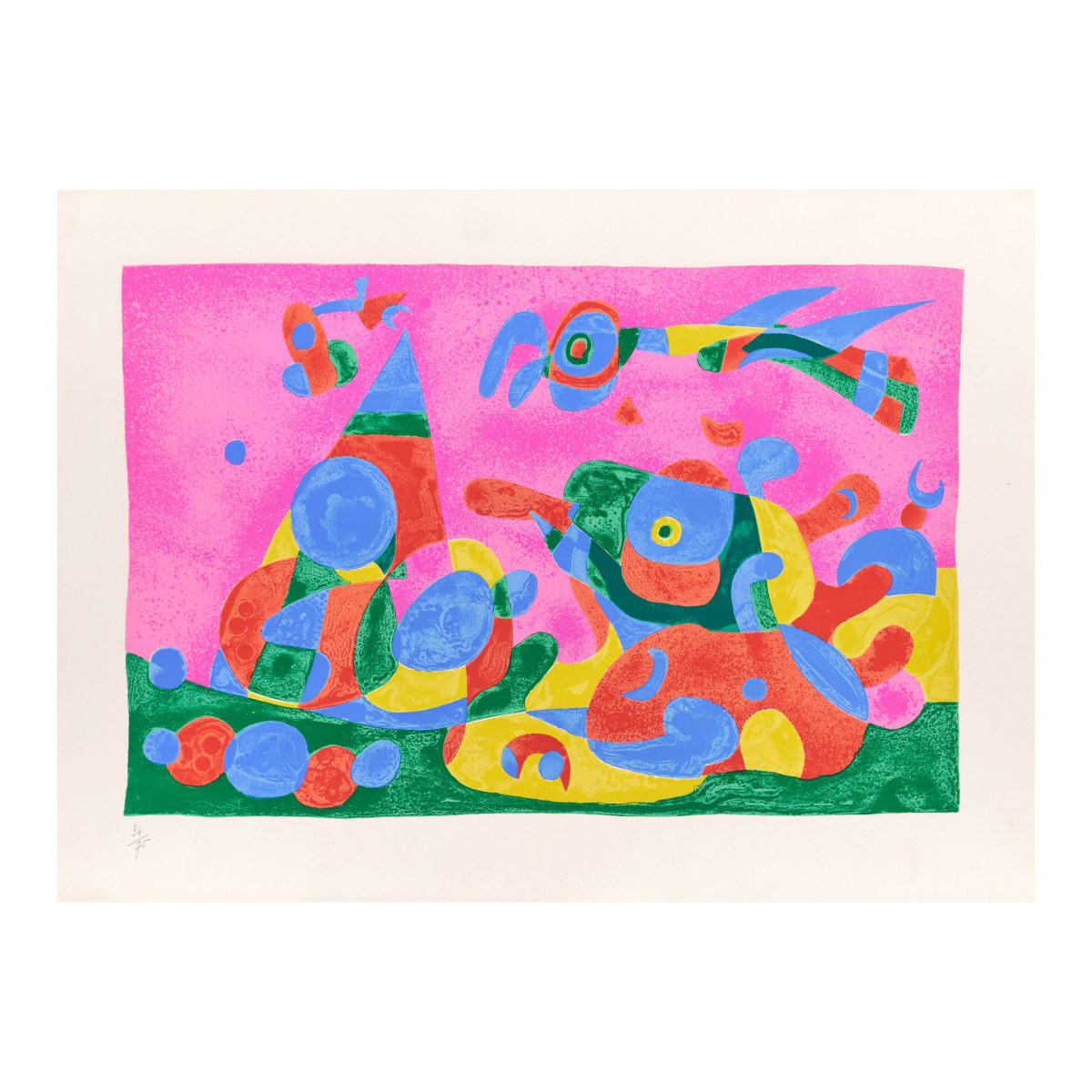
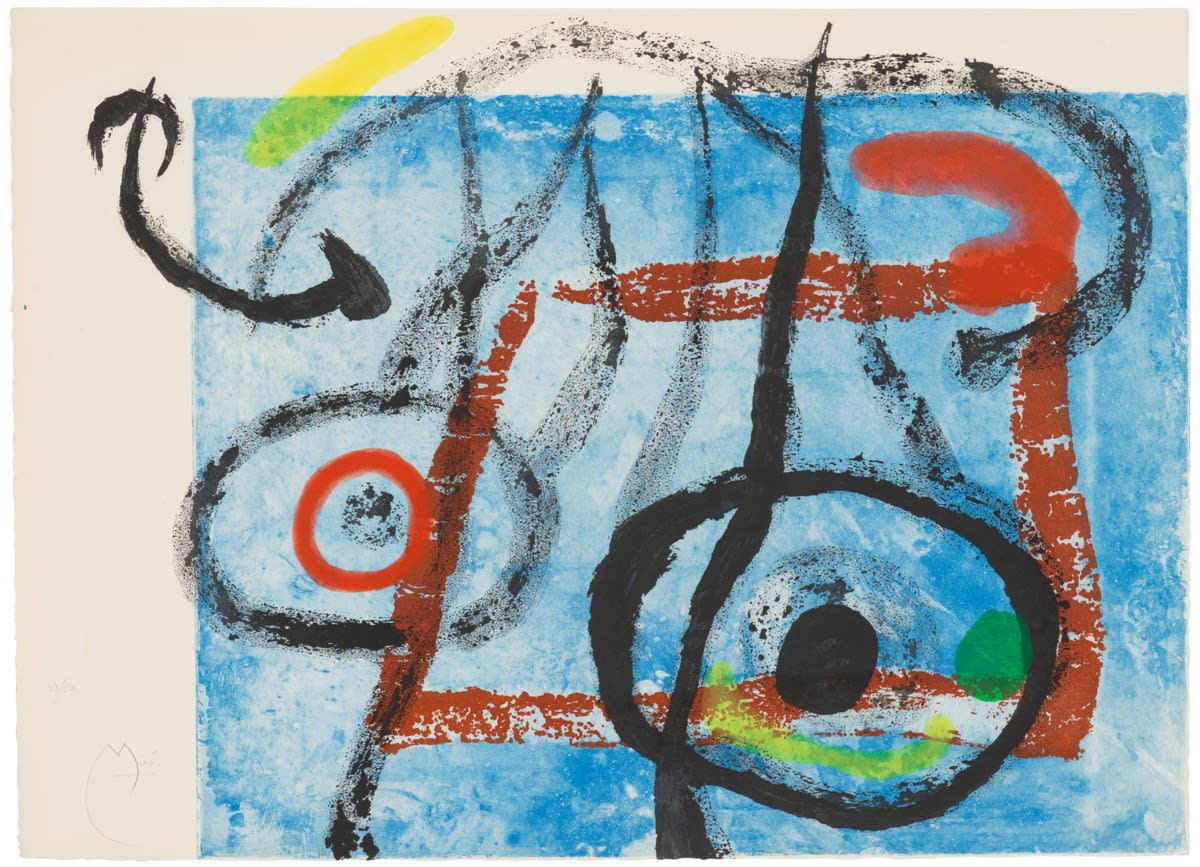
The volume engine and the entry point. $1,000–$50,000 covers the bulk of signed and numbered lithographs and etchings; scarce portfolio plates and major Maeght/Mourlot editions run higher. EGON's 2025–26 slice sits almost entirely in the $1,935–$45,150 band.
Unique vs multiple flag
CRITICAL for this artist: prints and multiples dominate lot COUNT while a handful of unique 1920s–30s canvases dominate VALUE. Any average computed across all Miró lots is close to meaningless without this split.
Later paintings 1950s 1970s
Typically low six figures to low seven figures depending on scale, date and whether the work is a major signed canvas or a small board/masonite piece.
Paintings trailing 12 months
Average of approximately $1,168,833 per painting across the trailing 12 months (MutualArt aggregate, Aug 2026) — heavily skewed upward by the Newhouse result and downward by a long tail of small late canvases.
Major early surrealist paintings 1923 1933
$10m–$53.5m. The 1924–27 Paris Surrealist years are the price apex — Portrait de Madame K (1924) at $53.5m and Peinture (Étoile Bleue) (1927) at $36.9m define the ceiling.
Liquidity
Depth
Exceptionally deep. MutualArt indexes 42,468 Miró artworks at auction. The print market alone has averaged over 1,300 lots annually across the last decade, peaking at 1,735 lots in 2024 (Artprice data cited by Mark Littler).
Turnover
Print-sector turnover grew from approximately £3.27m (2015) to £4.11m (2024), fluctuating within a narrow £3.15–4.11m band — described as resilient against broader art-market volatility.
Frequency
Miró trades in essentially every relevant international sale cycle at every price level, from $2,000 regional print lots to eight-figure evening-sale paintings. Among the most liquid names in modern art.
- Stability
- The unsold percentage in the print sector has been described as remarkably stable across the decade.
Comparables
Within Surrealism, Magritte is the direct turnover comparable and has outpaced Miró in some recent years; Ernst and Dalí trade below. Calder is the closest comparable on the sculpture/multiple axis and on the sheer breadth of a print-and-multiple tail. Picasso remains the only modern name with comparable lot volume and a materially higher ceiling.
Collector base
Profile
Three distinct constituencies: (1) trophy-level international collectors and guarantors for 1920s–30s canvases; (2) a broad mid-market of decorative-modern buyers for late paintings, ceramics and bronzes; (3) a very large, geographically dispersed print-collector base sustaining 1,300–1,700 lots per year.
Historical
Built through the Pierre Matisse Gallery, New York (Miró's dealer from the early 1930s until Matisse's death in 1989), whose client roster included Walter P. Chrysler Jr., A. E. Gallatin, Joseph Hirshhorn, Duncan Phillips, Joseph Pulitzer Jr., Nelson A. Rockefeller and James Thrall Soby, as well as major American museums.
Recent named
S.I. Newhouse (Portrait de Madame K, sold at Christie's May 2026); Max Ernst as first owner of that painting; Florene M. Schoenborn (Dutch Interior III, bequeathed to the Met); earlier single-owner sales carrying Miró include the A. Alfred Taubman and David M. Solinger collections at Sotheby's.
Dealer stock note
On Pierre Matisse's death the gallery's stock was purchased by Acquavella Galleries and Sotheby's, concentrating significant Miró inventory in those hands; the archives went to the Morgan Library.
- Primary market
- Not applicable — artist died in 1983. Access runs through the secondary trade and estate-linked dealers; see gallery_data.
Auction history
Buy in context
Bought-in risk concentrates in over-estimated late-period canvases and repeat-offered material. Notably, the 2012 Sotheby's London session that set the prior record was itself reported as thin, with 15 paintings failing to attract a single bid — a reminder that a headline Miró result can coexist with weak depth in the same room.
Current record
$53,535,000 — Portrait de Madame K (1924), oil, charcoal and coloured wax crayon on canvas, Christie's New York, 18 May 2026, in 'Masterpieces: The Private Collection of S.I. Newhouse'. Christie's confirmed it as a new auction record for the artist; the price more than doubled the low estimate.
Record context
The result beat the previous record by approximately $16.5m — a 44% uplift. The painting had traded twice previously and was first owned by fellow Surrealist Max Ernst. All 16 works in the Newhouse sale were backed by guarantees, and the session totalled $630.8m.
Previous record
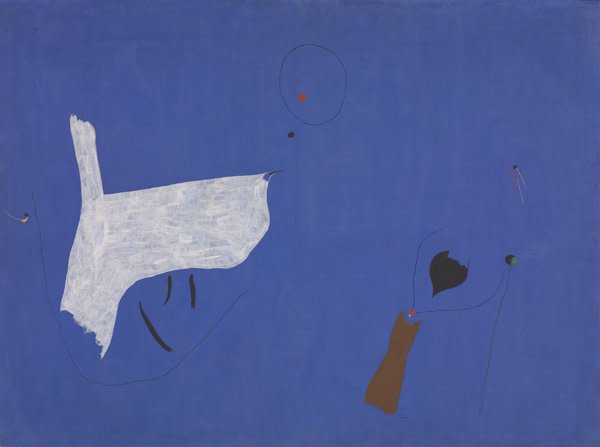
Peinture (Étoile Bleue) (1927) — £23,561,250 / $36,946,396 / €29,260,764, Sotheby's London, 19 June 2012 (some later reporting cites $37.04m). It exceeded a £15–20m estimate after a four-bidder contest and was the highest price for any work of art sold in London that year to that date. It stood unbeaten for 14 years.
- Works on paper record
- $10,401,000 — highest recorded result for a Miró work on paper (MutualArt aggregate).
Recent discovery event
Three previously unknown works on paper found among the belongings of Miró's friend Vernassa — including two large-scale drawings roughly nine feet long designed as indoor balcony railings, discovered in a sealed poster tube — consigned to auction in Antibes with estimates reaching €400,000, after a showcase during Paris Drawing Week (Artnet News, 17–18 March 2026).
Market position
- Peer set
- Picasso, Magritte, Ernst, Dalí, Calder, Léger, Kandinsky.
Macro context
The May 2026 Christie's two-session total of $1.1bn and the $630.8m Newhouse result place the Miró record within a broadly strong moment for blue-chip modern material, meaning some of the uplift is segment beta rather than Miró-specific alpha.
- Return profile
- Sotheby's cites Mei Moses data giving an average compound annual return of 8.0% for Miró, with 88.7% of resold works increasing in value.
Relative standing
A leading figure in the Western art market and the second pole of the Surrealist market. ArtPro notes that in 2019 and 2020 Miró was surpassed by René Magritte on total turnover — a function of Magritte's repricing rather than Miró weakness. The May 2026 record narrows that gap materially.
Price determinants research
A hedonic regression on 255 Miró works sold at Sotheby's and Christie's between 2003 and 2017 (Academia Revista Latinoamericana de Administración / Emerald) found higher prices, ceteris paribus, for works on canvas, sold at Sotheby's, in New York or London, in evening sessions, and varying with the period painted, surface area, the number of words in the lot description, and whether the work had appeared in an art book.
Investment outlook
Risks
Enormous supply of prints and late works structurally caps average price appreciation and creates severe quality dispersion; attribution and condition risk on newly surfaced material (see the March 2026 Antibes discovery); works on unevenly primed or mixed supports carry condition sensitivity; top-end results are guarantee-influenced and may not be replicable without another Newhouse-calibre consignment.
Drivers
Scarcity of 1923–33 Surrealist canvases; guarantee-backed single-owner sales; broad May 2026 strength in the modern segment; uninterrupted museum exhibition demand into 2026–27 (MFA Boston, Voorlinden, both Miró foundations).
Trajectory
Positive, with a clear structural split. The top of the market repriced sharply in May 2026 (+44% record); the mid and print markets are stable-to-slowly-appreciating rather than accelerating.
Entry points
Signed/numbered lithographs $2k–$20k; strong Maeght-period portfolio plates $20k–$60k; ceramics and bronzes in the low-to-mid six figures; late canvases from roughly $300k; 1920s–30s canvases only at seven-to-eight figures.
Egon database 2025 onward
- Sold
- 45
- Total lots
- 53
Recent sales
- Je travaille comme un jardinier — $1,935, Phillips, Apr 2026 (exceeded high estimate)
- Village d'oiseaux (Bird Village) (D. 526) — $7,095, Phillips, Apr 2026
- Le Journal (The Newspaper) (M. 836) — $7,095, Phillips, Apr 2026 (above estimate)
- Saccades, one plate (D. 331) — $3,096, Phillips, Apr 2026 (above estimate)
- Hai-Ku (M. 550-6) — $16,770, Phillips, Apr 2026 (exceeded high estimate)
- Upcoming lots
- 7
Interpretation
This slice is overwhelmingly the PRINTS AND MULTIPLES stratum (D./Dupin and M./Mourlot catalogue numbers throughout), not the painting market. It does not represent Miró's price ceiling: the same 18-month window contains a $53.5m painting result at Christie's that this slice does not capture. The two datasets describe two distinct market strata and are NOT reconciled here — the gap is structural, not a hammer-versus-premium artefact.
Provenance note
Figures in this block come from the EGON internal database (Christie's, Sotheby's, Phillips, Bonhams; 2025 onward) with work/house/date attached. They are reported SEPARATELY from web-sourced prices and are not merged with them.
Sell through note
45 of 53 lots settled as sold. Per the brief's own caveat, unsettled lots are disproportionately passes and any computed sell-through rate would be inflated, so no rate is asserted.
- Recent price range
- $1,935 – $45,150
- Recent average hammer
- $12,268
- Highest recorded in database
- $191,417 — Figure, Phillips, June 2025
Institutional presence
Research updated
Exhibitions
Landmark solo
- 1918 — Galeries Dalmau, Barcelona (first solo exhibition)
- 1925 — Galerie Pierre, Paris (first Paris solo)
- 1941 — Joan Miró, The Museum of Modern Art, New York (first major museum retrospective)
- 1959 — MoMA retrospective, New York
- 1974 — Grand Palais, Paris, retrospective organised by Jean Leymarie
- 1993 — MoMA centennial retrospective, New York
- 2004 — Joan Miró, 1917–1934: La Naissance du Monde, Centre Pompidou, Paris
- 2008–09 — Joan Miró: Painting and Anti-Painting 1927–1937, MoMA, New York (11 Feb 2008 – 12 Jan 2009 per lender records)
- 2011 — Joan Miró: The Ladder of Escape, Tate Modern, London (travelled)
- 2018 — Joan Miró: ordre i desordre, IVAM, Valencia (15 Feb – 17 Jun 2018); Joan Miró: Esculturas 1928–1982, Fundación Botín, Santander (19 Mar – 2 Sep 2018)
- 2018–19 — Miró, Galeries nationales du Grand Palais, Paris: retrospective of nearly 150 works (3 Oct 2018 – 4 Feb 2019), staged 44 years after the Leymarie exhibition in the same venue
Current and upcoming 2026 27
- Picasso, Miró, Dalí: Unbound — livres d'artiste, Museum of Fine Arts Boston, Lois B. and Michael K. Torf Gallery (Gallery 184), 1 August 2026 – 24 January 2027
- Museum Voorlinden, Wassenaar — Miró presentation opening 12 September 2026
- Reencountering Miró / 'The Magical Spark', Fundació Miró Mallorca, Espai Estrella, opened February 2026; the 2026 programme is led by this project
- Fundació Joan Miró, Barcelona — 2026 collection displays including the newly donated Untitled (1930); note the Foundation's own major autumn 2026 anthological exhibition is devoted to Charlotte Perriand, not to Miró
- Inquietude: Liberty and Democracy, La Casa Encendida, Madrid (until 8 March 2026) — 50+ artists including Miró, Paula Rego and Maria Helena Vieira da Silva
Significant group and biennial
- 1954 — Venice Biennale (awarded the Grand Prize for Graphic Work)
- 1955 — documenta 1, Kassel
- 2017 — Calder / Miró: Constellations, Acquavella Galleries and Pace Gallery, New York (approx. 60 sculptures, paintings and works on paper across two venues)
- 2016–17 — Mayoral presentations at La Biennale des Antiquaires, Paris, then Barcelona and London
Correction to a plausible misreading
A Grand Palais programme page titled 'Miró' surfaces adjacent to the dates 2 June – 6 September 2026, but those dates belong to a Leandro Erlich exhibition on the same page. The Grand Palais Miró retrospective ran 3 October 2018 – 4 February 2019. NO 2026 Grand Palais Miró exhibition is asserted here.
Publications
- Miró: Catalogue Raisonné, Paintings — six volumes covering 1908–1981; research begun in 1957, with the artist and later the Miró estate closely involved; by Jacques Dupin with Ariane Lelong-Mainaud and Joan Punyet Miró (Daniel Lelong / Successió Miró)
- Joan Miró: Catalogue Raisonné, Drawings — Jacques Dupin, multi-volume (D. Lelong / Successió Miró), vols. covering 1901–1937, 1938–1959, 1960–1972 and later
- Catalogues raisonnés of the graphic work: the 'D.' (Dupin) and 'M.' (Mourlot) numbering systems are the standard citation apparatus in auction cataloguing and appear throughout the 2025–26 Phillips lots
- Jacques Dupin's monograph, first published 1961, comprehensively revised and enriched for the 1993 centenary using posthumously discovered projects, sketchpads, texts and correspondence accessed through his relationship with the artist's family
- Museum-published scholarship: MoMA (1941, 1959, 1993, 2008), Centre Pompidou (2004), Tate Modern (2011), Grand Palais (2018), Galerie Lelong's 'Miró: Femmes, oiseaux et monstres' with a text by Rémi Labrusse (2018)
- Academic art-market literature: hedonic price analysis of 255 Miró works, Academia Revista Latinoamericana de Administración (Emerald)
Museum collections
The Museum of Modern Art, New York
- Tier
- First-rank
Holding
Described in MoMA's own curatorial material as one of the finest and most comprehensive Miró collections in the world; includes The Birth of the World (1925), The Hunter (Catalan Landscape), and Black and Red Series (1938)
Credit lines
Black and Red Series (Série noire et rouge), 1938
- Acquisition type
- Curatorial purchase — named fund plus donor-designated funds
Credit line verbatim
Purchased with the Frances Keech Fund and funds given by Agnes Gund and Daniel Shapiro, Gilbert Kaplan, Jeanne C. Thayer, Reba and Dave Williams, Ann and Lee Fensterstock, Linda Barth Goldstein, Walter Bareiss, Mrs. Melville Wakeman Hall, Emily Rauh Pulitzer, and Mr. and Mrs. Herbert D. Schimmel
The Birth of the World, Montroig, late summer–fall 1925
Acquisition type
Partially captured — MoMA press material states the Museum acquired the work in 1972, in part as a gift from the artist. The full published credit string was not retrieved; recorded as partial rather than reconstructed.
- Credit line verbatim
- Acquired through an anonymous fund, the Mr. [record truncated in retrieved source]
The Metropolitan Museum of Art, New York
- Tier
- First-rank
- Holding
- Dutch Interior (III) (1928); Collage Painting; Untitled; Moonbird (1946, acc. 2002.456.121)
Credit lines
Dutch Interior (III), 1928
- Acquisition type
- Bequest — offered and accepted; no fund or committee named
- Credit line verbatim
- Bequest of Florene M. Schoenborn, 1995
Collage Painting; Untitled
- Credit line verbatim
- credit line not published in retrieved record
Solomon R. Guggenheim Museum, New York
- Tier
- First-rank
- Holding
- Painting, plus further works in the Collection Online
- Credit line verbatim
- credit line not published in retrieved record
Centre Pompidou / Musée National d'Art Moderne, Paris
- Tier
- First-rank
- Holding
- Significant French national holdings; originated 'Joan Miró, 1917–1934: La Naissance du Monde' (3 Mar – 28 Jun 2004)
- Credit line verbatim
- credit line not published in retrieved record
Tate, London
- Tier
- First-rank
- Holding
- Paintings and works on paper in the UK national collection; Tate Modern staged the 2011 retrospective 'Joan Miró: The Ladder of Escape'
- Credit line verbatim
- credit line not published in retrieved record — Tate collection pages were not retrieved in this research pass; not inferred
View 8 more records
Museo Nacional Centro de Arte Reina Sofía, Madrid
- Tier
- First-rank
- Holding
- Spanish national holdings; Miró remains active in Spanish institutional programming
- Credit line verbatim
- credit line not published in retrieved record
Philadelphia Museum of Art
- Tier
- First-rank (US encyclopedic)
- Holding
- Works in the permanent collection; has featured Miró in exhibitions (per MutualArt institutional listing)
- Credit line verbatim
- credit line not published in retrieved record
Museum of Fine Arts, Boston
- Tier
- First-rank (US encyclopedic)
Holding
Livres d'artiste including Le Lézard aux plumes d'or (40 colour lithographs); Miró paintings shown in the new Modern Art galleries, where some Miró material is on loan rather than owned
- Credit line verbatim
- credit line not published in retrieved record
Mildred Lane Kemper Art Museum, Washington University in St. Louis
- Tier
- University museum
- Holding
- Peinture (Painting), 1933 — lent to MoMA's 'Painting and Anti-Painting 1927–1937' (2008–09) and to the Centre Pompidou's 2004 Miró exhibition
- Acquisition type
- Curatorial purchase — named fund; notable for its early date (1945)
- Credit line verbatim
- University purchase, Kende Sale Fund, 1945
Fundació Joan Miró, Barcelona
Tier
Dedicated single-artist foundation (Josep Lluís Sert building, opened 1975). Not counted as a first-rank encyclopedic museum acquisition for scoring purposes, but the primary public repository of the artist's own donations
- Holding
- Core collection formed by the artist's donation, incl. Morning Star and Constellations-period works; most recent addition Untitled (1930)
- Acquisition type
- Donation
- Credit line verbatim
- for Untitled (1930): added to the Collection 'thanks to a donation from Françoise Marquet Zao' (Foundation wording)
Fundació Pilar i Joan Miró a Mallorca, Palma
- Tier
- Dedicated foundation
Holding
Established 1981 by the Palma de Mallorca city council, housed in the four studios Miró donated for the purpose; holds studio contents, unfinished works and archives
- Credit line verbatim
- studios donated by the artist for the purpose (Foundation wording)
Museum Voorlinden, Wassenaar (Netherlands)
- Tier
- Private museum (non-accessioning for scoring purposes)
- Holding
- Miró presentation announced from 12 September 2026
Public commissions in situ
- Tier
- n/a
Holding
Painted mural, Harvard University; ceramic wall, UNESCO headquarters, Paris; monumental public sculpture and ceramics in Barcelona, Chicago and elsewhere
Awards and recognition
- 1954 — Grand Prize for Graphic Work, Venice Biennale
- 1958 — Guggenheim International Award (for the UNESCO ceramic wall)
- 1975 — Fundació Joan Miró established, Barcelona
- 1979 — Doctorate honoris causa, University of Barcelona
- 1980 — Gold Medal of Fine Arts, Spain, presented by King Juan Carlos
- 1981 — Fundació Pilar i Joan Miró a Mallorca founded by the Palma city council in his donated studios
Credit line methodology note
Credit lines are transcribed verbatim where the museum publishes one and the record was retrieved in this pass. Where a record was not retrieved, 'credit line not published in retrieved record' is used rather than an inference. Per the brief's own caveat on Rule 1, curatorial-initiation analysis has limited diagnostic value for a historical artist of Miró's standing — depth of national and international institutional holding and state cultural recognition are the operative evidence, and both are extensive.
Career & Biography
Research updated
Identity
- Born
- 20 April 1893, Barcelona, Catalonia, Spain
- Died
- 25 December 1983, Palma de Mallorca, Balearic Islands, Spain (aged 90)
- Family
- Born into a family of watchmakers/goldsmiths; married Pilar Juncosa Iglésias in 1929
- Gender
- Male
- Status
- Deceased — estate/foundation-administered market (Successió Miró, Palma; Fundació Joan Miró, Barcelona)
- Full name
- Joan Miró i Ferrà
- Nationality
- Spanish (Catalan)
Note on getty and museum api flags
The 'no Getty ULAN data' and 'no works found in checked museum APIs' flags in the brief are lookup/pipeline failures, NOT signals about the artist. Miró is among the most fully documented artists of the 20th century: a six-volume paintings catalogue raisonné begun in 1957, two dedicated public foundations, and MoMA retrospectives from 1941 onward.
Career timeline
- 1918
- First solo exhibition, Galeries Dalmau, Barcelona
- 1920
- Moves to Paris; enters the circle of André Breton, Max Ernst, Jean Arp, Tristan Tzara; establishes the Paris-winter / Mont-roig-summer rhythm
- 1928
- Dutch Interiors series after a two-week trip to Holland; begins collage / 'anti-painting' experiments
- 1941
- First major museum retrospective, The Museum of Modern Art, New York
- 1954
- Grand Prize for Graphic Work, Venice Biennale
- 1955
- Included in the first documenta, Kassel
- 1956
- Settles permanently in Palma de Mallorca; Josep Lluís Sert designs his Son Abrines studio
- 1958
- Guggenheim International Award (for the UNESCO ceramic wall)
- 1974
- Grand Palais retrospective, Paris, organised by Jean Leymarie
- 1975
- Fundació Joan Miró opens on Montjuïc, Barcelona, in a Josep Lluís Sert building
- 1979
- Doctorate honoris causa, University of Barcelona
- 1980
- Gold Medal of Fine Arts awarded by King Juan Carlos of Spain
- 1981
- Fundació Pilar i Joan Miró a Mallorca established by the Palma city council in the four studios Miró donated for the purpose
- 1983
- Dies in Palma de Mallorca
1930s
Pierre Matisse becomes his New York dealer in the early 1930s, decisive for his American reputation; 'savage paintings' respond to the Spanish Civil War; Aidez l'Espagne (1937) and The Reaper for the Spanish Pavilion
- 1940-41
- Constellations series begun at Varengeville, continued in Palma and Mont-roig during war and exile
1924-1925
Aligns with Surrealism; paints Portrait de Madame K (1924, the year of Breton's Surrealist Manifesto) and The Birth of the World (1925); first Paris solo show at Galerie Pierre (1925)
1944-1950s
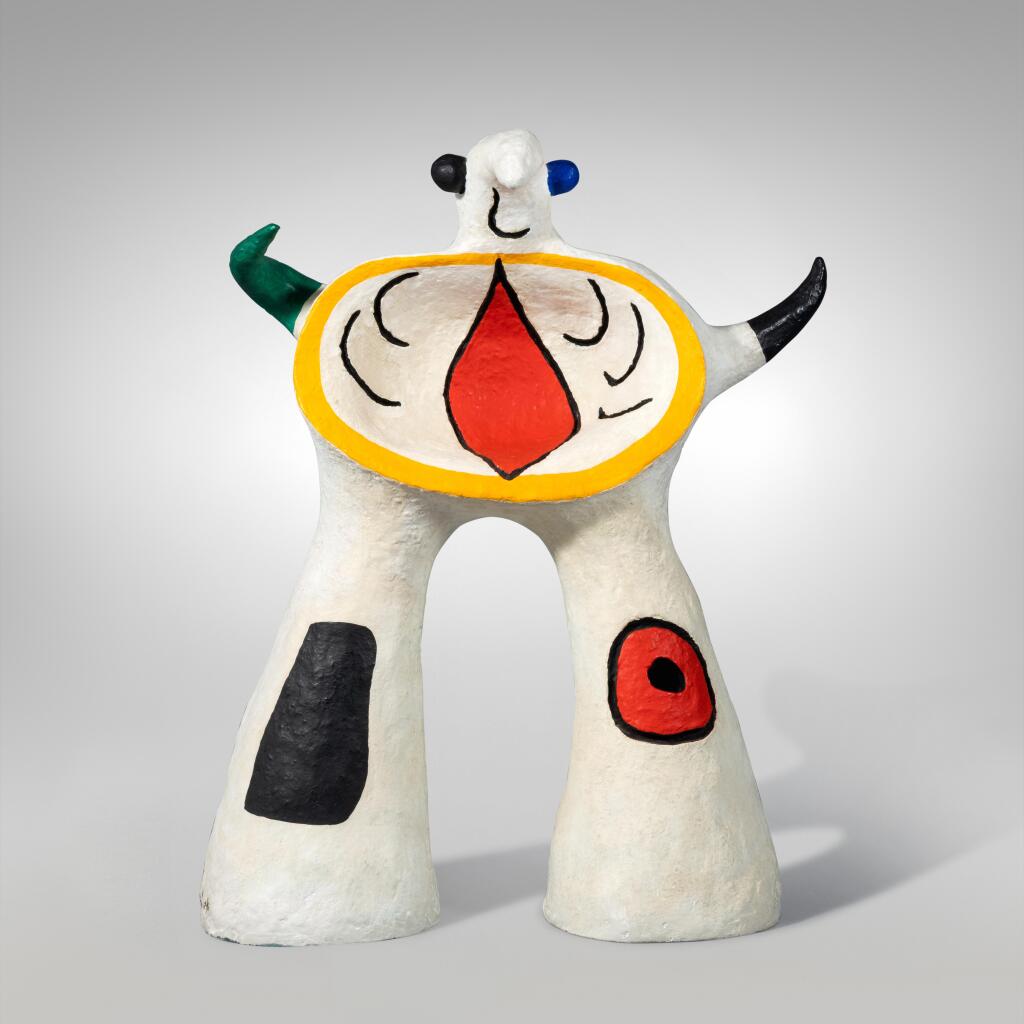
Turns intensively to ceramics (with Josep Llorens Artigas), printmaking and sculpture; from 1945 works in terracotta to make maquettes for large-scale bronzes such as Moonbird (1946)
- 1959 and 1993
- Further MoMA retrospectives (1993 marking the birth centenary)
- 1950s commissions
- Painted mural for Harvard University; ceramic wall for the UNESCO headquarters, Paris
Studio practice
Dual-base practice (Paris/Mont-roig, later Palma). Method combined an uncontrolled first stage — poured, brushed and flung paint on an unevenly primed canvas so pigment soaks in some areas and rests on top in others — with a carefully calculated second stage of drawn signs derived from prior studies; Miró described beginning to paint and letting the picture assert itself under the brush. Later decades were dominated by collaborative workshop production: ceramics with Llorens Artigas, lithography with Maeght/Mourlot and Galerie Gérald Cramer, bronze casting from found-object assemblages.
Education and training
- 1911
- Exhibited his first painting at the sixth Exposición Internacional de Arte, Barcelona
1907-1913
Enrolled in business/commerce school at 14 while concurrently taking art classes; studied at the Escola de Belles Arts de la Llotja (Escuela Superior de Artes Industriales y Bellas Artes), Barcelona; also Cercle Artístic de Sant Lluc
- 1912-1915
- Studied under Francesc Galí at the Escola d'Art de Francesc Galí, Barcelona
- Pre art career
- Worked as an accounts clerk (Dalmau i Oliveres, Barcelona); abandoned the commercial path around 1912, reportedly following a breakdown/illness
Political social engagement
Anti-Franco Catalan. The Spanish Civil War produced Aidez l'Espagne (1937) and the Spanish Pavilion mural The Reaper; long exile from Francoist Spain; his donation of studios and works to public foundations in Barcelona and Palma functioned as a cultural restitution to Catalonia. Works by Miró were included in the 2026 Madrid exhibition 'Inquietude: Liberty and Democracy' examining the end of the Spanish and Portuguese dictatorships.
Artistic context and influences
Formative
Catalan Romanesque frescoes and folk art; the Mont-roig landscape of the Baix Camp; Fauvism and Cubism absorbed in Barcelona and the early Paris years
- Self positioning
- Resisted the Surrealist label; considered his art free of any 'ism' (per the Met's account)
- Surrealist circle
- Breton, Ernst, Arp, André Masson (studio neighbour on rue Blomet), Tzara, Éluard; automatism and poetic dictation
- Emotional geographies
- Per the Fundació Joan Miró, the landscapes that shaped him were principally Mont-roig, Paris and Majorca, later New York and Japan
Contemporaries and dialogues
Picasso, Calder (lifelong friendship; the paired Constellations projects), Giacometti, Dubuffet, Balthus — several sharing the Pierre Matisse Gallery stable; significant influence on Abstract Expressionism after his New York exposure in the 1940s
Artistic Profile
Research updated
Style
Formal devices
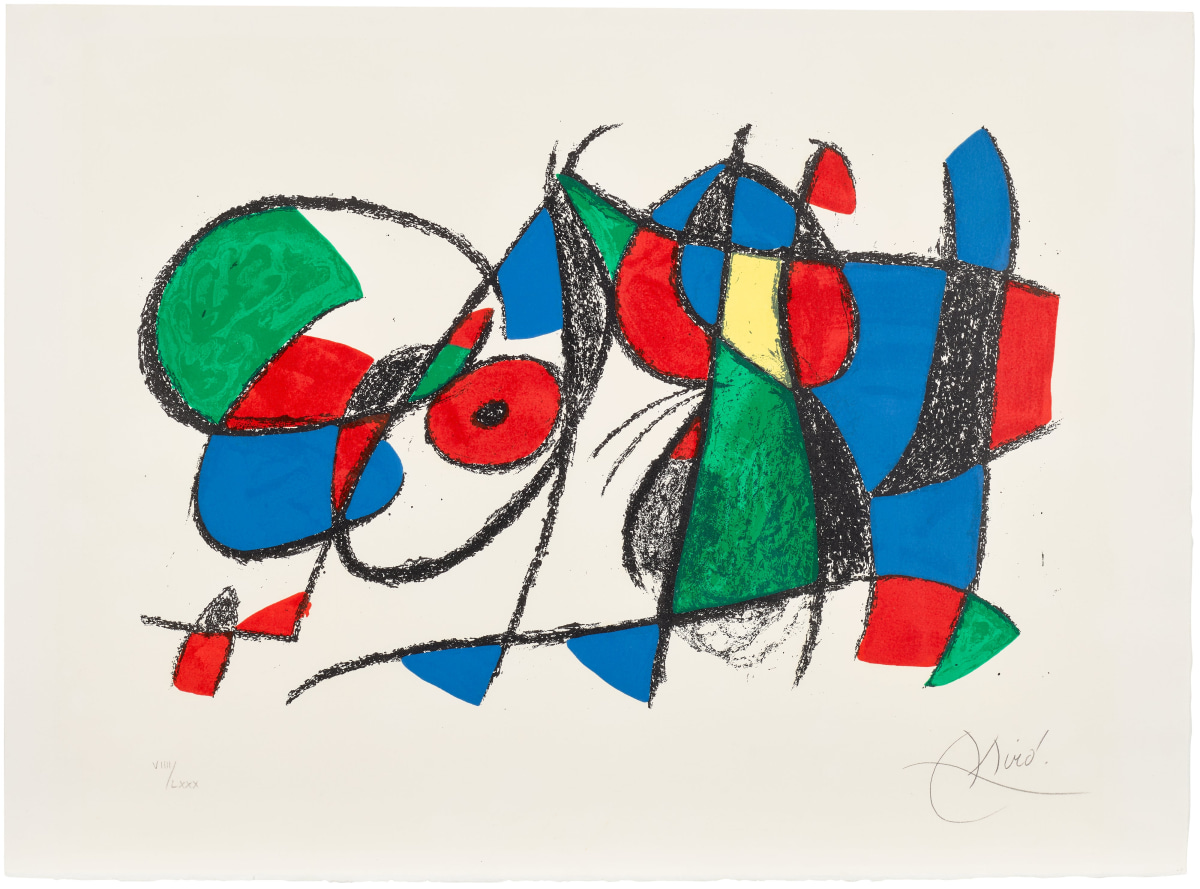
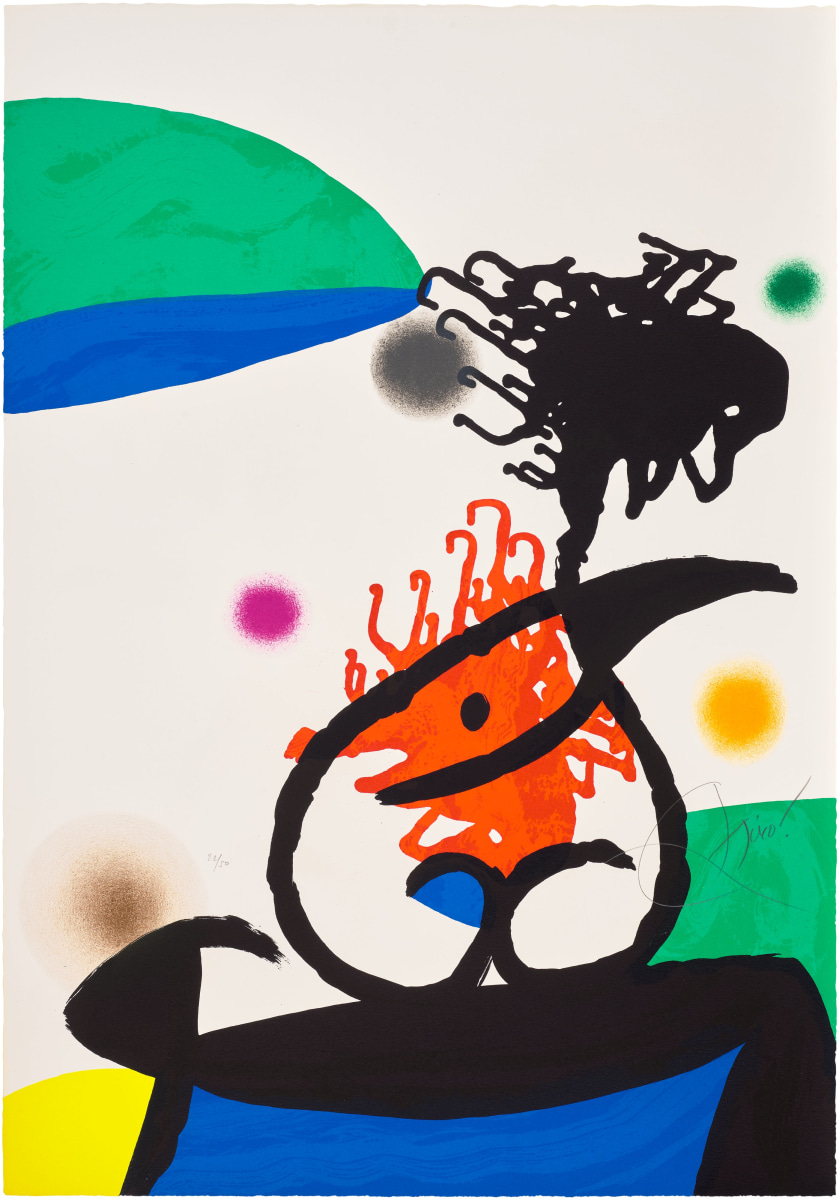
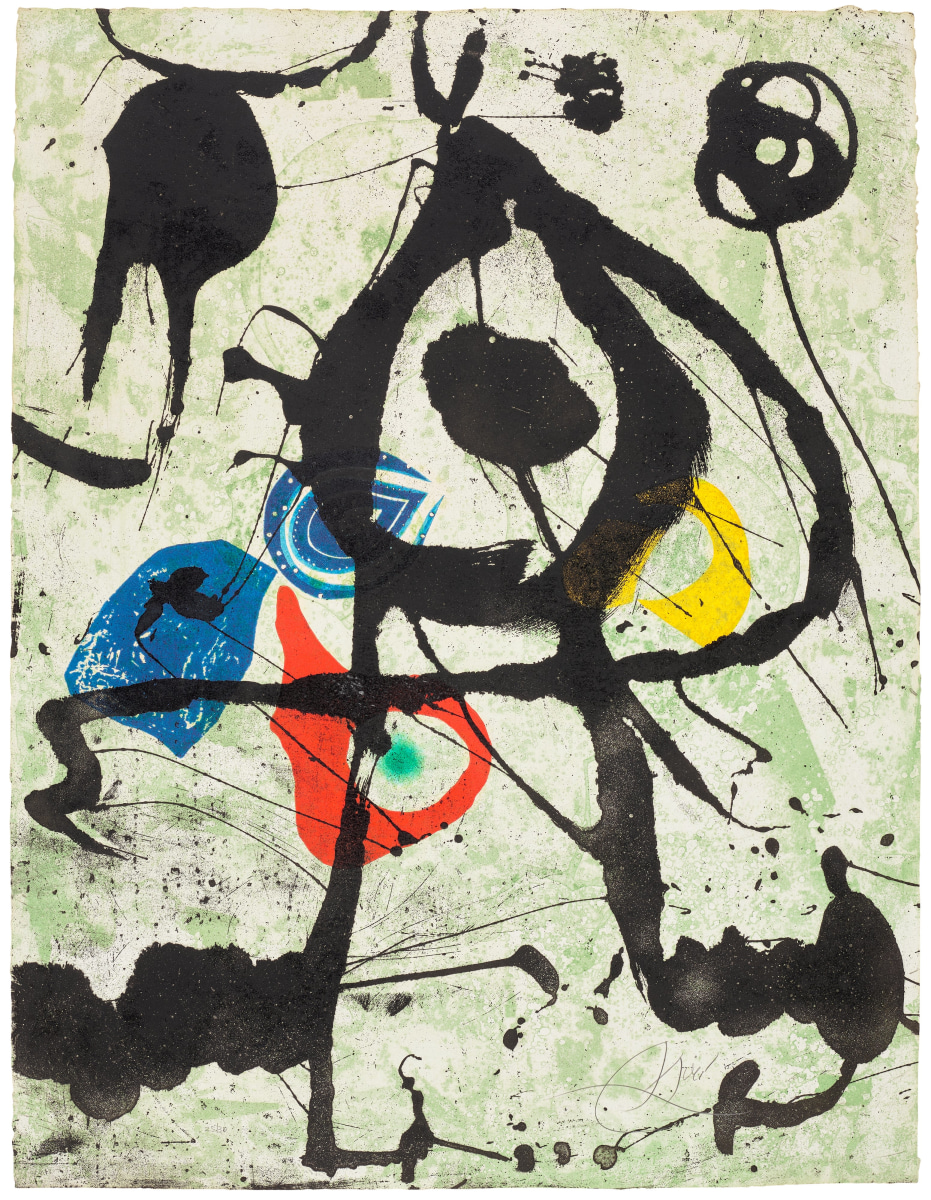
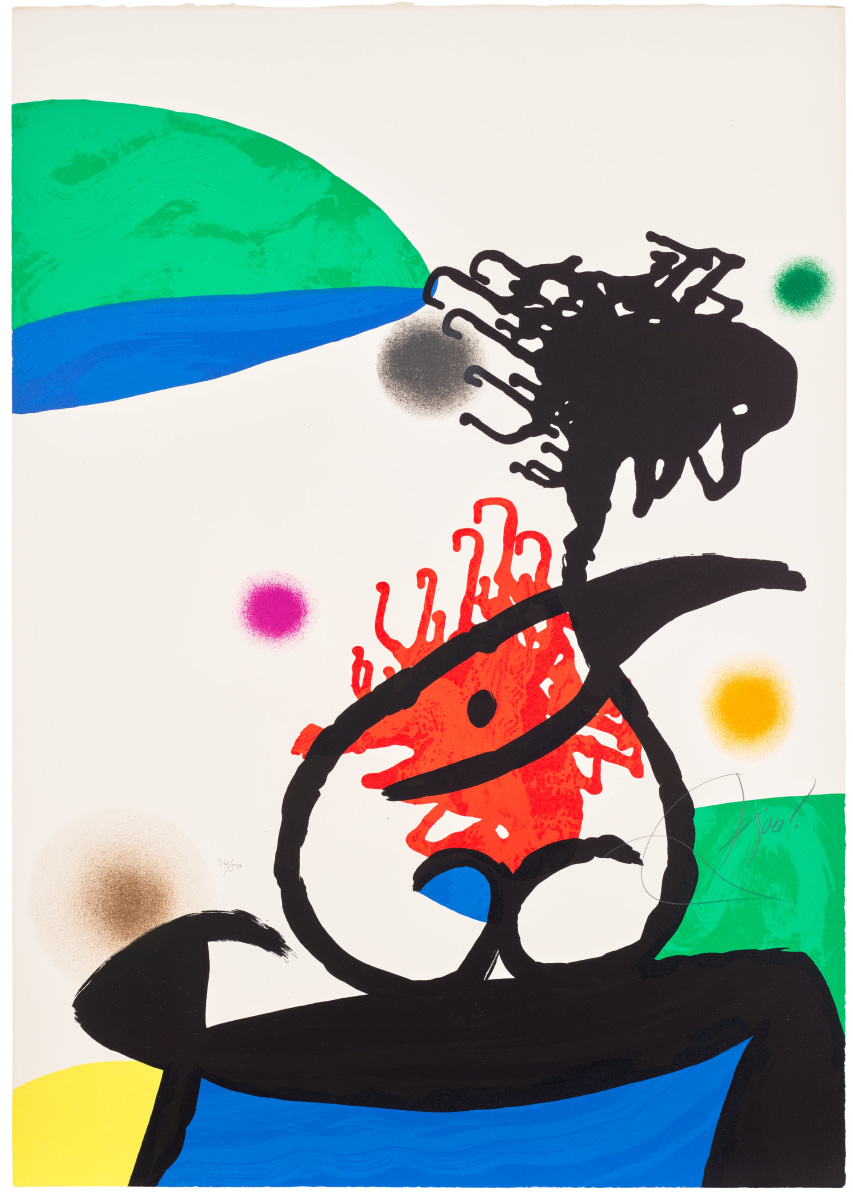
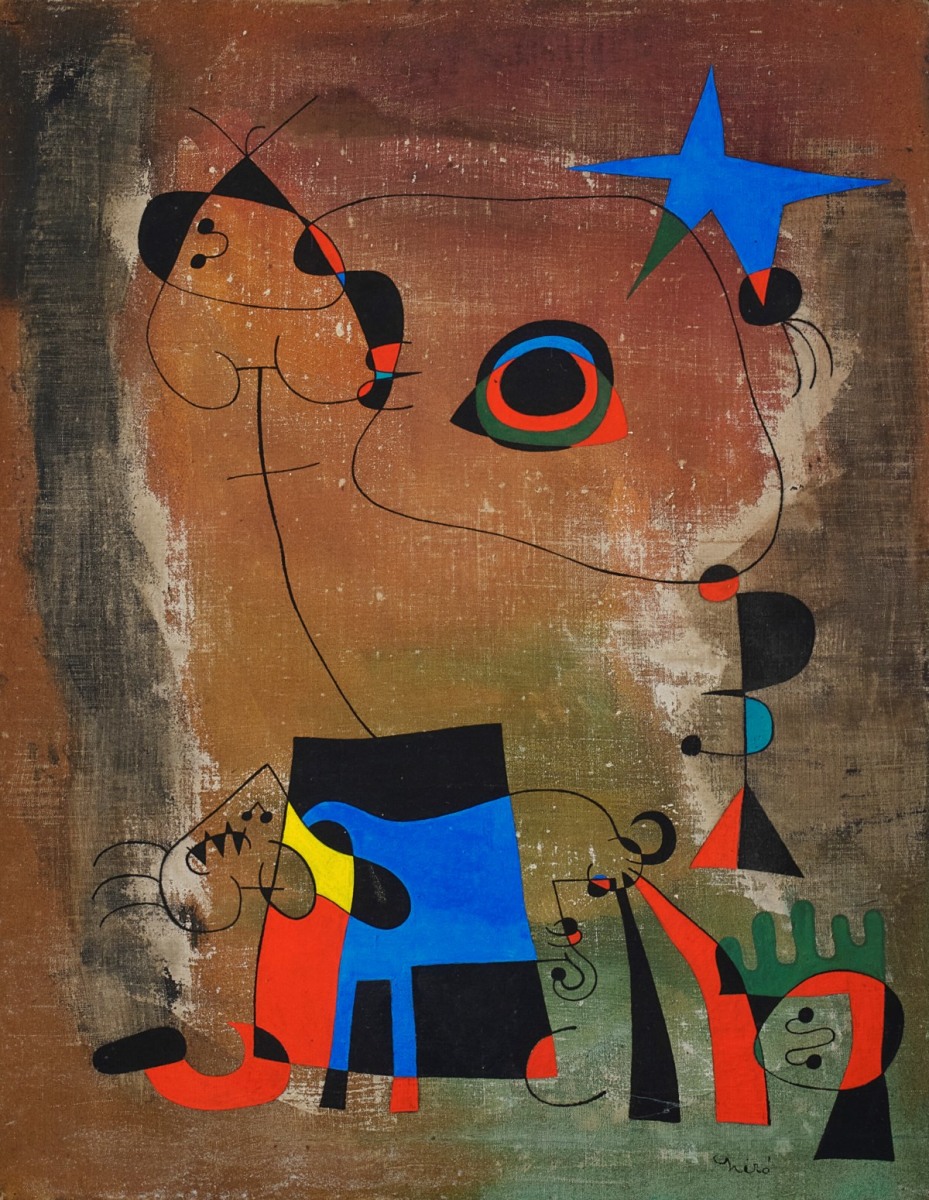
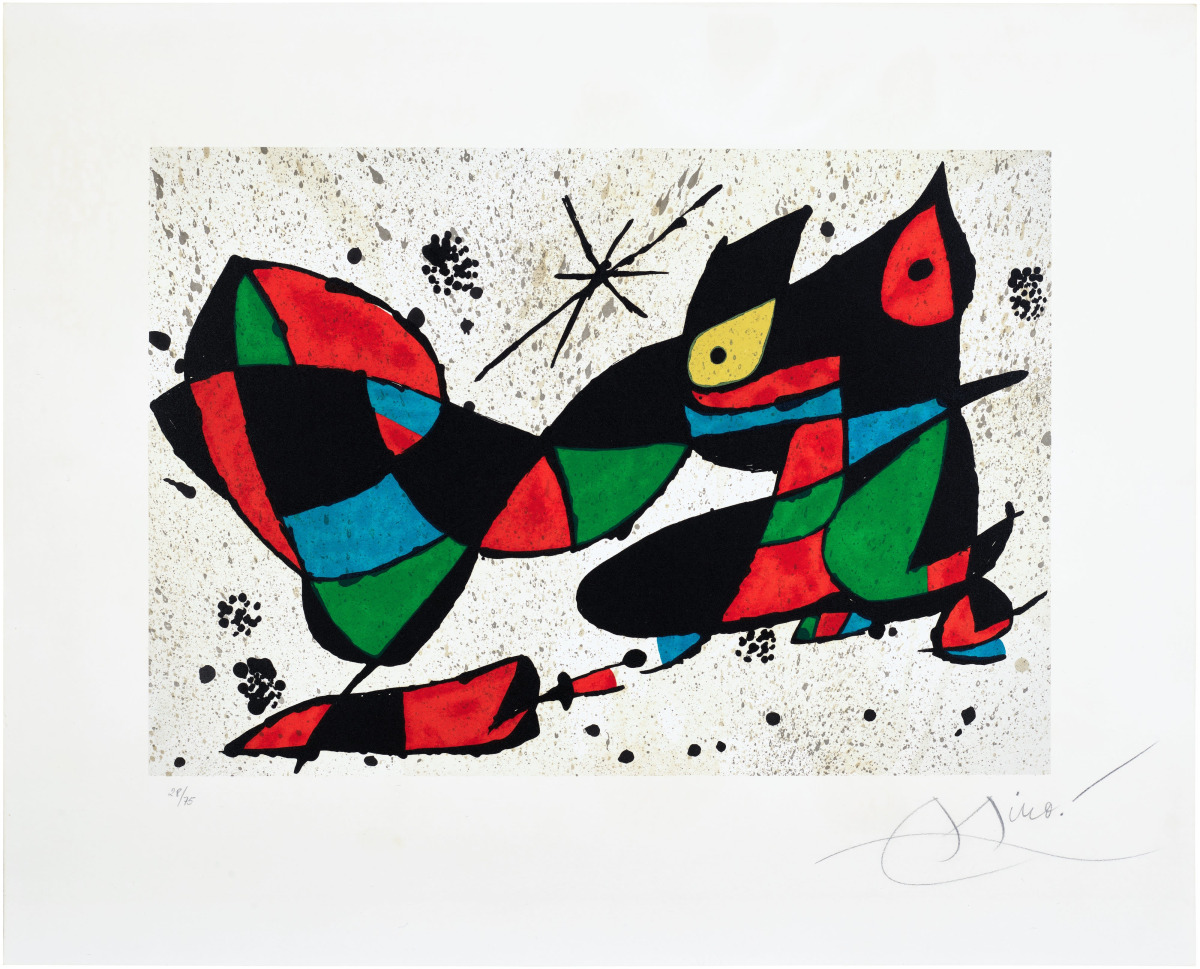
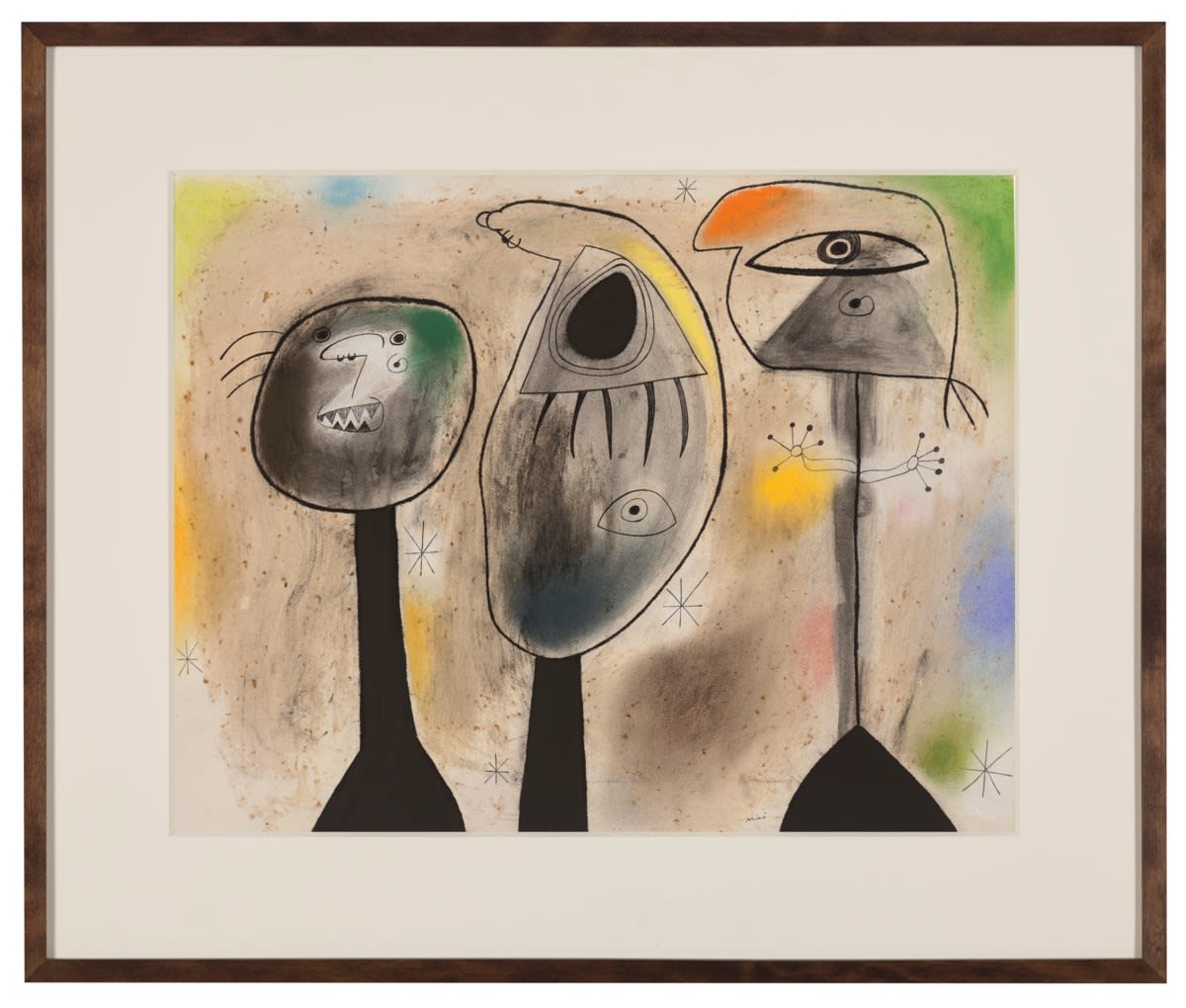
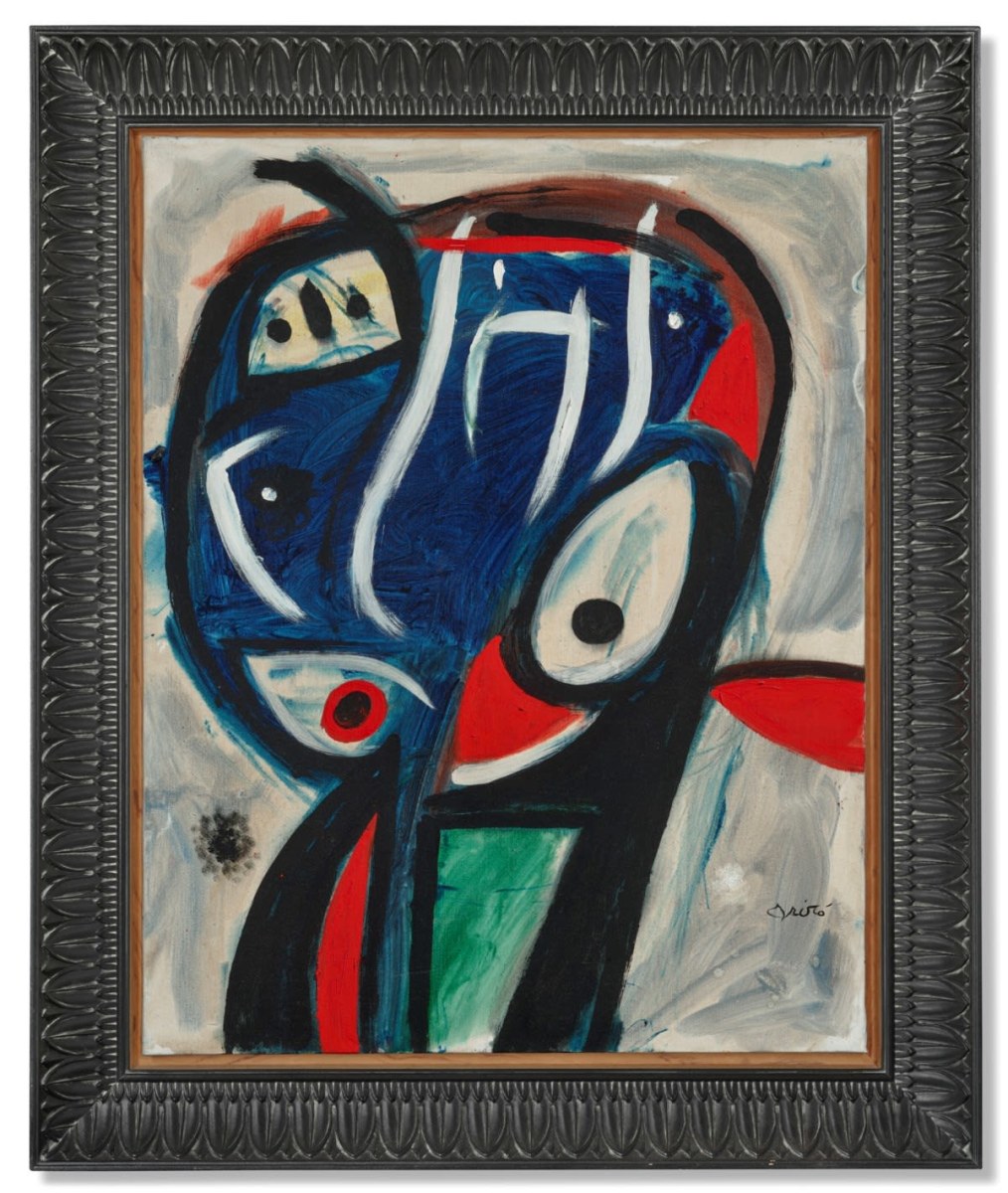
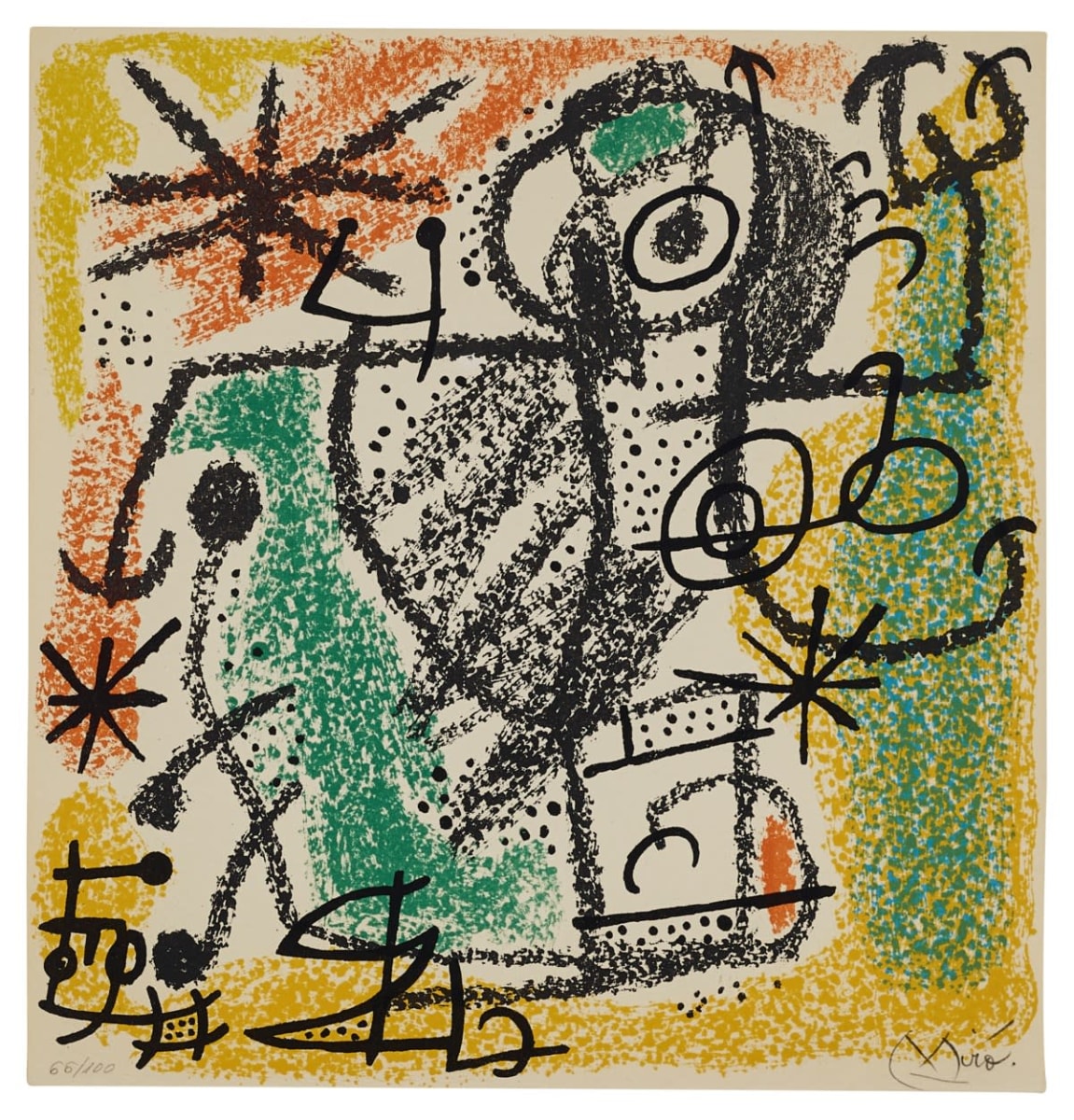
All-over composition; asymmetrical balance; assertive flatness; active negative space; monumental scale in the poster and mural work; a black brush-armature partitioning saturated red, blue, yellow and green zones against white or spattered grounds.
Surface method
An uncontrolled first stage — poured, brushed and flung paint on unevenly primed canvas so that pigment soaks in some areas and rests on top in others — overlaid by a deliberately calculated second stage of pre-studied signs. Miró described the second stage as carefully calculated, and elsewhere described beginning to paint and letting the picture assert itself under the brush.
Core visual language
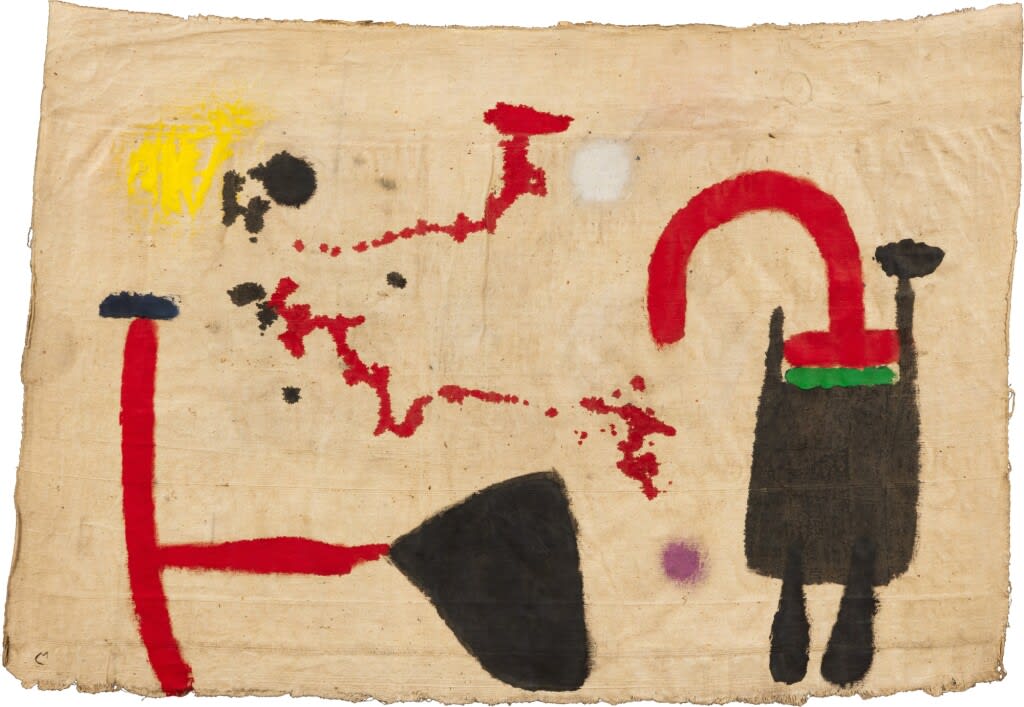
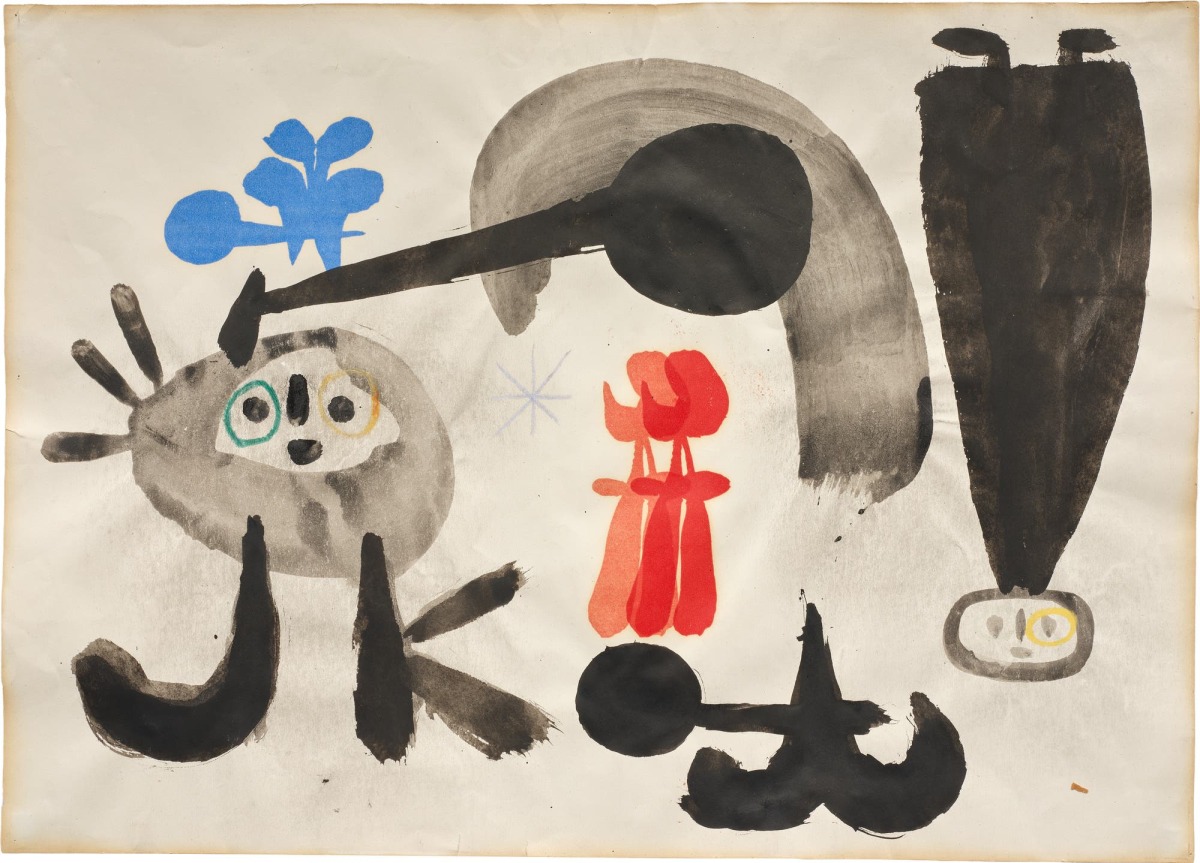
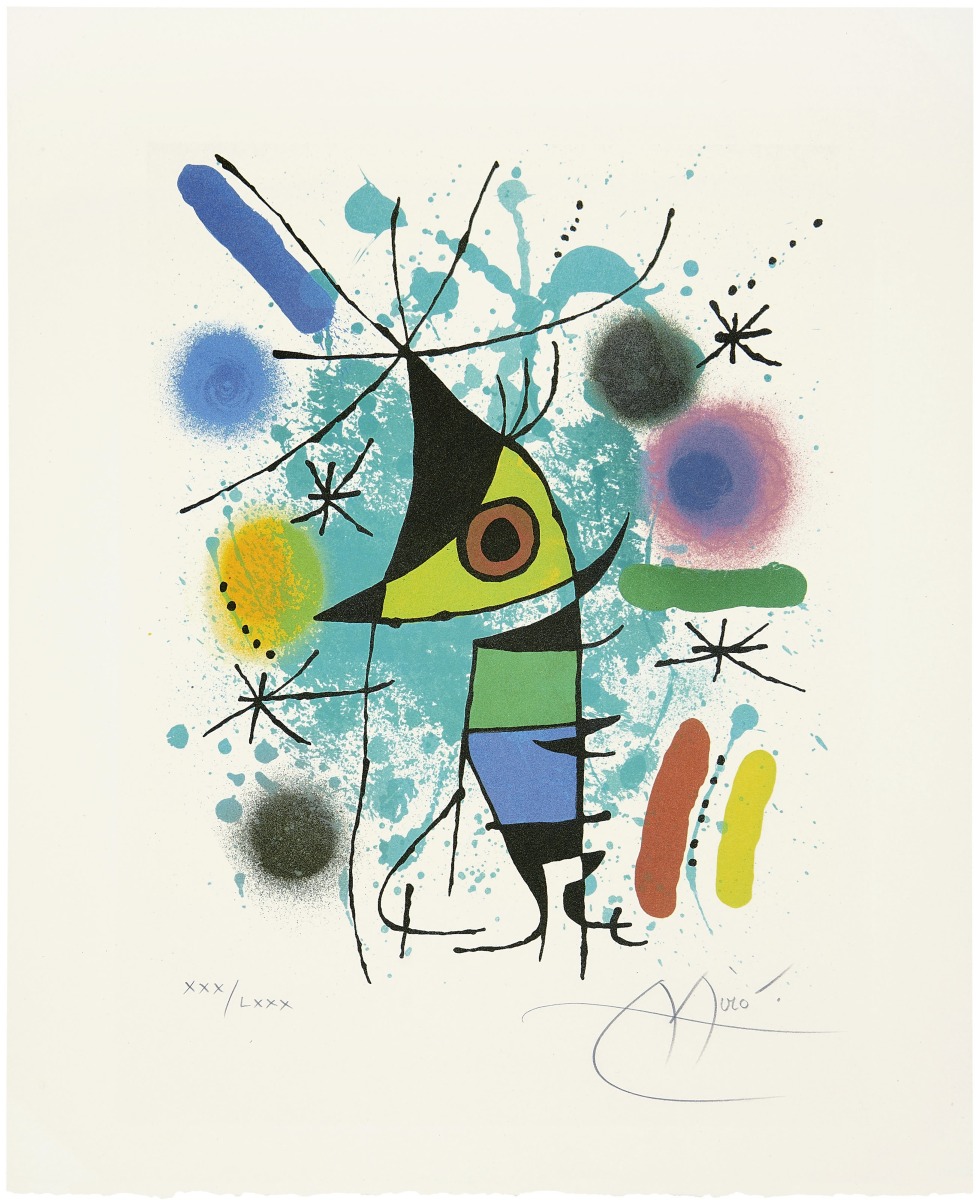
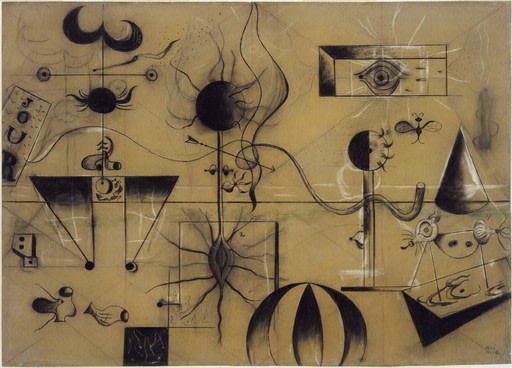
A private sign-language of biomorphic personages, birds, stars, ladders, eyes and lunar/solar discs, drawn in thick black calligraphic line and filled with flat unmodulated primary colour on a frontal, shallow, often stained or scraped ground.
Evolution
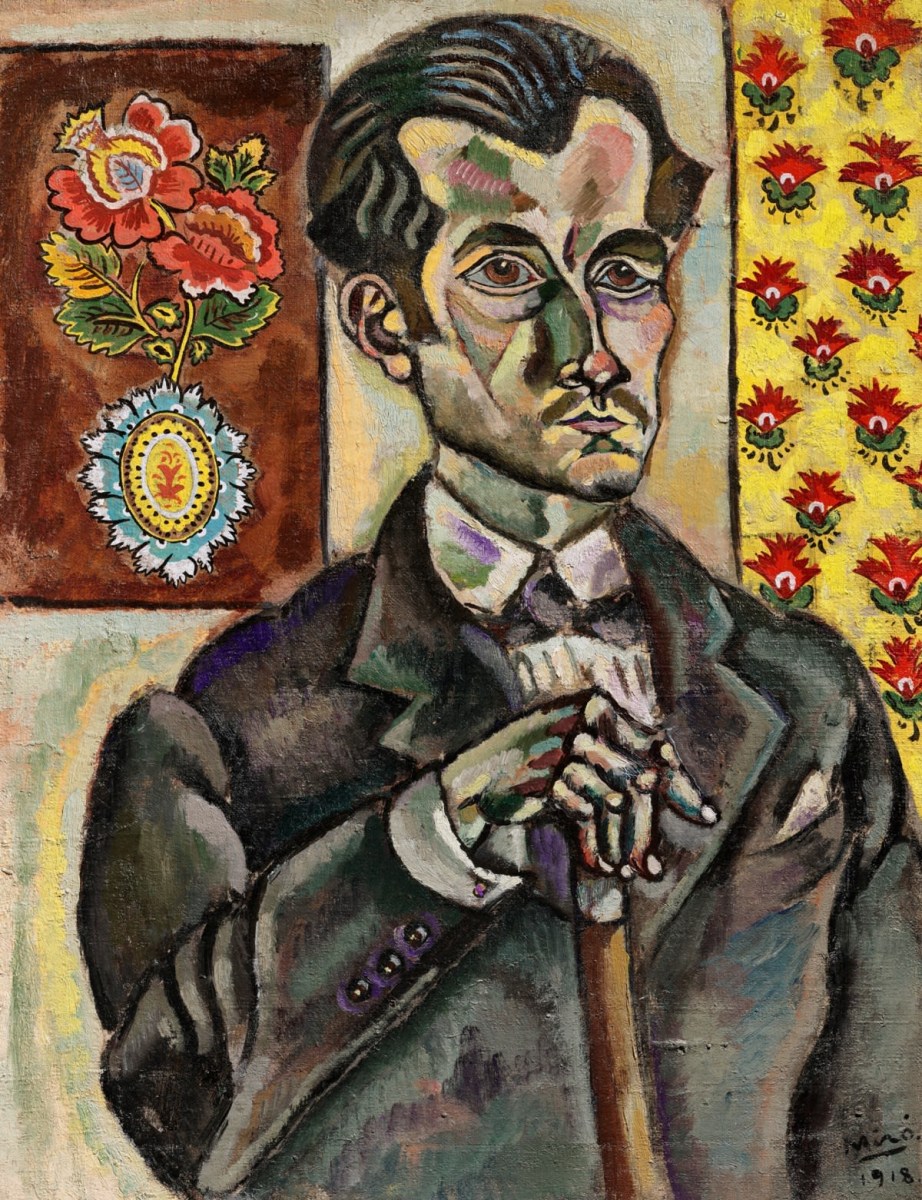
Detailed Catalan realism (to 1922) → Paris Surrealist automatism and dream painting (1923–27) → collage, anti-painting and object-based experiment (1928–34) → politically inflected 'savage' distortion (1934–39) → the intimate cosmological Constellations (1940–41) → post-war expansion into ceramics, print and sculpture (1944–1960s) → radically pared late sign-painting, monumental commissions and gestural black-on-white canvases (1960s–1983).
Influences
- Catalan Romanesque fresco painting and folk art
- Fauvism and Cubism (early absorption)
- Surrealist automatism via Breton, Masson and Ernst; poetic dictation
- Dutch seventeenth-century genre painting, appropriated via postcards for the Dutch Interiors (1928)
- Japanese calligraphy and, later, the artist's travels to Japan
- Reciprocal influence with Calder; forward influence on Abstract Expressionism
Visual language
Reduction toward a small number of forms and colours — Miró compared this narrow range to tenth-century fresco painting, as in the Blue I, II, III triptych of 1961, which conjures a floating world from blue, orange and black alone.
Signature series
- The Farm (1921–22)
- Peintures de rêve / dream paintings (1925–27), incl. The Birth of the World
- Dutch Interiors (1928)
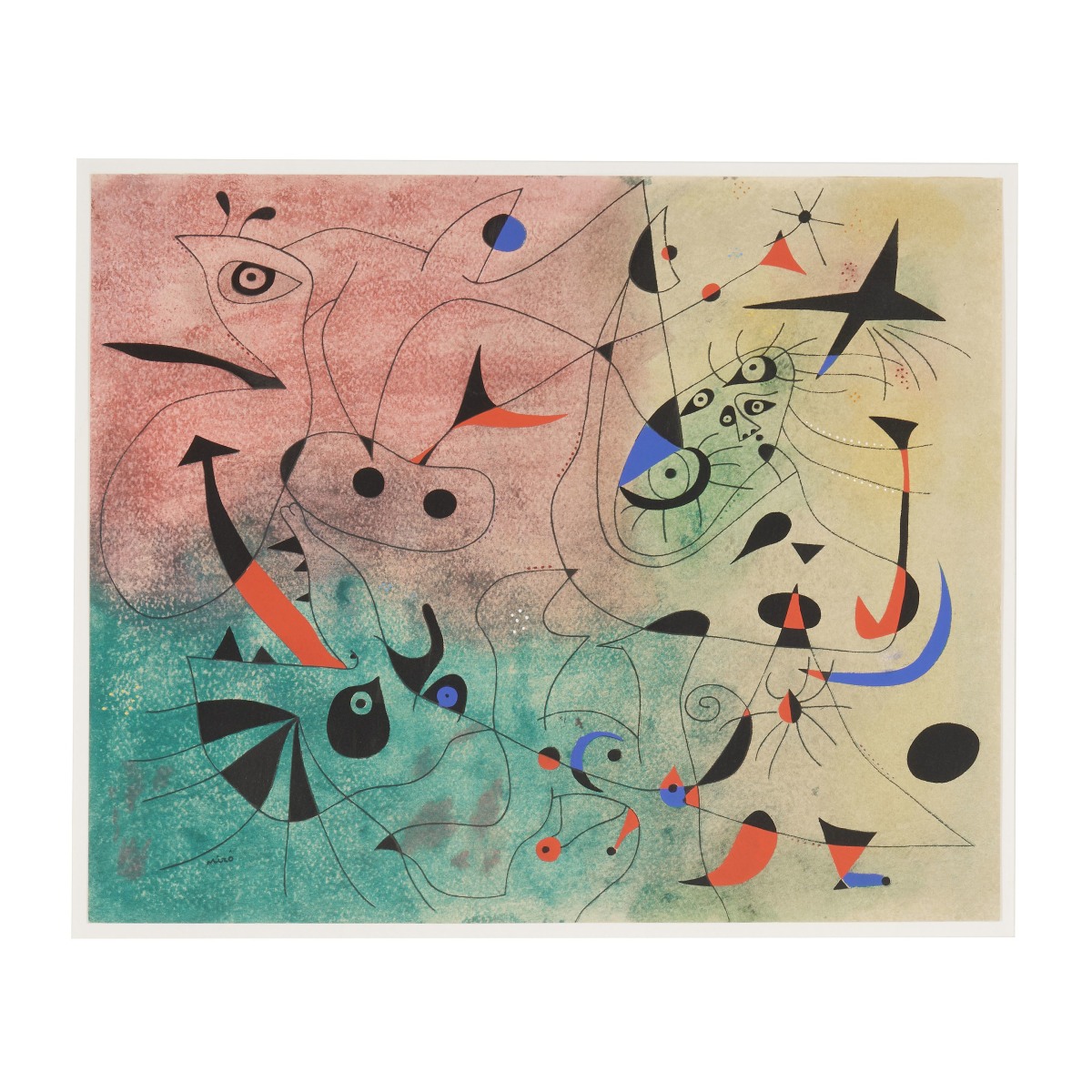
- Constellations (1940–41)
- Blue I, II, III (1961)
- Femmes et oiseaux series
- The Maeght-era poster and portfolio lithographs (M. and D. numbers)
Themes and subjects
- Cosmology — stars, constellations, sun and moon
- The bird and the woman as recurring paired personages
- The ladder of escape as an emblem of flight and transcendence
- Catalan land, Mont-roig farmland and the Majorcan landscape
- Genesis and origin — Miró described The Birth of the World as depicting 'a sort of genesis'
- Poetry and the written sign; painting-poems
- Everyday and studio objects anthropomorphised
- Anti-Francoist politics and Catalan identity
- Play, humour and the childlike
Movements and periods
- Surrealism — core association, personally resisted by the artist
- Catalan modernism, the milieu of origin
- Fauve- and Cubist-inflected early work (1915–1922)
- Detailed realism / 'Catalan Fauvism' — Mont-roig period, culminating in The Farm (1921–22)
- Peintures de rêve (dream paintings), 1925–27
- Anti-painting and collage experiments, 1928–1934
- 'Savage paintings', 1934–39
- Constellations, 1940–41
- Late Modern / Postwar sign-painting, ceramics and monumental sculpture, 1945–1983
Techniques and mediums
- Oil, charcoal and coloured wax crayon on canvas (the medium of the record work, Portrait de Madame K, 1924)
- Tempera, gouache and oil wash on paper (Constellations)
- Collage and assemblage; 'anti-painting' on sandpaper, masonite, copper, cardboard, wood and other hard supports
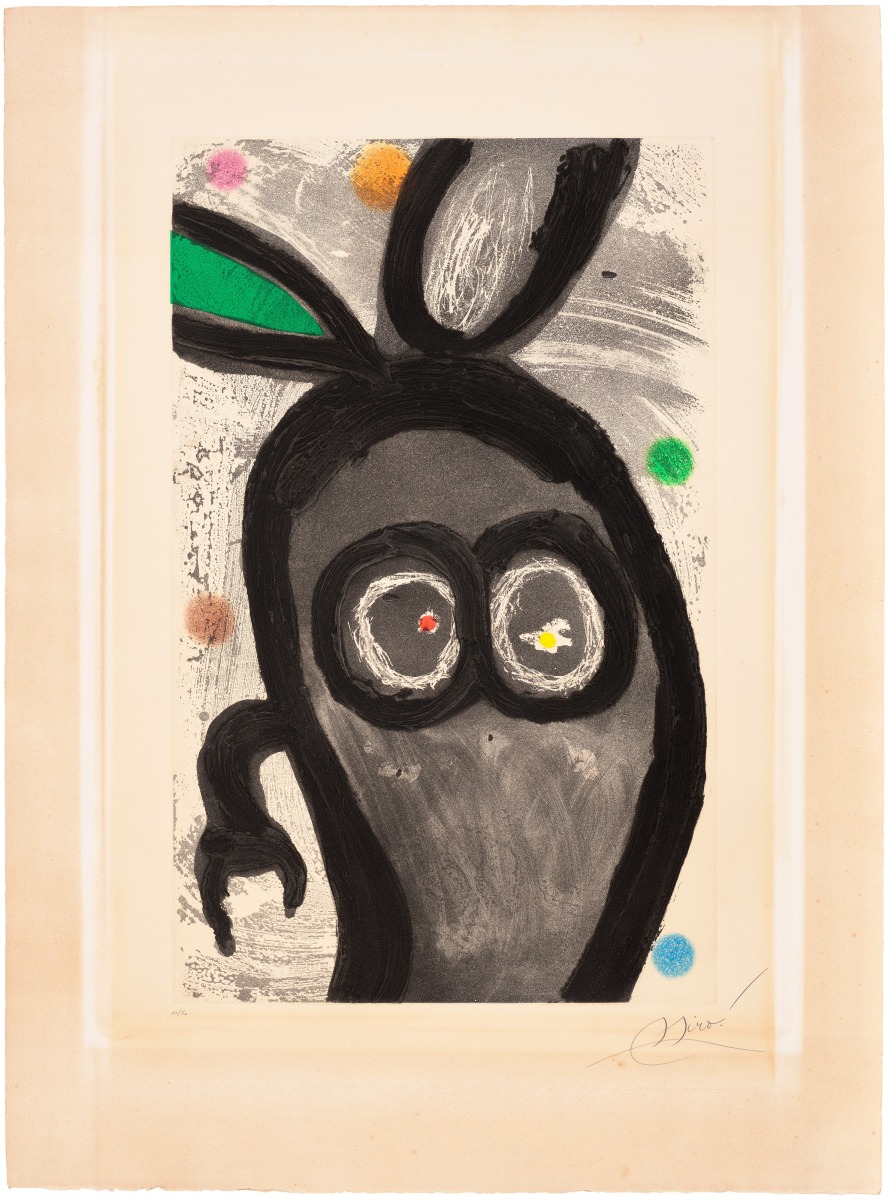
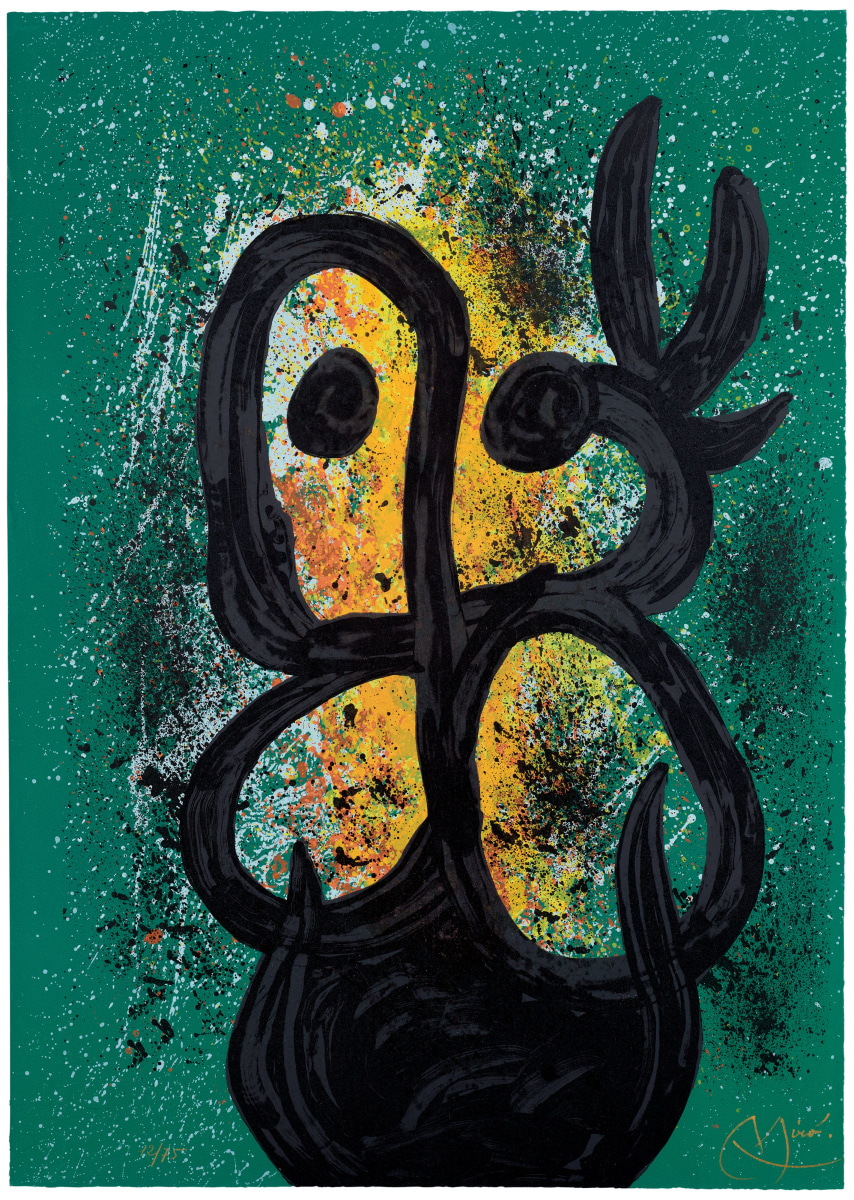
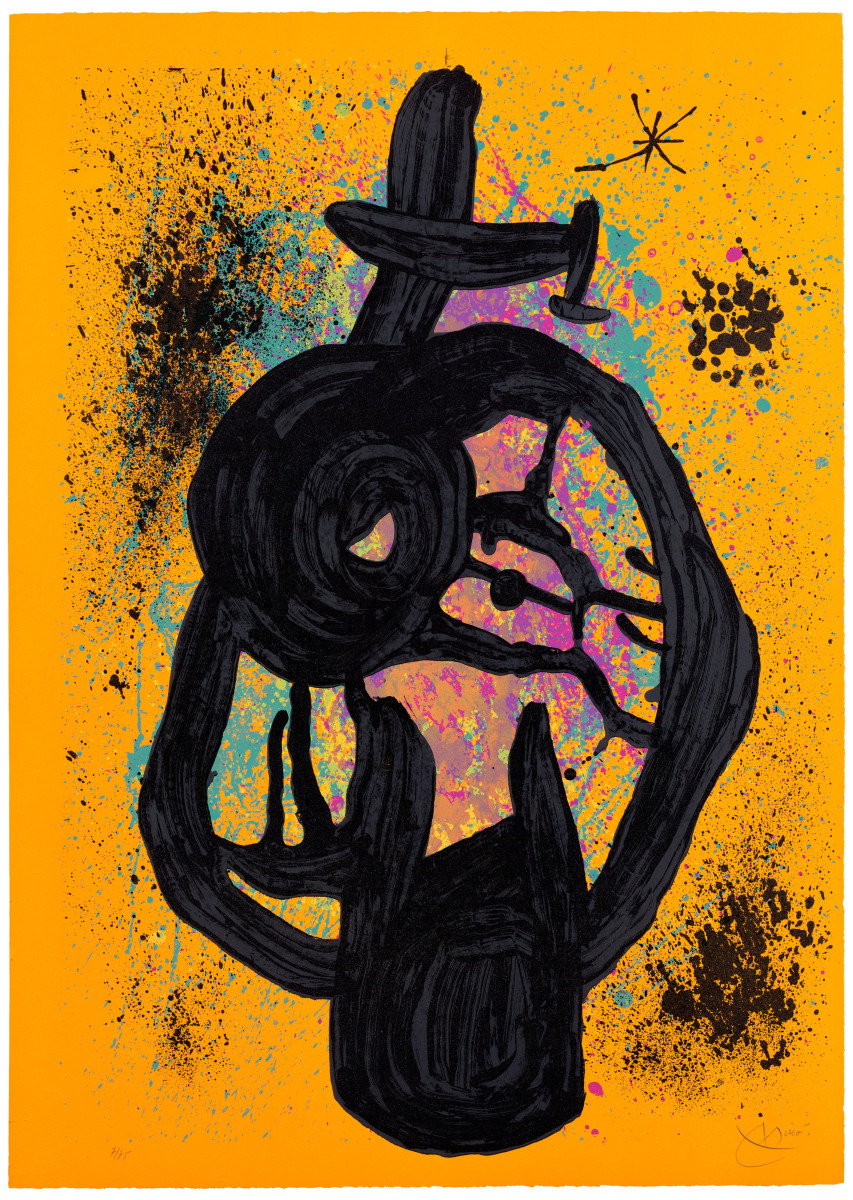
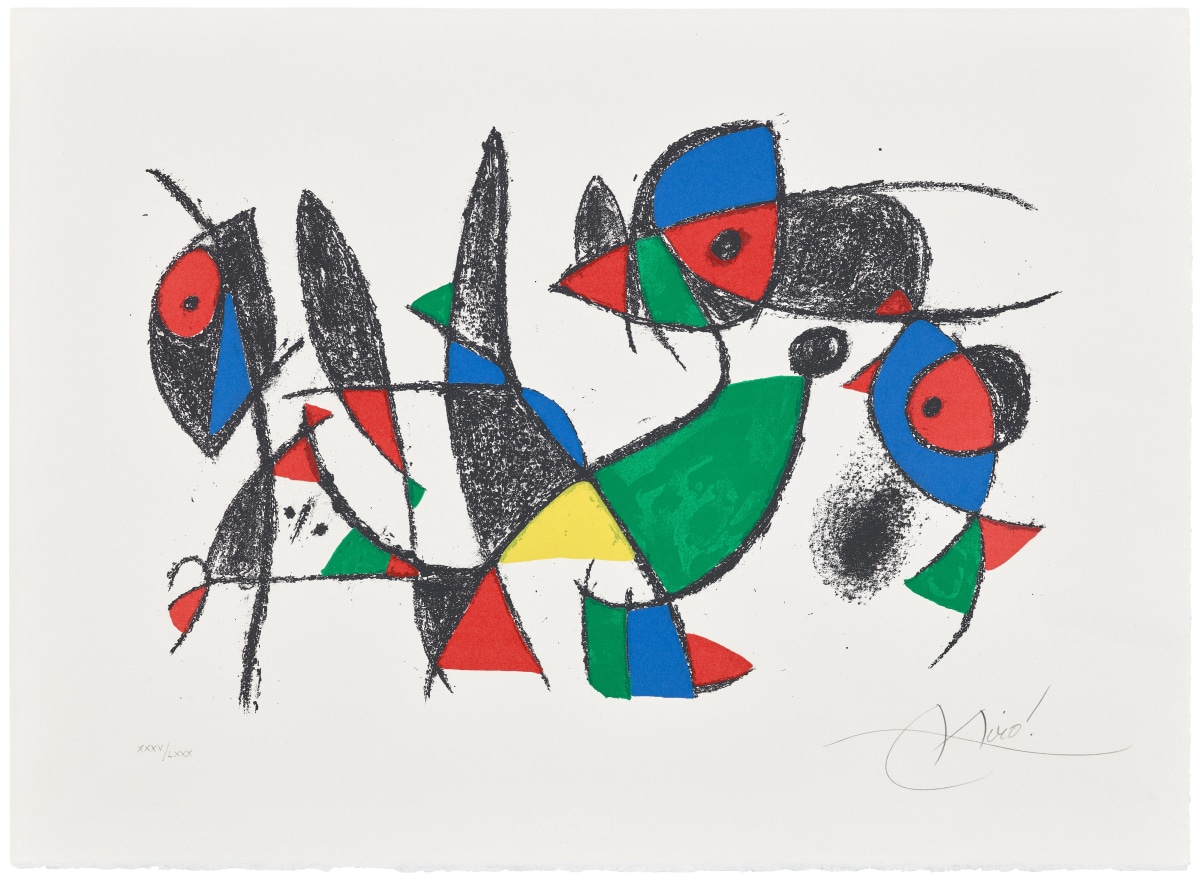
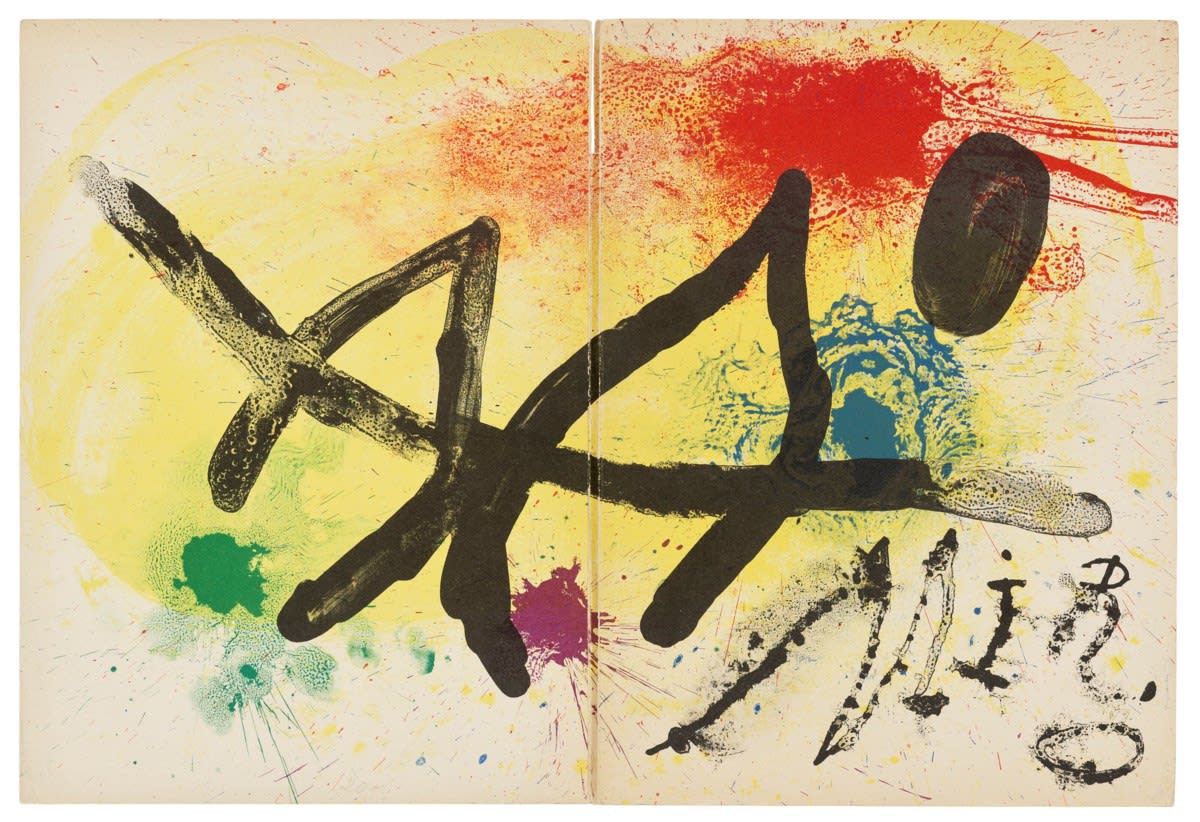
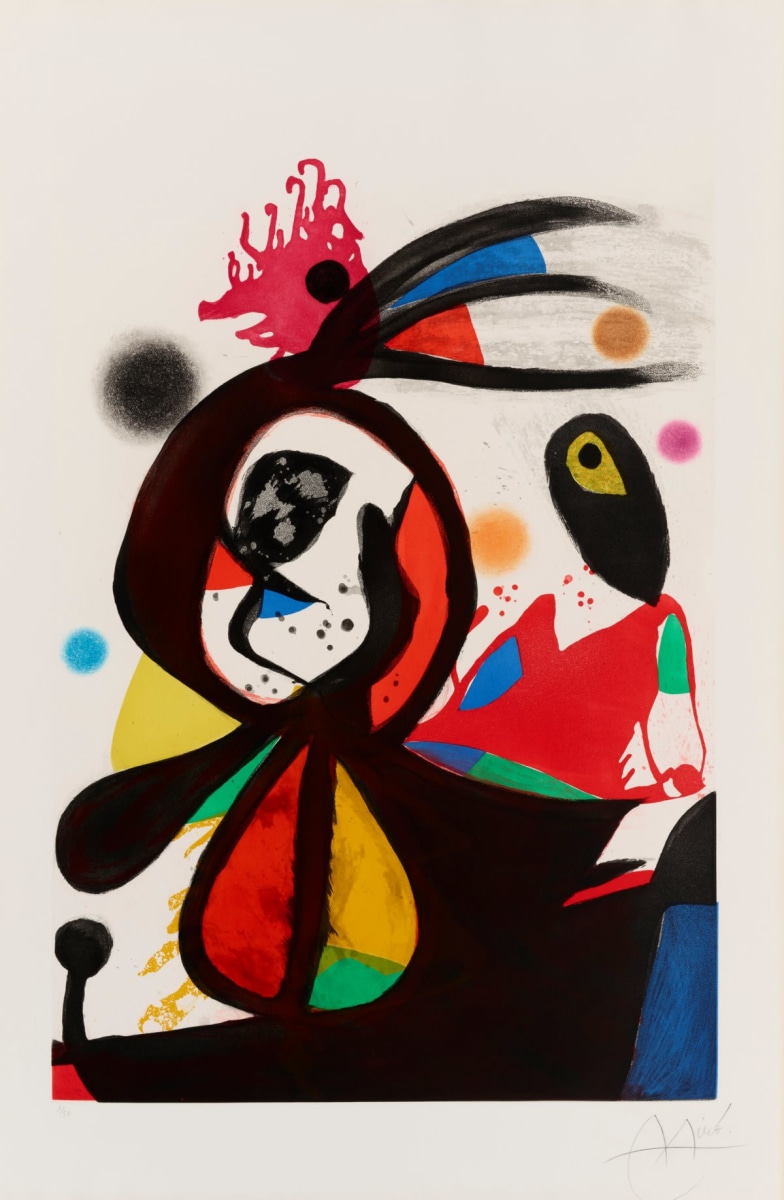
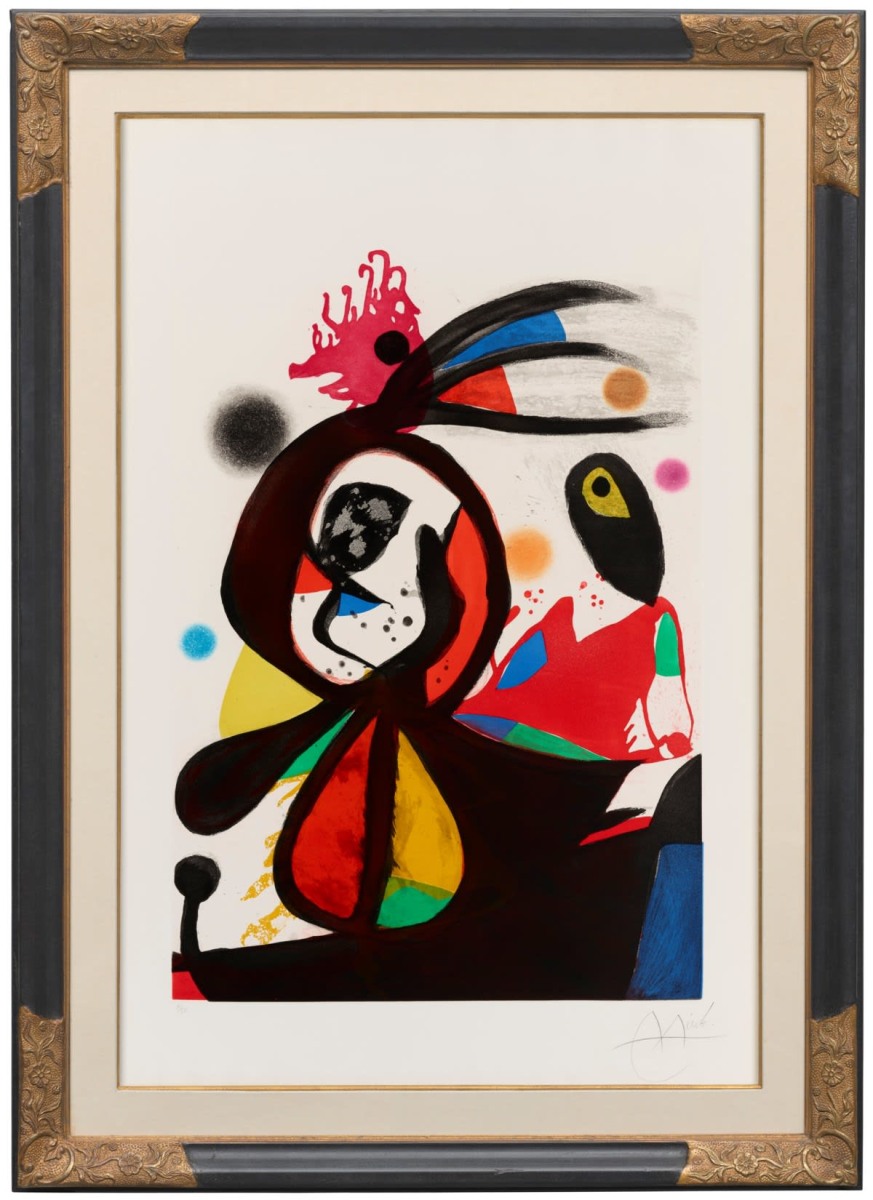
- Colour lithography on Arches (Maeght, Mourlot, Galerie Gérald Cramer) — flat saturated inks bounded by broad black brush gesture, grey aerosol-spattered grounds, pencil-signed numbered editions
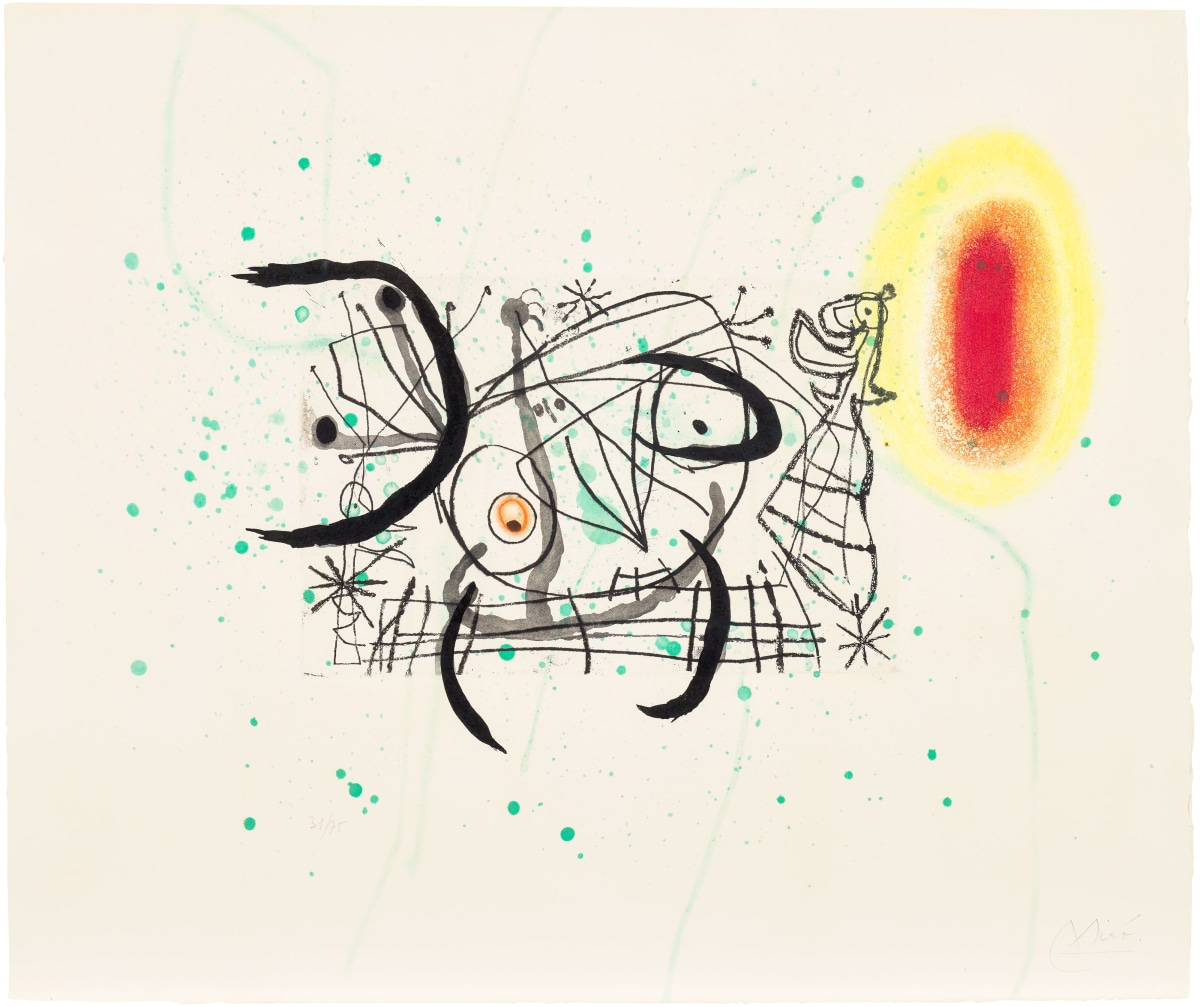
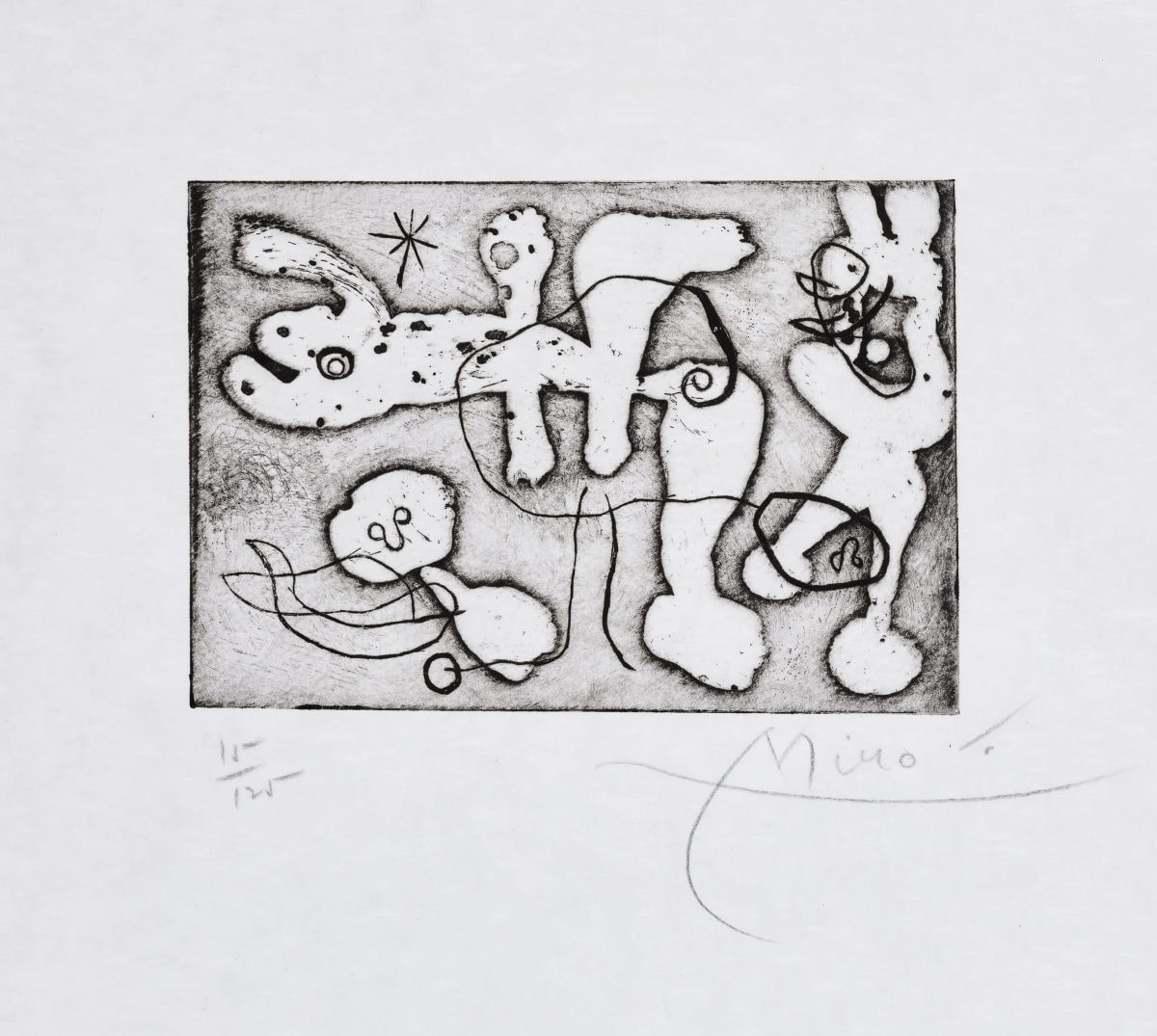
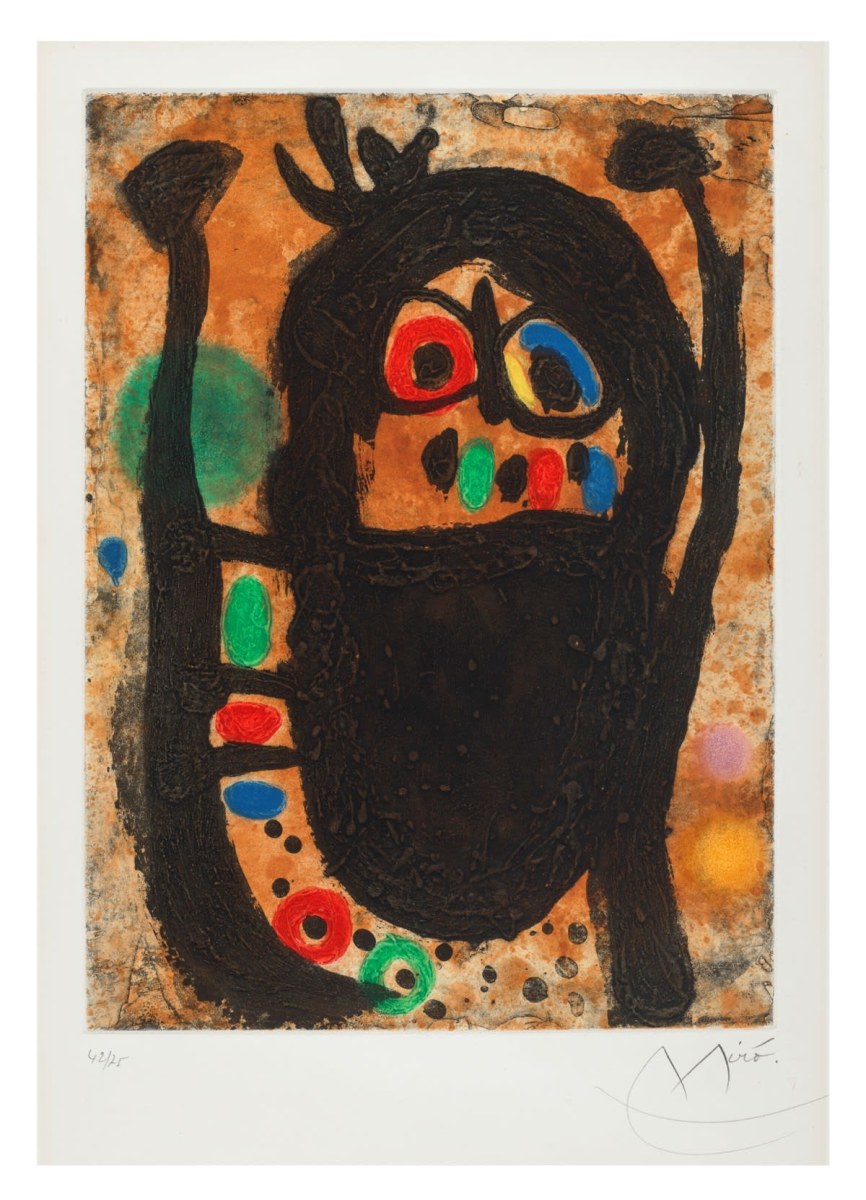
- Etching and aquatint; livres d'artiste (e.g. Le Lézard aux plumes d'or, 40 colour lithographs)
- Ceramics and glazed ceramic murals made with Josep Llorens Artigas
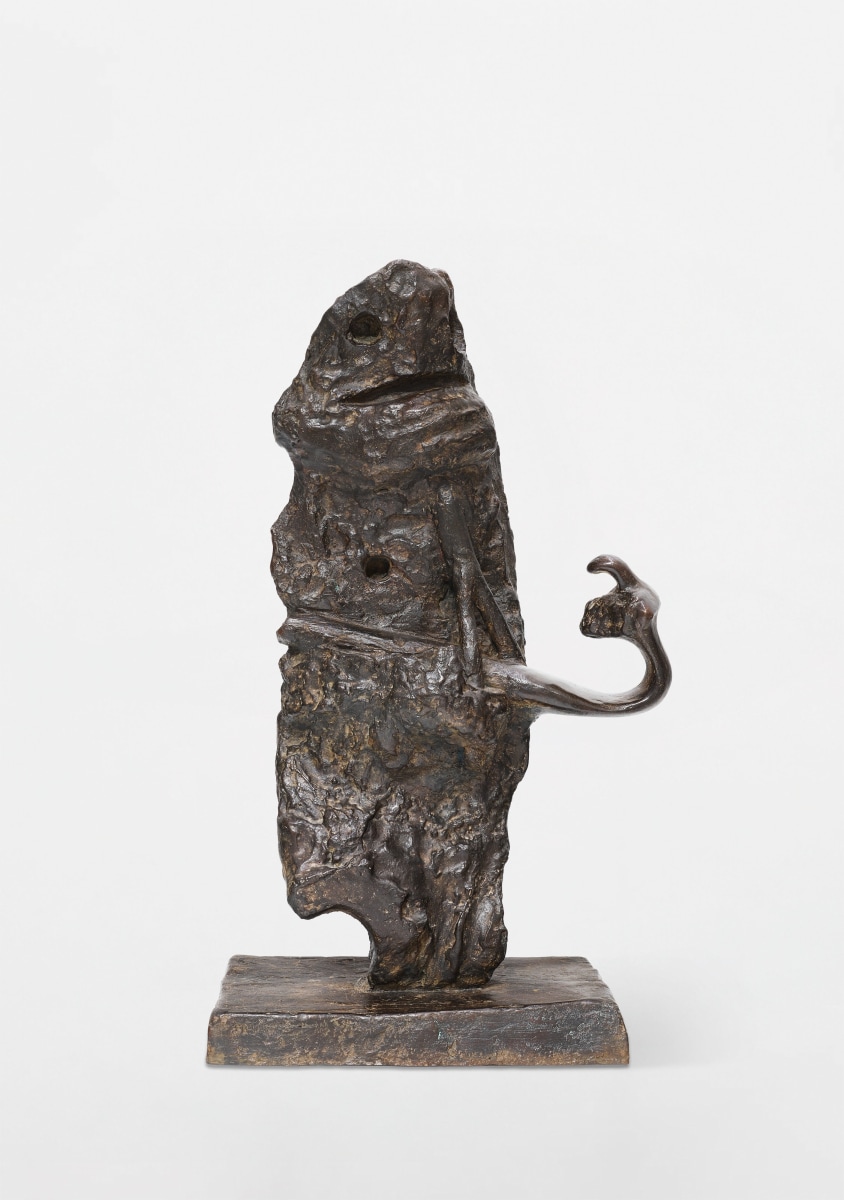
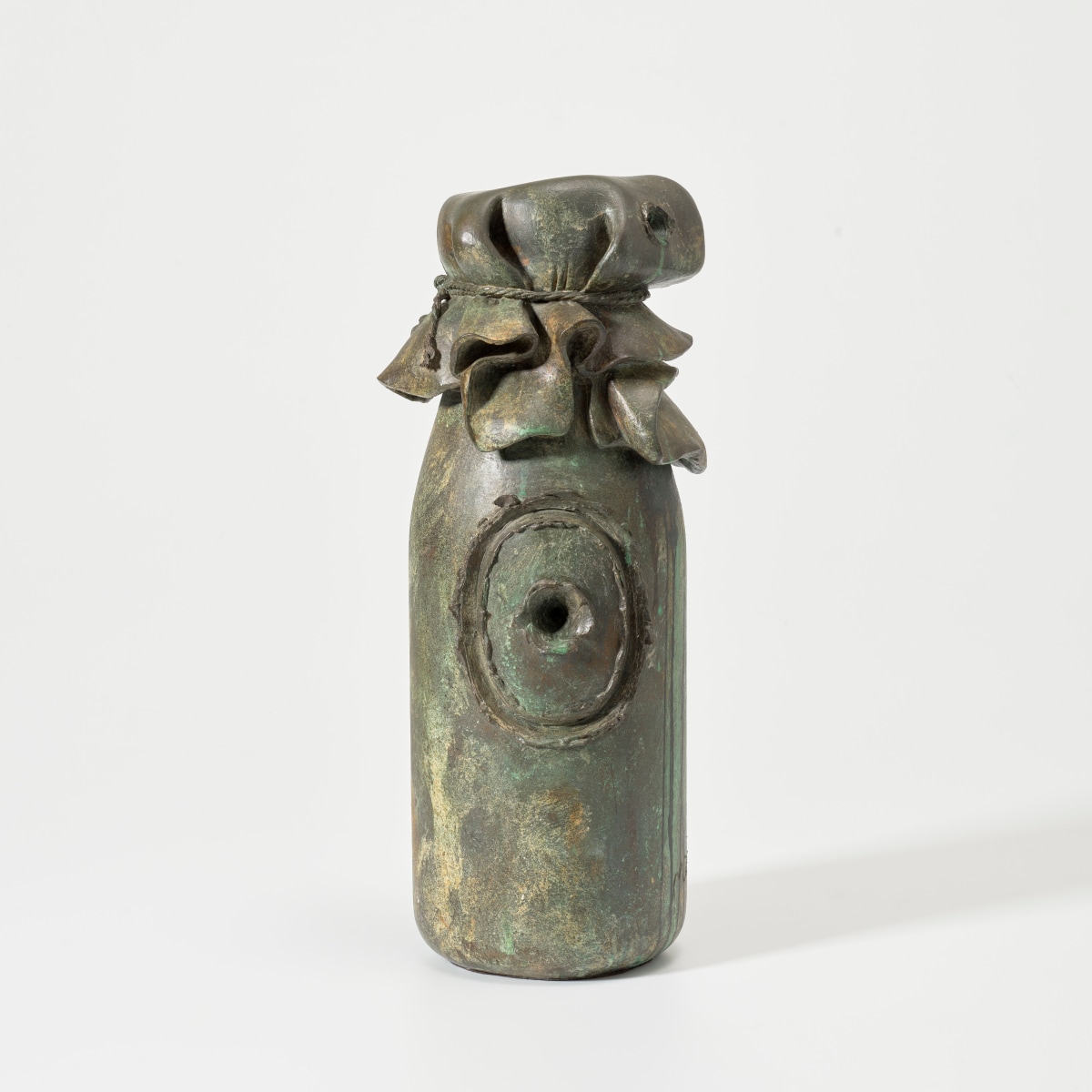
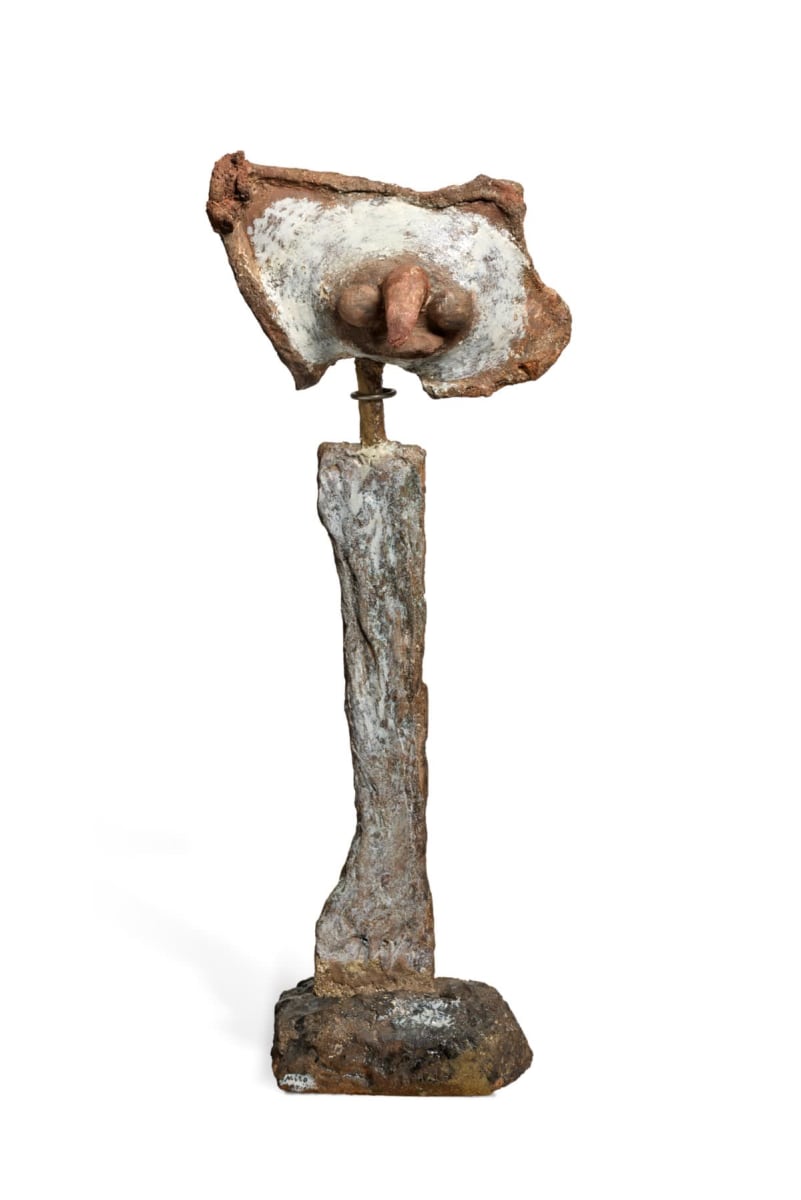
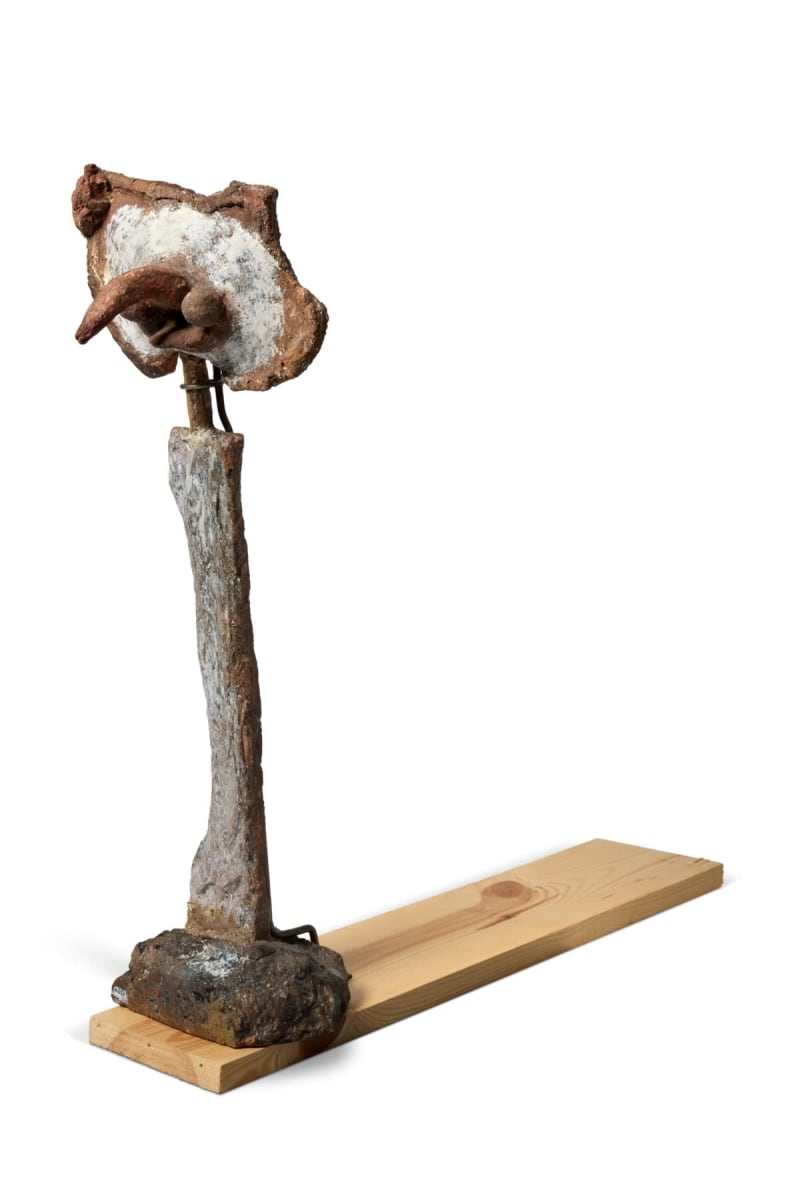
- Lost-wax bronze cast from found-object assemblages, patinated; terracotta maquettes from 1945
- Tapestry and monumental public commissions
Fingerprint verification
Confirmed
- Surrealism as the dominant movement tag, and the Late Modern / Postwar / 1945–1970 period bracketing, are corroborated by museum and scholarly sources.
- High-key, saturated, primary-colour palette; all-over composition; asymmetrical balance; flatness; active negative space — all corroborated.
- Gestural register and automatist black sign-strokes over spattered ground — corroborated by MoMA's account of the working method.
- The sculpture read (lost-wax bronze recording cloth folds and cord knots, verdigris patina, anthropomorphic one-eyed totem) is accurate and matches the documented late practice of casting found objects — the basis of Acquavella's 'Miró the Sculptor: Elements of Nature' (2020) and of the terracotta-maquette-to-bronze method Miró began around 1945 with works such as Moonbird (1946).
- 'Print' as a consistent medium tag is an accurate reflection of the artist's auction supply.
Disagreements
- MOOD TAGGING: the fingerprint reads Miró as uniformly 'playful, whimsical, exuberant'. That is accurate for the Maeght-era graphics that dominate its sample, but it is a genuine DISAGREEMENT with the 1934–39 'savage paintings', with Aidez l'Espagne (1937) and with The Reaper for the 1937 Spanish Pavilion — a deliberately violent, distorted, politically anguished body of work. Any buyer or valuation model calibrated only on the playful register will misread that material.
- SCALE TAGGING: 'monumental-scale' appears in the formal terms, but the sampled works are posters and editions at modest physical dimensions; the tag appears to describe compositional monumentality rather than object size, and should be read that way to avoid a scale-versus-price error.
Extensions and gaps
- SAMPLE BIAS: the fingerprint's 50 tier-1 images are dominated by prints and Fundació/Maeght poster editions. That faithfully reflects Miró's auction VOLUME but not his aesthetic centre of gravity or his VALUE centre. Both are defined by the 1920s–30s oil canvases — Portrait de Madame K (1924), The Birth of the World (1925), Peinture (Étoile Bleue) (1927), Dutch Interior (III) (1928) — which are underrepresented in the current fingerprint.
- MISSING PHASE: the stained, washed, near-monochrome ground of the 1925 dream paintings — thin blue-grey fields with sparse floating signs — is aesthetically distinct from the high-key primary-colour poster idiom the fingerprint captures, and is precisely the phase the top of the market pays eight figures for.
- MISSING MEDIA: ceramics with Josep Llorens Artigas; monumental architectural commissions (Harvard mural, UNESCO ceramic wall); tapestry; and the livre d'artiste. The MFA Boston 2026 exhibition frames the livre d'artiste as a genuinely collaborative form in which authors, publishers, designers and printmakers played essential roles — a co-authorship the fingerprint's single-artist framing does not register.
- MISSING GESTURE: the Dutch Interiors (1928), where dreamlike distortion is applied to appropriated seventeenth-century genre-scene sources — a procedure absent from the fingerprint's purely automatist framing.
Critical Reception
Research updated
Critical reception
Recurring debates
(a) whether the vast late output and industrial-scale print production dilute the achievement of the 1920s–40s canvases; (b) the political reading of the Civil War and 'savage painting' years; (c) his contested membership of Surrealism given his own rejection of the label; (d) the boundary between autograph and workshop production in ceramics and editions.
Surrealist framing
Read critically as a pioneer of Surrealism whose 1924–25 work marks a decisive break. Artsy's account of Portrait de Madame K (1924) describes Miró rejecting his earlier meticulous realism, stripping away colour and perspectival depth in favour of an abstract vision of surreal and mystical imagery; Miró himself recalled in 1928 that he was able to lose contact with reality, above all in that painting.
Scholarly apparatus
Independent, market-independent scholarship is extensive and long-running: Dupin's monograph (1961, comprehensively revised 1993 using posthumously discovered documents), the six-volume paintings catalogue raisonné begun in 1957, separate drawings and graphic-work catalogues, and museum-published scholarship from MoMA (1941, 1959, 1993, 2008), Centre Pompidou (2004), Tate Modern (2011) and the Grand Palais (2018), plus peer-reviewed art-market literature.
Late career assessment
Critics consistently note his refusal to consolidate: rather than resting on his laurels he pushed repeatedly into new territory, devoting stretches of the 1950s almost exclusively to printmaking and ceramics — work honoured with the 1954 Venice Biennale grand prize for graphic work.
Art historical standing
Canonical. Positioned in mainstream art publishing alongside Picasso and Warhol as one of the twentieth century's most influential artists, credited with a pictorial world in which visionary and cosmic elements intertwine with the earthly and mundane. The Met describes him as a Catalan modernist who resisted the Surrealist pigeonhole and experimented feverishly across painting, pastel, printmaking, sculpture, ceramics, collage, muralism and tapestry as a way of expressing the contemporary moment without mimetic realism.
Academic positioning
Standard survey placement as a founding Surrealist painter, a decisive bridge from Parisian automatism to American Abstract Expressionism (via his 1940s New York exposure and the Constellations), and the central figure of twentieth-century Catalan modernism. His absence from any survey of twentieth-century art would be conspicuous — the test the scoring framework sets for the top institutional rung.
Publications and media
Recent coverage
- Date
- 17–18 March 2026
- Outlet
- Artnet News (Richard Whiddington)
- Headline
- Lost Joan Miró Drawings Reemerge at Auction
Substance
Three previously unknown works on paper discovered among the belongings of Miró's friend Vernassa, including two large-scale drawings roughly nine feet long conceived as designs for indoor balcony railings, found in a poster tube unopened for decades and passed down to Vernassa's descendants. Consigned for sale in Antibes with estimates reaching €400,000 after a showcase during Paris Drawing Week.
CLASSIFICATION CORRECTION
EGON's provisional label 'Auction Record' is WRONG and I am flagging it explicitly. The quoted evidence describes a REDISCOVERY / ATTRIBUTION-AND-CONSIGNMENT event with a €400,000 top estimate — roughly 0.75% of the artist's record. The genuine record event of the period is an entirely separate sale (Christie's, 18 May 2026). Per the brief's instruction, the quote wins over the label.
- Date
- 18 May 2026
- Outlet
- Christie's / HENI News / Artsy
- Headline
- Miró sets new artist auction record at the S.I. Newhouse sale
Substance
Portrait de Madame K (1924) achieved $53,535,000, establishing a new auction record for the artist; the Newhouse session totalled $630.8m. Artsy included Miró in its round-up of 17 new artist auction records set in May 2026.
- Date
- 2026
- Outlet
- Observer, Daily Art Magazine, ArtDaily, Christie's Daily, The Art Newspaper
- Headline
- General-interest and trade coverage through 2026
- Substance
- Continuous coverage; The Art Newspaper's preview of 2026 shows in the world's great art cities includes Miró within Madrid programming.
Editorial signal assessment
The 'artists to watch / new talent / ones to watch' category in the research checklist is NOT APPLICABLE — Miró is a canonical historical figure who died in 1983. The equivalent editorial signals for him are museum catalogues, retrospective reviews in Artforum, The Art Newspaper, Apollo and the mainstream press, and inclusion in standard survey literature, all of which are abundant and continuous.
Gallery & Representation
Research updated
Fair presence
Consistently present at TEFAF Maastricht, Art Basel (modern sections), Frieze Masters and Biennale des Antiquaires-type fairs via Acquavella, Lelong, Mayoral and the wider international modern trade. Prints appear at essentially every print fair and in regional and online-only sales worldwide.
Representation
Status
Deceased artist (d. 1983) — no primary representation. Estate matters are administered by Successió Miró (Palma) together with the two foundations; the catalogues raisonnés are published under the Lelong / Successió Miró imprint.
Auction house channel
Christie's, Sotheby's and Phillips are the dominant venues at the top; Bonhams, Artcurial and a wide regional/online field transact the print tail. The 2026 record and the Antibes discovery consignment (Métayer-Mermoz) show both channels active simultaneously.
Historical representation
- Galeries Dalmau, Barcelona (1918)
- Galerie Pierre, Paris (from 1925)
- Pierre Matisse Gallery, New York (early 1930s – 1989) — the decisive channel for Miró's American reputation; Matisse promoted individual artists rather than movements
- Galerie Maeght, Paris (post-war; principal publisher of his lithographs, alongside Mourlot and Galerie Gérald Cramer, Geneva)
Principal secondary dealers
Acquavella Galleries
- Tier
- Tier 1 secondary / modern masters
Notes
Exhibited Miró as early as autumn 1972; 'Miró the Sculptor: Elements of Nature', 13 January – 29 February 2020, presented with Joan Punyet Miró; co-organised Calder/Miró: Constellations (2017); jointly purchased the Pierre Matisse Gallery stock with Sotheby's after Matisse's death in 1989, concentrating significant Miró inventory
- Location
- New York, 18 East 79th Street
Pace Gallery
- Tier
- Tier 1
- Notes
- Co-organised Calder / Miró: Constellations with Acquavella, 20 April – 30 June 2017
- Location
- New York and international
Galerie Lelong & Co.
- Tier
- Tier 1 European, estate-linked
- Notes
- Publisher of the catalogues raisonnés with Successió Miró; 'Miró: Femmes, oiseaux et monstres', 6 September – 10 October 2018
- Location
- Paris / New York
Mayoral
- Tier
- Tier 2 specialist in Catalan and Spanish modernism
Notes
Miró presentations at La Biennale des Antiquaires, Paris (10–18 September 2016), Barcelona (22 September 2016 – 7 January 2017) and London (January–February 2017)
- Location
- Barcelona / Paris / London
Geographic reach
Fully global. Core markets New York, London, Paris, Barcelona/Madrid and Geneva; substantial Asian and Latin American secondary demand for prints and mid-market works; regional US and European houses transact Miró prints continuously.
Sources & research notes
Egon’s artist research combines historical auction records, recent sales, institutional history, critical reception and gallery information. Researched auction records and auction highlights are identified separately.
Read prices with their work, sale date, currency and stated basis. Egon’s market assessments are distinct from reported auction results.
Reference: Egon, “Joan Miró: Market Intelligence & Investment Profile.”
Research bibliography · 51 sources
Sources recorded for this artist’s research. This bibliography does not assign every source to an individual claim.
- Joan Miro's Auction Record Jumps 44% With $53.5m Sale — HENI News
- Christie's Sale of S.I. Newhouse's Masterpieces Totals $630.8m — HENI News
- Christie's announcement: Portrait de Madame K achieves USD 53,535,000, a new auction record for the artist (18 May 2026)
- 17 New Artist Auction Records Set in May 2026 — Artsy
- Miro painting sells for record $36.9M at auction — TODAY
- Joan Miro Smashes Record at Sotheby's with $37m for Peinture (Etoile Bleue) — Spear's
- Miró and Picasso lead auctions in London — theartwolf
- Painting (Blue Star) — Wikipedia
- Lost Joan Miró Drawings Reemerge at Auction — Artnet News
- Lost Joan Miró Drawings Reemerge at Auction — USA Art News
- Joan Miró. The Birth of the World. Montroig, late summer–fall 1925 — MoMA
- Joan Miró. Black and Red Series (Série noire et rouge). 1938 — MoMA
- MoMA Presents Focused Exhibition on Joan Miró and His Masterpiece The Birth of the World — MoMA press release
- Joan Miró, Dutch Interior (III) — The Metropolitan Museum of Art
- Joan Miró (1893–1983) — The Met, Heilbrunn Timeline of Art History essay
- Joan Miró, Untitled — The Metropolitan Museum of Art
- Joan Miró, Collage Painting — The Metropolitan Museum of Art
- Joan Miró, Painting — The Guggenheim Museums and Foundation, Collection Online
- Joan Miró, Peinture (Painting), 1933 — Mildred Lane Kemper Art Museum
- Biography Joan Miró — Fundació Joan Miró
- Exhibitions — Fundació Joan Miró
- Morning Star — Catalogue of works, Fundació Joan Miró
- Fundació Joan Miró, Barcelona — museum homepage and 2026 programming
- Programme 2026: Exhibitions, events and activities — Fundació Miró Mallorca
- Joan Miró — Wikipedia
- Joan Miro — New World Encyclopedia
- What You Need to Know about Joan Miró, Pioneer of Surrealism — Artsy
- A Guide to Joan Miró Prints and Their Value — Mark Littler (citing Artprice data)
- The determinants of art prices: an analysis of Joan Miró — Academia Revista Latinoamericana de Administración / Emerald
- Joan Miro | Auction Market Personal Report — ArtPro
- Joan Miró Market Data: Auction Results & Gallery Prices — MutualArt
- Joan Miró | Art for Sale, Results & Biography — Sotheby's
- Joan Miró Auction Results — Artnet
- Joan Miró Sold at Auction Prices — Invaluable
- Joan Miro Art for Sale: Prints & Originals — MyArtBroker
- Miró the Sculptor: Elements of Nature — Acquavella Galleries
- Calder | Miró Constellations, in collaboration with Pace Gallery — Acquavella Galleries
- Acquavella at 100 — Acquavella Galleries
- Pierre Matisse Gallery — The Met, Modern Art Index Project
- Pierre Matisse, an Art Dealer in New York — Musée Matisse Nice
- Joan Miró Art Monographs and Museum Exhibition Catalogs — Artbook/D.A.P.
- Miró: Catalogue Raisonné, Paintings, Volume III — Artbook/D.A.P.
- Joan Miró: catalogue raisonné, drawings — Jacques Dupin (Internet Archive)
- Miró, by Jacques Dupin — Fundació Joan Miró shop
- Advance Exhibition Schedule — Museum of Fine Arts, Boston
- Museum of Fine Arts, Boston, to Unveil New Galleries for Modern Art — press release
- Picasso, Miró, Dalí: Unbound at the Museum of Fine Arts Boston — Air Mail Arts Intel Report
- Our pick of the shows to see in the world's great art cities in 2026 — The Art Newspaper
- Miró — Grand Palais programme page
- Exposition Miró, Grand Palais – Galeries nationales — L'Officiel des spectacles
- Miró, the exhibition at Paris Grand Palais (3 Oct 2018 – 4 Feb 2019) — Sortiraparis
Research updates by section
These dates show when Egon’s research sections were updated. Source retrieval dates, where supplied above, refer to individual evidence notes.
Ranking updated . Research sections follow their own update dates.
This is what the market knows about Joan Miró. What Egon can also tell you: whether Joan Miró fits your portfolio — based on your existing holdings, budget, and investment timeline.
Get personalized analysisActive market signals
Inside Egon
Signal timeline & strength analysis
Gallery moves, auction records, institutional acquisitions, price milestones — tracked over 90 days
Full signal timeline, strength analysis, and alert configuration for Joan Miró.
Collector demographics & buyer analysis
Geographic distribution, institutional vs. private buyers, collector profiles, and secondary market activity
Who is collecting Joan Miró? Geographic distribution, institutional vs. private buyers, and collector profile analysis.
Personalized acquisition strategy
Optimal entry points, comparable pricing analysis, timing recommendations, and portfolio fit assessment
Personalized acquisition strategy for Joan Miró based on your budget, timeline, and collection goals.
Go deeper with personalized intelligence
You now have Egon's market assessment of Joan Miró. The next question is personal: does this artist belong in your collection? Egon analyzes collection fit based on your aesthetic thesis, existing holdings, budget, and investment goals — delivering acquisition strategies no public index can provide.