Paul Henry
Blue-chip




Egon investment scores
Market position
- Pricing
- Works on Paper
- Charcoal and pencil drawings: low four figures to c.€10,000.
- Temporal Summary
- Pre-2013: records under €400,000. 2013–2020: €400,000–€420,000 record band. 2021 peak: £622,500 / €730,199. 2022–2026 plateau: top lots €230,000–€270,000 hammer. Irish Arts Review notes he has not come within £200,000 of the record since 2021.
- Primary Market Note
- No primary market — artist died 1958. Dealer asking prices are not published; contact The Oriel Gallery (Dublin), Milmo-Penny Fine Art (Dublin), Gorry Gallery (Dublin) or Pyms Gallery (London), or the private-treaty desks at Whyte's/Adam's, for current pricing.
- Achill Figure Subjects 1910 1919
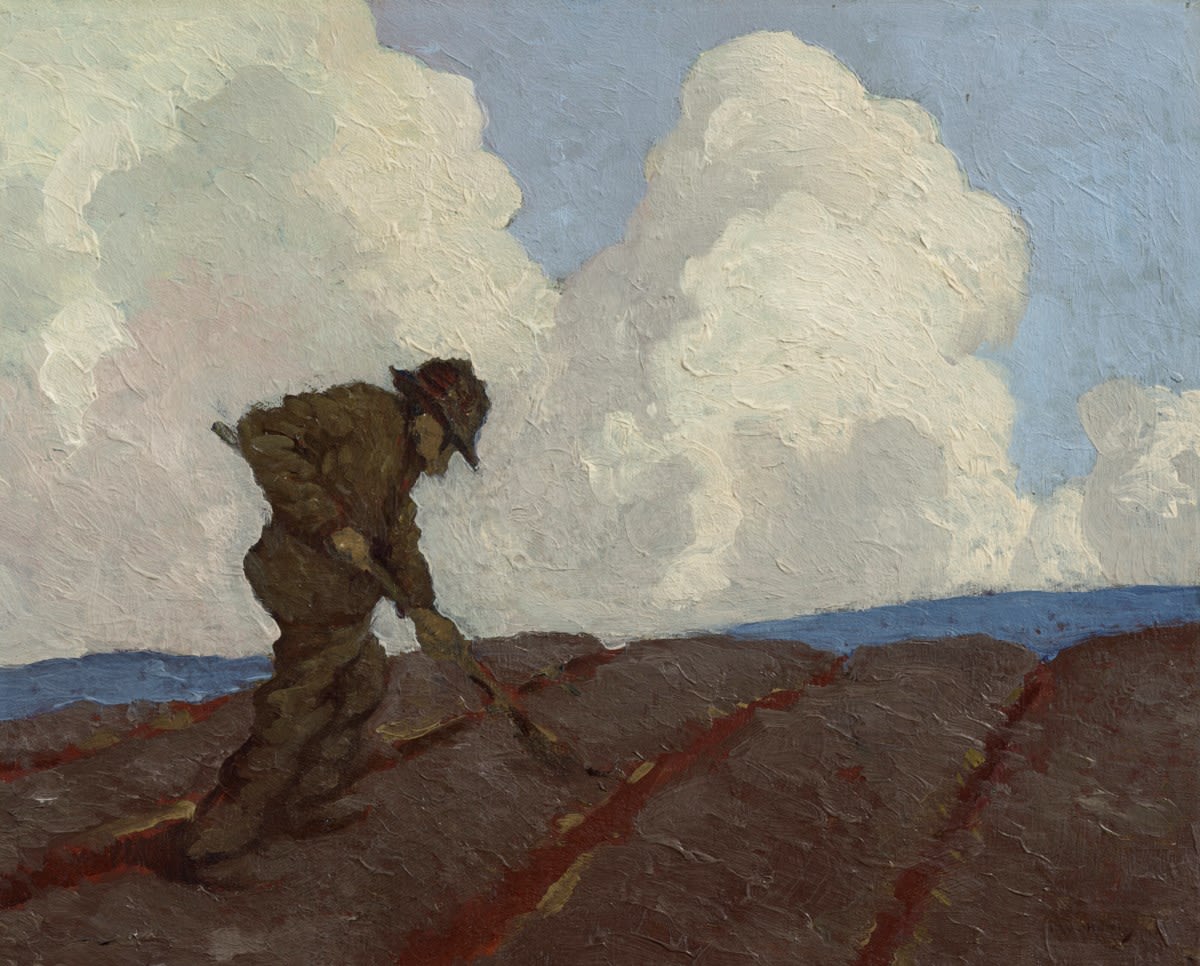
- Scarcest and most sought-after category — potato diggers, currach launching, seaweed gathering; top of the range (The Potato Diggers €400,000, 2013).
- Later Kerry and Studio Repetitions
- €20,000–€80,000; abundant supply of variant compositions caps prices.
- Prints Multiples and After Paul Henry
- Hundreds of euro to low thousands — e.g. 'The Blue Lake, Connemara' lithograph (Cheffins, 9 July 2021); pencil-signed print pairs (Adam Partridge, 26 September 2025); numerous 'After Paul Henry' reproduction prints at Adam's. CAUTION: a large share of online 'Paul Henry' listings are reproductions, not unique works.
- Small Oil on Panel Field Studies C 10 X 12 in
- Roughly £10,000–£60,000 depending on subject, date and condition; the classic cottage/turf-stack panels are the volume segment.
- Major Signed West of Ireland Oils on Canvas 14 to 32 in
- 2020–2023 range: €170,000–€730,000 (record £622,500, 2021). 2024–2026 range: €125,000–€287,000 including premium — the market has not returned to the 2021 peak.
- Liquidity
- Volume
- High for a historical regional-school artist. Multiple lots in every major Dublin Irish art sale (Whyte's, Adam's, deVeres, Morgan O'Driscoll) plus London (Christie's, Bonhams, Sotheby's) and US regional salerooms. Aggregators list well over 100 recorded results; realistic annual volume is roughly 25–60 lots across all media including prints.
- Constraint
- Supply, not demand, is binding: Ian Whyte reported that in 2025 there was not enough good quality art to meet demand, and Adam's cited vendor hesitancy plus the effects of tariffs and new Brexit regulations.
- Market Depth
- Deep at €20,000–€150,000; thinner but consistently bid above €200,000. Irish Arts Review reports Henry took six of the top ten prices at Irish auction houses in 2025.
- Collector Base
- Composition
- Irish domestic collectors and institutions; the Irish diaspora in the US and UK (the 2021 Cincinnati rediscoveries went to Irish and US buyers); Irish corporate and bank collections; occasional international decorative buyers drawn by the iconography.
- Demand Drivers
- National-identity iconography, railway-poster familiarity of the compositions, catalogue-raisonné verifiability, and very small supply of pre-1920 Achill figure subjects.
- Named Collections and Provenance Markers
- The B.J. Eastwood Collection (dispersed at Christie's, 9 July 2021 — source of the record); Pyms Gallery, London; Combridge Gallery and Oriel Gallery labels recur in provenance; Queen's University Belfast (purchased 1936); works acquired directly from the artist by friends and by emigrant families (e.g. the McGovern/Kane family, USA, whose great-grandfather emigrated in 1891).
- Auction History
- Recent 24 Months
Work Date Price Venue Status Lake and Mountains in Connemara (reported by Irish Arts Review as 'Lakes and Mountains in Connemara' — similar title, different painting from the record work) 3 March 2025 €270,000 hammer, top lot of a sale grossing over €1.2m; est. €250,000–€350,000; last on the market in 1979 at c.€2,000 Whyte's Important Irish Art, Dublin SOLD — best Henry price of 2025 West of Ireland Bog 26 May 2025 €125,000 hammer Whyte's, Dublin SOLD West of Ireland Landscape / 'Cottages, Connemara', 1925–35, oil on canvas 15 x 18.5 in., Combridge and Oriel Gallery labels; acquired originally from the artist by a friend of Paul and Grace Henry 3 March 2025 mid-market example; price per saleroom record Whyte's, Dublin OFFERED/SOLD Dapping on Lough Mask, County Mayo (1928–36), oil on canvas 16 x 20 in.; Kennedy catalogue raisonné no. 708, previously recorded 'whereabouts unknown'; ex-Christie's 4 March 1988 (as Lough Corrib), Pyms Gallery London, private collection Belfast 25 May 2026 €230,000 hammer / €286,580 including buyer's premium and VAT (est. €150,000–€200,000) Whyte's Important Irish Art, Dublin — top lot of the sale SOLD above high estimate — highest reported Henry price of 2026 to date Evening, Killarney March 2026 $96,000 (exceeded high estimate) Sotheby's SOLD Lough Mask subject 2026 not stated in source Whyte's, Dublin — led the sale SOLD — reported by Antiques Trade Gazette - Record and Landmarks
Work Date Price Venue Status Mountains and Lake, Connemara (1934), oil on canvas, 71.1 x 81.2 cm 9 July 2021 £622,500 (c.€730,199) including premium Christie's, The B.J. Eastwood Collection: Important Sporting and Irish Pictures, London SOLD — current world auction record A Sunny Day, Connemara (16 x 20 in.; used by the artist on the dust jacket of 'An Irish Portrait', 1951, and on the covers of the 1998 Ulster Museum and 2003 NGI catalogues and Kennedy's 2000 monograph) 2020 €420,000 hammer (est. €150,000–€200,000) Whyte's, Dublin — online Irish and international art auction grossing c.€1.6m SOLD — world record at the time The Potato Diggers (painted Achill, 1910–11; in the same Irish family for c.80 years, bought from the artist for c.£300) 2013 €400,000 Dublin saleroom, reported by The Irish Times SOLD — record at the time; bought by an Irish family living abroad Two rediscovered Connemara/Achill paintings ('In Connemara' and an untitled Connemara landscape), long assumed to be worthless prints 8 September 2021 €143,000 each (est. $60,000–$80,000 each) Caza Sikes, Cincinnati, Ohio SOLD — one to Irish buyers, one to a US buyer - Historical Context Sales
Work Date Price Venue Status Killarney Harbour view late 1990s (Irish Times report) £20,000 — by far the highest price in the sale John de Vere White / deVeres, National Concert Hall, Dublin SOLD Lobster Fishermen of Achill 2006 and c.2022 €170,000 plus premium in 2006; re-offered c.18 years later with an expectation of €200,000–€300,000 Whyte's, Dublin SOLD 2006; re-offered later — described in the press as a litmus test of the market In the Western Mountains September 2016 €52,000 hammer, within estimate (€40,000–€60,000) — top price of the sale Adam's Irish art sale, Dublin SOLD Two unrecorded canvases: 'A scene near Achill Sound' (40 x 60.8 cm) and 'Dugort Bay, Achill Island' (38 x 45.7 cm) undated press release estimates £40,000–£60,000 and £30,000–£50,000 Bonhams, London OFFERED Turf stacks with mountains, oil on panel, 25.2 x 31 cm — not publicly disclosed (Artsy result paywalled) Bonhams 20 November 2019; the same work in Christie's B.J. Eastwood sale, 9 July 2021 SOLD twice within two years — evidence of active re-trading - Bought in and Sell Through
- Whyte's publishes an unsold list for every sale, confirming buy-ins occur; Henry-specific buy-in rates are not published. Market context: at Adam's Irish art sale (September 2016) 70% of 194 lots sold for a total of €450,000 — a representative Irish sell-through band of roughly 65–80%. Henry lots at the quality end have consistently sold, several above high estimate (2020, 2025, 2026).
- Market Position
- Peers
- Jack B. Yeats (higher ceiling, more volatile), Sir John Lavery, William Orpen, Roderic O'Conor, Mainie Jellett, William John Leech, Sean Keating, Harry Kernoff, Gerard Dillon, Daniel O'Neill, William Scott.
- Segment
- Blue-chip of the Irish national market — the domestic canonical landscapist.
- Commentary
- Irish Arts Review's 2025 auction overview characterised Henry as arguably the closest thing to a reliable investment in the Irish market, citing consistency of quality and the broad accessibility of the imagery, while noting the record has not been approached since 2021. Auctioneers reported stronger prices and greater confidence in 2026 than in the tariff-clouded 2025 market.
- Relative Benchmarks 2025 26
- Mainie Jellett 'Achill Horses' (1933) €210,000 hammer (Whyte's, May 2025); Harry Kernoff 'Anglesea Market, Dublin' (1933) €40,000; William Scott 'Still Life on White with Beans' €150,000 hammer (Morgan O'Driscoll, April 2026); Sean Keating 'Waiting for the Tide' €46,000 (Adam's, 2016). Henry's 2025 top of €270,000 and 2026 top of €230,000 hammer sit at or above the top of the Irish domestic field.
- Investment Outlook
- Risks
- Attribution and copy risk (very large volume of 'After Paul Henry' prints and studio-variant compositions); concentration in a single small national market with currency, tariff and post-Brexit friction; late repetitive compositions are abundant and illiquid at the top of their range; the 2021 record came from one exceptional single-owner collection and has not been retested.
- Trajectory
- Stable-to-firming plateau below the 2021 peak. 2026 evidence is positive: the May 2026 Whyte's top lot exceeded its high estimate at €230,000 hammer (€286,580 with premium and VAT), and auctioneers report restored confidence relative to 2025.
- Opportunities
- Rediscovered works absent from the catalogue raisonné's known whereabouts have repeatedly outperformed (Cincinnati 2021; 'Dapping on Lough Mask', recorded by Kennedy as whereabouts unknown, €230,000 hammer in 2026). Pre-1920 Achill figure subjects remain the scarcest and best-performing category.
Institutional presence
- Upcoming
- No monographic museum exhibition announced for 2026–27 in the sources consulted. Institutional visibility is continuous through permanent displays at the NGI and Ulster Museum. Market calendar: Whyte's, deVeres and Adam's hold Irish art evening sales in late May (25th/26th/27th in 2026) and further sales in autumn/winter, with Henry lots in nearly every sale; Whyte's held an online sale on 29 June 2026, and The Irish Times has flagged a major Irish collection sale as the most talked-about auction of 2026.
- Exhibitions
- Significant Group
- When Time Began to Rant and Rage: Twentieth Century Figurative Paintings from Ireland — Walker Art Gallery, Liverpool (16 Oct 1998 – 10 Jan 1999); Berkeley Art Museum, California (10 Feb – 1 May 1999); Grey Art Gallery, New York (25 May – 24 Jul 1999) — international touring show including 'Launching the Currach'
- Lines of Vision: Irish Writers at the National Gallery of Ireland — NGI, 8 October 2014 – 12 April 2015
- Royal Hibernian Academy annual exhibitions from 1910; Society of Dublin Painters exhibitions from 1920; Ulster Academy of Arts exhibitions from 1930
- Solo and Monographic
- Paul Henry: Retrospective Exhibition — Ritchie Hendriks Gallery, Dublin, and Museum and Art Gallery, Belfast, May–July 1957 (lifetime retrospective)
- Paul Henry 1876–1958: Retrospective Exhibition — Trinity College Dublin and Ulster Museum, Belfast, October 1973 – January 1974
- Paul Henry — Ulster Museum, Belfast, 1998 (catalogue cover: 'A Sunny Day, Connemara')
- Paul Henry — National Gallery of Ireland, Dublin, Millennium Wing, 19 February – 18 May 2003; curated by Dr S.B. Kennedy; the first major show devoted to an Irish artist in the Millennium Wing
- Kathleen Henry / CEMA Northern Ireland tour, November 1956 (Henry material shown via CEMA)
- Publications
- S.B. Kennedy, 'Paul Henry', Yale University Press, 2000 (monograph)
- S.B. Kennedy, 'Paul Henry: Paintings, Drawings, Illustrations' (with the catalogue of works), Yale University Press, New Haven and London, 2007 — the catalogue raisonné, routinely cited in saleroom catalogues (e.g. cat. no. 708)
- Paul Henry, 'An Irish Portrait', Batsford, London, 1951 (autobiography)
- Paul Deane, 'Paul Henry on Achill Island: Paintings and Drawings', Éire-Ireland, Spring 1989
- Eamon Mallie, 'One Hundred Years of Irish Art', Nicholson & Bass, Belfast, 2000
- Dictionary of Irish Biography (Royal Irish Academy) entry
- Museum Collections
Institution Credit Line Holdings Tier National Gallery of Ireland, Dublin credit line not published in the sources consulted — the accessible NGI online collection text for 'Launching the Currach' displays provenance/exhibition history but no acquisition credit line Multiple works including 'Launching the Currach' (Achill subject), plus West of Ireland material used in the Gallery's teaching resources First-rank national museum (Ireland) Ulster Museum, Belfast (National Museums NI) credit line not published in the sources consulted Paul Henry paintings; venue for the 1957 and 1973–74 retrospectives and the 1998 exhibition First-rank regional/national museum (Northern Ireland) Hugh Lane Gallery (Dublin City Gallery The Hugh Lane) credit line not published in the sources consulted Paul Henry works Major municipal modern collection Irish Museum of Modern Art (IMMA), Dublin credit line not published in the sources consulted Paul Henry works National modern/contemporary museum Victoria and Albert Museum, London credit line not published in the sources consulted Paul Henry work(s) First-rank international museum Musée National d'Art Moderne, Paris credit line not published in the sources consulted Paul Henry work(s) First-rank international museum Queen's University Belfast — Naughton Gallery / QUB Art Collection The collection states the work was 'purchased for the Collection in 1936' — a documented institutional PURCHASE (curatorial initiation), though no named fund is published 'The Road to Coomasharn, Co. Kerry' (c.1934–5); widely loaned for exhibition; currently hangs in the Lodge at Lennoxvale University collection Art Institute of Chicago / Smithsonian Institution / Cleveland Museum of Art / Europeana (from supplied public-API data) not applicable / not verified UNVERIFIED FOR THE PAINTER. These name-matched hits are very likely the Henry brothers' astronomical photographs — the Metropolitan Museum demonstrably holds Paul & Prosper Henry lunar and stellar prints. Treat as a name collision until each record is individually verified. First-rank (AIC, Smithsonian, Cleveland) Metropolitan Museum of Art, New York credit line not published in the sources consulted Astronomical photographs by PAUL HENRY the French photographer (the Getty-record person): 'Lunar Photograph, South Pole'; 'A Section of the Constellation Cygnus' (13 August 1885) First-rank international museum - Awards and Recognition
- Associate, Royal Hibernian Academy, 1926; full Academician (RHA), 1928
- One of the first twelve academicians of the Ulster Academy of Arts (later RUA), 1930
- Member, United Arts Club, Dublin
- Commissioned railway/travel poster designs (notably a Connemara landscape) achieving wide circulation — de facto state-adjacent cultural recognition in the early Free State
- Commemorated by the Ulster History Circle
Career & Biography
- Identity
- Born
- 11 April 1876, 61 University Road, Belfast, Ireland
- Died
- 24 August 1958, Bray, Co. Wicklow, Ireland (buried St Patrick's cemetery, Wicklow)
- Family
- Third of four sons of Rev. Robert Mitchell Henry (Reformed Presbyterian, later Baptist, then Plymouth Brethren) and Kate Anne Berry; brother Robert Mitchell Henry was a classical scholar and Professor of Latin at Queen's University Belfast.
- Gender
- male
- Full Name
- Paul Henry, RHA, RUA
- Nationality
- Irish (Ulster-born; worked in Ireland, London and Paris)
- Note on Dates
- Some auction houses (Adam's, Artnet, Invaluable) list 1877 as birth year; scholarly consensus and the Dictionary of Irish Biography give 11 April 1876.
- Career Timeline
- 1898 — travels to Paris; absorbs Millet's rural realism and Whistler's tonal reduction
- 1903 — marries Scottish-born painter Grace Mitchell (Grace Henry) in London
- 1900s–1910 — London: illustration, teaching, pamphlet writing
- 1910 — first visit to Achill Island, Co. Mayo with Grace, prompted in part by J.M. Synge's 'Riders to the Sea'; first exhibits at the Royal Hibernian Academy
- 1910/1912–1919 — resident on Achill Island; peasant-subject and landscape phase (potato digging, turf cutting, seaweed harvesting, fishing)
- 1919/1920 — moves to Dublin; co-founder (1920) of the Society of Dublin Painters with Grace Henry, Jack B. Yeats, Mary Swanzy and others; member of the United Arts Club
- 1920s — designs railway/travel posters (notably a Connemara landscape) that circulate his imagery nationally and shape the popular image of the West of Ireland
- 1924 — begins relationship with painter Mabel Young; separates from Grace Henry in 1929
- 1926 — elected Associate, Royal Hibernian Academy; 1928 — full member (RHA)
- 1930 — among the first twelve academicians of the Ulster Academy of Arts (RUA)
- 1930s — moves to Co. Wicklow with Mabel Young; continues West of Ireland and Kerry subjects, often from memory in the studio
- c.1945 onward — failing eyesight effectively ends the painting career; turns to writing
- 1951 — publishes autobiography 'An Irish Portrait' (Batsford, London)
- 1953 — marries Mabel Young after Grace Henry's death
- 1958 — dies at Bray, Co. Wicklow
- Education and Training
- Methodist College Belfast from 1882 (began drawing regularly); Royal Belfast Academical Institution from 1891, where drawing master John Sumner encouraged him
- Belfast School of Art / Government School of Design, Belfast (fellow student William Conor)
- Paris, 1898: Académie Julian (teaching associated with Jean-Paul Laurens) and subsequently Whistler's Académie Carmen
- London years (c.1900–1910): worked as illustrator for books, magazines and newspapers; encouragement from Walter Sickert; supported himself teaching and writing
- Notable Personal Factor
- According to his biographer S.B. Kennedy, Henry was colour blind — a condition not publicly known until c.1973, when it was revealed by his doctor at the time of the retrospective; this materially informs readings of his restricted, tonal palette.
- ⚠️ Identity Disambiguation
- Issue
- The supplied Getty ULAN record (ID 500332088, 'Henry, Paul', French photographer, 1849–1901) does NOT correspond to the artist whose market data and aesthetic fingerprint were supplied (Evening, Killarney; Connemara bogland; Post-Impressionist oil landscapes). Those belong to PAUL HENRY RHA (1876–1958), the Irish landscape painter.
- Research Focus
- This report profiles PAUL HENRY RHA (1876–1958), Irish painter — the artist with the live market and the supplied aesthetic fingerprint. A section on the French photographer is included at the end of bio_data.
- Museum Data Caveat
- The supplied museum hit-counts (Art Institute of Chicago, Smithsonian, Cleveland, Europeana) are very likely a MIXTURE of the two Pauls: the Metropolitan Museum, AIC and Smithsonian hold Henry-brothers astronomical photographs, while the Irish painter's holdings are concentrated in Irish/UK/French institutions. Name collision confirmed; do not merge.
- Getty Record Person
- Paul (Paul-Pierre) Henry, French astronomer/optician at the Paris Observatory who, with his brother Prosper-Mathieu Henry, built a photographic refractor in 1885 and produced pioneering astronomical photographs (Moon, star fields, Carte du Ciel project). Dates commonly given as 1848–1905 for Paul-Pierre and 1849–1903 for Prosper; Getty gives 1849–1901.
- Influences Context Contemporaries
- Influences
- Jean-François Millet (peasant iconography, rural realism); Whistler (tonal reduction, Académie Carmen); the Barbizon plein-air tradition; Cézanne and Gauguin cited for simplification of form; literary stimulus from J.M. Synge
- Art Historical Context
- Central to the visual construction of national identity in the early Irish Free State; regarded as the father of an inter-war Irish school of landscape painting alongside Craig and McKelvey
- Contemporaries and Peers
- Jack B. Yeats, Grace Henry, Mary Swanzy, Sean Keating, William Conor, James Humbert Craig, Frank McKelvey, Harry Kernoff, William John Leech, Roderic O'Conor, Sir John Lavery, William Orpen
- The Other Paul Henry Getty Record
- Identity
- Paul(-Pierre) Henry, French astronomer, optician and photographer, Paris Observatory; worked in partnership with his brother Prosper-Mathieu Henry
- Significance
- Inherited (1872) a sky-mapping project; from 1884 applied photography; built a photographic refractor with a precision clock drive in 1885; charted tens of thousands of stars; endorsers of the Carte du Ciel photographic sky atlas; discovered 14 asteroids and, on plates of 16 November 1885, the nebulosity around Maia in the Pleiades (NGC 1432)
- Market and Institutions
- Albumen lunar and stellar prints held by the Metropolitan Museum of Art (e.g. 'Lunar Photograph, South Pole'; 'A Section of the Constellation Cygnus', 13 August 1885) and by university/scientific repositories; appear at auction as photographic lots (e.g. Bonhams, 'The Moon at 167 hours', Paris Observatory, 27 March 1890). A wholly separate, low-value market from the Irish painter's.
- Studio Practice and Working Methods
- Plein-air observation on Achill and in Connemara/Kerry, but many finished canvases were produced from memory in the studio — local residents on Achill were reportedly reluctant on superstitious grounds to be sketched or painted. Small oil-on-panel field studies (c.25 x 31 cm) feed larger easel canvases (typically 14–20 in.). Heavily loaded impasto, palette knife and stiff brush, alla prima wet-into-wet skies. He occasionally asked his Achill friend Johnny Tom Owen MacNamara to supply Irish-language titles for pictures.
Artistic Profile
- Style
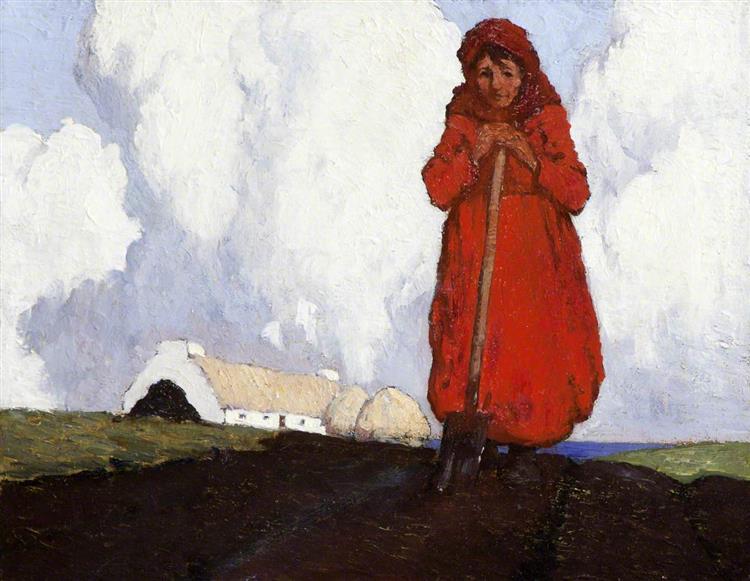
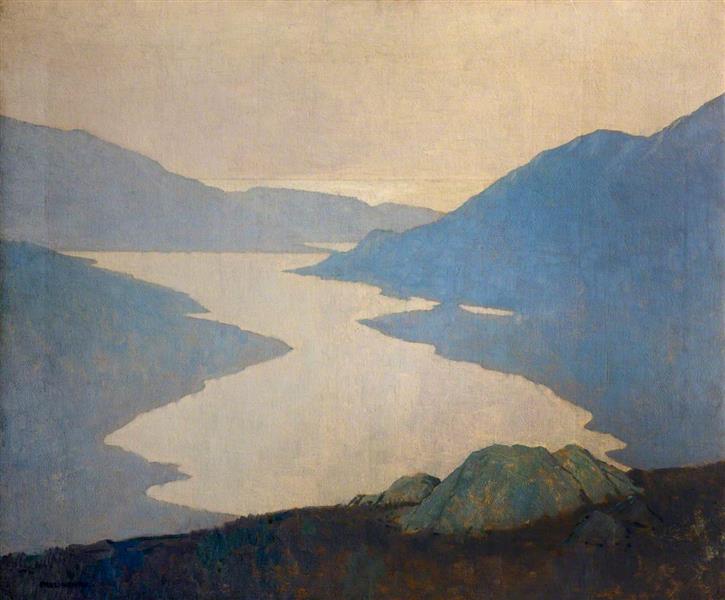
- Spare, simplified, tonally restrained landscape. Massed cumulus dominating a low horizon; blue-violet silhouetted mountain ridges; whitewashed thatched cottages as small bright accents; bog pools and lakes reflecting cloud-light; parallel diagonal furrows or turf banks driving recession. Forms reduced to flat interlocking planes with minimal internal detail; the picture plane deliberately flattened.
- Evolution
- Illustrator and tonal realist (London, to 1910) → Millet-inflected Achill peasant subjects with heavy impasto (1910–1919) → simplified, depopulated, poster-flat Connemara landscapes (1920s–30s) → repetitive late Kerry/Wicklow studio variants (1930s–40s) → cessation of painting c.1945 with failing eyesight.
- Influences
- Jean-François MilletJames McNeill WhistlerBarbizon plein-air paintingCézanne and Gauguin (simplification of form)J.M. Synge (literary source for the Achill turn)Walter Sickert (London encouragement)
- Visual Language
- Tripartite horizontal banding (foreground water/bog, midground grasses or furrows, silhouetted ridge under massed cloud); human figures either monumentalised in solitary labour or eliminated entirely; light and tone take precedence over descriptive detail.
- Signature Series
- Achill figure paintings, 1910–1919 (The Potato Diggers; Launching the Currach) — scarcest and most valuable
- Connemara lake-and-mountain landscapes, 1920s–30s (Mountains and Lake, Connemara; A Sunny Day, Connemara) — the market's core
- Kerry and Killarney subjects, 1930s (The Road to Coomasharn; Evening, Killarney)
- Railway/travel poster designs, 1920s
- Themes and Subjects
- West of Ireland landscape — Achill Island, Connemara, Killarney and Kerry, Lough Mask, Killary
- Peasant labour: potato digging, turf cutting, seaweed harvesting, fishing, launching the currach (pre-1919)
- Depopulated bogland, lake and mountain (post-1919)
- Cottages and turf stacks
- Human smallness within an expansive sky; quietude and solitude
- National landscape identity
- Movements and Periods
- Post-Impressionism (Irish)Tonalism / Whistlerian tonal reductionBarbizon-derived rural realismIrish Revival and Free State cultural nationalismEarly Modern, 1900–1945
- Techniques and Mediums
- Oil on canvas (typically 14 x 18 to 28 x 32 in.)Oil on panel/board — small field-study format c.10 x 12 in.Charcoal and pencil drawingsWatercolour (early)Book, magazine and newspaper illustration (London period)Lithographic railway and travel postersLoaded impasto, palette knife, stiff brush, dry-brush scumbling, alla prima blending
- Fingerprint Verification
- Confirmed
- Post-Impressionist, representational register; Early Modern / 1900–1945 bracket — confirmed by every source (Wikipedia, NGI, Irish Arts Review all describe a spare Post-Impressionist style)
- Oil on panel and canvas; alla prima wet-into-wet skies; loaded impasto and palette-knife handling — consistent with saleroom descriptions and the small-panel/large-canvas division of his output
- Landscape as the dominant collector theme; contemplative and solitary mood; cool, muted, earth-toned palette
- Low horizon line, foreground recession, easel-scale format — the canonical Connemara/Achill compositional formula
- Millet-derived peasant iconography via a Barbizon-to-Post-Impressionist lineage and Whistlerian tonal reduction (Académie Carmen) — both directly documented in the biography
- Extensions and Corrections
- ADD — COLOUR BLINDNESS: Kennedy's finding that Henry was colour blind (made public c.1973) is the material explanation for the restricted, tonal, muted palette the fingerprint identifies. This reframes 'muted palette' from pure stylistic choice to physiological condition combined with deliberate Whistlerian training.
- ADD — A HARD CHRONOLOGICAL BREAK AROUND 1919: pre-1919 Achill works are FIGURE subjects (potato digging, turf cutting, seaweed gathering, launching the currach, fishing); post-1919 works become increasingly depopulated pure landscape. The two tier-1 exemplars sit on either side of this divide (one peasant-figure panel, one unpeopled bogland), which likely explains the low coherence score (0.38) — it is not noise, it is two distinct career phases.
- ADD — WORKS OFTEN PAINTED FROM MEMORY in the studio rather than fully plein-air, because Achill residents were reluctant on superstitious grounds to be sketched. This qualifies the fingerprint's 'plein-air field study' reading of the small panels.
- ADD — GRAPHIC/POSTER DIMENSION: Henry designed railway travel posters in the 1920s whose flattened, simplified massing fed back into the paintings; the flattening of the picture plane and geometric simplification noted in the Dictionary of Irish Biography is as much design sensibility as Cézannian influence.
- ADD — Cézanne and Gauguin are cited alongside Millet and Whistler as Paris-period influences.
- NO DISAGREEMENT FOUND between the fingerprint and the sources; the fingerprint is under-specified rather than inaccurate.
Critical Reception
- Critical Reception
- Standing
- Regarded as the most influential landscape painter to work in Ireland in the twentieth century; the Yale/NGI literature presents his West of Ireland imagery as the quintessential view of the Irish scene, drawing an equivalence with Cézanne's Provence and Constable's Suffolk.
- Reputational Arc
- Enormous popular fame in the 1920s–30s through railway posters and reproductions; a period of critical discount in the later twentieth century; rehabilitation from the 1998 Ulster Museum and 2003 NGI exhibitions and the Yale publications, which restored attention to the early Achill figure paintings.
- Key Critical Voices
- Dr S.B. Kennedy — formerly head of fine and applied art at the Ulster Museum — is the principal scholar: monograph (Yale, 2000), catalogue raisonné (Yale, 2007) and curator of the 2003 NGI retrospective. Kennedy is quoted as saying Henry, more than anybody, showed us how to look at the landscape. His death was marked by an Irish Times appreciation of his curatorial and literary legacy, with tributes from James O'Halloran of Adam's.
- Art Historical Critique
- Scholarship notes the double edge of the achievement: technical innovation (flattening of the picture plane, geometric simplification of forms, tonal restraint noted in the Dictionary of Irish Biography) set against the way the post-1919 depopulated landscapes hardened into a state-friendly, heavily reproduced image of the West. Dr Mary Cosgrove, quoted in saleroom literature, frames the Achill work as a new realism in Irish art.
- Academic Positioning
- Studied within Irish Revival and Free State cultural-nationalism scholarship as much as within painting history; a standard case study in the visual construction of national identity, alongside Synge's writing and Keating's figure painting.
- Publications and Media
- Yale University Press monograph (2000) and catalogue raisonné (2007) — the benchmark of independent, non-commercial scholarship on this artist
- Dictionary of Irish Biography (Royal Irish Academy) entry
- Sustained coverage in The Irish Times fine art & antiques column and the Irish Examiner (record sales 2013, 2020, 2021; market analyses 2022, 2025, 2026)
- Irish Arts Review — 'Art at Auction: 2025 Overview' naming Henry as the most reliable investment name in the Irish market
- Antiques Trade Gazette Irish art coverage (2026 Lough Mask sale)
- Irish Echo feature, May 2025, on Achill's effect on his painting, quoting S.B. Kennedy
- Ulster History Circle biographical entry
- Friends of the National Collections of Ireland (FNCI) artist entry
- Editorial Recognition Gap
- No coverage found in Artforum, frieze, Art in America, e-flux or Brooklyn Rail — expected for a pre-war national-school landscape painter who died in 1958. The relevant editorial ecosystem is the Irish art-historical and market press (Irish Arts Review, Irish Times, Irish Examiner, Antiques Trade Gazette), where his presence is continuous and prominent.
Gallery & Representation
- Fair Presence
- Not shown at contemporary art fairs. Appears at Irish antiques and art fairs and on dealer stands at Irish-interest events; the Dublin auction calendar, not the fair circuit, is the market's clearing mechanism.
- Representation
- Status
- No primary representation — the artist died in 1958. The market is entirely secondary, split between Dublin auction houses and specialist dealers in historical Irish art.
- Secondary Market Dealers
Name Location Note Tier The Oriel Gallery 17 Clare Street, Dublin Maintains a Paul Henry page; Oriel Gallery labels appear in saleroom provenance Specialist Irish-paintings dealer since 1968 Milmo-Penny Fine Art Dublin Maintains a Paul Henry archive page Private dealer in fine Irish and European paintings Pyms Gallery London Appears in the provenance of 'Dapping on Lough Mask' Historic specialist in Irish and British pictures Gorry Gallery Dublin Closely associated with the scholarship circle around S.B. Kennedy Long-established Irish historical-pictures dealer Combridge Gallery (historic) Dublin Original framing labels are a provenance marker on 1920s–30s canvases Period retailer/framer - Auction Houses Dominating the Market
- Whyte's, Dublin — dominant venue for top Henry lots (2020, 2025, 2026)James Adam & Sons / Adam's, DublindeVeres, DublinMorgan O'Driscoll, Cork/onlineChristie's, London — record 2021 (B.J. Eastwood Collection)Sotheby's — Irish Art sales; 'Evening, Killarney', March 2026 (per EGON database)Bonhams, LondonCaza Sikes, Cincinnati — US rediscoveries
- Geographic Reach
- Primary demand in Ireland (Republic and Northern Ireland); secondary demand in the UK (London salerooms) and among the US Irish diaspora; occasional continental European interest. Effectively a national market with diaspora extension.
- Representation History
- During his lifetime Henry sold through Dublin outlets including the Combridge Gallery, exhibited with the RHA and the Society of Dublin Painters, and held a 1957 retrospective at the Ritchie Hendriks Gallery, Dublin.
This is what the market knows about Paul Henry. What Egon can also tell you: whether Paul Henry fits your portfolio — based on your existing holdings, budget, and investment timeline.
Get personalized analysisActive market signals
Inside Egon
Signal timeline & strength analysis
Gallery moves, auction records, institutional acquisitions, price milestones — tracked over 90 days
Full signal timeline, strength analysis, and alert configuration for Paul Henry.
Collector demographics & buyer analysis
Geographic distribution, institutional vs. private buyers, collector profiles, and secondary market activity
Who is collecting Paul Henry? Geographic distribution, institutional vs. private buyers, and collector profile analysis.
Personalized acquisition strategy
Optimal entry points, comparable pricing analysis, timing recommendations, and portfolio fit assessment
Personalized acquisition strategy for Paul Henry based on your budget, timeline, and collection goals.
Go deeper with personalized intelligence
You now have Egon's market assessment of Paul Henry. The next question is personal: does this artist belong in your collection? Egon analyzes collection fit based on your aesthetic thesis, existing holdings, budget, and investment goals — delivering acquisition strategies no public index can provide.