Tim Eitel
Value#85

Egon Investment Scores
Liquidity
4/10
How easily works can be bought and sold at auction
Institutional
8/10
Museum collections, biennials, and institutional recognition
Momentum
5/10
Recent price trends, gallery moves, and market buzz
Discovery
2/10
Undervaluation opportunity relative to peer artists
Risk
3/10
Investment risk factors — higher means more volatile
Market Position
- Pricing
- Market Notes
- Peak auction record from 2006 reflects New Leipzig School market peak
- Since 2009 financial crisis, prices have stabilized but market depth is limited
- Primary market controlled through major galleries (Pace, EIGEN + ART, Jousse Entreprise)
- Secondary market shows modest activity with consistent but not spectacular results
- Price by Scale
- Small Works
- $10,000-$25,000 USD (typical range for smaller paintings and works on paper)
- Medium Works
- $25,000-$100,000 USD (estimated based on historical data)
- Major Paintings
- Contact Pace Gallery or Galerie EIGEN + ART for current pricing on significant works
- Early Career Prices
- Works from 2001-2004 period (including pieces acquired by Rubell Family Collection) drove six-figure prices during mid-2000s market peak
- Current Market 2024 2025
- Recent auction activity shows smaller works and secondary pieces coming to market. Major works held in collections. Prices not publicly disclosed for recent sales, indicating gallery-controlled primary market.
- Historical Pricing Context
- Major auction record set in 2006 during the peak of New Leipzig School market hype. The art market for New Leipzig School experienced significant growth 2003-2009, followed by contraction after the 2009 financial crisis.
- Liquidity
- Buy-in Rate
- Data not sufficient for accurate assessment
- Market Depth
- Thin secondary market, most significant works held in institutional and private collections
- Geographic Concentration
- Strongest markets: Germany, USA, UK, South Korea
- Annual Transaction Volume
- Low to moderate - typically under 10 auction lots annually
- Comparables
- Peer Artists
- Neo Rauch (New Leipzig School, auction record significantly higher)Matthias Weischer (New Leipzig School peer)David Schnell (New Leipzig School peer)Christoph Ruckhäberle (New Leipzig School peer)Tilo Baumgärtel (New Leipzig School peer)
- Market Positioning
- Mid-tier within New Leipzig School - below Neo Rauch but established presence. Solid institutional validation but more modest auction results than top tier.
- Collector Base
- Major Collectors
Collector Status Rubell Family Collection (Don and Mera Rubell) — Deutsche Bank Collection Corporate collection with significant holdings Museum Frieder Burda Private museum collection Private collectors in Bayern (Bavaria) — - Collector Profile
- Institutional collectors, sophisticated private collectors focused on contemporary German painting, collectors of New Leipzig School artists
- Primary Market
- Gallery Representation
Locations Gallery Relationship Tier New York, Seoul, Hong Kong, Beijing Pace Gallery Primary representation since 2006, first solo show 2006 Tier 1 international gallery Berlin, Leipzig Galerie EIGEN + ART Joined 2002, long-term relationship Leading German contemporary gallery Paris Jousse Entreprise French representation Established Paris gallery Seoul Hakgojae Gallery Asian market representation, multiple exhibitions Leading Korean gallery - Primary Market Strategy
- Gallery-controlled pricing with limited secondary market exposure. Focus on museum-quality works for serious collectors.
- Auction History
- Price Range
- Overall
- $375 USD to $284,800 USD
- Typical Range
- $10,000-$25,000 USD (most artworks sold in this range per LotSearch data)
- Auction Record
- Date
- November 2006
- Size
- 102 1/4 x 74 3/4 in. (259.7 x 189.9 cm)
- Work
- Schwarzer Sand
- Price
- $284,800 USD
- Year Painted
- 2004
- Auction House
- Christie's New York
- Auction Volume
- Activity Level
- Moderate secondary market presence, typically under 10 lots annually
- Primary Market
- UK (21 lots sold)
- Lotsearch Archive
- 57 works, 36 with realized prices
- Total Lots Tracked
- 113 artworks at auction according to MutualArt
- Recent Auction Activity 2024 2025
Work Year Date Auction House Note Monks 2009 February 5, 2025 Nagel Auction — Monks 2009 December 10, 2024 Christie's Price not disclosed Waldrand (watercolor) 2003 December 6, 2024 AaG Auktionshaus am Grunewald — — 2009 September 25, 2024 Nagel Auction — Boygroup 2003 May 14, 2024 Sotheby's Contemporary Day Auction Price not disclosed Blau und Gelb 2002 March 20, 2024 Phillips Price not disclosed
- Market Position
- Market Segment
- Established mid-career German contemporary painter with strong institutional validation but modest secondary market liquidity
- Market Challenges
- Limited secondary market liquidityAuction record from 2006 peak, no recent comparable major salesOvershadowed by Neo Rauch within New Leipzig School narrativeNew Leipzig School market cooled significantly post-2009
- Competitive Advantages
- Tier 1 gallery representation (Pace)Strong museum holdings including major institutionsAcademic teaching position at prestigious École des Beaux-Arts de Paris adds gravitasPart of historically significant New Leipzig School movement
- Investment Outlook
- Risks
- Limited auction liquidity makes price discovery challengingNew Leipzig School market has cooled from 2000s peakMid-career artist without explosive recent market momentumGerman contemporary painting market can be cyclical
- Strengths
- Exceptional institutional validation (major museum collections)
- Tier 1 gallery support maintains market stability
- Career continues to develop with recent exhibitions and academic position
- Works held by major collectors unlikely to flood market
- Outlook Assessment
- Stable to modest growth. Strong fundamentals (institutional validation, gallery support) provide floor. Limited liquidity means best suited for collectors focused on quality and long-term appreciation rather than short-term trading.
Institutional Presence
- Exhibitions
- Exhibition Count
- Over 50 group exhibitions and 20+ monographic exhibitions worldwide since 2000
- Solo Exhibitions Major
Title Dates Venue something there somewhere outside November 17, 2023 – January 13, 2024 Pace Gallery, New York Vorschläge für Nachbilder (Proposals for Afterimages) 2015-2024 May 31 – August 8, 2024 Kunsthalle Rostock, Germany Tim Eitel: Open Walls September 8 – December 8, 2019 Museum der bildenden Künste Leipzig untitled (2001-2020) July 7 – October 18, 2020 Daegu Art Museum, South Korea Untitled (Interior) November 25, 2020 – January 30, 2021 Pace Gallery, Seoul Sites and Attitudes September 29 – November 10, 2018 Pace Gallery, Beijing Tim Eitel June 5 – September 15, 2013 Essl Museum-Contemporary Art, Klosterneuburg, Austria Elsewhere January 26 – April 28, 2013 Rochester Art Center, Minnesota Currents 96: Tim Eitel 2005-2006 Saint Louis Art Museum, Missouri Terrain — Museum zu Allerheiligen, Schaffhausen, Switzerland First solo exhibition — Pace Gallery, New York - Group Exhibitions Notable
Title Dates Venue Copyists June 14, 2025 – February 2, 2026 Centre Pompidou-Metz, France Österreich – Deutschland (Austria-Germany, Painting 1970 to 2020) September 7, 2023 – January 21, 2024 Albertina Modern, Vienna Life After Death: New Leipzig Paintings from the Rubell Family Collection December 2004 – 2008 Rubell Family Collection, Miami (touring) Western Motel: Edward Hopper and Contemporary Art October 3, 2008 – February 15, 2009 Kunsthalle Wien, Vienna Germania contemporanea: Tim Eitel, David Schnell, Matthias Weischer June 28 – October 26, 2008 MART Museo di arte moderna, Trento, Italy Vertrautes Terrain May 22 – October 12, 2008 ZKM Karlsruhe, Germany sieben mal malerei (seven times painting) — Museum der Bildenden Künste Leipzig Deutsche Malerei Zweitausenddrei January 15 – April 13, 2003 Frankfurter Kunstverein
- Publications
Title Year Authors Publisher Life After Death: New Paintings from the Rubell Family Collection (exhibition catalogue) 2005 Mark Coetzee and Laura Steward Heon Rubell Family Collections Tim Eitel: Terrain (exhibition catalogue) 2004 Martin Schick and Markus Stegmann Holzwarth Publications Sieben mal Malerei: Baumgärtel, Busch, Eitel, Kobe, Ruckhäberle, Schnell, Weischer (exhibition catalogue) 2003 — — Marion Ermer-Preis 2003: Tim Eitel 2003 — Hochschule für Bildende Künste Dresden - Media Coverage
Note Publication Featured coverage of Seoul exhibitions The Korea Times Coverage of Korean exhibitions Korea Herald Contemporary art coverage WHITEWALL Most recent: Taipei Dangdai 2022 coverage, May 2022 ArtDaily June 2004 - 'A League of Their Own' feature, cover Art + Auction Exhibition review by David Galloway The International Herald Tribune Multiple articles 2003-2004 during New Leipzig School rise Der Tagesspiegel - Museum Collections
Institution Location Tier Albertina Vienna, Austria Tier 1 European museum ARKEN Museum of Modern Art Ishøj, Denmark Major Scandinavian contemporary museum Daegu Art Museum South Korea Major Korean museum Deutsche Bank Collection Germany Leading corporate collection Hamburger Bahnhof - Museum für Gegenwart Berlin, Germany Tier 1 contemporary museum Museum der bildenden Künste Leipzig Leipzig, Germany Major regional museum Museum Frieder Burda Baden-Baden, Germany Important private museum Rubell Family Collection (now Rubell Museum) Miami, USA Major private museum Musée d'art Moderne de Paris Paris, France Tier 1 French museum Smithsonian Institution Washington, D.C., USA Tier 1 American institution - Awards and Recognition
Year Significance Award 2003 Prestigious early career award Marion Ermer Prize 2002 — Landesgraduiertenstipendium, Saxonia, Germany 2002 — — — Major critical recognition —
Career & Biography
- Career
- Awards and Honors
Year Award 2002 Landesgraduiertenstipendium, Saxonia, Germany 2003 Marion Ermer Prize 2002 Residency at Künstlerhaus Bethanien, Berlin - Critical Recognition
- Art Review magazine declared Eitel as one of 'the best young painters working today'
- Standard bearer for the New Leipzig School alongside Neo Rauch and Matthias Weischer
- Described as 'one of the most important painters of his generation'
- Professional Milestones
Year Event 2001 Graduated from Leipzig Academy 2002 Co-founded Galerie LIGA in Berlin with fellow Leipzig graduates to promote young painters from Leipzig 2003 Joined Galerie EIGEN + ART in Berlin 2006 First solo exhibition at Pace Gallery, New York - marked international breakthrough 2023 First solo exhibition in New York since 2009 at Pace Gallery
- Identity
- Gender
- Male
- Full Name
- Tim Eitel
- Birth Year
- 1971
- Birth Place
- Leonberg, Germany (near Stuttgart)
- Nationality
- German
- Getty Ulan Id
- 500122847
- Current Location
- Berlin, Germany (also works in Paris)
- Education
- Teaching Positions
- Years
- 2015-present
- Position
- Professor/Studio Master
- Institution
- École Nationale Supérieure des Beaux-Arts de Paris
- Academic Background
Institution Years Degree Field University of Stuttgart 1993-1994 Studied but did not complete Literature, Philosophy, and German Studies Burg Giebichenstein University of Art and Design, Halle 1994-1996 — Fine Arts Hochschule für Grafik und Buchkunst, Leipzig 1997-2001 Diploma in Painting Painting Hochschule für Grafik und Buchkunst, Leipzig 2001-2003 — Master Student (Meisterschüler) under Professor Arno Rink
- Artistic Context
- Key Influences
- Caspar David Friedrich (Romantic painter)Gerhard Richter (contemporary German artist)Arno Rink (teacher and mentor)Neo Rauch (influential peer from Leipzig Academy)
- Artistic Philosophy
- 'Painting is always artificial and staged; there's no such thing as a straight realism'
- 'I translate reality for myself and extract a kind of parallel world from the flood of imagery bombarding us every day'
- Explores the neurological aspects of perception - 'What do we really see and what does the brain construct, the memory of images subconsciously add?'
- Works are based on photographs he takes himself, using photorealism techniques
- Formative Influences
- Francis Bacon retrospective in Stuttgart (1986) - cited as the moment he decided to become a painter at age 15
- Mother Andrea Eitel is also a painter, began painting around the same time
Artistic Profile
- Style
- Technical Approach
- Based on photographs Eitel takes himselfUses photorealism techniquesRecently shifted to egg tempera for matte surfaces without glareTraditional painting methods learned at Leipzig AcademyLayered, meticulously composed approachFocus on precise representation while creating abstract spatial relationships
- Stylistic Evolution
- Early works (2001-2004): Interior scenes of lone figures in museums, direct references to art history
- Mid-career: Expanded to include architecture and landscape simultaneously
- Recent work (2020s): Increasingly explores neurological aspects of perception, gallery spaces as subject matter, vacant or nearly vacant spaces
- Visual Characteristics
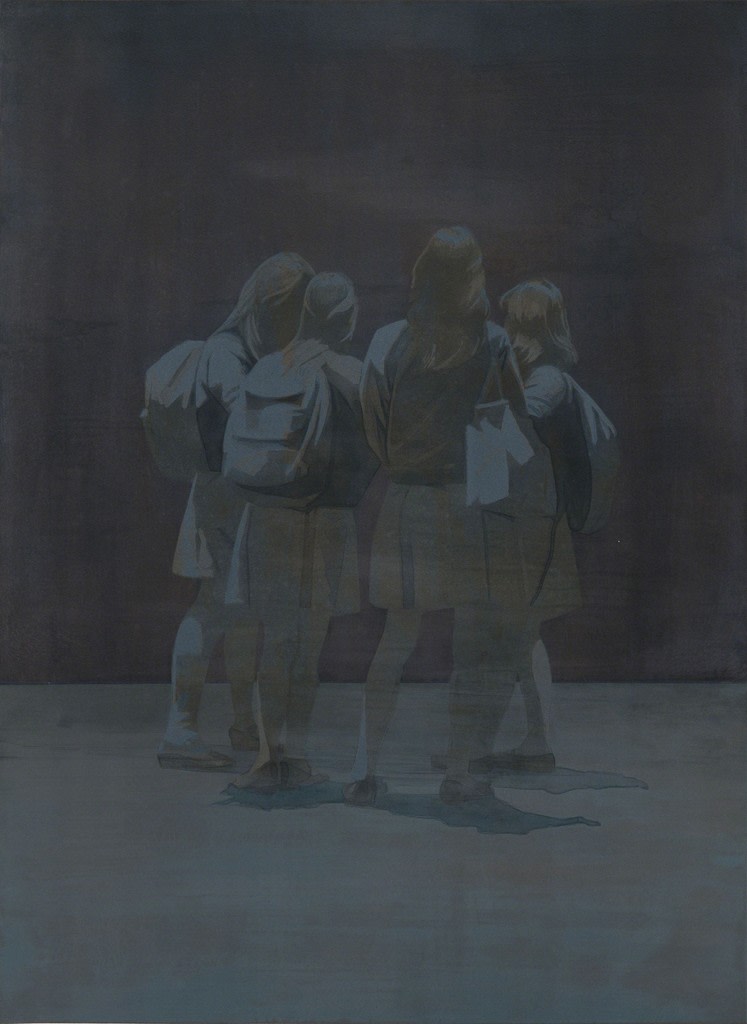
- Figurative painting with abstract elementsMonochromatic or limited color palettes with strategic use of colorSolitary or small groups of figures in ambiguous, isolated environmentsExploration of depth versus flatnessMuted, industrial colors combined with areas of intense colorFigures often depicted from behind or with faces turned awayArchitectural elements and spatial ambiguityQuietude, melancholy, psychological depth
- Evolution
- Mid Period 2006 2015
- Key Works
- Boat (2004)Container (2004)Matratze (2008)Mexican window (2014)
- Characteristics
- Expansion to include architecture and landscape simultaneously, continued exploration of figure-space relationships, international recognition
- Early Period 2000 2005
- Key Works
- Murakami (2001)Mantel (2002)Rot und Blau (2002)Abend (2003)Schwarzer Sand (2004)
- Characteristics
- Interior museum scenes, direct art historical references (especially Mondrian), lone figures or small groups, establishing signature style
- Mature Period 2016 Present
- Key Works
- Conversation (2018)Three Attitudes (2018)Split Moon (2023)out where (2023)Loop (2023)
- Developments
- Teaching position at École des Beaux-Arts de Paris (since 2015), return to New York exhibitions (2023), continued institutional validation
- Characteristics
- Increased focus on neurological aspects of perception, gallery spaces as subject, shift to egg tempera, greater abstraction and spatial ambiguity, more vacant spaces
- Influences
- Contextual Influences
- Leipzig Academy figurative painting traditionPost-reunification German cultural climateSocialist Realism legacy (transformed through contemporary lens)Contemporary photography and image culture
- Historical Influences
Artist Connection Caspar David Friedrich Romantic painter, influence on use of solitary figures and contemplation of space Gerhard Richter Contemporary German painter, influence on relationship between painting and photography Piet Mondrian Early works directly referenced Mondrian, exploring contradictions within his work Francis Bacon 1986 Stuttgart retrospective was catalyst for Eitel deciding to become painter at age 15 Edward Hopper Included in 'Western Motel: Edward Hopper and Contemporary Art' exhibition, shared concerns with isolation and architectural space - Educational Influences
- Teacher
- Arno Rink
- Connection
- Master teacher at Leipzig Academy, traditional figurative painting techniques
- Peer
- Neo Rauch
- Connection
- Influential peer and senior figure in New Leipzig School
- Visual Language
- Color Palette
- Monochromatic expanses (blacks, grays, whites)Strategic use of saturated color (blues, yellows, reds)Muted, industrial colorsColor as both form and atmosphere
- Atmospheric Qualities
- Quietude and contemplationMelancholy and introspectionPsychological tensionSense of alienation or strangenessDetachment from reality despite realistic elements
- Compositional Strategies
- Figures placed in relation to large abstract color fieldsInterplay between depth and flatnessUse of architectural elements to structure spaceFigures often at edges or backs turned to viewerEmpty or nearly empty spacesCareful attention to light and shadow
- Themes and Subjects
- Thematic Concerns
- Perception and vision - what we see versus what our brain constructsRelationship between figures and architectureWays humans interact with art and spacesMemory and constructed realityIsolation and alienation in contemporary lifeTime and temporality - moments suspended without before or afterRelationship between abstraction and representationSpace, light, and spatial perception
- Recurring Subjects
- Solitary figures in museum settingsPeople viewing artArchitectural interiors and exteriorsLandscapes and urban spacesGallery and museum spacesMoments of introspection and contemplationAmbiguous, staged scenarios
- Conceptual Framework
- Creates 'fictitious parallel worlds' from experienced realityPaintings are 'analogies to reality' rather than representationsExplores 'the flood of imagery bombarding us every day'Investigates how we decode images versus languageQuestions relationship between photography and painting
- Movements and Periods
- Movement Context
- Third generation of Leipzig School, relates to post-reunification climate of modern Germany. Characterized by combination of figurative and abstract elements, technical skill, and renewed interest in figurative painting.
- Primary Movement
- New Leipzig School (Neue Leipziger Schule)
- Contemporary Relevance
- Work continues to be relevant in discussions of contemporary painting, perception, and relationship between abstraction and figuration
- Historical Positioning
- Part of generation that studied at Leipzig Academy in late 1990s/early 2000s under Arno Rink. Emerged alongside Neo Rauch, Matthias Weischer, David Schnell, Christoph Ruckhäberle as key New Leipzig School figures.
- Techniques and Mediums
- Scale
- Ranges from small intimate works (under 30cm) to large-scale paintings (over 2 meters)
- Other Mediums
- Egg tempera on canvas (recent works)Oil on linenOil on wood panelLithographsScreenprintsWatercolorWorks on paper
- Primary Medium
- Oil on canvas
- Technical Notes
- Uses photography as source materialEmploys reflections and shadows to create 'image within image' effectsRecent works use egg tempera for matte finish to avoid reflectionWorks in series and develops paintings in relation to each other
Critical Reception
- Critical Reception
- Critical Quotes
- 'Painting is always artificial and staged; there's no such thing as a straight realism' - Tim Eitel
- 'I translate reality for myself and extract a kind of parallel world from the flood of imagery bombarding us every day' - Tim Eitel
- 'One of the best young painters working today' - Art Review magazine
- 'A painter who came in from the cold' - Roberta Smith, New York Times (2002, about Neo Rauch/New Leipzig School)
- 'Their concerns were very disparate and there was no confusing who was who' - Don Rubell on New Leipzig School artists
- Key Critical Themes
- Standard bearer for New Leipzig School alongside Neo Rauch and Matthias Weischer
- Bridges European painting tradition with distinctly contemporary sensibility
- Work described as 'discrete inconspicuous depictions of daily life' with psychological depth
- Praised for investigation of perception, space, light, and temporality in painting
- Critical Assessments
- Work balances figurative painting with conceptual approach
- Explores the contradictions within art history (particularly Mondrian references)
- Addresses neurological aspects of perception - what we see versus what memory constructs
- Creates 'parallel worlds' from photographed reality, reduced to essential elements
- Critical Positioning
- Recognized as a leading figure of the New Leipzig School, celebrated for psychologically charged figurative paintings that explore contemporary human experience through technically accomplished, conceptually sophisticated work.
- Publications and Media
- Critical Discourse
- Work situated within broader discussions of contemporary German painting, New Leipzig School legacy, figurative painting's role in contemporary art, and European painting tradition
- Scholarly Attention
- Featured in major exhibition catalogues including Rubell Collection touring showSubject of monographic exhibition catalogue 'Terrain' (2004)Included in key New Leipzig School publicationsRegular coverage in international art press
- Media Coverage Summary
- Substantial international coverage 2003-2009 during New Leipzig School peak. Consistent coverage since then related to major exhibitions. Featured in Korean, American, and European art media.
Gallery & Representation
- Fair Presence
- Art Fairs
Year Note Fair 2004 Rubell Collection debut of 'Life After Death' exhibition during fair Art Basel Miami Beach 2019 Representation by Jousse Entreprise FIAC Paris 2022 Featured at third edition Taipei Dangdai - Fair Strategy
- Gallery-represented at major international fairs through Pace and EIGEN + ART
- Representation
- Primary Galleries
Locations Significance Gallery Recent Exhibitions Relationship Start Tier New York, Seoul, Hong Kong First solo exhibition 2006 marked international breakthrough. Leading blue-chip gallery representing top contemporary artists. Pace Gallery something there somewhere outside (New York, 2023-2024), Untitled (Interior) (Seoul, 2020-2021), Sites and Attitudes (Beijing, 2018) 2006 Tier 1 international Berlin, Leipzig Major German gallery that helped establish New Leipzig School. Founded by Gerd Harry Lybke, played crucial role in introducing Leipzig painters to international market. Galerie EIGEN + ART Vie imaginaire, chapitre II: Ensemble (Berlin, 2021), Vie imaginaire (Berlin, 2018) 2002 Leading German contemporary Paris French market representation, reflects Eitel's connection to Paris (teaches at École des Beaux-Arts) Jousse Entreprise Untitled (Paris, 2022), Tomorrow, 2 seconds later (Paris, 2015) — Established Paris gallery Seoul Asian market representation Hakgojae Gallery — — Leading Korean gallery
- Geographic Reach
- Market Strength
- Asia
- Growing presence in South Korea through Hakgojae Gallery and Pace Asia locations
- Europe
- Strong, particularly Germany (home market) and France (teaching position)
- North America
- Established through Pace representation and Rubell Collection visibility
- Primary Markets
- GermanyUnited StatesSouth KoreaFranceUnited Kingdom
Tim Eitel's fundamentals are strong. But is the timing right for your collection? Egon analyzes fit against your aesthetic thesis, risk tolerance, and portfolio gaps.
Get Personalized AnalysisActive Market Signals
Signal Timeline & Strength Analysis
Gallery moves, auction records, institutional acquisitions, price milestones — tracked over 90 days
Collector Demographics & Buyer Analysis
Geographic distribution, institutional vs. private buyers, collector profiles, and secondary market activity
Personalized Acquisition Strategy
Optimal entry points, comparable pricing analysis, timing recommendations, and portfolio fit assessment
Go Deeper with Personalized Intelligence
You now have Egon's market assessment of Tim Eitel. The next question is personal: does this artist belong in your collection? Egon analyzes collection fit based on your aesthetic thesis, existing holdings, budget, and investment goals — delivering acquisition strategies no public index can provide.