Dorothea Tanning
Blue-chipEgon research · Artist market profile
The market, in context.
Explore Dorothea Tanning’s auction history alongside the exhibitions, collections and gallery relationships behind the market.
Auction record
$6,261,433 / £4,686,000 with fees (hammer £3,800,000)
Children's Games (1942), oil on canvas, 23.3 x 14.3 cm
View the sale and market context →Gallery relationships
Kasmin (estate), Alison Jacques (estate), Gallery Wendi Norris (estate), Michael Rosenfeld Gallery (secondary)
Explore representation →Institutional research
Collections & exhibitions
Read holdings, exhibition history and their qualifications in context.
Read the institutional research →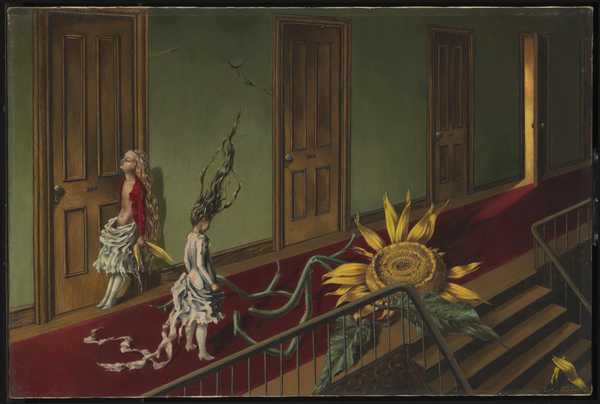



Egon investment scores
Market position
Research updated
Auction record
Beat the previous record by $2.86M, a rise of 83-84% (HENI). Artnet calculated about $120,000 per square inch, a per-square-inch record for the artist.
Auction highlights
Scroll horizontally if needed →
| Work | Result | Venue and date |
|---|---|---|
| Le Machinateur désintéressé (oil on canvas) | Not supplied | Christie's (Paris), 2026-09-30 |
| Témoins du drame (1947), oil on linen, 30.5 x 28.3 cm, The Collection of Sybil Shainwald | Not supplied | Sotheby's New York, Modern Evening Auction, 2026-05-19 |
| Birthday (Self Portrait at Age 30), c.1970 offset lithograph (edition of 150) | Not supplied | Bonhams, 2026-04 |
3 further auction entries on record for Dorothea Tanning — inside Egon.
Pricing
Temporal context
2025
Step-change: two successive records ($2.35M, then $3.22M by Egon's premium-inclusive figure; HENI reports $3.4M) and annual turnover of about $7.7M per Artnet, roughly 7x 2024.
- Pre 2019
- Predominantly five-figure to low six-figure results for paintings; prints and works on paper routinely $3,000-$30,000
2019 2024
Re-rating after the Reina Sofía/Tate retrospective; auction record $1.44M (Le mal oublié, Christie's, May 2022). Artnet's January 2025 market appraisal called the market solid but by no means frothy, with the record still at $1.4M.
2026 current
Record $6.26M (Children's Games, March 2026). Sotheby's offered a second trophy-tier 1940s oil in May 2026: 'Témoins du drame' (1947, 30.5 x 28.3 cm), estimated $1.0-1.5M. Its result was not established in the sources checked. Guidance as of October 2026: early Surrealist canvases (1942-1951) with strong provenance run about $1M-$6.5M; strong mid-period and abstract works about $200K-$1.2M; secondary paintings and significant works on paper about $30K-$250K (Le Machinateur désintéressé, a minor oil, made $61,044 premium-inclusive at Christie's Paris in September 2026); signed lithographs and offset lithographs generally $1,500-$15,000 (a Birthday offset lithograph hammered at $3,800 at Bonhams in April 2026). A record is a ceiling event, not a floor for the category.
By work type and scale
Soft sculpture
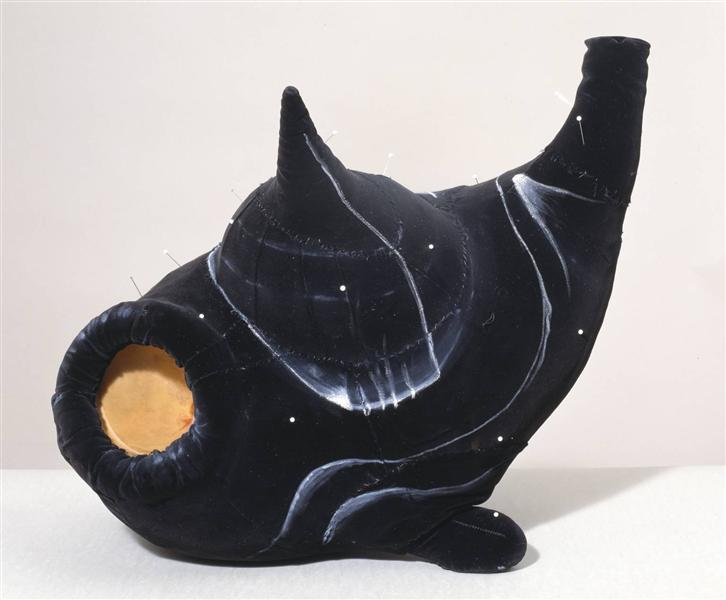
Extremely rare at auction and largely held by institutions (Tate's 'Pincushion to Serve as Fetish' 1965; Centre Pompidou's 'De quel amour' 1969 and 'Chambre 202'). No reliable public price benchmark was identified.
Prints and multiples
$1,500-$15,000. The c.1970 offset lithograph after 'Birthday' (edition of 150) trades regularly at regional houses: Bonhams, April 2026, $3,800 hammer per Egon's database; Invaluable shows another copy offered 29 July 2026 with a low estimate of $5,000. Keep this segment separate from unique-work statistics, because blending it materially distorts average prices.
- Later paintings 1960s 1990s
- $100,000-$700,000 depending on subject and exhibition history
Early surrealist oils 1942 1951
$1,000,000-$6,300,000 — the value core. Scale does NOT drive price: the record work measures only 23.3 x 14.3 cm, and the May 2026 Sotheby's offering was 30.5 x 28.3 cm at a $1-1.5M estimate.
- Works on paper drawings gouaches
- $20,000-$250,000 (Simplified Botany - The Sea at $207,493 is a category high-water mark)
- 1950s prismatic abstract paintings
- $400,000-$1,500,000 (Le mal oublié $1.44M in 2022; Katchina and Her Soul $1.21M in 2025)
Minor or small oils regional and day sales
Roughly $50,000-$150,000. Le Machinateur désintéressé (oil on canvas) made $61,044 premium-inclusive at Christie's Paris on 30 Sep 2026 per Egon's database, against an estimate of about $11,000-$17,000 on a hammer basis. The bases differ, so no over/under multiple is claimed. 'Daja' (1949), a smaller work offered in Paris on 3 June 2026 at €6,000-8,000 (Invaluable listing), had no result established in the sources checked.
Liquidity
Assessment
Thin but high-conviction. An estimated 10-25 lots a year across all houses, including prints, with only a handful of significant unique works. Egon's database (2025 onward, four major houses) shows 9 sold lots in the past 730 days and a canonical sell-through of 89% across 9 settled lots, up from the 78% in the previous version of this file. Artnet's dedicated market appraisal led on the scarcity of top-quality material. Major-house results have repeatedly exceeded estimates, with the caveat that premium-inclusive prices are not directly comparable with hammer-basis estimates.
Depth risk
Severe concentration risk. A single lot can account for most of a year's turnover, so year-on-year turnover is volatile and hard to extrapolate. As of October 2026, no verified trophy-tier result has followed the March 2026 record.
Comparables
- Toyen
- Also set a record in the same Christie's March 2026 Art of the Surreal sale
- Max Ernst
- Historically the comparison that suppressed her valuation; Tanning is now being repriced independently of her husband
- Frida Kahlo
- Segment halo effect; a Kahlo was expected to fetch up to $60M at Sotheby's New York in November 2025
- Remedios Varo
- Record $6.2M (Revelación / El relojero, Christie's, May 2025), about the same level as Tanning's new record
René Magritte
His painted bottle 'Femme-bouteille', from the same Sybil Shainwald collection as the May 2026 Tanning, set an auction record for a painted bottle at Sotheby's New York on 19 May 2026 (Artnet News). That points to strong demand for the consignment's Surrealist material, though the Tanning's own result was not established.
Leonora Carrington
Record $28.5M (Les Distractions de Dagobert, Sotheby's New York, May 2024), up from a $3.3M prior high. This is the segment benchmark and the clearest headroom comparison.
Collector base
Composition
US and European collectors of Surrealism, a fast-growing group building dedicated women-Surrealist holdings, and museums. US and Latin American demand has been identified as a driver of the broader surge for women Surrealists, alongside the #MeToo-era reassessment and a wave of museum shows.
Demand pattern
Strongest for 1942-1951 figurative Surrealist canvases with exhibition and literature history. Interest has deepened in the 1950s prismatic abstractions and the soft sculptures since the Reina Sofía/Tate retrospective.
Named collectors and provenance
Max Ernst; Gypsy Rose Lee and her son Erik Lee Preminger (Children's Games); the Ulla and Heiner Pietzsch Collection, Berlin, now owned by the Neue Nationalgalerie (includes 'Voltage', 1942); Lincoln Kirstein, who acquired 'Témoins du drame' in 1952, followed by Philip Bloom, the Bloom estate, Michael Rosenfeld Gallery and Sybil Shainwald (bought December 2007); Sybil Shainwald, a women's-health lawyer whose collection Sotheby's describes as focused on under-represented women artists; Gallery Wendi Norris as a long-standing dealer-collector channel since c.2004.
Primary market
Structure
Controlled by the estate and foundations (The Destina Foundation and The Dorothea Tanning Foundation), working with Kasmin (New York), Alison Jacques (London, representing since 2012) and Gallery Wendi Norris (San Francisco). The Foundation also helps auction houses catalogue works and is gathering information toward a paintings catalogue raisonné.
Pricing disclosure
Gallery prices are NOT disclosed publicly. This is a gallery-controlled market with deliberate supply management. Contact Kasmin (New York), Alison Jacques (London) or Gallery Wendi Norris (San Francisco) for current primary pricing.
Auction history
Current record
- Work
- Children's Games (1942), oil on canvas, 23.3 x 14.3 cm
- Price
- $6,261,433 / £4,686,000 with fees (hammer £3,800,000)
- Venue
- Christie's London, 'The Art of the Surreal' Evening Sale, 5 March 2026, Lot 120
- Estimate
- £1,000,000-2,000,000. HENI reports the price at more than 4.5x the low estimate, after a bidding contest of about 10 minutes.
Provenance
Max Ernst (acquired directly from the artist) → Gypsy Rose Lee, January 1948 → Erik Lee Preminger by descent → present owner via Jeffrey Hoffeld & Company, New York, June 1985. HENI notes the work had traded three times.
Significance
Beat the previous record by $2.86M, a rise of 83-84% (HENI). Artnet calculated about $120,000 per square inch, a per-square-inch record for the artist.
Record progression
- 2022: Le mal oublié (1955) — $1.44M at Christie's; stood as the record until 2025
- 12 May 2025: Endgame (1944) — $2.34-2.35M, Christie's New York 20th Century Evening Sale (est. $1-1.5M); new record
- 21 November 2025: Interior with Sudden Joy (1951) — $3,222,000, Sotheby's New York (reported up to $3.4M in some accounts); new record
- 5 March 2026: Children's Games (1942) — $6,261,433, Christie's London; current record
- 14 May 2022 (date per HENI): Le mal oublié (1955) — $1.44M at Christie's; stood as the record until 2025
- November 2025: Interior with Sudden Joy (1951), Sotheby's New York, new record. Egon's database: $3,222,000 premium-inclusive. HENI: $3.4M, dated 20 November 2025. The previous version of this file dated it 21 November. Both figures and dates are reported with their sources and not reconciled.
Volume and outcomes
Egon's database (2025 onward; Christie's, Sotheby's, Phillips, Bonhams) holds 9 sold lots from the past 730 days, ranging from $3,800 (a print, hammer) to $6,261,433. The average is $1,550,928, heavily skewed by three trophy lots and meaningless as a typical price. Canonical sell-through is 89% across 9 settled lots. Artnet's Price Database put 2025 turnover at just over $7.7M, the highest ever for the artist and nearly seven times 2024. The March 2026 London result alone equals roughly 80% of that 2025 total. Calendar-2026 turnover cannot be computed until the May 2026 'Témoins du drame' outcome is established.
Bought in and unsold
Egon's canonical sample shows an 89% sell-through across 9 settled lots, meaning about one failed lot. This replaces the earlier figure of 78% (two of nine unsold), which used a different and since-updated population. Buy-in risk concentrates in the low-value tail (prints, minor works on paper, later gouaches). Every trophy-tier early painting with a verified result in 2025 to March 2026 sold. The May 2026 Sotheby's trophy lot is unresolved and is counted as neither sold nor bought in.
Historical depth caveat
The complete pre-2019 lot-by-lot series sits behind Artnet and Artprice paywalls and could not be fully reconstructed. Invaluable lists 374 sold results across all houses and media, and LotSearch about 417 lots in its database. Both mix prints and multiples with unique works. Regional-house data (Doyle, RoGallery, DUMBO Auctions, Bonhams) confirms a persistent low-value print segment with estimates around $4,000-$6,000 in 2024-2026.
Other recent results 2025 onward egon database
- Katchina and Her Soul — $1,213,040, Sotheby's, Sep 2025 (exceeded high estimate)
- Daughters — $606,520, Sotheby's, Sep 2025
- Simplified Botany - The Sea — $207,493, Sotheby's, Sep 2025 (exceeded high estimate)
- Low end of the 2025+ sample: $34,020 (smaller works / works on paper)
- Simplified Botany - The Sea — $207,493 premium-inclusive, Sotheby's, Sep 2025 (estimate about $20,000-27,000, hammer basis)
- Le Machinateur désintéressé — $61,044 premium-inclusive, Christie's, Sep 2026 (estimate about $11,355-17,032, hammer basis; bases not directly comparable)
- Birthday (Self Portrait at Age 30), offset lithograph — $3,800 hammer, Bonhams, Apr 2026
- Earlier version of this file: low end of the 2025+ sample $34,020 (smaller works / works on paper)
Market position
- Segment
- Women Surrealists — currently the fastest-appreciating segment of the 20th-century market
Segment data
Sotheby's figures cited by Art Basel show annual auction sales of works by women Surrealists rising from $7.9M in 2018 to $94.3M in 2024, outpacing their male contemporaries.
Sale context 2026
Christie's London's March 2026 triple-header evening sale, where the record was set, brought in £197.4M with fees, up 52% year on year (The Art Newspaper). Sotheby's New York Modern Evening Auction of 19 May 2026 totalled $303.9M, which ARTnews called 'solid but subdued'. The top end of the Modern/Surrealist market remained liquid through spring 2026.
Advisor commentary
Art advisor Megan Fox Kelly has said Tanning's market is still early in full price discovery and that she is no longer a niche interest. Dealer Wendi Norris notes Tanning had a head start on peers because many museums acquired her work during her lifetime.
Investment outlook
Risks
Momentum is driven by records and constrained by supply, so annual turnover will be lumpy. The broader Surrealism category in March 2026 ran roughly 10% below the auction house's historical average for such sales despite the headline record, a caution against extrapolating trophy results across the whole market. Since March 2026 no verified trophy result has followed: the May 2026 Sotheby's lot ($1-1.5M estimate) has an unestablished outcome, and verified post-record results are minor (a $61K oil, a $3.8K print). Secondary and later material has not repriced as aggressively, widening the quality gap. The paintings catalogue raisonné is still in preparation (the Foundation is soliciting information on missing paintings), so authentication and documentation rely on the Foundation's cataloguing help rather than a published reference.
Drivers
Surrealism centenary programming (Centre Pompidou 2024 and its international tour through February 2026; 'International Surrealism' from Tate touring the US in 2026), the legacy of the Reina Sofía/Tate retrospective, the 2022 Venice Biennale, Alyce Mahon's 2026 Yale monograph, acute scarcity of top-tier supply, and repricing of women Surrealists across the sector.
Trajectory
Steep upward re-rating 2024-2026: roughly 7x growth in annual turnover from 2024 to 2025, and a 4.3x rise in the auction record from 2022 ($1.44M) to 2026 ($6.26M). Since March 2026 the trajectory is unconfirmed rather than negative: there is no verified new trophy datapoint either way.
Opportunity
Mid-tier material (1950s prismatic abstractions, major drawings, small oils and the under-traded soft sculptures) is still priced well below both the trophy tier and the Carrington comparables. This is the most plausible catch-up trade. The September 2026 Christie's Paris result for a minor oil, well above its hammer-basis estimate, is one data point consistent with depth in this tier, not proof of a trend.
Next verification steps
Get the 19 May 2026 Sotheby's lot 13 result for 'Témoins du drame' (logged-in Sotheby's results or the Artnet Price Database) before treating 2026 momentum as confirmed. Watch the November 2026 New York evening sales for the next trophy-tier test.
Institutional presence
Research updated
Exhibitions
Major solo
- Julien Levy Gallery, New York — first solo, 1944 (second 1948)
- Centre Pompidou / Musée National d'Art Moderne, Paris, 1974
- Camden Arts Centre, London, 1993
- Malmö Konsthall, Sweden, 1993
- Philadelphia Museum of Art, 2000
- Gallery Wendi Norris, San Francisco, 2009 (during the artist's lifetime); 'Dorothea Tanning | Musical Chairs', 8 March - 4 May 2024
- 'Dorothea Tanning: Behind the Door, Another Invisible Door', Museo Reina Sofía, Madrid, November 2018 - 7 January 2019 (150+ works), travelling to Tate Modern, London, 27 February - 9 June 2019; curated by Alyce Mahon with Ann Coxon (Tate) — the first large-scale exhibition of her work in 25 years and the first ever to span her full seven-decade career
- 'Dorothea Tanning: Doesn't the Paint Say It All?', Kasmin, New York, 3 March - 16 April 2022 — works 1947-1987; the most comprehensive presentation for a US audience in decades, with scholarly catalogue
- Julien Levy Gallery, New York — first solo, 1944 (second 1948, 'Recent Paintings by Dorothea Tanning')
- Alexandre Iolas Gallery, New York, 1953
- 'Dorothea Tanning: Behind the Door, Another Invisible Door', Museo Reina Sofía, Madrid, 3 October 2018 - 7 January 2019 (150+ works), travelling to Tate Modern, London, 27 February - 9 June 2019. Curated by Alyce Mahon with Ann Coxon (Tate). The first large-scale exhibition of her work in 25 years and the first to span her full seven-decade career. The opening date is corrected from 'November 2018' per Alison Jacques.
- 'Dorothea Tanning: Doesn't the Paint Say It All?', Kasmin, New York, 3 March - 16 April 2022. Works from 1947-1987; the most comprehensive presentation for a US audience in decades, with a scholarly catalogue.
- Alison Jacques, London: 'Dorothea Tanning: Collages' (29 June - 28 July 2012), 'Web of Dreams' (2014), 'Flower Paintings' (1 September - 1 October 2016), plus further solo shows in 2015 and 2017
- 'Encyclopedia: The Late Collages of Dorothea Tanning', Kasmin, New York, 4 September - 24 October 2024
- Dorothea Tanning prints exhibition, The Viktor Wynd Museum of Curiosities, Fine Art & Natural History, London, 4 June - 13 September 2026 (now closed). A small private museum exhibition, not a first-rank museum solo.
- 'Dorothea Tanning', James Cope Gallery, Dallas, on view through 17 October 2026 (commercial gallery exhibition; per the Foundation homepage snippet)
Significant group
- 'Exhibition by 31 Women', Art of This Century (Peggy Guggenheim), New York, 1943
- 'The Witches' Cradle', one of five historical sections within the 59th Venice Biennale, 2022
- 'Nick Mauss: Transmissions', Whitney Museum of American Art, New York, 2018
- 'Virginia Woolf: An Exhibition Inspired By Her Writings', Tate St Ives
- Centre Pompidou Surrealism centenary exhibition, Paris, 2024, and its international tour
- 'Rendezvous der Träume: Surrealismus und deutsche Romantik', Hamburger Kunsthalle, 13 June - 12 October 2025 (with the Royal Museums of Fine Arts of Belgium, Centre Pompidou, Fundación MAPFRE and the Philadelphia Museum of Art)
- 'Animal!? Une exposition de chefs-d'œuvre', Fonds Hélène & Édouard Leclerc pour la Culture, Landerneau, 14 June - 2 November 2025
- 'Surreal America', Michael Rosenfeld Gallery, New York, 4 September - 8 November 2025
- 'Modern Milieu', Gallery Wendi Norris, San Francisco, 5 August - 10 September 2025
- 'Woman in the World of Man: A Loan Exhibition by Three Women Painters: Irene Rice Pereira, Kay Sage, Dorothea Tanning', University of Michigan Museum of Art, 20 June - 25 July 1954
- 'Surrealism USA', National Academy Museum, New York and Phoenix Art Museum, 2005
- 'Una Galleria, Tante Collezioni', Galleria d'Arte Moderna e Contemporanea di Bergamo, 10 February 2024 - 11 January 2026
- 'The Subterranean Sky: Surrealism in the Moderna Museet Collection', Moderna Museet, Stockholm, through 11 January 2026. Nearly 200 works from the museum's collection, including 'Don Juan's Breakfast' (1972) and 'Insomnias' (1957).
- 'Dreamworld: Surrealism at 100', Philadelphia Museum of Art, 8 November 2025 - 16 February 2026 (closed); final stop of the touring centenary project; included the museum's own 'Birthday' (1942)
- 'International Surrealism' (from Tate), Dallas Museum of Art, through 22 March 2026 (closed); included Tate's 'Pincushion to Serve as Fetish' (1965)
- 'From Max Ernst to Dorothea Tanning: Networks of Surrealism / Provenances from the Ulla and Heiner Pietzsch Collection', Neue Nationalgalerie, Berlin, from 17 October 2025 (closed). The Foundation gives the end date as 1 March 2026 and the SMB page as 8 April 2026. Includes 'Voltage' (1942).
- 'Miró and the United States', Fundació Joan Miró, Barcelona, 10 October 2025 - 20 February 2026 → The Phillips Collection, Washington DC, 21 March - 5 July 2026 (closed); included 'Tout est illusion peut-être' (1973)
Current and upcoming
- 'Dreamworld: Surrealism at 100', Philadelphia Museum of Art, 8 November 2025 - 16 February 2026 — final iteration of the touring Surrealism centenary project; includes 'Birthday' (1942)
- 'Miró and the United States', Fundació Joan Miró, Barcelona, 10 October 2025 - 20 February 2026, travelling to The Phillips Collection, Washington DC, 21 March - 5 July 2026; includes Tanning's 'Tout est illusion peut-être' (1973)
- 'From Max Ernst to Dorothea Tanning: Networks of Surrealism / Provenances from the Ulla and Heiner Pietzsch Collection', Neue Nationalgalerie, Berlin, opening 17 October (2025-26 season) — Tanning named in the exhibition title at a major national museum
- 'Lucid Dreams', The Israel Museum, Jerusalem — c.200 works from the permanent collection including 'Don Juan's Breakfast' (1972) and 'Insomnias' (1957)
- Dorothea Tanning prints exhibition, The Viktor Wynd Museum of Curiosities, Fine Art & Natural History (The Last Tuesday Society), London, 4 June - 13 September 2026 — billed as the largest exhibition of Tanning's prints ever staged in London, drawing on the museum's holdings and a significant private Cornish collection, with an Alyce Mahon book signing
- 'Endless Sunday: Maurizio Cattelan & The Centre Pompidou Collection', Centre Pompidou-Metz, through 2 February 2027; includes the soft sculpture 'De quel amour' (1969) from the Musée National d'Art Moderne collection
- 'Dorothea Tanning', James Cope Gallery, Dallas, through 17 October 2026 (commercial gallery)
- 'International Surrealism from Tate: Fifty Years of Dreams', Frist Art Museum, Nashville (announced 30 March 2026). This is the US tour of the Tate exhibition that included Tanning in Dallas. Her inclusion at the Frist venue was not confirmed on the page checked.
- No new museum solo exhibition announced for 2026-2027 was identified in the sources checked
Biennial participation
59th Venice Biennale, 2022 ('The Milk of Dreams' / 'The Witches' Cradle' historical capsule), a decisive visibility event repeatedly cited as a market catalyst.
- Museum tier
- Tier 1 — Tate, Centre Pompidou / Musée National d'Art Moderne, MoMA, Metropolitan Museum of Art, Whitney (named approved list)
Publications
- Alyce Mahon, 'Dorothea Tanning: A Surrealist World', Yale University Press, 2026 — the definitive scholarly monograph; Christie's Best New Art Book 2026; endorsed by Dawn Ades
- Victoria Carruthers, 'Dorothea Tanning: Transformations', Lund Humphries, 2020
- Kasmin, 'Dorothea Tanning: Doesn't the Paint Say It All?', 2022 — illustrated scholarly catalogue with texts by Mary Ann Caws, Katharine Conley and Victoria Carruthers, introduction by Pamela S. Johnson (Executive Director, Dorothea Tanning Foundation / Destina Foundation), reprinting Tanning's 1986 essay 'To Paint'
- Jean-Christophe Bailly, 'Image Redux: The Art of Dorothea Tanning', 1995
- Reina Sofía / Tate Modern retrospective catalogue, 2018-19
- Artist's own writings: 'Birthday' (1986), 'Between Lives' (2001), 'Chasm: A Weekend' (2004), 'A Table of Content' (2004), 'Coming to That' (2011)
- NO CATALOGUE RAISONNÉ of paintings has been publicly announced — a notable infrastructure gap given the price level now reached
- Amy Lyford, 'Exquisite Dreams: The Art and Life of Dorothea Tanning', Reaktion Books, 2023
- Victoria Carruthers, 'Dorothea Tanning: Transformations', Lund Humphries, 2020 (includes previously unpublished interviews, 2000-2009)
- Anna Watz (ed.), 'A History of the Surrealist Novel', Cambridge University Press, 2023, with essays on 'Chasm: A Weekend' and the memoir 'Birthday'
- Kasmin, 'Dorothea Tanning: Doesn't the Paint Say It All?', 2022. Illustrated scholarly catalogue with texts by Mary Ann Caws, Katharine Conley and Victoria Carruthers, an introduction by Pamela S. Johnson (Executive Director, Dorothea Tanning Foundation / Destina Foundation), and a reprint of Tanning's 1986 essay 'To Paint'. Named one of Hyperallergic's Best Art Books of 2022.
- Alison Jacques Gallery, 'Dorothea Tanning: Web of Dreams', London, 2014
- Roberta Waddell and Louisa Wood Ruby (eds.), essay by Donald Kuspit, 'Dorothea Tanning: Hail, Delirium! A Catalogue Raisonné of the Artist's Illustrated Books and Prints, 1942-1991', New York Public Library, 1992 (held by Smithsonian Libraries as a book)
- Alain Bosquet, 'La Peinture de Dorothea Tanning', Paris, 1966
- Gilles Plazy, 'Dorothea Tanning' (monograph)
- CATALOGUE RAISONNÉ STATUS (corrected): a catalogue raisonné of the prints and illustrated books exists ('Hail, Delirium!', 1992, covering 1942-1991). A catalogue raisonné of the PAINTINGS is in preparation: the Dorothea Tanning Foundation publicly asks for information on paintings it is trying to document. It is not yet published.
- Tier framework
- named-institutions-v1
Museum collections
Tier 1
- Museum of Modern Art, New York
- Metropolitan Museum of Art, New York (confirmed via museum API data)
- Whitney Museum of American Art, New York
- Tate, London
- Centre Pompidou / Musée National d'Art Moderne, Paris (including the environment 'Chambre 202, Hôtel du Pavot')
- Philadelphia Museum of Art (holds 'Birthday', 1942)
- Los Angeles County Museum of Art
- San Francisco Museum of Modern Art
- Art Institute of Chicago (confirmed via museum API data)
- Museo Nacional Centro de Arte Reina Sofía, Madrid
- Moderna Museet, Stockholm
- The Menil Collection, Houston
- Victoria & Albert Museum, London (confirmed via museum API data)
- Cleveland Museum of Art (confirmed via museum API data)
- Smithsonian Institution, Washington DC (confirmed via museum API data)
- The Israel Museum, Jerusalem (including the sculpture 'Don Juan's Breakfast', 1972 and the painting 'Insomnias', 1957)
- Metropolitan Museum of Art, New York (candidate records in museum API data; specific objects not re-verified this pass)
- Whitney Museum of American Art, New York (Wikidata records 2 works)
- Tate, London (including 'Eine Kleine Nachtmusik', 1943, and the soft sculpture 'Pincushion to Serve as Fetish', 1965)
- Centre Pompidou / Musée National d'Art Moderne, Paris (including the environment 'Chambre 202, Hôtel du Pavot' and the soft sculpture 'De quel amour', 1969)
- Art Institute of Chicago (candidate records in museum API data)
- Moderna Museet, Stockholm (including the sculpture 'Don Juan's Breakfast', 1972, and the painting 'Insomnias', 1957, per the Dorothea Tanning Foundation)
- Victoria & Albert Museum, London (candidate records in museum API data)
- Cleveland Museum of Art (candidate records in museum API data)
- Smithsonian Institution, Washington DC. UNRESOLVED: the sampled Smithsonian records are Smithsonian Libraries artist files and books (including 'Hail, Delirium!', 'Birthday' and the Bosquet and Plazy monographs). These are bibliographic, not artwork holdings, and no specific Smithsonian museum artwork was confirmed.
- The Israel Museum, Jerusalem. Wikidata records 3 works; the specific works were not verified. The earlier attribution of 'Don Juan's Breakfast' (1972) and 'Insomnias' (1957) to the Israel Museum is CONTRADICTED: the Foundation places both in the Moderna Museet collection.
Additional
Neue Nationalgalerie, Berlin: 'Voltage' (1942), part of the Ulla and Heiner Pietzsch Collection, which the Foundation says now belongs to the Neue Nationalgalerie. Wikidata also records works at National Galleries Scotland, Musée d'Art Moderne de Paris, Miyazaki Prefectural Art Museum and Vanderbilt Museum of Art (a community-curated floor, not verified this pass). Further European public holdings are aggregated via Europeana. The museum API data held candidate records across six sources; this is a floor, not a holdings count.
Assessment
Deep, multi-continent holdings at first-rank institutions that long predate the market re-rating, a maximal validation base. Holdings at the named Tier-1 institutions (Tate, Centre Pompidou, MoMA, the Met, the Whitney) include multiple media: painting, soft sculpture and environment.
Acquisition pattern
Unusually, many institutional acquisitions were made during the artist's lifetime rather than posthumously. Dealer Wendi Norris cites this as evidence Tanning had a head start on peers such as Carrington and Varo. Credit lines were not retrieved in this pass (credit line unknown for all entries).
Awards and recognition
Data gap
No comprehensive, verified list of lifetime prizes or fellowships with dates was found within the search budget. Award years should be checked against the Dorothea Tanning Foundation chronology.
Lifetime
Elected to the American Academy of Arts and Letters. Recognised in her final decade for her poetry by the US literary establishment (two collections published by Graywolf Press; poems in leading literary magazines). She endowed The Destina Foundation and The Dorothea Tanning Foundation, New York.
- Posthumous
- Alyce Mahon's Yale University Press monograph was selected by Christie's as a Best New Art Book 2026.
Career & Biography
Research updated
Identity
- Birth
- August 25, 1910, Galesburg, Illinois, USA
- Death
- January 31, 2012, New York, New York (aged 101)
- Gender
- Female
Status
Deceased. The market is managed by the estate and foundations (The Destina Foundation and The Dorothea Tanning Foundation, New York). The Dorothea Tanning Foundation helps auction houses catalogue works; Sotheby's credited it in the May 2026 'Témoins du drame' lot.
- Full name
- Dorothea Margaret Tanning
- Disciplines
- Painter, sculptor, printmaker, stage/costume designer, poet, novelist, memoirist
- Nationality
- American (lived and worked in the United States and France)
- Name variants
- Sources use 'Dorothea Tanning'. Getty ULAN 500000210 also lists 'Dorothea Ernst', 'Mrs. Max Ernst' and 'Ernst-Tanning, Dorothea'.
Career timeline
- 1910: Born Galesburg, Illinois
- 1935: Moves to New York; supports herself with commercial/advertising illustration
- 1936: Sees 'Fantastic Art, Dada, Surrealism' at MoMA — turns decisively toward Surrealism
- 1942: Paints 'Birthday' (self-portrait at age 30), her first major painting, which Max Ernst titled; meets Ernst; begins exhibiting alongside the major Surrealists in exile in New York
- 1943: Included in Peggy Guggenheim's 'Exhibition by 31 Women', Art of This Century, New York; paints 'Eine Kleine Nachtmusik'
- 1944: First solo exhibition, Julien Levy Gallery, New York (second solo 1948)
- 1946: Marries Max Ernst; designs sets/costumes for Balanchine ballets in the mid-1940s
- 1946-1956: Lives and works in Sedona, Arizona with Ernst; hosts a circle including Marcel Duchamp, Henri Cartier-Bresson, George Balanchine and Dylan Thomas
- Mid-1950s: Shifts from meticulous dreamworld figuration toward prismatic, fractured, quasi-abstract compositions ('Le mal oublié' 1955; 'Insomnias' 1957)
- 1956/57: Relocates to France (Huismes, Touraine; later Seillans, Provence)
- 1969-1973: Makes soft fabric sculptures and the immersive environment 'Chambre 202, Hôtel du Pavot' (Centre Pompidou collection)
- 1974: Solo exhibition, Centre Pompidou / Musée National d'Art Moderne, Paris
- 1976: Death of Max Ernst
- 1980: Returns permanently to New York
- 1986-2011: Sustained literary career — memoirs 'Birthday' (1986) and 'Between Lives' (2001), novel 'Chasm: A Weekend' (2004), poetry collections 'A Table of Content' (2004) and 'Coming to That' (2011)
- 1993: Solo exhibitions at Camden Arts Centre, London and Malmö Konsthall, Sweden
- 2000: Solo exhibition, Philadelphia Museum of Art
- 2012: Dies in New York at 101
- 2018-2019: Posthumous career-spanning retrospective, Museo Reina Sofía, Madrid → Tate Modern, London
- 2022: 'The Witches' Cradle' historical section, 59th Venice Biennale; Kasmin, New York mounts the most comprehensive US solo presentation in decades
- 2024-2026: Surrealism centenary programming and a steep market re-rating culminating in a $6.26M auction record (March 2026)
- 1944: First solo exhibition, Julien Levy Gallery, New York (second solo 1948, 'Recent Paintings by Dorothea Tanning')
- 1953: Solo exhibition, Alexandre Iolas Gallery, New York (per Sotheby's exhibition history for 'Témoins du drame')
- 1978: Peter Schamoni's short film 'Dorothea Tanning: Insomnia', shot at her Seillans home and studio
- 1992: 'Hail, Delirium!', a catalogue raisonné of her illustrated books and prints 1942-1991, published with the New York Public Library
- 2012: Dies in New York at 101; Alison Jacques, London begins representation that year
- 2018-2019: Posthumous career-spanning retrospective, Museo Reina Sofía, Madrid (3 Oct 2018 - 7 Jan 2019) → Tate Modern, London (27 Feb - 9 Jun 2019)
- 2024: 'Encyclopedia: The Late Collages of Dorothea Tanning', Kasmin, New York (4 Sep - 24 Oct 2024)
Artistic context
Influences
Gothic and Romantic literature, Northern Renaissance descriptive detail, Max Ernst (notably 'Histoire Naturelle'), Dalí's paranoiac-critical specimen imagery, Baroque illusionism and vanitas conceits, music and dance, her own poetry
Movement affiliation
Surrealism (the New York exile generation and post-war European Surrealism). She later stood apart from movement labels. In 1989 she said she had 'no label except artist' (quoted on the Dorothea Tanning Foundation homepage).
Contemporaries and peers
Max Ernst, Marcel Duchamp, Leonora Carrington, Remedios Varo, Leonor Fini, Toyen, Kay Sage, Man Ray, Yves Tanguy, George Balanchine, Irene Rice Pereira (exhibited with Sage and Tanning in 'Woman in the World of Man', University of Michigan Museum of Art, 1954)
Position on gender labels
She explicitly resisted the 'woman artist' category. Her view, quoted by Kasmin Gallery, was that being a woman was a given while being an artist was the achievement.
Ulan reconciliation
The Getty ULAN record held for this artist (500000210) agrees with independent sources on birth (1910, Galesburg), death (2012), gender, marriage to Max Ernst, the 1936 MoMA revelation and her media. It gives nationality as 'French (culture or style)'. That does not conflict with her US birth and citizenship. It reflects her French decades (1957-1980) and should not replace 'American' as her nationality. The ULAN biography says she 'remained active as an illustrator and a scenographer' after returning to New York. Our sources instead put her late emphasis on painting, collage and writing.
Education and training
Note
The Knox College and Chicago Academy details are the standard biographical record. They were not independently re-verified within the search budget.
Formal training
Largely self-taught as a painter. Attended Knox College, Galesburg, Illinois (early 1930s, did not graduate); brief enrollment at the Chicago Academy of Fine Arts before moving to New York in 1935.
Formative encounter
Encountered Surrealism at MoMA's landmark 1936 exhibition 'Fantastic Art, Dada, Surrealism', the decisive event of her artistic formation. This is corroborated by Trinity College Cambridge / Tate curatorial material and by the Getty ULAN biography.
Personal life shaping work
The 30-year marriage to Max Ernst placed her at the centre of the Surrealist network but caused decades of critical eclipse — a central theme of her posthumous rehabilitation. Widowhood (1976) and her return to New York coincided with a turn toward writing and poetry.
Political social engagement
Not a conventional activist, but her work is read (notably by Alyce Mahon) as a sustained feminist and erotic critique of domesticity, girlhood and the body. She endowed two foundations that now steward her legacy and support the arts.
Studio practice and methods
Worked across easel painting (oil, often small-scale and jewel-like in the 1940s), drawing in pen/ink, gouache and graphite, printmaking (lithography, etching/aquatint portfolios such as 'En chair et en or', 1973), hand-sewn fabric/soft sculpture, and late collage (the subject of Kasmin's 2024 'Encyclopedia' show). Studios in New York, Sedona, Huismes and Seillans; late career divided between painting and writing. She wrote extensively about her own process, including the 1986 essay 'To Paint', effectively a personal manifesto on the medium.
Artistic Profile
Research updated
Style
Core
Meticulously rendered dreamworlds in which commonplace domestic elements (wallpaper, corridors, doors, staircases, furniture, children's clothing) are recombined into psychologically charged, uncanny scenes painted with illusionistic precision. In her words, she aimed at unknown but knowable states.
Scale
Frequently small, easel- or cabinet-scale. The record work measures just 23.3 x 14.3 cm and 'Témoins du drame' (1947) 30.5 x 28.3 cm. Intensity, not size, drives value.
Palette
Low-key umbers, ochres and earth tones against dark grounds in the figurative work; markedly higher-key, fractured prismatic colour in the mid-1950s to 1960s abstractions
Signature devices
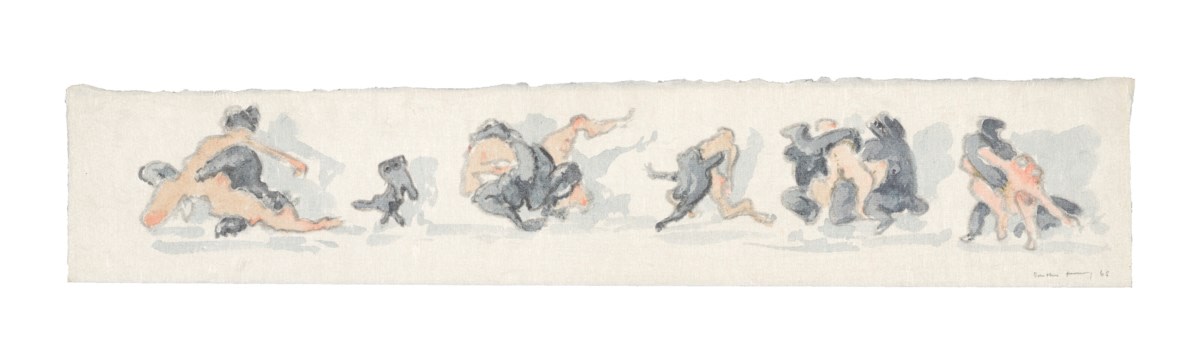
The door or threshold as a portal to the unconscious (a recurring motif that critics note goes beyond the standard Surrealist symbol); the corridor and shabby hotel interior; girls with wind-blown hair; the trompe-l'oeil painted frame and picture-within-picture; steep tumbling diagonals of entangled bodies; sustained figure-ground ambiguity; affinity with cloth and drapery, which she herself linked to the later soft sculptures (Foundation interview excerpt with Monique Lévi-Strauss, on the 'Témoins du drame' page).
Fingerprint agreement and disagreement
CONFIRMS the fingerprint's formal terms (figure-ground, asymmetrical balance, directional light, easel-scale, foreground) and moods (tense, uncanny). DISAGREEMENT: the 'muted / low-key / earth tones' palette holds for the 1940s canvases and late figurative works but NOT for the mid-1950s prismatic paintings (Le mal oublié, Insomnias), which are chromatically fractured and higher-key. A muted palette should not be treated as a necessary condition for attribution.
Evolution
- 1935-41: Commercial illustration and early figuration
- 1942-early 1950s: Canonical Surrealist dreamworlds — 'Birthday' (1942), 'Children's Games' (1942), 'Eine Kleine Nachtmusik' (1943), 'Endgame' (1944), 'Interior with Sudden Joy' (1951). The value core of the market.
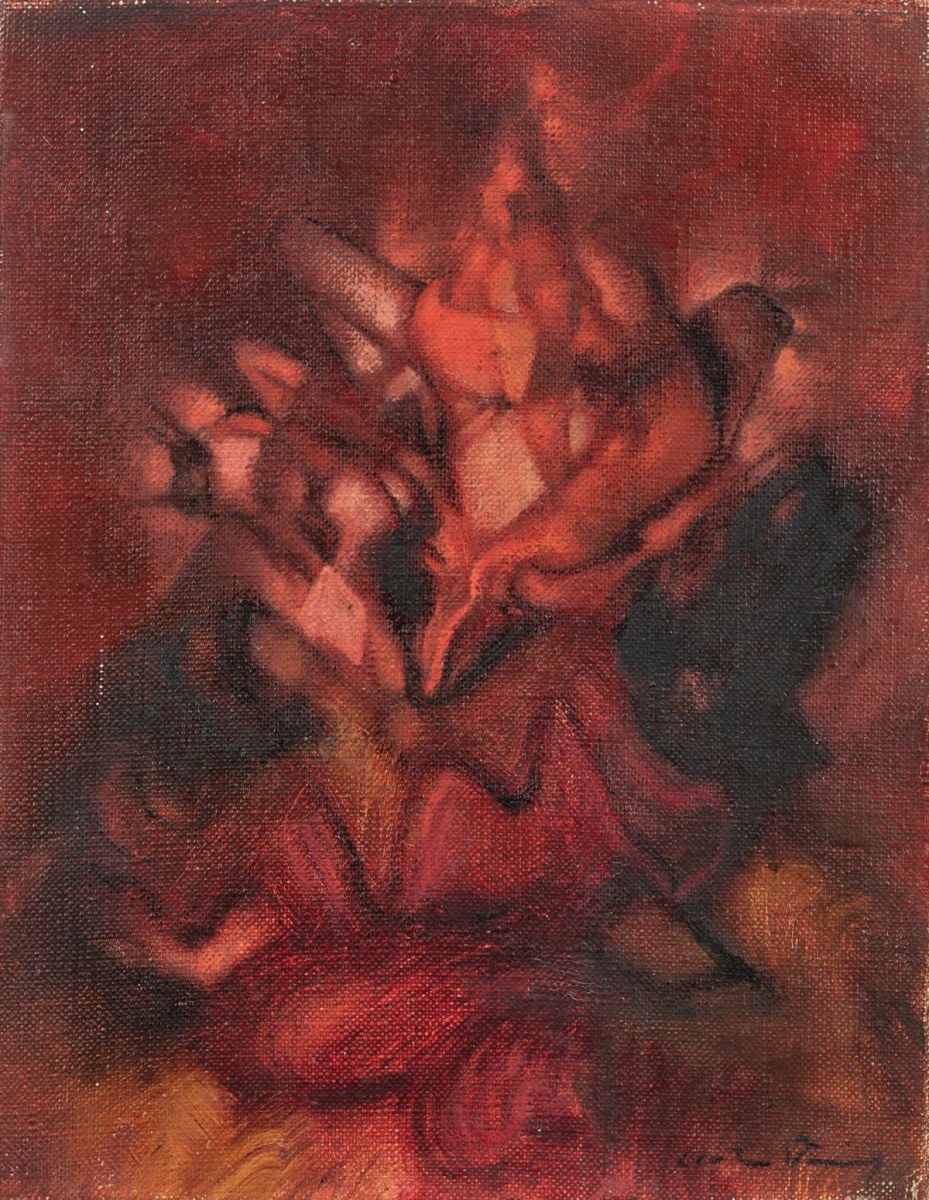
- Mid-1950s-1960s: Dissolution of contour into prismatic, fractured, near-abstract compositions of bodies and faces — 'Le mal oublié' (1955), 'Insomnias' (1957)
- 1969-1973: Soft fabric sculptures and immersive environments — the most art-historically radical phase and the one most cited by critics as ahead of its time
- 1970s-1990s: Return to Baroque-inflected figuration — entangled bodies, trompe-l'oeil frames, meta-pictorial devices ('Don Juan's Breakfast' 1972, 'Tout est illusion peut-être' 1973, 'On Avalon' 1987)
- 1986-2011: Primarily literary output
- 1942-early 1950s: Canonical Surrealist dreamworlds: 'Birthday' (1942), 'Children's Games' (1942), 'Voltage' (1942), 'Eine Kleine Nachtmusik' (1943), 'Endgame' (1944), 'Témoins du drame' (1947, shown in 1948 as 'Dramatis Personae'), 'Interior with Sudden Joy' (1951). The value core of the market.
- Mid-1950s-1960s: Contours dissolve into prismatic, fractured, near-abstract compositions of bodies and faces: 'Le mal oublié' (1955), 'Insomnias' (1957)
- 1965-1973: Soft fabric sculptures and immersive environments, from 'Pincushion to Serve as Fetish' (1965, Tate) and 'De quel amour' (1969, Centre Pompidou) to 'Chambre 202' (1970-73). The most art-historically radical phase and the one critics most often call ahead of its time.
- Late career: collage (the subject of Kasmin's 2024 'Encyclopedia: The Late Collages') alongside flower paintings (Alison Jacques 2016) and primarily literary output, 1986-2011
Influences
Exerted
Anticipates the fabric and soft-sculpture practices later associated with Louise Bourgeois and Annette Messager. A touchstone for contemporary artists working with domesticity, girlhood and the uncanny (included in Nick Mauss's 'Transmissions' and in the Venice Biennale's 'The Milk of Dreams' framework). Contemporary painters still interpret her: Tali Lennox on 'Témoins du drame' for Sotheby's, 2026.
Received
MoMA's 1936 'Fantastic Art, Dada, Surrealism'; Max Ernst (notably the 'Histoire Naturelle' logic behind her ink specimen drawings); Dalí's paranoiac-critical specimen plates; Gothic and Romantic literature; Baroque ceiling-fresco illusionism and vanitas conceits; a corporeal intensity comparable to Lucian Freud in the late figurative work
Visual language
High-finish illusionistic description set against irrational content; a single horizon or architectural framework organising otherwise unstable zones of the picture; directional light isolating figures against closed dark grounds; meta-pictorial framing that questions the status of the painted body.
Themes and subjects
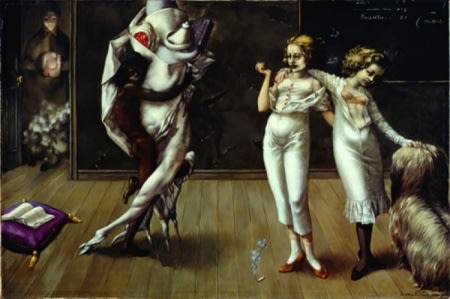
- Girlhood, adolescence and the awakening of female desire and autonomy — Christie's specialist Ottavia Marchitelli described 'Children's Games', in which young girls tear at patterned wallpaper, in exactly these terms
- The unconscious, dream and insomnia
- Sexuality and eros — bodies entangled, dissolving or merging with architecture and furniture
- Domestic interiority as a site of psychic threat rather than comfort
- Myth, allegory, the gaze and the uncanny
- Games, chess and play as metaphors for power and gender ('Endgame' 1944; 'Musical Chairs' 1951; 'Children's Games' 1942)
- Hybrid natural-history invention — biomorphic botanical/zoological specimens in the ink drawings
- Intimacy and the body (confirming the fingerprint's collector-theme tags)
- Girlhood, adolescence and the awakening of female desire and autonomy. Christie's specialist Ottavia Marchitelli described 'Children's Games', in which young girls tear at patterned wallpaper, in exactly these terms.
- Myth, allegory, the gaze and the uncanny; theatricality and spectatorship ('Témoins du drame' / 'Witnesses', 1947, originally titled 'Dramatis Personae')
Movements and periods
- Primary
- Surrealism — the New York exile wing of the 1940s and post-war European Surrealism
- Period brackets
- Early Modern / 1900-1945 for the canonical breakthrough works; practice extends 1935-2000s across at least four distinct phases
Fingerprint verification
CONFIRMS Egon's 'Surrealism / Early Modern / 1900-1945' tags for the Tier-1 exemplars. EXTENDS them: roughly half her output post-dates 1950 and is better described as post-Surrealist prismatic abstraction (1955-65), soft sculpture (1965-73) and late Baroque-inflected figuration and collage (1970s-90s). The fingerprint's low coherence (0.47) correctly reflects genuine stylistic breadth, not unreliable attribution.
Techniques and mediums
- Design
- Sets and costumes for Balanchine ballets, mid-1940s
Painting
Oil on canvas, using glazing and scumbling: thin glazed darks build depth, flesh passages are painted alla prima, and canvas tooth shows in lighter zones. Some 1940s works are oil on linen mounted on panel ('Témoins du drame').
Sculpture
Hand-sewn soft sculpture in tweed, wool and fabric with stuffing, culminating in room-scale environments ('Chambre 202, Hôtel du Pavot', 1970-73, Centre Pompidou)
Printmaking
Lithography and colour etching/aquatint portfolios, e.g. 'En chair et en or' (In Flesh and Gold), nine colour etchings and aquatints, 1973, Éditions Georges Visat, Paris, edition of 100. Offset lithographs after key paintings, such as the c.1970 'Birthday' (edition of 150). Catalogued 1942-1991 in 'Hail, Delirium!' (1992).
Works on paper
Pen and ink (controlled hatching, cross-hatching, stippling), gouache and graphite, watercolour, collage (including a substantial late-collage body shown at Kasmin in 2024)
Fingerprint agreement
CONFIRMS oil/painting, glazing and scumbling. EXTENDS: soft sculpture, printmaking, collage and stage design are materially significant and missing from the technical fingerprint, yet increasingly central to institutional interpretation (London's 2026 prints exhibition; Kasmin's 2024 collage show).
Signature series and works
- Birthday (Self-Portrait at Age 30), 1942 — Philadelphia Museum of Art
- Children's Games, 1942 — auction record holder
- Eine Kleine Nachtmusik, 1943 — Tate
- Endgame, 1944
- Interior with Sudden Joy, 1951
- Musical Chairs, 1951
- Le mal oublié, 1955
- Insomnias, 1957
- Chambre 202, Hôtel du Pavot, 1970-73 — Centre Pompidou
- Don Juan's Breakfast, 1972
- Tout est illusion peut-être, 1973
- On Avalon, 1987
- Voltage, 1942 — Pietzsch Collection / Neue Nationalgalerie, Berlin
- Témoins du drame (Witnesses), 1947 — offered at Sotheby's May 2026
- Insomnias, 1957 — Moderna Museet
- Pincushion to Serve as Fetish, 1965 — Tate
- De quel amour, 1969 — Centre Pompidou
- Don Juan's Breakfast, 1972 — Moderna Museet
- Notes for an Apocalypse, 1978
Fingerprint recommendations
Egon's exemplar set leans toward two poles: the ink natural-history drawings and the late entangled-figure paintings. It therefore under-weights the 1942-51 figurative dreamworlds that now drive essentially all of the artist's market value, and omits soft sculpture and collage entirely. Recommendations: add Tier-1 exemplars from the early Surrealist canon (Birthday, Endgame, Children's Games, Témoins du drame), at least one 1950s prismatic abstraction and one soft sculpture, and treat palette as phase-dependent rather than a fixed signature.
Critical Reception
Research updated
Data notes
Getty ULAN record 500000210 has now been supplied and matches this artist on dates, birthplace, roles and the Ernst marriage. Its 'French (culture or style)' nationality reflects her French decades; she was American-born.
Academic discourse
Positioning
Increasingly positioned not as a satellite of Max Ernst but as an independent reinventor of Surrealist visual language for the post-war era, spanning meticulous dream figuration, 1950s prismatic abstraction, pioneering soft sculpture and late collage.
Research threads
Feminist re-readings of Surrealism; eroticism, Eros and the body in the avant-garde (Mahon's broader scholarship); textile and soft-sculpture lineages linking to Bourgeois and Annette Messager; Surrealism's American chapter and the exile network; provenance and collecting networks (the Neue Nationalgalerie Pietzsch research project, 2025-26); the Surrealist novel and life-writing (Watz, CUP 2023: essays by Anna Watz and Catriona McAra on 'Chasm', Katharine Conley on 'Birthday').
Critical reception
Overall arc
Critically eclipsed for decades by her marriage to Max Ernst and by Surrealism's male-centred canon. Since 2018 she has been the subject of a rapid, well-documented art-historical rehabilitation driven by feminist scholarship and major museum programming.
Key scholars
Alyce Mahon (Professor of Modern and Contemporary Art History, Trinity College, University of Cambridge) is the leading authority: guest curator of the Reina Sofía retrospective (invited 2015), co-curator of the Tate Modern version, and author of the 2026 Yale monograph. Others: Victoria Carruthers, Amy Lyford (Reaktion monograph, 2023), Mary Ann Caws, Katharine Conley, Anna Watz, Catriona McAra, Dawn Ades, Ann Coxon (Tate).
Editorial signals
Christie's 'Best New Art Book 2026' selection for the Mahon monograph; named in an exhibition title at a national museum (Neue Nationalgalerie, Berlin); headline billing in Art Basel market reporting; Sotheby's built editorial content (including a Tali Lennox video) around the May 2026 'Témoins du drame' consignment. This is sustained tier-1 editorial attention across scholarly, museum and market press, not a single news spike.
Notable reviews and features
- Outlet
- Hyperallergic
- Subject
- Reina Sofía retrospective
Substance
Framed her Surrealism around depictions of women's pain and argued her 1960s soft sculptures collided head-on with Minimalism and predated Louise Bourgeois's fabric work by decades
- Date
- March 2022
- Critic
- Natasha Gural
- Outlet
- Forbes
- Subject
- Kasmin survey
Substance
Described a subversive, prolific artist who will no longer be overshadowed by her male counterparts, and noted the recurring door motif as more than a Surrealist portal cliché
- Critic
- Ariane Bankes
- Outlet
- The Spectator
- Subject
- Mahon monograph
- Substance
- Praised the nuanced, sophisticated readings of works designed to confound and unsettle
- Critic
- Eleanor Sutherland
- Outlet
- Aesthetica
- Subject
- Mahon monograph
- Substance
- Described the study as reframing canonical accounts of Surrealism through one woman artist's reinvention of its visual language
- Critic
- Eileen Kinsella (Jan 2025) and Vivienne Chow (Mar 2026)
- Outlet
- Artnet News
Substance
Two dedicated market appraisals — the first on scarcity of top material, the second a 'Work of the Week' feature on the $120,000-per-square-inch record
View 6 more records
- Outlet
- Art Basel Stories
- Substance
- Repeated inclusion in flagship market reports on Surrealism and the women-Surrealist surge
- Outlet
- HENI News / The Value / Artsy / TheCollector
- Substance
- Record coverage across 2025-26, including Artsy's roundup of new artist auction records
- Outlet
- Hyperallergic
- Subject
- Kasmin 2022 catalogue
- Substance
- Named among 'The Best Art Books of 2022' (per the Dorothea Tanning Foundation)
- Date
- April 2026
- Outlet
- The Spectator Australia
- Subject
- Mahon monograph
Substance
Review headlined 'Defiantly creative to the end: the transgressive Dorothea Tanning'. The reviewer notes the book arrived on the day of the Christie's record sale. Critic not identified in the snippet; possibly the syndicated Bankes review.
- Critic
- Eileen Kinsella (Jan 2025) and Vivienne Chow (Mar 2026)
- Outlet
- Artnet News
Substance
Two dedicated market appraisals: the first on the scarcity of top material, the second a 'Work of the Week' feature on the $120,000-per-square-inch record, attributing it to Surrealism's visibility after the 2024 Pompidou show and a long-overdue reassessment of women artists
- Date
- 6 March 2026
- Outlet
- The Art Newspaper
- Substance
- Headlined Tanning, alongside Henry Moore, as a record-setter in Christie's London triple-header evening sale
Publications and media
- Film
- Peter Schamoni, 'Dorothea Tanning: Insomnia' (1978), available through the Schamoni Film & Media Archive, Munich
Volume
High and rising: the Tate/Reina Sofía press cycle (2018-19), Venice Biennale (2022), Kasmin survey (2022), three record-setting sales (2025-26), the Yale monograph (2026) and further reviews in 2026.
Monographs
Mahon 2026 (Yale UP); Lyford 2023 (Reaktion); Carruthers 2020 (Lund Humphries); Bailly 1995; Bosquet 1966; Plazy; plus the Kasmin 2022 scholarly catalogue and the 1992 prints catalogue raisonné 'Hail, Delirium!'
Artist as writer
Two memoirs, a novel and two poetry collections published between 1986 and 2011, now treated by scholars as integral to her visual practice rather than separate from it. Literary responses continue, e.g. JOAN Publishing's re-release of Claire-Louise Bennett's 'Fish Out of Water', a response to Tanning's 'Self-Portrait' (1944), with a new poem by Chloe Aridjis.
Gallery & Representation
Research updated
Fair presence
Gallery Wendi Norris has staged fair presentations dedicated to women Surrealists, pairing Tanning with Eileen Agar, Leonora Carrington, Remedios Varo and Alice Rahon (e.g. October 2022). Kasmin and Alison Jacques present Tanning at major fairs; the specific fair years were not re-verified this pass. Alison Jacques also reports Tanning in group contexts such as 'Check Mate(s)', Casa SP Arte, São Paulo. Fair pricing is not published.
Representation
Galleries
Kasmin
- Tier
- 1
- Since
- 2022
- Status
- estate
- Location
- New York (509 West 27th Street)
- Institution tier
- 2
Alison Jacques
- Tier
- 1
- Since
- 2012
- Status
- estate
- Location
- London
- Institution tier
- 2
Gallery Wendi Norris
- Tier
- 1
- Since
- c.2004
- Status
- estate
- Location
- San Francisco
- Institution tier
- 3
Michael Rosenfeld Gallery
- Tier
- 1
- Status
- secondary
- Location
- New York
- Pricing note
- Primary-market prices are not disclosed. Contact Kasmin, Alison Jacques or Gallery Wendi Norris for current pricing.
Primary galleries
Kasmin
Role
Represents Tanning; organised 'Doesn't the Paint Say It All?' (2022), the most comprehensive US presentation in decades, in collaboration with the Destina Foundation and the Dorothea Tanning Foundation, with a scholarly catalogue
- Tier
- Tier 1 / upper Tier 2 blue-chip
- Location
- New York, 509 West 27th Street
Alison Jacques
- Role
- European representation and promotion; publishes Tanning exhibition programming and places work institutionally
- Tier
- Tier 1 European estate specialist
- Location
- London
Gallery Wendi Norris
Role
Longest-standing dealer relationship (began handling Tanning c.2004; solo exhibition 2009 during the artist's lifetime, plus 'Musical Chairs' 2024 and 'Modern Milieu' 2025). Also represents Carrington, Varo and Rahon, giving cross-segment placement power
- Tier
- Tier 2 specialist — market-defining dealer for women Surrealists
- Location
- San Francisco
Kasmin
Role
Represents the Tanning estate/foundations. Organised 'Doesn't the Paint Say It All?' (2022), the most comprehensive US presentation in decades, with the Destina Foundation and the Dorothea Tanning Foundation and a scholarly catalogue. Followed with 'Encyclopedia: The Late Collages of Dorothea Tanning' (4 Sep - 24 Oct 2024) and maintains the artist CV.
- Tier
- Tier 1 / upper Tier 2 blue-chip
- Location
- New York, 509 West 27th Street
Alison Jacques
Role
European representation since 2012, with solo exhibitions in 2012, 2014, 2015, 2016 and 2017. Publishes Tanning programming and promotes institutional placement (e.g. announced the Reina Sofía/Tate retrospective).
- Tier
- Tier 1 European estate specialist
- Location
- London
Gallery Wendi Norris
Role
Longest-standing dealer relationship: began handling Tanning c.2004, with a solo exhibition in 2009 during the artist's lifetime, 'Musical Chairs' in 2024 and 'Modern Milieu' in 2025. Also represents Carrington, Varo and Rahon, which gives it placement power across the segment.
- Tier
- Tier 2 specialist — market-defining dealer for women Surrealists
- Location
- San Francisco
Estate stewardship
The Destina Foundation and The Dorothea Tanning Foundation, New York (Executive Director Pamela S. Johnson), both endowed by the artist. They collaborate directly on gallery presentations, help auction houses with cataloguing (credited by Sotheby's in May 2026), are compiling a paintings catalogue raisonné, and control supply to the market.
Secondary market channels
Christie's (Art of the Surreal, London; 20th Century Evening Sale, New York; Paris sales); Sotheby's New York (Modern Evening Auction); Phillips and Bonhams for mid-market material and prints; Michael Rosenfeld Gallery (New York) in American Surrealism contexts, including handling 'Témoins du drame' before its 2007 sale to Sybil Shainwald; regional houses (Doyle, RoGallery, DUMBO Auctions) for prints and multiples; James Cope Gallery, Dallas (solo exhibition through 17 Oct 2026; representation status not established).
Geographic reach
Tri-continental: New York (Kasmin, the foundations, Christie's and Sotheby's), London (Alison Jacques, Christie's Art of the Surreal), San Francisco (Wendi Norris), Paris (Christie's sales), Dallas (2026 gallery exhibition), with institutional demand across Spain, France, Germany, Sweden, the UK, the US and Israel.
Representation history
Julien Levy Gallery, New York (1940s) and Alexandre Iolas Gallery (1953) → European dealers during the French decades (1957-1980) → Gallery Wendi Norris from the mid-2000s (a lifetime relationship) → Alison Jacques from 2012 → Kasmin from 2022, in a foundation-led programme aligned with the institutional retrospective cycle.
Sources & research notes
Egon’s artist research combines historical auction records, recent sales, institutional history, critical reception and gallery information. Researched auction records and auction highlights are identified separately.
Read prices with their work, sale date, currency and stated basis. Egon’s market assessments are distinct from reported auction results.
Reference: Egon, “Dorothea Tanning: Market Intelligence & Investment Profile.”
Evidence & qualifications
These notes preserve the sources, status and qualifications recorded in the research.
Children's Games (1942) sold for $6.26M (£4.69M) at Christie's London on 5 March 2026, more than 4.5x the low estimate and 83% above the prior record. The work was originally owned by Gypsy Rose Lee.
Market · Reported · Event: 2026-03-05 · Source retrieved: 2026-10-12
HENI is a secondary market-data publisher. Corroborated by The Art Newspaper (6 March 2026) and Artnet News. The Christie's lot page was not re-fetched in this pass.
https://heni.com/news/article/dorothea-tanning-children-s-games-2026-03-05Sotheby's New York, Modern Evening Auction, 19 May 2026, lot 13: Dorothea Tanning, 'Témoins du drame', 1947, oil on linen, 30.5 x 28.3 cm, from The Collection of Sybil Shainwald, estimated $1,000,000-1,500,000. Provenance: Lincoln Kirstein (1952), Philip Bloom, the Bloom estate, Michael Rosenfeld Gallery, present owner (December 2007). Exhibited Julien Levy Gallery 1948 and Iolas 1953. Catalogued with the help of The Dorothea Tanning Foundation.
Market · Documented · Event: 2026-05-19 · Source retrieved: 2026-10-12
The lot page shows the sale as closed but hides the result behind a login. Whether it sold, and at what price, is NOT established. The search snippets checked from Artnet News and ARTnews coverage of the sale did not mention the Tanning result. Not counted as sold or bought in.
https://www.sothebys.com/en/buy/auction/2026/modern-evening-auction/temoins-du-drame?locale=frInterior with Sudden Joy (1951) sold at Sotheby's New York in November 2025. HENI lists $3.4M dated 20 November 2025. Egon's database records $3,222,000 premium-inclusive.
Market · Contradicted · Event: 2025-11-20 · Source retrieved: 2026-10-12
The two figures come from different sources and are not reconciled here. The sale date also conflicts with the previous version of this file (21 November). Both remain recorded with their provenance.
https://heni.com/news/article/dorothea-tanning-children-s-games-2026-03-05Sotheby's 19 May 2026 Modern Evening Auction totalled $303.9M; ARTnews described it as solid but subdued. The Shainwald collection's Magritte 'Femme-bouteille' set an auction record for a painted bottle (Artnet News).
Market · Reported · Event: 2026-05-19 · Source retrieved: 2026-10-12
This is context for the sale, not evidence of the Tanning lot's outcome.
https://news.artnet.com/market/sothebys-modern-art-auction-new-york-2774587Christie's London's March 2026 triple-header evening sales brought in £197.4M with fees, up 52% year on year, with an artist record for Tanning.
Market · Reported · Event: 2026-03-05 · Source retrieved: 2026-10-12
Based on the search snippet of The Art Newspaper report.
https://www.theartnewspaper.com/2026/03/06/henry-moore-and-dorothea-tanning-set-records-at-christies-triple-header-evening-sale-in-londonInvaluable lists Tanning lots offered on 30 Sep 2026 (Le Machinateur désintéressé, oil on canvas), 29 Jul 2026 (Birthday offset lithograph, low estimate $5,000), 5 Jun 2026 (Untitled (Figurinen)) and 3 Jun 2026 (Daja, 1949, est. €6,000-8,000), and 374 sold results in total.
Market · Reported · Event: 2026-06-03/2026-09-30 · Source retrieved: 2026-10-12
These are aggregator listings seen in search snippets. Prices and outcomes for the July, June and Daja lots were not established. The $61,044 figure for Le Machinateur désintéressé comes from Egon's internal database, not Invaluable.
https://www.invaluable.com/artist/tanning-dorothea-kafdwtz7h5/sold-at-auction-prices/The Moderna Museet exhibition 'The Subterranean Sky' (through 11 January 2026) draws nearly 200 works from the museum's permanent collection, including Tanning's 'Don Juan's Breakfast' (1972) and 'Insomnias' (1957). This CONTRADICTS the existing entries placing these works, and the related 'Lucid Dreams' exhibition, at The Israel Museum, Jerusalem.
Institutional · Contradicted · Event: 2026-01-11 · Source retrieved: 2026-01-18
This is the artist foundation's own statement, not a museum collection record. The Moderna Museet online record was not fetched. The Israel Museum may still hold other Tanning works (Wikidata records 3), but these two works and the 'Lucid Dreams' entry should be treated as a misattribution. The 'Lucid Dreams' item has been removed from current_and_upcoming for this reason.
https://www.dorotheatanning.org/Existing publications entry 'NO CATALOGUE RAISONNÉ of paintings has been publicly announced'. CORRECTION: the Dorothea Tanning Foundation publicly asks for information on paintings it is trying to document for a catalogue raisonné, and a catalogue raisonné of the illustrated books and prints ('Hail, Delirium!', NYPL, 1992) has existed since 1992.
Institutional · Contradicted · Source retrieved: 2026-01-18
The paintings catalogue raisonné is in preparation, not published, and no publication date was found. The 'Hail, Delirium!' bibliographic record comes from the Smithsonian Libraries data supplied with this brief.
https://www.dorotheatanning.org/The Ulla and Heiner Pietzsch Collection, including Tanning's 'Voltage' (1942), now belongs to the Neue Nationalgalerie. The 'Max Ernst to Dorothea Tanning' exhibition ran from 17 October 2025.
Institutional · Reported · Event: 2025-10-17 · Source retrieved: 2026-10-12
The SMB page gives the run as 17.10.2025-08.04.2026, while the Foundation homepage says through 1 March 2026 (likely an extension). Ownership of 'Voltage' is stated by the Foundation; the museum's object record was not fetched. Neue Nationalgalerie is assessed as institution Tier 2 (national influence) under named-institutions-v1, while meeting the research rubric's first-rank criterion.
https://www.smb.museum/en/exhibitions/detail/max-ernst-to-dorothea-tanning-networks-of-surrealism/Tate's 'Pincushion to Serve as Fetish' (1965) was shown in 'International Surrealism' at the Dallas Museum of Art (through 22 March 2026). Centre Pompidou's 'De quel amour' (1969) is in 'Endless Sunday' at Centre Pompidou-Metz through 2 February 2027.
Institutional · Reported · Event: 2026-03-22 · Source retrieved: 2026-01-18
Foundation statements that these works are in the Tate and Musée National d'Art Moderne collections. Credit lines are unknown (not retrieved).
https://www.dorotheatanning.org/The Reina Sofía retrospective 'Behind the Door, Another Invisible Door' ran 3 October 2018 - 7 January 2019, presented with Tate Modern.
Institutional · Reported · Event: 2018-10-03 · Source retrieved: 2026-10-12
Gallery page (Alison Jacques), seen in a search snippet. It corrects the 'November 2018' opening date in the earlier version of this file.
https://alisonjacques.com/news/589/Legacy 'tier_1' group label: only MoMA, the Metropolitan Museum, the Whitney, Tate and the Centre Pompidou are named Tier-1 institutions under named-institutions-v1. The others in the legacy group (Philadelphia, LACMA, SFMOMA, Art Institute of Chicago, Reina Sofía, Moderna Museet, Menil, V&A, Cleveland, Israel Museum) are Tier 2 by that framework, although most meet the research rubric's first-rank criterion.
Institutional · Unresolved
This is a classification note, not a holdings claim. The legacy label is kept for structural continuity and is not proof of rank. The Smithsonian entry is unresolved as an artwork holding.
Alison Jacques Gallery has represented Dorothea Tanning since 2012, with solo exhibitions in 2012, 2014, 2015, 2016 and 2017.
Gallery · Reported · Event: 2012 · Source retrieved: 2026-10-12
This is an Internet Archive copy of an encyclopedic text, seen in a search snippet. The Foundation's solo-exhibition page corroborates Alison Jacques shows in 2012, 2014 and 2016. Current representation in October 2026 was not checked on the gallery's own artist page.
https://archive.org/details/item_912133_317668d1d6Kasmin staged 'Encyclopedia: The Late Collages of Dorothea Tanning', 4 September - 24 October 2024.
Gallery · Reported · Event: 2024-09-04 · Source retrieved: 2026-10-12
Foundation exhibition list (search snippet), consistent with the Kasmin CV PDF. No change in representation was detected.
https://www.dorotheatanning.org/dorothea-tanning/solo-exhibitionsArtnet News 'Work of the Week' attributed the $6.26M record to heightened visibility for Surrealism, including the 2024 Centre Pompidou show, and a broader long-overdue reassessment of women artists.
Critical · Reported · Event: 2026-03 · Source retrieved: 2026-10-12
Market journalism, not independent scholarship.
https://news.artnet.com/market/work-of-the-week-dorothea-tanning-childrens-games-2753316Amy Lyford's monograph 'Exquisite Dreams: The Art and Life of Dorothea Tanning' was published by Reaktion Books in 2023.
Critical · Reported · Event: 2023 · Source retrieved: 2026-01-18
Foundation announcement. This scholarly monograph was missing from the earlier version of this file.
https://www.dorotheatanning.org/
Research bibliography · 40 sources
Sources recorded for this artist’s research. This bibliography does not assign every source to an individual claim.
- Dorothea Tanning | Biography, Paintings, Birthday, & Facts | Britannica
- HENI News — Dorothea Tanning's Auction Record Jumps 83% With $6.26m Sale
- Artnet News — This Small Dorothea Tanning Painting Sold for $120,000 per Square Inch
- Christie's $57m Surrealism Sale Grabs Headlines But the Reality Isn't So Rosy | HENI News
- Henry Moore sets US$35.2m auction record amid Christie's trio of evening sales in London | The Value
- Dorothea Tanning | Kasmin Gallery
- Dorothea Tanning: Doesn't the Paint Say It All? | Kasmin Gallery, 2022
- Dorothea Tanning: Doesn't the Paint Say It All? – Alison Jacques
- Dorothea Tanning Exhibition At Kasmin Reveals A Subversive, Prolific Genius | Forbes
- Dr Alyce Mahon curates Dorothea Tanning exhibition at Tate Modern | Trinity College Cambridge
- Dorothea Tanning – Press Release | Tate
- Dorothea Tanning's Surrealist Depictions of Women's Pain | Hyperallergic
- Dorothea Tanning | Gallery Wendi Norris
- Collectors Covet Dorothea Tanning's Surrealist Work. The Best Is in Short Supply | Artnet News
- Art Market Report: As Fridamania grips London, female Surrealists' market surges | Art Basel
- Surrealism's second act: The 20th-century movement dominating today's market | Art Basel
- Women Surrealist Artists Set New Records at Auction | TheCollector
- 11 New Artist Auction Records Set in May 2025 | Artsy
- Dorothea Tanning - Auction Results and Sales Data | Artsy
- Home | Dorothea Tanning Foundation
- The Dorothea Tanning Foundation — Group Exhibitions
- Dorothea Tanning | The Viktor Wynd Museum of Curiosities (The Last Tuesday Society), 2026
- Dorothea Tanning: A Surrealist World by Alyce Mahon | Yale University Press
- Invaluable — Dorothea Tanning Sold at Auction Prices
- Women Artists Market Insights 2025 (Sotheby's report)
- HENI News — Dorothea Tanning's Auction Record Jumps 63%
- The Art Newspaper — Henry Moore and Dorothea Tanning set records at Christie's triple-header sale in London
- Sotheby's — Dorothea Tanning, Témoins du drame, Modern Evening Auction 2026, Lot 13
- Sotheby's — The Collection of Sybil Shainwald
- Sotheby's — Modern Evening Auction digital catalogue, May 2026
- Sotheby's — Dorothea Tanning artist page
- Artnet News — Sotheby's Hauls In $304 Million at Modern Art Auction
- ARTnews — Sotheby's Pulls In $303.9 M. in a Solid but Subdued Modern Evening Sale
- Invaluable — Dorothea Tanning artist page
- The Dorothea Tanning Foundation — Home (On View, publications, catalogue raisonné notice)
- The Dorothea Tanning Foundation — Solo Exhibitions
- Staatliche Museen zu Berlin — Max Ernst to Dorothea Tanning: Networks of Surrealism
- Frist Art Museum — International Surrealism from Tate
- Alison Jacques — Dorothea Tanning: Behind the Door, Another Invisible Door (Museo Reina Sofía)
- Internet Archive — Dorothea Tanning (1910-2012) text (Alison Jacques representation since 2012)
Research updates by section
These dates show when Egon’s research sections were updated. Source retrieval dates, where supplied above, refer to individual evidence notes.
Ranking updated . Research sections follow their own update dates.
This is what the market knows about Dorothea Tanning. What Egon can also tell you: whether Dorothea Tanning fits your portfolio — based on your existing holdings, budget, and investment timeline.
Get personalized analysisActive market signals
Inside Egon
Signal timeline & strength analysis
Gallery moves, auction records, institutional acquisitions, price milestones — tracked over 90 days
Full signal timeline, strength analysis, and alert configuration for Dorothea Tanning.
Collector demographics & buyer analysis
Geographic distribution, institutional vs. private buyers, collector profiles, and secondary market activity
Who is collecting Dorothea Tanning? Geographic distribution, institutional vs. private buyers, and collector profile analysis.
Personalized acquisition strategy
Optimal entry points, comparable pricing analysis, timing recommendations, and portfolio fit assessment
Personalized acquisition strategy for Dorothea Tanning based on your budget, timeline, and collection goals.
Go deeper with personalized intelligence
You now have Egon's market assessment of Dorothea Tanning. The next question is personal: does this artist belong in your collection? Egon analyzes collection fit based on your aesthetic thesis, existing holdings, budget, and investment goals — delivering acquisition strategies no public index can provide.