Jean Fautrier
Blue-chipEgon research · Artist market profile
The market, in context.
Explore Jean Fautrier’s auction history alongside the exhibitions, collections and gallery relationships behind the market.
Institutional research
Collections & exhibitions
Read holdings, exhibition history and their qualifications in context.
Read the institutional research →




Egon investment scores
Market position
Research updated
Recent auction highlight
A result from Egon’s tracked auction sales; historical auction records are researched separately. Price including buyer’s premium.
Pricing
- Structure
- Explicitly layered by period and series - dealer and trade-press reporting describes very distinct tiers rather than a single price level.
Temporal context
Pre-2018 the market was thinner and Europe-centric. The 2017 Kunstmuseum Winterthur and 2018 Musée d'Art Moderne de Paris retrospectives, and the 2023 paintings catalogue raisonné, are the structural events that reset the top. 2021 produced the record (€4.35m-€5.2m depending on source). 2024-2026 evidence shows consistent estimate outperformance in the $79k-$358k band, with four of six recent EGON lots exceeding high estimate.
Tier 4 sculpture
MutualArt reports sculptures averaging $30,860 over the trailing twelve months; well-provenanced lead Otage casts from editions of 6 trade materially higher.
Tier 1 masterworks
Otages (1943-45) and 1920s 'dark period' oils: €1.7m-€5.2m at auction. A 1927 dark composition, La mort du sanglier, was sold privately by Franck Prazan at Art Basel in 2023 for about €4 million (dealer's own account).
Unique vs multiples
Prices above assume unique works. Prints and illustrated books (Fautrier l'enragé, 1949, edition of 250 plus H.C.) and the late 'originaux multiples' are a separate, far cheaper stratum and should never be blended into painting averages.
Regional french auctions
Judith Benhamou reported estimates around €20,000 for paintings in a De Baecque Paris sale, framing the level as bargain pricing relative to the artist's standing - evidence of a wide gap between the top and the tail.
Tier 3 mid scale hautes pates
Roughly $80,000-$150,000 (Les boîtes de conserve $108,800; Grand paysage $89,600; Raisins et poires $79,360, all Sotheby's Mar 2026 per EGON). MutualArt reports paintings averaging $109,491 over the trailing twelve months as of its listing.
- Tier 2 major postwar paintings
- Six figures USD. 2026 evidence from EGON's database: Tête d'otage no. 19 $832,000; Up and down $358,400 (both Sotheby's, Mar 2026).
Tier 5 works on paper and prints
Roughly $17,000-$50,000 for small mixed media on paper; EGON's low was Nudo at $17,920 (Sotheby's, Apr 2026). Etchings from Les Otages and Fautrier l'enragé trade in the low thousands at regional houses.
Liquidity
Depth
Deep and multi-tiered: entry from low four figures (prints) to seven and eight figures in euros (Otages, dark period), with genuine liquidity at every rung. Geographic depth across France, Germany, Italy, Switzerland, Japan and the US.
Volume
MutualArt records 2,113 works offered at auction cumulatively. EGON's four-house 2025+ sample alone captured 23 lots; adding French regional houses (De Baecque, Artcurial), Italian houses (Martini Studio d'Arte, Meeting Art) and print sales, realistic annual global volume is comfortably in the dozens.
- Sell through
- 85% (EGON, 2025 onward, 26 settled lots)
Comparables
For pricing triangulation use Soulages and Hartung (comparable prize-era standing, deeper markets), Wols (comparable scarcity, thinner market), and Burri/Tàpies (comparable matter-painting proposition, materially higher top prices).
Collector base
Italy
Italy has been persistently favourable thanks to sustained support from Italian intellectuals and dealers; Palma Bucarelli's 1960 monograph remains a core cataloguing reference.
Japan
Tapié's promotion produced lasting Japanese institutional and private holdings (Yokohama Museum of Art, National Museum of Art Osaka, Tamagawa University Museum of Education per Wikidata) and the 1961 Tokyo Biennale Grand Prize.
Us gap
American collecting has historically lagged; his first US museum exhibition came only in the 2000s at a university gallery, and the US market remains shallower than the European one.
Geography
Franck Prazan: demand is strongest in Europe - France and Germany - and in Japan, where Fautrier was introduced in the 1940s by the critic Michel Tapié.
Collector types
Single-owner European collections are a recurring supply source - Lévy Gorvy Dayan's 2023 New York show drew on one European private collection assembled over twenty years; a 2025 Sotheby's lead Otage was catalogued as 'Property from a Prestigious Collection'.
Primary market
Access
No living-artist primary market. Access runs through specialist secondary dealers: Applicat-Prazan (Paris), Lévy Gorvy Dayan (New York), Tornabuoni Art, Olivier Malingue.
Pricing disclosure
Gallery pricing is not published - treat all dealer levels as price on application. Contact Applicat-Prazan (Paris) or Lévy Gorvy Dayan (New York) for current pricing.
Private sale evidence
Franck Prazan states he sold La mort du sanglier (1927) for about €4m at Art Basel 2023 - private-treaty pricing for top material sits at or above the auction record level, and the best works increasingly bypass the saleroom.
Auction history
Egon database 2025 onward
- Sold
- 20
- Range
- $17,920 - $832,000
- Coverage
- Christie's, Sotheby's, Phillips, Bonhams, 2025 onward - PARTIAL
- Total lots
- 23
- Sell through
- 85% across 26 settled lots (100% of lots older than 90 days have settled)
- Average hammer
- $216,828
Bought in and sell through
EGON data shows 3 of 23 catalogued lots unsold from 2025 onward (85% sell-through). Comprehensive historical buy-in data was not retrievable from open sources; Artnet/Artprice subscription data would be required. MutualArt records 2,113 Fautrier works offered at auction cumulatively, indicating a deep and long-established secondary market.
Market position
Peer set
- Jean Dubuffet
- Pierre Soulages
- Nicolas de Staël
- Wols
- Alberto Burri
- Antoni Tàpies
- Hans Hartung
- Lucio Fontana
Gap thesis
The persistent trade-press argument is that his price level understates his historical position (Benhamou's framing of a Paris sale as bargain prices for one of the modern geniuses of French painting).
Relative position
Fautrier is priced well below Dubuffet, de Staël, Fontana and Burri at the top end despite comparable art-historical priority as the inventor of the hautes pâtes and a co-founder of Informel. Applicat-Prazan handles him inside the same stable as Soulages, de Staël, Appel, Freundlich and Vieira da Silva - the reference peer group for pricing.
Investment outlook
Risks
- Condition: haute pâte surfaces are physically fragile, prone to cracking and loss; condition drives unusually wide price dispersion
- Authentication dependency on the Comité Jean Fautrier
- Thin US demand caps the ceiling relative to Abstract Expressionist peers
- A large volume of small, late and repetitive works on paper dilutes perceived scarcity
- The record has not been publicly retested since 2021
Catalysts
- 2023 catalogue raisonné of the paintings (reviewed by The Art Newspaper) - attribution clarity is the classic precondition for a repricing
- 2017 Kunstmuseum Winterthur / 2018 Musée d'Art Moderne de Paris double retrospective
- Continued Japanese, German and Italian demand
- Broader institutional appetite for postwar European matter painting (Burri, Tàpies, Gutai)
Trajectory
Positive but strongly bifurcated. Top-tier Otages and 1920s dark-period works are scarce, competitively bid and increasingly traded privately at €1.7m-€5m+. The mid-market has shown consistent estimate outperformance in 2025-26. The tail - small works on paper, prints, late compositions - is abundant and price-soft.
Entry points
Prints and illustrated books under $10k; small hautes pâtes on paper $20k-$80k; lead/bronze sculpture $30k-$100k; museum-quality Otages far above $1m.
Institutional presence
Research updated
Exhibitions
Major group
Un art autre (Michel Tapié)
- Note
- Founding exhibition/manifesto of Art informel
- Year
- 1952
- Venue
- Studio Paul Fachetti, Paris
- Year
- 1959
- Venue
- documenta II, Kassel
- Note
- Palazzo Centrale presentation of more than 130 works
- Year
- 1960
- Venue
- XXX Venice Biennale
- Year
- 1961
- Venue
- 7th Tokyo Biennial
Soldier, Spectre, Shaman: The Figure and the Second World War
- Year
- 2015-16
- Dates
- 24 Oct 2015 - 20 Mar 2016
- Venue
- Museum of Modern Art, New York
Head On
- Year
- 2022
- Venue
- Lévy Gorvy Dayan, New York
Mirrors of the Portrait: Highlights of the Centre Pompidou Collection, Vol. III
- Note
- Evidence of continued first-rank institutional circulation into Asia
- Year
- 2023-24
- Dates
- 21 Jul 2023 - 5 Nov 2024
- Venue
- Centre Pompidou x West Bund Museum, Shanghai
Solo museum
- Year
- 1963
- Venue
- Stedelijk Museum, Amsterdam
- Year
- 1963
- Venue
- Kunsthaus Zürich
- Note
- First retrospective, organised in close collaboration with the artist and accompanied by his large-scale donation to the museum
- Year
- 1964
- Venue
- Musée d'Art Moderne de la Ville de Paris
- Note
- Second retrospective
- Year
- 1989
- Venue
- Musée d'Art Moderne de la Ville de Paris
Note
Reported by Frieze as the FIRST Fautrier exhibition at any American museum - c.60 paintings, prints and drawings; catalogue with essays by Yves-Alain Bois and Benjamin Buchloh plus period criticism by Malraux, Ponge and Paulhan
- Year
- c.2002
- Venue
- US university art museum (survey reviewed by Frieze)
- Note
- Included a section devoted to the Otages
- Year
- 2005
- Venue
- Fondation Pierre Gianadda, Martigny, Switzerland
- Note
- Retrospective, subsequently reprised and expanded in Paris
- Year
- 2017 (summer)
- Venue
- Kunstmuseum Winterthur, Switzerland
Jean Fautrier
Note
Third MAM retrospective; c.160-200 works - paintings, drawings, prints and a substantial group of sculptures - from public and private collections in France and abroad, including practically the whole of the artist's donation; first major French survey in nearly thirty years
- Year
- 26 Jan - 20 May 2018
- Venue
- Musée d'Art Moderne de Paris
Commercial solo
Otages
- Year
- 1945
- Venue
- Galerie René Drouin, Paris
Les Objets
- Year
- 1955
- Venue
- Galerie Rive Droite, Paris
Nus
- Year
- 1957
- Venue
- Galerie Rive Droite, Paris / Sidney Janis Gallery, New York
Jean Fautrier: A Private Collection
- Note
- Paintings, works on paper and sculpture, 1926-1944, from one European private collection assembled over twenty years
- Year
- 2023
- Venue
- Lévy Gorvy Dayan (LGDR), New York
Publications
Palma Bucarelli, Jean Fautrier, pittura e materia, Milan
- Note
- Early monograph; still used in auction cataloguing (e.g. no. 493)
- Year
- 1960
Edwin Engelberts, Jean Fautrier: Œuvre gravé, œuvre sculpté: essai d'un catalogue raisonné, Geneva
- Note
- Prints and sculpture catalogue raisonné
- Year
- 1969
Catalogue raisonné of Fautrier's paintings
Note
Covered by The Art Newspaper, 5 Dec 2023; stresses Paulhan, Malraux and Bataille to his career and his subversion of Watteau, Chardin and Monet. Marie-José Lefort, president of the Comité Jean Fautrier, among the authorities.
- Year
- 2023
US survey catalogue with essays by Yves-Alain Bois and Benjamin Buchloh
- Note
- Described by Frieze as a formidable piece of scholarship
Collection note
Public-API counts are name-matched floors, not holdings totals, and Wikidata figures are community-curated floors. The reliable signal is the institution list, which is unusually broad: France, UK, US, Spain, Germany, Italy, Portugal and Japan. Only MoMA and Tate published credit lines retrievable in this research; both are purchases from named funds.
Museum collections
Musée d'Art Moderne de Paris (MAM)
- Tier
- First-rank (major modern collection, international loan standing)
- Holdings
- Over 60 works - stated by the museum to be the largest Fautrier collection of any museum. Wikidata separately records 19.
Credit line
credit line not published in sources consulted; the museum states the core of the holding derives from the artist's own large-scale donation made in connection with his 1964 retrospective, plus later gifts and acquisitions
- Significance
- Originating institution of three Fautrier retrospectives (1964, 1989, 2018).
Museum of Modern Art (MoMA), New York
- Tier
- First-rank
- Holdings
- 47 works online (prints, illustrated books, drawings)
Credit line
'Arthur B. Stanton Fund' (Hostages Black Ground / Otages fond noir, 1944-47, printed c.1962, acc. 7.1985); 'Monroe Wheeler Fund' (Fautrier l'enragé, 1949, acc. 280.2011) - both named-fund PURCHASES, i.e. curatorially initiated acquisitions
Significance
MoMA framed the 2011-12 Fautrier/Burri acquisitions as filling a gap in its illustrated-book collection, which previously held no work by either artist.
Tate, London
- Tier
- First-rank
- Holdings
- Includes Head of a Hostage (1943-4), lead on marble base, acc. T07300
- Credit line
- 'Purchased with assistance from the Friends of the Tate Gallery 1997' - a purchase, curatorially initiated
Centre Pompidou / Musée National d'Art Moderne, Paris
- Tier
- First-rank
- Holdings
- Artist record maintained in the Pompidou collection database; Wikidata records 2 works; Pompidou-collection loans have travelled to Shanghai
- Credit line
- credit line not published in sources consulted
Art Institute of Chicago
- Tier
- First-rank
- Holdings
- Confirmed via museum API name-match
- Credit line
- credit line not published in sources consulted
View 17 more records
National Gallery of Art, Washington DC
- Tier
- First-rank
- Holdings
- Listed among selected international collections
- Credit line
- credit line not published in sources consulted
Museo Nacional Centro de Arte Reina Sofía, Madrid
- Tier
- First-rank
- Holdings
- 3 recorded (Wikidata); also listed by dealers among his collections
- Credit line
- credit line not published in sources consulted
Musée d'Orsay, Paris
- Tier
- First-rank
- Holdings
- 2 recorded (Wikidata)
- Credit line
- credit line not published in sources consulted
Städel Museum, Frankfurt
- Tier
- First-rank
- Holdings
- 2 recorded (Wikidata)
- Credit line
- credit line not published in sources consulted
Smithsonian Institution
- Tier
- First-rank (US national)
- Holdings
- Confirmed via museum API name-match
- Credit line
- credit line not published in sources consulted
Victoria & Albert Museum, London
- Tier
- First-rank (UK national; prints/design)
- Holdings
- Confirmed via museum API name-match
- Credit line
- credit line not published in sources consulted
Galleria Civica d'Arte Moderna e Contemporanea (GAM), Turin
- Tier
- Second-tier / strong national (Italy)
- Holdings
- Listed among selected collections
- Credit line
- credit line not published in sources consulted
Museu Coleção Berardo, Lisbon
- Tier
- Second-tier
- Holdings
- Listed among selected collections
- Credit line
- credit line not published in sources consulted
The Menil Collection, Houston
- Tier
- Private-foundation museum (accessioning, but not first-rank for this axis)
- Holdings
- Cited as representing postwar Paris practice alongside Léger
- Credit line
- credit line not published in sources consulted
Fogg Art Museum / Harvard Art Museums
- Tier
- First-rank university museum
- Holdings
- Cited in the scholarly literature
- Credit line
- credit line not published in sources consulted
Museum of Contemporary Art, Los Angeles (MOCA)
- Tier
- First-rank (modern/contemporary)
- Holdings
- Cited in the scholarly literature
- Credit line
- credit line not published in sources consulted
Haggerty Museum of Art, Marquette University
- Tier
- Regional / university
- Holdings
- Cited in the scholarly literature
- Credit line
- credit line not published in sources consulted
Sainsbury Centre, Norwich
- Tier
- Second-tier / university
- Holdings
- 2 recorded (Wikidata)
- Credit line
- credit line not published in sources consulted
Musée d'art moderne, Saint-Étienne
- Tier
- Strong regional (France)
- Holdings
- 1 recorded (Wikidata)
- Credit line
- credit line not published in sources consulted
Yokohama Museum of Art
- Tier
- First-rank (Japan, municipal)
- Holdings
- 1 recorded (Wikidata)
- Credit line
- credit line not published in sources consulted
National Museum of Art, Osaka
- Tier
- First-rank (Japan, national)
- Holdings
- 1 recorded (Wikidata)
- Credit line
- credit line not published in sources consulted
Tamagawa University Museum of Education, Tokyo
- Tier
- University
- Holdings
- 1 recorded (Wikidata)
- Credit line
- credit line not published in sources consulted
Upcoming or current
No confirmed 2026-27 monographic museum exhibition was identified in open sources as of 31 August 2026. Near-term public activity is auction-led (Christie's, Diagonales, 21 Mar 2026; Sotheby's sales Mar-Apr 2026). Collectors should monitor the Musée d'Art Moderne de Paris and the Kunstmuseum Winterthur, the two institutions with the deepest recent commitment, and Applicat-Prazan's Art Basel/artgenève stands.
Awards and recognition
Scroll horizontally if needed →
| Year | Award |
|---|---|
| 1960 | International Grand Prize for Painting, XXX Venice Biennale (shared with Hans Hartung) |
| 1961 | International Grand Prize, 7th Tokyo Biennial |
| 1959 | Selected for documenta II, Kassel (not a prize, but a canonising selection) |
Career & Biography
Research updated
Identity
- Birth
- 16 May 1898, Paris, France (Getty ULAN: 1898, Paris)
- Death
- 21 July 1964, Châtenay-Malabry, France (died of cancer)
- Gender
- male
- Ulan ID
- 500002013
- Full name
- Jean Fautrier
- Nationality
- French
Roles getty
- painter
- sculptor
- printmaker
- lithographer
- watercolorist
- draftsman
- illustrator
- pastelist
- graphic artist
Estate status
Deceased 1964. Authentication/scholarship anchored by the Comité Jean Fautrier; Marie-José Lefort is its president and a Fautrier expert of some 40 years, and has managed the Jeanne Castel gallery archive.
Career timeline
- Event
- Career as an artist begins in Paris (per Musée d'Art Moderne de Paris).
- Period
- 1920
- Event
- 'Dark period': sombre nudes, still lifes, landscapes, boars and carcasses; subversive re-readings of Watteau, Chardin and Monet.
- Period
- 1920s-early 1930s
Event
Via André Malraux, commissioned to illustrate a literary text; Rimbaud's Illuminations blocked by copyright so he produced 34 lithographs for Dante's Inferno; the Gallimard publication was abandoned in 1930.
- Period
- 1928-1930
- Event
- Divided his practice between painting and sculpture.
- Period
- to 1933
Event
Short of funds, withdrew to the alpine resort of Tignes, working as a ski instructor and running a jazz club - a near-total interruption of studio practice.
- Period
- 1934-1936
View 13 more records
Event
Left the mountains at the outbreak of WWII; moved through Marseille, Aix-en-Provence and Bordeaux before returning to Paris in 1940 and resuming painting.
- Period
- 1939-1940
Event
In Paris met or renewed acquaintance with Malraux, Francis Ponge, Paul Éluard, Georges Bataille and above all Jean Paulhan, who became his most ardent champion.
- Period
- 1940-1943
- Event
- Arrested by the Gestapo for Resistance activity; after brief imprisonment fled Paris.
- Period
- January 1943
Event
Took refuge at Châtenay-Malabry, in a psychiatric hospital where Paulhan arranged studio space; produced the Otages (Hostages) series, prompted by hearing German troops abusing and executing prisoners in the surrounding forest.
- Period
- 1943-1945
Event
Otages exhibited at Galerie René Drouin, Paris - the defining event of his postwar reputation; Malraux described the hostages as the most beautiful monument to the dead of the Second World War.
- Period
- 1945
- Event
- Exhibited in Paris alongside Dubuffet and Wols; through the three of them postwar Informel took shape.
- Period
- 1945-1947
- Event
- Objets series; Les Objets shown at Galerie Rive Droite, Paris in 1955.
- Period
- 1947-1948 / 1955
- Event
- Nus (Nudes) and Partisans series; Nudes at Galerie Rive Droite (1957) and with Sidney Janis, New York.
- Period
- 1956-1957
- Event
- Participated in documenta II, Kassel.
- Period
- 1959
Event
Shared the International Grand Prize for Painting at the XXX Venice Biennale with Hans Hartung, on the back of a Palazzo Centrale presentation of more than 130 works.
- Period
- 1960
- Event
- International Grand Prize, 7th Tokyo Biennial.
- Period
- 1961
- Event
- Exhibitions at the Stedelijk Museum, Amsterdam and the Kunsthaus Zürich.
- Period
- 1963
Event
Retrospective at the Musée d'Art Moderne de la Ville de Paris, organised in close collaboration with the artist and accompanied by his large-scale donation to the museum; died 21 July 1964.
- Period
- 1964
Education and training
Summary
Trained almost entirely in England, not France. Born to an unwed mother whose surname he took; raised by his grandmother until she and his father both died in 1908, after which he moved to London to join his mother.
Institutions
Royal Academy of Arts, London
- Note
- Enrolled aged ~14; left, finding the instruction too rigid
- Years
- from 1912
Slade School of Fine Art, London
- Note
- Attended briefly, attracted by its more avant-garde reputation; also left dissatisfied and became largely self-taught
- Years
- c.1913-1917
Formative influence
Discovery of J.M.W. Turner in London is repeatedly cited by dealers and scholars as a lasting influence on his handling of light and dissolved form.
Personal life shaping work
Illegitimate birth and early bereavement (father and grandmother both died in 1908); expatriation to London at ten; a mid-1930s withdrawal from art altogether at Tignes; wartime arrest and refuge in a psychiatric hospital. The Otages emerge directly from the last of these.
Studio practice and methods
Worked flat, building a glue/plaster-based paste (haute pâte) on paper laid down on canvas, into which dry pigment and transparent/opaque coloured inks were dusted, rubbed and scraped; impasto reportedly built up to around a centimetre thick. Deliberately anti-gestural relative to Action Painting: the mass is worked and abraded rather than struck. Also a lifelong printmaker (etching, aquatint, heliogravure, zincograph, lithography) and sculptor in lead and bronze.
Political and social engagement
Active in the Resistance (arrested by the Gestapo, January 1943). Otages (1943-45) and Partisans (1956-57) are explicitly politically motivated series - among the very few canonical attempts to make abstract painting carry atrocity.
Artistic context and contemporaries
Peers
- Jean Dubuffet
- Wols
- Hans Hartung
- Pierre Soulages
- Alberto Burri
- Antoni Tàpies
- Georges Mathieu
- Jean-Paul Riopelle
- Henri Michaux
- Germaine Richier
Positioning
Tapié's 1952 manifesto/exhibition Un art autre (Studio Paul Fachetti) grouped Fautrier with Dubuffet, Wols, Soulages, Mathieu, Riopelle, Michaux, Bryen, Richier and Francken under Art informel; the term became effectively synonymous with tachisme and lyrical abstraction. Tapié also introduced Fautrier to Japan in the 1940s, seeding a durable Japanese collector base.
Reception abroad
In 1964 John Ashbery described Fautrier as France's answer to Jackson Pollock and the New York School; US institutional reception nonetheless lagged badly - New York gallery shows in the 1950s, then little museum attention until the 2000s.
Critical champions
- Jean Paulhan
- André Malraux
- Francis Ponge
- Georges Bataille
- Paul Éluard
- René Char
- Michel Tapié
Artistic Profile
Research updated
Style
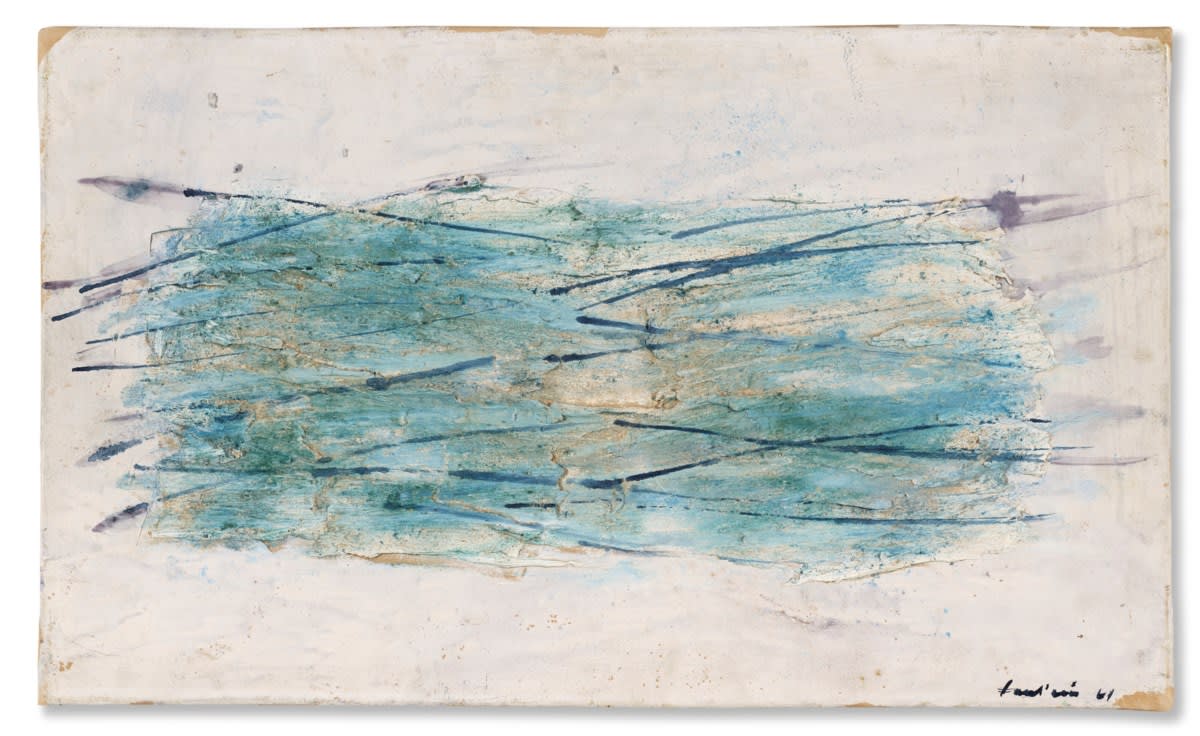
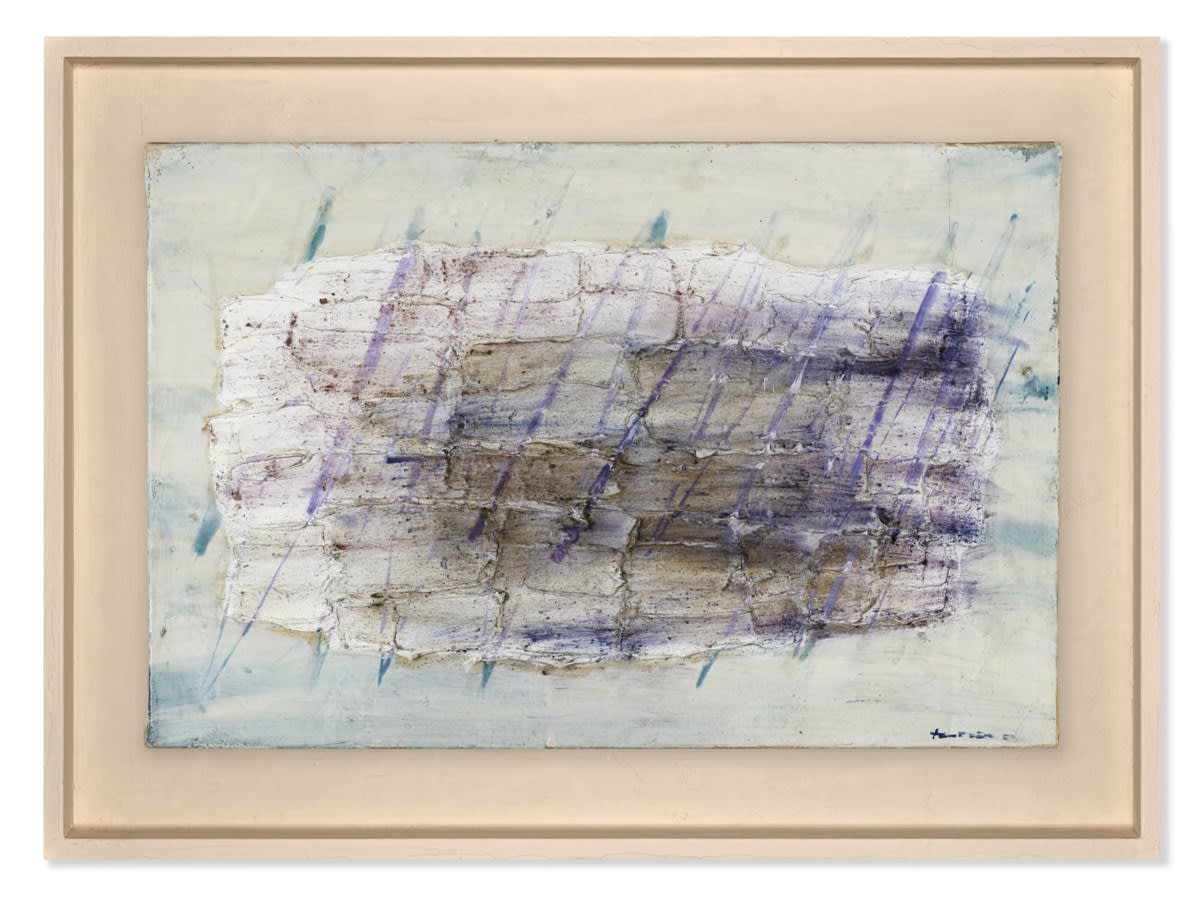
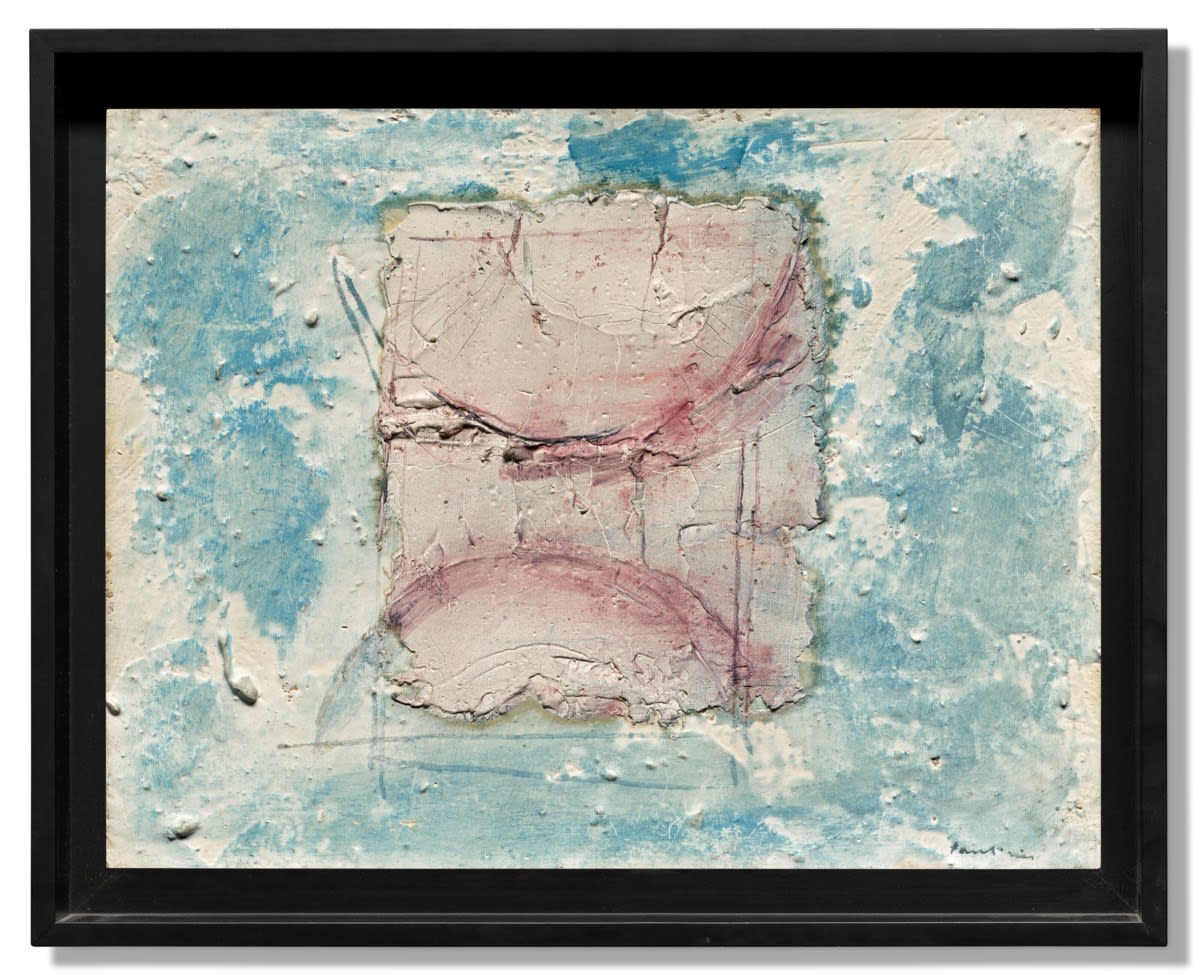
A centralised, heavily built-up mass of matière - a cracked, fissured, geologically stratified island of paste - floating on a thinly washed, atmospheric ground. Contour is dissolved rather than drawn; colour is dusted, rubbed and scraped into the paste rather than brushed. Characteristically easel-scale and intimate, which intensifies rather than dilutes the physical impact. The mode is anti-gestural: mass, erosion and sedimentation rather than the recorded stroke.
Evolution
1920-1933: dark-period figuration and sculpture - nudes, still lifes, carcasses, near-black tonality. 1934-1939: near-cessation of practice at Tignes. 1940-1945: return to Paris, wartime invention of the haute pâte, culminating in the Otages. 1947-1957: Objets, Nus, Partisans - matière becomes the subject and colour re-enters. 1958-1964: late refined chromatic hautes pâtes, 'originaux multiples' and prints, alongside international prizes and retrospectives.
Influences
- J.M.W. Turner, discovered in London as a student
- Rembrandt and the flayed-ox lineage of carcass painting
- Watteau, Chardin and Monet - subverted rather than followed, per the 2023 catalogue raisonné
- Francis Ponge's poetics of the object
Lineage forward
- Jean Dubuffet
- Wols
- Alberto Burri
- Antoni Tàpies
- Gutai (via Michel Tapié's Japanese activity)
- Later matter and process painting generally
Visual language
- Scale
- Predominantly easel-scale and small; many key works are 22-65cm
Palette
Muted, desaturated, cool-to-earth: greys, blacks, whites, ochres, maroons, with sudden pinks, blues and greens flaring inside the paste. A restricted palette used to modulate texture, brilliance and density rather than to describe.
- Surface
- Impasto reportedly up to c.1cm thick, cracked and fissured, holding raking light
- Composition
- Centralised, figure-ground, flat; a single dense positive form against an open field
Signature series
- Otages / Têtes d'otage (1943-45) - the defining body of work and the top of the market
- Objets (1947-48, 1955)
- Nus (1956)
- Partisans (1956-57)
- 1920s dark-period paintings - La mort du sanglier, nudes, still lifes, carcasses
Themes and subjects
- Atrocity, execution and the anonymous war dead (Otages, 1943-45)
- Political resistance and insurrection (Partisans, 1956-57)
- The nude, dissolved into matter (Nus, 1956)
- Everyday objects - inkwells, tin cans, fruit (Objets; Les boîtes de conserve; Raisins et poires)
- Landscape and abstract paysagisme (Grand paysage; Paysage d'Espagne)
- Still life and the hanging carcass or boar (1920s dark period)
- The 'thingness' of matter - a phenomenological preoccupation shared with Ponge
Movements and periods
- Art Informel (founding figure)
- Tachisme
- Matter painting / hautes pâtes
- Un art autre (Tapié, 1952)
- Postwar European abstraction, 1945-1964
- Interwar 'dark period' figuration, 1920s-early 1930s
Techniques and mediums
- Haute pâte: glue/plaster-based paste built up on paper laid down on canvas (marouflage)
- Dry pigment, transparent and opaque coloured inks, tempera, watercolour, pastel
- Oil on canvas and on cardboard (early and dark-period works)
- Mixed media on paper marouflé sur toile - the dominant format of the late work
- Sculpture in lead and in bronze (Otage editions of 6; earlier modelled figures)
- Etching, aquatint, heliogravure, zincograph, woodcut and lithography; deluxe illustrated books (Fautrier l'enragé, 1949, with Paulhan, published by Librairie Auguste Blaizot, edition 250 plus H.C.)
Fingerprint verification
Extended
- Use 'haute pâte / matter painting' as the precise technical descriptor - the ground is a glue/plaster paste on paper marouflé onto canvas with dry pigment and inks worked in, not conventional oil impasto
- Add the interwar 'dark period' (1920s-early 1930s) as a second, figurative and near-black phase absent from the fingerprint's postwar bracket - and which commands the highest prices alongside the Otages (c.€4m privately, Art Basel 2023)
- Add lead and bronze sculpture as a sustained parallel practice (Tête d'otage in lead, editions of 6; Tate holds one)
- Add printmaking and the deluxe illustrated book as a substantial, separately-priced stratum
- Add the explicit political-atrocity content of Otages and Partisans - the fingerprint's geological-erosion reading is formally accurate but omits that these forms are pulped human heads
Confirmed
- Art Informel classification
- Postwar / 1945-1970 period bracket
- Mixed media, oil, painting; impasto technique
- Contemplative, solitary, austere mood
- Process and materiality, landscape, pure abstraction as collector themes
- Cool, desaturated, earth-toned, muted palette
- Easel-scale, centralised composition, figure-ground, flatness, positive space
Disagreement
- 'Gestural' is the standard tag but is arguably misleading. Contemporaries stressed precisely that Fautrier's surfaces are worked, dusted and abraded flat rather than gesturally struck - which is why his work sat badly with an Action Painting-dominated audience. Treat 'gestural' as a genre label, not a description of facture.
- The fingerprint's sculpture narrative reads as expressionist bronze figuration in the post-Rodin tradition. That fits the 1920s-30s modelled figures but not the Otages lead heads, which are as anti-classical and eroded as the paintings.
- 'Pure abstraction' is only half right: even the most dissolved Otages retain a residual head or torso armature. Fautrier is better described as an artist of dissolved figuration than of pure abstraction.
Signature works note
Egon's centroid works (Barres en bleu, Bobine x2, Sillons, Diagonales) are all late abstract hautes pâtes - a coherent visual centroid but not the art-historical or market centre of the oeuvre. Diagonales is corroborated as a Christie's lot (21 Mar 2026). Recommend supplementing the signature set with a Tête d'otage (Sotheby's has offered nos. 15 and 19; Tate holds a lead Head of a Hostage, 1943-4) and a 1920s dark-period painting, which together define his historical claim and his top price tier.
Critical Reception
Research updated
Academic discourse
A serious scholarly literature exists independent of the trade: Bucarelli's 1960 monograph, Engelberts' 1969 prints/sculpture catalogue raisonné, essays by Yves-Alain Bois and Benjamin Buchloh, the 2023 paintings catalogue raisonné, and continuing phenomenological readings linking Fautrier's matière to Francis Ponge's Le Parti pris des choses (1942). The Comité Jean Fautrier under Marie-José Lefort anchors attribution scholarship.
Critical reception
Consensus
Firmly canonical in European postwar art history as the inventor of the haute pâte and a precursor of Informel; persistently under-recognised in the United States. That asymmetry is the structural feature of both his critical position and his market.
Anglophone
John Ashbery in 1964 called Fautrier France's answer to Jackson Pollock and the New York School - yet US institutional reception lagged for four decades. Frieze's review of the first American museum survey noted that his haute pâte concoctions were unpalatable to an Action Painting-dominated art world, and recounted that on receiving the 1960 Venice prize Fautrier attacked Franz Kline and Americans generally (Kline's riposte: 'French Cook!'). The same review judged the catalogue - with Bois and Buchloh - formidable scholarship while faulting the choice of venue for softening the show's impact.
Historical
Fautrier's reputation was built by writers rather than by critics: Jean Paulhan was his most ardent champion, and Malraux, Ponge, Éluard, René Char and Bataille all wrote around him. Malraux described the hostages as the most beautiful monument to the dead of the Second World War. Michel Tapié canonised him within Art informel in Un art autre (1952).
Contemporary
The Art Newspaper (5 Dec 2023) covered the paintings catalogue raisonné, presenting Fautrier as a prolific subverter of genres who reinvented painting by pulling the hautes pâtes away from the tradition and techniques of oils, and crediting him - with Dubuffet and Wols - with the birth of postwar Informel. MutualArt notes recent coverage in Kunstkritikk, Observer and Christie's Daily.
Editorial signals note
'Artists to watch' / 'new talent' list formats are not applicable to an artist who died in 1964. The equivalent leading indicators here - a new catalogue raisonné, a two-venue international retrospective, and repeat first-rank museum loans to Asia - have all occurred within the last decade.
Publications and media
- Type
- Exhibition review
- Subject
- First American museum survey; Bois/Buchloh catalogue; the Kline anecdote
- Publication
- Frieze
- Date
- 5 Dec 2023
- Type
- Feature
- Subject
- Catalogue raisonné of Fautrier's paintings
- Publication
- The Art Newspaper
- Type
- Market feature
- Subject
- Fautrier's layered market and bargain prices at a Paris sale, with interview material from Franck Prazan
- Publication
- Judith Benhamou Reports
- Type
- Movement essay
- Subject
- Art Informel - Fautrier within Tapié's founding group
- Publication
- Sotheby's editorial
- Type
- Curatorial writing
- Subject
- Otages origin narrative, the 1943 arrest and the Châtenay-Malabry asylum studio
- Publication
- MoMA collection texts
- Type
- Press coverage
- Subject
- Noted by MutualArt as recent editorial coverage
- Publication
- Kunstkritikk / Observer / Christie's Daily
Art historical positioning
Positioned as the hinge between interwar School of Paris figuration and postwar Informel: the artist who, before Dubuffet, made the physical substance of paint the subject, and who forced abstraction to carry documentary political content.
Gallery & Representation
Research updated
Fair presence
Applicat-Prazan shows Fautrier at artgenève and Art Basel (Basel); the 2024 artgenève catalogue lists Fautrier among the gallery's exhibited artists alongside Appel, de Staël, Freundlich, Soulages and Vieira da Silva. A c.€4m private Fautrier sale was made by the same dealer at Art Basel 2023, confirming that fair stands are a live channel for top material.
Representation
Status
Deceased 1964 - no exclusive representation. The market is intermediated by specialist postwar-European secondary dealers, with the Comité Jean Fautrier controlling authentication.
Historical representation
- Galerie René Drouin, Paris - 1945 Otages exhibition, the career-defining show
- Galerie Rive Droite, Paris - Les Objets 1955, Nus 1957
- Sidney Janis Gallery, New York - 1957
- Galerie Jeanne Castel, Paris - archive now overseen by Marie-José Lefort
- Michel Tapié's dealer-critic network, which carried him into Japan and Italy in the 1950s
Primary secondary dealers
Applicat-Prazan
Note
Founded 1993 by Bernard Prazan; run since 2004 by Franck Prazan, former managing director of Christie's France. Specialises exclusively in the major postwar School of Paris painters. Franck Prazan is described in the trade press as a Fautrier specialist and reports selling a 1927 Fautrier for about €4m at Art Basel 2023.
- Tier
- Tier 1 specialist
- Location
- Paris - 16 rue de Seine, 75006 (Left Bank) and 14 avenue Matignon, 75008 (Right Bank)
Lévy Gorvy Dayan (formerly LGDR)
Note
Maintains a dedicated Fautrier artist page; staged Jean Fautrier: A Private Collection (2023) and included him in Head On (2022). The principal US access point.
- Tier
- Tier 1
- Location
- New York flagship, with London / Paris / Hong Kong reach
Tornabuoni Art
- Note
- Maintains a Fautrier artist page with a full biography - consistent with strong Italian demand
- Tier
- Tier 1-2 (postwar Italian and European specialist)
- Location
- Florence / Milan / Paris / London / Crans-Montana
Olivier Malingue
- Note
- Publishes a Fautrier biography and a selected-collections list
- Tier
- Tier 2 specialist
- Location
- London / Paris
Geographic reach
Paris and Basel/Geneva are the pricing centres; New York (Lévy Gorvy Dayan) is the US access point; Italy (Tornabuoni, Martini Studio d'Arte, Meeting Art) is a genuine secondary hub; Japan is a demand centre with limited visible local dealer infrastructure. Also present on Ocula's artist directory, indicating ongoing gallery-side promotion.
Sources & research notes
Egon’s artist research combines historical auction records, recent sales, institutional history, critical reception and gallery information. Researched auction records and auction highlights are identified separately.
Read prices with their work, sale date, currency and stated basis. Egon’s market assessments are distinct from reported auction results.
Reference: Egon, “Jean Fautrier: Market Intelligence & Investment Profile.”
Research bibliography · 34 sources
Sources recorded for this artist’s research. This bibliography does not assign every source to an individual claim.
- Jean Fautrier - Wikipedia
- Jean Fautrier. Hostages (Les Otages), 1942 from Fautrier l'enragé. 1949 | MoMA
- Jean Fautrier. Hostages Black Ground (Otages fond noir). 1944-47, printed c. 1962 | MoMA
- Jean Fautrier. Les Fusillés, 1943 from Fautrier l'enragé. 1949 | MoMA
- MoMA | New to the Print Collection: Matisse to Bourgeois | Jean Fautrier and Alberto Burri
- Head of a Hostage, Jean Fautrier, 1943-4 | Tate Images
- Jean Fautrier | City of Paris Museum of Modern Art
- Jean Fautrier - Centre Pompidou
- Jean FAUTRIER - Biography | Olivier Malingue
- Fautrier Jean - Tornabuoni Art
- Jean Fautrier | Lévy Gorvy Dayan
- Jean Fautrier: A Private Collection | Lévy Gorvy Dayan
- Applicat-Prazan - Wikipedia
- Franck Prazan - Wikipedia
- artgenève 2024 exhibitor catalogue (Applicat-Prazan listing)
- Jean Fautrier: Bargain prices at a Paris auction for one of the modern geniuses of French painting - Judith Benhamou Reports
- Jean Fautrier - Rating, value, analysis - Auctie's
- Jean Fautrier Sold at Auction Prices | Invaluable
- Jean Fautrier | 2,113 Artworks at Auction | MutualArt
- Jean Fautrier | Art for Sale, Results & Biography | Sotheby's
- Otage | Modernités | 2025 | Sotheby's
- Art Informel | Sotheby's
- Catalogue raisonné of Jean Fautrier paintings reveals a prolific subverter of genres - The Art Newspaper
- Jean Fautrier | Frieze
- Jean Fautrier, 1898-1964 (PDF)
- Jean Fautrier - ACC Art Books
- Jean Fautrier's Art For Sale, Exhibitions & Biography | Ocula Artist
- Exposition Jean Fautrier au Musée d'Art Moderne de Paris - Arts in the City
- Jean Fautrier, the exhibition at The City of Paris Museum of Modern Art - Sortiraparis
- Michel Tapié - Wikipedia
- L'œil de Michel Tapié 'amateur d'art', par Juliette Evezard
- Modern Art | University of Miami Libraries Research Guides (Menil Collection holdings note)
- Head of a Hostage, No.1 - MIT Dome visual collections
- Jean Fautrier - 70 artworks - WikiArt
Research updates by section
These dates show when Egon’s research sections were updated. Source retrieval dates, where supplied above, refer to individual evidence notes.
Ranking updated . Research sections follow their own update dates.
This is what the market knows about Jean Fautrier. What Egon can also tell you: whether Jean Fautrier fits your portfolio — based on your existing holdings, budget, and investment timeline.
Get personalized analysisActive market signals
Inside Egon
Signal timeline & strength analysis
Gallery moves, auction records, institutional acquisitions, price milestones — tracked over 90 days
Full signal timeline, strength analysis, and alert configuration for Jean Fautrier.
Collector demographics & buyer analysis
Geographic distribution, institutional vs. private buyers, collector profiles, and secondary market activity
Who is collecting Jean Fautrier? Geographic distribution, institutional vs. private buyers, and collector profile analysis.
Personalized acquisition strategy
Optimal entry points, comparable pricing analysis, timing recommendations, and portfolio fit assessment
Personalized acquisition strategy for Jean Fautrier based on your budget, timeline, and collection goals.
Go deeper with personalized intelligence
You now have Egon's market assessment of Jean Fautrier. The next question is personal: does this artist belong in your collection? Egon analyzes collection fit based on your aesthetic thesis, existing holdings, budget, and investment goals — delivering acquisition strategies no public index can provide.