Olga de Amaral
Blue-chipEgon research · Artist market profile
The market, in context.
Explore Olga de Amaral’s auction history alongside the exhibitions, collections and gallery relationships behind the market.
Institutional research
Collections & exhibitions
Read holdings, exhibition history and their qualifications in context.
Read the institutional research →





Egon investment scores
Market position
Research updated
Recent auction highlight
A result from Egon’s tracked auction sales; historical auction records are researched separately. Price including buyer’s premium.
Pricing
Primary market
Gallery-controlled and generally not published. artnet's June 2025 appraisal reported auction prices trending only slightly above primary-market levels and that scarcity makes it effectively a seller's market. Paris dealer Agnès Monplaisir has said she sells privately at prices in excess of auction records, though these are large, important pieces. CONTACT LISSON GALLERY (New York / London / Los Angeles / Shanghai) or GALERIE AGNÈS MONPLAISIR (Paris) FOR CURRENT PRICING — not disclosed publicly.
Disclosure flag
Many recent results are listed as 'sign up to see price' on Artsy and sit behind the artnet Price Database paywall; open-source pricing is therefore skewed toward record-setting lots.
Temporal context
- 2024
- Record $698,500 (Pueblo X, Sotheby's, May 2024).
2025
First $1m+ results — $1.16/1.17m (Phillips, May) and $1.14m (Sotheby's day sale, May) — then $3.12m (Christie's, Nov). artnet described 2025 as her best auction year to date with her highest volume.
- 2026 ytd
- Range $361,200–$1,677,000 across the May 2026 New York sales and an April 2026 Christie's sale (EGON internal database).
- Pre 2010
- Small panel works transacted in the low thousands — artnet records a low of $1,200 for Vestigio 50 at Christie's, Jan 2007.
- 2013 2020
- Rising six-figure territory; artnet reported prices 'moving up—fast' as dealer and museum attention returned.
- 2021 2023 post Lisson
- Signing with Lisson (2021) plus the 'To Weave a Rock' retrospective repriced the market; low-to-mid six figures became routine.
By work type and scale
- Small panels
- e.g. Agua B (50.8 x 37.2 cm, Christie's Oct 2024) — typically five figures to low six figures
- Mid scale panels
- Alquimia, Escrito, Tabla, Cesta lunar — roughly $350k–$780k in 2025–26 auction sales (internal DB)
- Hanging column works
- Nudos, e.g. Nudo 10 (2011), 450 x 30 cm, Sotheby's May 2025 — price undisclosed in open sources
Prints and multiples
Serigraphs and editioned works appear at Bogota Auctions at a small fraction of unique-work prices — must not be conflated with the unique-work market.
- Early 1970s fiber works
- Wool/horsehair works form a distinct sub-market, e.g. Hojarasca barbas de piedra (1973), Sotheby's Feb 2025
Monumental gold leaf wall works
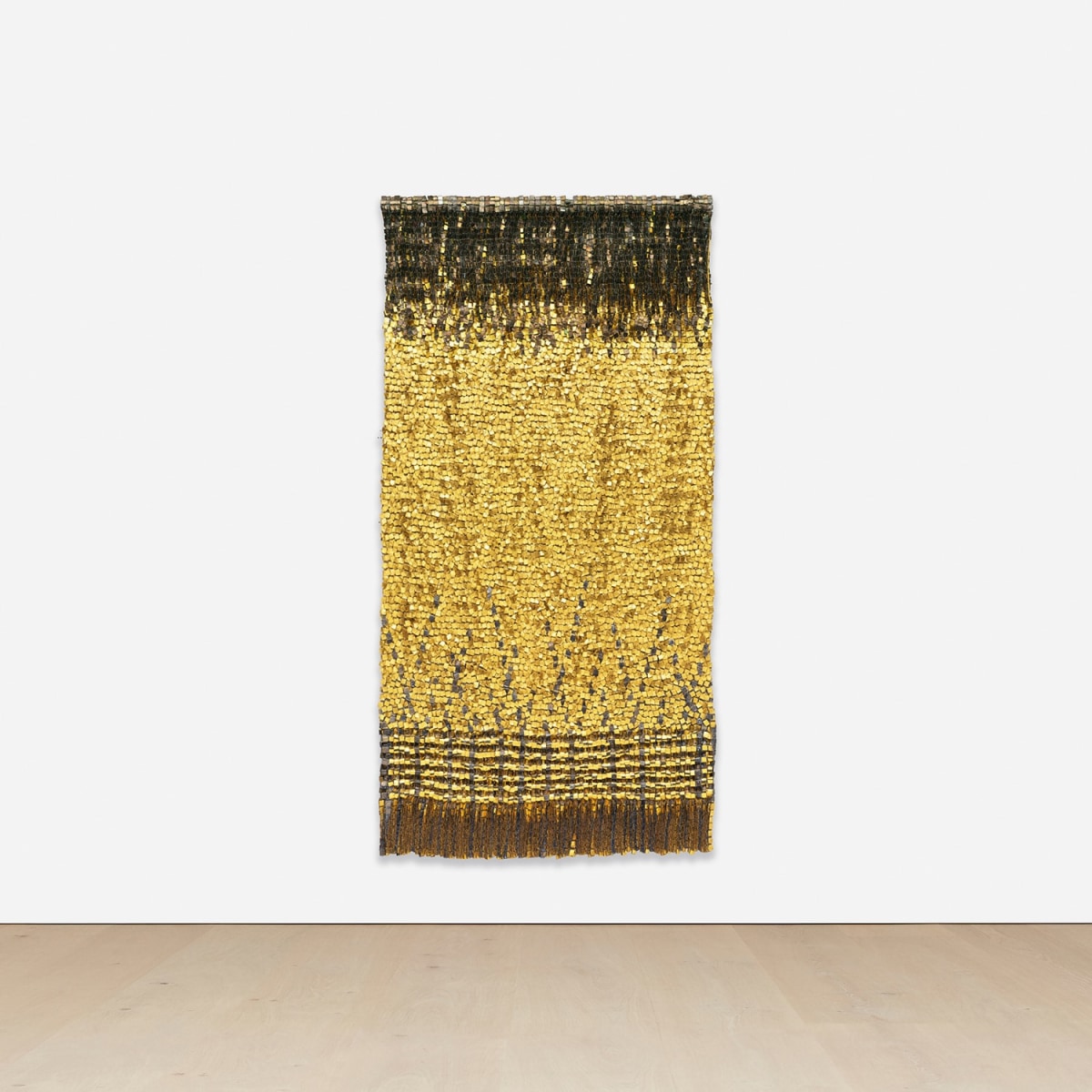
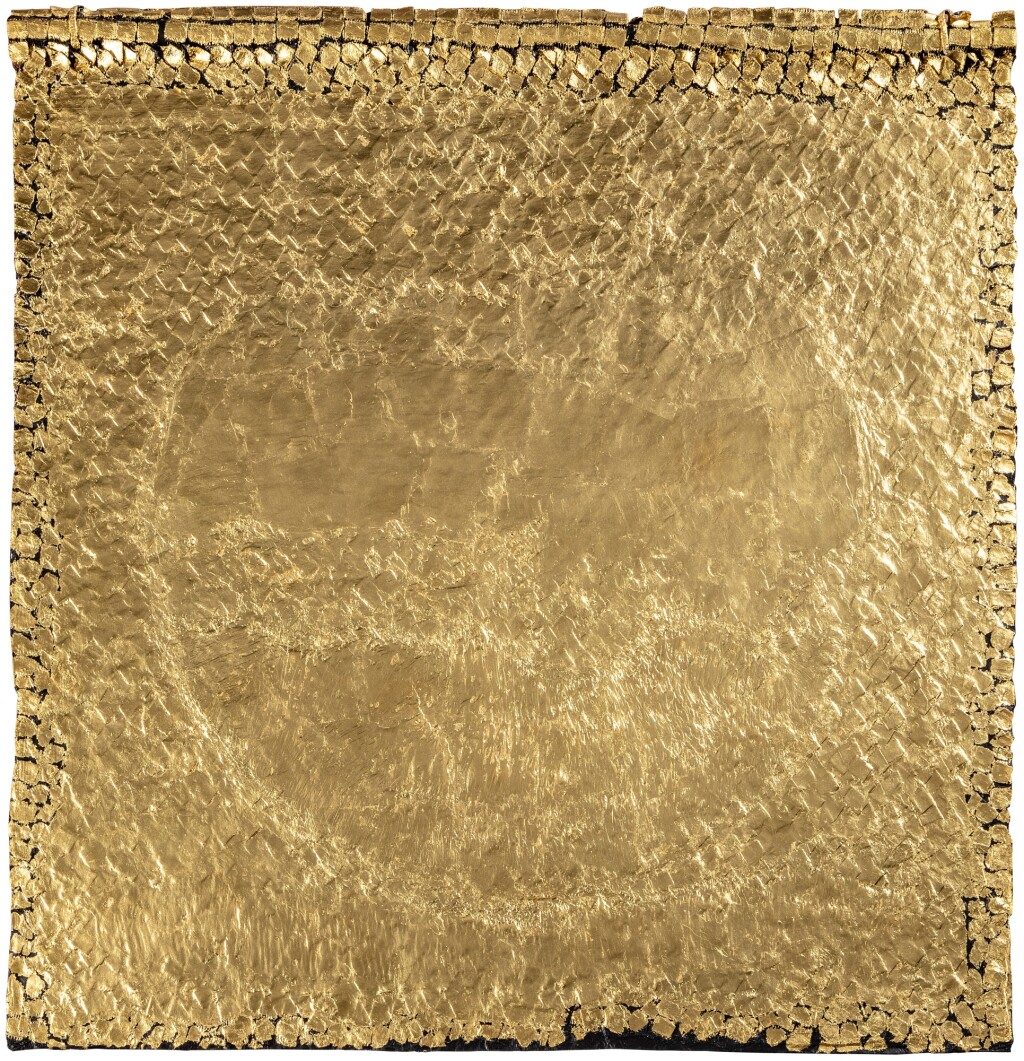
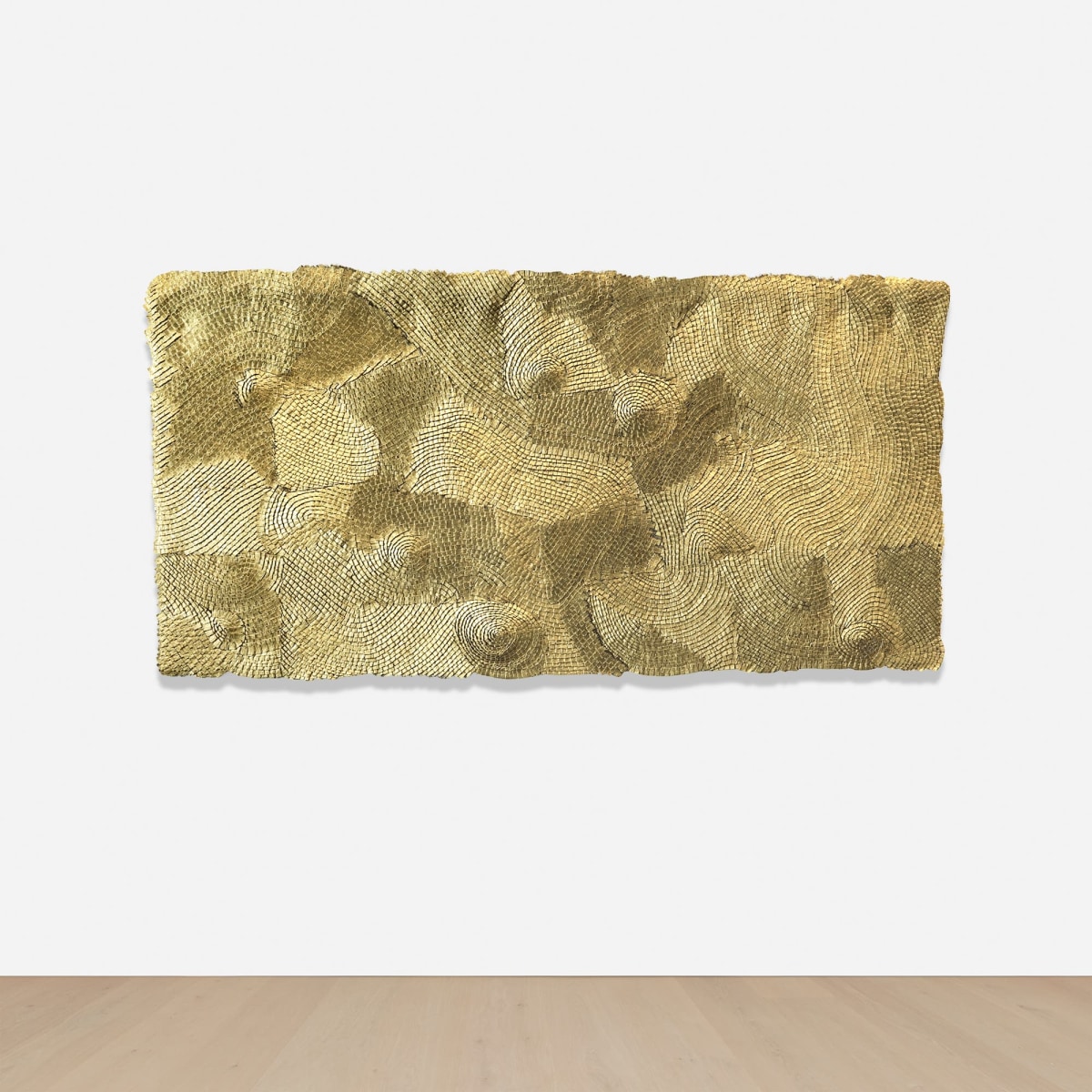
Pueblos, Imagen perdida, Imagen Paisaje, Umbra, Estelas — $700k to $3.1m at auction; the top of the market. Large monochromatic gold works are described by dealers as the most sought-after.
Liquidity
Market depth
$1m+ results have occurred in a day sale as well as an evening sale, and material trades across all three major houses. The constraint is supply, not demand: works are labour-intensive and much of the best material sits in long-term private and museum hands.
- Sell through
- Very high — 16 of 17 settled lots sold in the 2025–26 internal record, with multiple lots exceeding high estimates by 3–5x.
Annual volume
Roughly 15–25 lots per year across the major houses plus regional Colombian sales; the EGON internal database alone records 17 lots from 2025 onward. artnet reported 2025 as her highest-volume auction year to date.
Comparables
- Sheila Hicks — closest international fiber peer; comparable institutional standing, deeper US market history
- Magdalena Abakanowicz — Lausanne-generation peer whose market repriced earlier
- Sonia Gomes, Ione Saldanha, Emmi Whitehorse — named alongside de Amaral in the current 'previously overlooked' repricing narrative
- Fernando Botero, Carlos Cruz-Diez, Jesús Rafael Soto — Latin American modernists in the same $1m+ bracket; de Amaral is the reference name in fiber
Collector base
Composition
Historically a dedicated but niche group concentrated in the Americas — Phillips deputy chairman Vivian Pfeiffer noted her long-standing strength there — now broadened to European and Asian buyers following Lisson representation and the Fondation Cartier retrospective. Corporate collections were early buyers of fiber art in the 1970s–80s.
Demand pattern
Concentrated on large gold monochromes with a 'spiritual' register; buyers increasingly include institutions and collectors building textile/fiber and Latin American women-artist holdings.
Named collectors and provenance
- The Portman Family Collection (Sotheby's, 'A Visionary Eye', Feb 2025)
- Mr. and Mrs. Solomon B. Smith, Lake Forest, IL — bought directly from the artist in June 1973 and gave the work to the Art Institute of Chicago the same year
- Andrea and Diego Amaral (family) — donors to the Metropolitan Museum of Art, 2004
- Fondation Cartier pour l'art contemporain — institutional collector
- Dealer networks: Agnès Monplaisir (Paris, seven-plus solo shows), Allrich Gallery (San Francisco, 1980s)
Auction history
Historical depth
Artsy's price database lists 105 past auction results. Additional activity occurs outside the major houses, notably Bogota Auctions (Colombia), which handles works and editions (e.g. a serigraph, ed. 20/100, Sept 2024). Sotheby's 'A Visionary Eye: The Portman Family Collection' (26 Feb 2025) included Hojarasca barbas de piedra (1973, wool and horsehair, 190.5 x 198.1 x 10.2 cm), evidencing single-owner-collection provenance.
Bought in and unsold
Sell-through is very high; the EGON internal database records 1 of 17 lots (2025–26) as unsold. No systematic historical buy-in data was retrievable — Artsy and artnet price databases are paywalled at lot level. This is a genuine data gap.
Egon internal database 2025 onward
- Sold
- 16
- Total lots
- 17
- Sell through
- 100% across 17 settled lots (every catalogued lot at least 90 days old has settled)
- Recent average
- $732,610
Cross reference
The internal $3,125,000 Pueblo H figure and the publicly reported $3.12m Christie's result are consistent and describe the same 19 Nov 2025 lot — no conflict.
Provenance note
These figures come from the EGON internal auction database (coverage 2025 onward; Christie's, Sotheby's, Phillips, Bonhams). They are NOT web-sourced and are reported with their own work/house/date attached; they are not merged with externally sourced figures.
Five most recent
- Tabla 20 — $361,200, Phillips, May 2026 (above estimate)
- Escrito V — $503,100, Phillips, May 2026
- Umbra E — $1,677,000, Phillips, May 2026 (exceeded high estimate)
- Cesta lunar 41 — $742,400, Sotheby's, May 2026
- Olga de Amaral (née en 1932) [Christie's French-language catalogue heading] — $777,951, Christie's, Apr 2026 (above estimate)
- Highest recorded
- $3,125,000 — Pueblo H, Christie's, Nov 2025
- Recent price range
- $361,200 – $1,677,000
Market position
Price leader of the international fiber-art market and among the most valuable Latin American women artists. The 2024–26 repricing is textile-segment-wide (LACMA/NGA/MoMA 'Woven Histories', Venice 2024, and the April 2026 $33.5m design record signalling structural repricing of craft-adjacent categories), but she sits at the top of it.
Investment outlook
Risks
The $3.12m November 2025 result was over five times its high estimate and roughly 2.7x the prior record — a single unrepeated evening-sale outlier that should be read as a ceiling, not a level. The artist is 93–94: supply is finite, but an estate transition and possible consignment flush lie ahead. Current pricing is partly a segment trade (textile / women / Latin American rediscovery) and is exposed if attention rotates. House estimates still lag results, meaning price discovery is incomplete in both directions.
Supports
Forthcoming Pulitzer Arts Foundation (Sept 2026) and Cooper Hewitt/Smithsonian (April 2027) touring retrospective; a 65-year career and museum holdings that pre-date the market surge; genuine supply scarcity; sustained institutional appetite for textile abstraction.
Trajectory
Steeply upward: record +67% in May 2025 and a further +150% in November 2025; 2026 results have sustained the new level (a $1.677m Phillips result in May 2026, internal DB) without repeating the November outlier.
Institutional presence
Research updated
Upcoming
Pulitzer Arts Foundation, St. Louis — 'Olga de Amaral: Weaving the Infinite', from 10 September 2026 (opening within days of this research date); Cooper Hewitt, Smithsonian Design Museum, New York, from April 2027. MoMA has Riscos IV on collection display through 19 April 2027.
Exhibitions
Significant group exhibitions
- 60th Venice Biennale, 'Stranieri Ovunque – Foreigners Everywhere', 2024
- 'Weaving Abstraction in Ancient and Modern Art', The Metropolitan Museum of Art, 2024
- 'Subversive, Skilled, Sublime: Fiber Art by Women', Smithsonian American Art Museum, 2024
- 'Woven Histories: Textiles and Modern Abstraction' — LACMA 2023, National Gallery of Art (Washington) 2024, National Gallery of Canada 2024, MoMA 2025
- 'Southern Geometries, from Mexico to Patagonia', Fondation Cartier, Paris, 2018–19
- 'El Dorado: Myths of Gold', Americas Society, New York
- 'Threads to the South', ISLAA, New York, 2024
- 'Threaded Visions: Contemporary Weavings from the Collection', Art Institute of Chicago, Feb–Aug 2024
- São Paulo Biennial, 2013
- Venice Biennale 1986 — represented Colombia
- 15th International Lausanne Biennial of Contemporary Textile Art (itinerant, incl. Nordjyllands Kunstmuseum, Aalborg)
- 'Modern Design: 1890–1990', The Metropolitan Museum of Art
Solo museum and institutional
- 'Olga de Amaral: Weaving the Infinite' — Pulitzer Arts Foundation, St. Louis, opening 10 September 2026; travelling to Cooper Hewitt, Smithsonian Design Museum, New York, April 2027. 130 textiles and works on paper spanning 65 years; co-curated by Stephanie Weissberg (Pulitzer) and Christina L. De León (Cooper Hewitt); billed as the most comprehensive examination to date of her contribution to fiber art and design, underscoring how her architectural-drafting background shaped her experiments with dimensionality and scale.
- 'Olga de Amaral' — Institute of Contemporary Art, Miami, 1 May – 12 October 2025, in collaboration with Fondation Cartier; more than 50 works; co-presented with ICA curator Stephanie Seidel; exhibition design by Lina Ghotmeh.
- 'Olga de Amaral' — Fondation Cartier pour l'art contemporain, Paris, 12 October 2024 – 16 March 2025. First comprehensive European retrospective; around eighty works from the 1960s to the present, many never shown outside Colombia; originated by curator Marie Perennès; scenography by Lina Ghotmeh; three years in preparation; final exhibition at the Fondation's Boulevard Raspail building and part of its 40th-anniversary programme.
- 'Olga de Amaral: To Weave a Rock' — first major US retrospective, co-organised by Cranbrook Art Museum and the Museum of Fine Arts, Houston. MFA Houston 25 July – 19 September 2021; Cranbrook Art Museum 30 October 2021 – 20/27 March 2022. Curated by Laura Mott (Cranbrook) and Anna Walker (MFAH); supported by the National Endowment for the Arts, a Craft Research Fund grant from the Center for Craft, and the Graham Foundation.
- Numerous solo presentations in Colombia and Europe since the 1970s, including seven-plus solo shows at Galerie Agnès Monplaisir, Paris (e.g. 'Cortex of Our World').
Publications
- Anna Walker and Laura Mott, eds., 'Olga de Amaral: To Weave a Rock', exh. cat., Museum of Fine Arts, Houston / Arnoldsche Art Publishers, Stuttgart, 2020, 143 pp., 91 colour ills.
- 'Olga de Amaral, el manto de la memoria' (The Mantle of Memory), Zona Ediciones, Bogotá, 2000, 224 pp.; Paris edition 2013 with essay by Juan Carlos Moyano Ortiz and text by Matthew Drutt ('Colombian Gold')
- 'The House of My Imagination: Lecture by Olga de Amaral at The Metropolitan Museum of Art, April 24, 2003', Bogotá, 2003
- Fondation Cartier retrospective catalogue, 2024
- Forthcoming Pulitzer / Cooper Hewitt publication for 'Weaving the Infinite', 2026–27
- No catalogue raisonné identified
Museum collections
Umbra 30 (2003), linen, silver leaf, gesso, acrylic paint, 81.3 x 199.4 x 1.3 cm, obj. 2004.69
- Tier
- First-rank (encyclopedic, international loan standing)
- Notes
- Shown in 'One of a Kind: The Studio Craft Movement', Dec 2006 – Dec 2007
- Institution
- The Metropolitan Museum of Art, New York
- Acquisition reading
- Offered and accepted — donor gift from the artist's family; no fund or committee named
- Credit line verbatim
- Gift of Andrea Amaral and Diego Amaral, 2004
Alquimia 13 (Alchemy 13), 1984, obj. 1987.387, Modern and Contemporary Art department
- Tier
- First-rank
- Institution
- The Metropolitan Museum of Art, New York
- Acquisition reading
- Offered and accepted — gift from the artist and her husband; no fund or committee named
- Credit line verbatim
- Gift of Olga and Jim de Amaral, 1987
Farallón Granate (Garnet Rock Ridge), 1973
- Tier
- First-rank
- Institution
- Art Institute of Chicago
Acquisition reading
Offered and accepted — collector gift; provenance shows the collectors bought from the artist in June 1973 and gave the work to the museum the same year
- Credit line verbatim
- Gift of Mr. and Mrs. Solomon B. Smith
Alquimia III (Alchemy III), 1983
- Tier
- First-rank
- Institution
- Art Institute of Chicago
Acquisition reading
Unclear. The object was published in the AIC Annual Report 1986–87 and shown in 'Gift, Bequest and Purchase: A Selection of Textile Acquisitions from 1982–1987' and 'Twenty Years of Textile Society Collecting (1978–1998)' — suggestive of Textile Society involvement but NOT stated, and not inferred here.
- Credit line verbatim
- credit line not published in the record retrieved
A de Amaral sculpture acquired by the Art Institute of Chicago (announced via Lisson Gallery news during the representation period)
- Tier
- First-rank
- Institution
- Art Institute of Chicago
- Acquisition reading
- Recent acquisition; mechanism unverified
- Credit line verbatim
- credit line not published in the record retrieved
View 9 more records
Rios 5 (1990) — on view, Gallery 516; Riscos IV (1987) — on view through 19 April 2027
- Tier
- First-rank
- Institution
- The Museum of Modern Art, New York
- Acquisition reading
- Unverified. Both works are currently on permanent-collection display — a meaningful curatorial commitment independent of the credit line.
- Credit line verbatim
- credit line not published in the record retrieved
Alchemy 50 (1987), canvas, gesso, gold leaf and acrylic paint
- Tier
- First-rank
- Institution
- Tate (Tate Modern), London
- Acquisition reading
- Unverified
- Credit line verbatim
- credit line not published in the record retrieved
2 works recorded (Wikidata floor, not a museum-API count)
- Tier
- First-rank national collection
- Institution
- Smithsonian American Art Museum, Washington DC
- Acquisition reading
- Unverified. SAAM exhibited her in 'Subversive, Skilled, Sublime: Fiber Art by Women' (2024).
- Credit line verbatim
- credit line not published in the record retrieved
1 work recorded (Wikidata floor)
- Tier
- First-rank (encyclopedic)
- Institution
- Cleveland Museum of Art
- Credit line verbatim
- credit line not published in the record retrieved
Holdings reported by Artsy
- Tier
- Major US museum
- Institution
- Fine Arts Museums of San Francisco (de Young Museum)
- Credit line verbatim
- credit line not published in the record retrieved
Holdings reported by Fondation Cartier and ICA Miami
- Tier
- First-rank modern collection
- Institution
- Musée d'Art Moderne de la Ville de Paris
- Credit line verbatim
- credit line not published in the record retrieved
Holdings reported by Artsy
- Tier
- Leading national museum, Colombia
- Institution
- Museo de Arte Moderno de Bogotá
- Credit line verbatim
- credit line not published in the record retrieved
Works in the foundation collection, incl. Muro en rojo (wool and horsehair, 700 x 830 cm)
Tier
Private foundation collection — NOT counted as a first-rank museum accession for institutional scoring, though its exhibition programme is fully credited
- Institution
- Fondation Cartier pour l'art contemporain, Paris
- Credit line verbatim
- credit line not published in the record retrieved
Institutional relationships confirmed through the co-organised retrospective and awards; specific accession records not retrieved
- Tier
- Major US museums / specialist collections
- Institution
- Museum of Fine Arts, Houston; Cranbrook Art Museum; Museum of Arts and Design, New York
- Credit line verbatim
- credit line not published in the record retrieved
Awards and recognition
- Guggenheim Fellowship, 1973
- Represented Colombia at the Venice Biennale, 1986
- 'Visionary Artist', Museum of Arts and Design, New York, 2005
- Honorary co-chair, Multicultural Audience Development Initiative benefit, The Metropolitan Museum of Art (2008 per Graham Foundation; 2011 per Ocula — sources conflict)
- Lifetime Achievement Award, Women's Caucus for Art, New York, 2019
- Honorary Master of Fine Arts, Cranbrook Academy of Art, 2022
- Order of Boyacá, Knight Degree, Republic of Colombia, 2022
Museum collections summary
Public-API name-matching found at least 18 works across the Met, Art Institute of Chicago, Smithsonian and Cleveland — a FLOOR, not a total. Institutional sources (ICA Miami, Fondation Cartier) list her in major public collections worldwide including Tate Modern, MoMA, Fondation Cartier, Musée d'Art Moderne de Paris and the Art Institute of Chicago; Artsy adds the de Young and Museo de Arte Moderno, Bogotá. CAVEAT FOR SCORING: every credit line actually verified is a donor gift (family or collector), not a curatorial purchase — the holdings are broad and long-standing, but the documented acquisition mechanism is 'offered and accepted' rather than 'purchase, X fund'.
Career & Biography
Research updated
Identity
- Name
- Olga de Amaral (born Olga Ceballos Vélez)
- Birth
- 1932, Bogotá, Colombia (Getty ULAN: b. 1932, Colombia)
Family
Born to parents from Colombia's Antioquia region; one of eight siblings (five sisters, two brothers). Married American artist Jim Amaral in 1957; children include Andrea and Diego Amaral, donors of a work to the Metropolitan Museum of Art in 2004.
- Gender
- female
- Nationality
- Colombian
- Getty ulan ID
- 500125060
- Living status
- Living (age 93–94 as of August 2026)
- Current location
- Lives and works in Bogotá, Colombia
- Professional roles
- Artist (visual artist), sculptor, textile artist
Career timeline
- 1952 — completes architectural drafting degree, Bogotá
- 1954–55 — studies fiber at Cranbrook Academy of Art; meets fellow student Jim Amaral
- 1955 — returns to Colombia; begins making decorative textiles on commission for architects
- 1957 — marries Jim Amaral; settles in Bogotá
- 1960s — founding director of the Textiles Department, Universidad de los Andes, Bogotá
- 1967 — teaches at Haystack Mountain School of Crafts, Maine; sets students the assignment 'to weave a rock', later the title of her US retrospective
- 1970s — international recognition via the Lausanne International Biennial circuit; one of very few South American artists internationally known in fiber art in the 1960s–70s
- 1973 — Guggenheim Fellowship; monumental fibre works (El Gran Muro, 1976)
- 1980s — adopts gold leaf as a signature material; launches the Alquimias (Alchemies) series
- 1986 — represents Colombia at the Venice Biennale
- 1990s–2010s — Estelas, Brumas, Bosques, Imagen perdida, Umbra, Nudos and Pueblos series
- 2005 — named 'Visionary Artist' by the Museum of Arts and Design, New York
- 2008/2011 — honorary co-chair, Multicultural Audience Development Initiative benefit, The Metropolitan Museum of Art
- 2018–19 — included in 'Southern Geometries, from Mexico to Patagonia', Fondation Cartier, Paris
- 2021 — signs with Lisson Gallery (New York, London, Shanghai); first major North American retrospective 'To Weave a Rock' opens at MFA Houston, then Cranbrook Art Museum
- 2024 — included in the 60th Venice Biennale 'Stranieri Ovunque – Foreigners Everywhere'; first comprehensive European retrospective at Fondation Cartier, Paris (Oct 2024 – Mar 2025)
- 2025 — retrospective travels to ICA Miami (May–Oct 2025); auction record broken twice
- 2026–27 — 'Olga de Amaral: Weaving the Infinite' at Pulitzer Arts Foundation (from 10 Sept 2026) and Cooper Hewitt, Smithsonian Design Museum (April 2027)
Studio practice
Works from a Bogotá studio with assistants; hand-weaves linen, cotton, wool, horsehair and Japanese paper into strips and lattices, then applies gesso, acrylic and gold, silver or palladium leaf. Individual works take months. The practice deliberately dissolves boundaries between weaving, painting, sculpture, installation and architecture; the artist's and the Met's own framing is the 'woven wall'.
Artistic context
Influences
Colombian landscape; adobe-walled, tile-roofed vernacular architecture; gilded Baroque colonial churches; pre-Columbian textiles and goldwork (El Dorado); Indian basket weaving; abstract geometry and Bauhaus-derived modernism encountered at Cranbrook; her mother's needlework and domestic textiles.
Art historical position
Pioneer of the Fiber Art movement that established textiles as a fine-art medium from the 1960s; central figure in post-war Latin American abstraction and in the current art-historical reassessment of textiles ('Woven Histories', 'Weaving Abstraction').
Contemporaries and peers
Sheila Hicks, Magdalena Abakanowicz, Lenore Tawney, Claire Zeisler and the international Fiber Art / Lausanne Biennial generation. Auction-house and catalogue literature situates her formally between Ad Reinhardt and Mark Rothko and the Latin American kinetic tradition of Jesús Rafael Soto and Carlos Cruz-Diez.
Social engagement
Institution-builder in Colombia — founding director of the textiles department at Universidad de los Andes — and a lifelong advocate for craft-based practice as fine art. Her career is central to feminist and post-colonial reassessment of fiber, a medium historically devalued as 'women's craft'.
Education and training
- Colegio Mayor de Cundinamarca, Bogotá — degree in architectural design / architectural drafting, 1951–52
- Columbia University, New York — English study, 1954
- Cranbrook Academy of Art, Bloomfield Hills, Michigan — Fiber/Textiles department, 1954–55 (one-year attendance without degree, then customary at Cranbrook); awarded honorary Master of Fine Arts by Cranbrook in 2022
- Source note: artnet and the Graham Foundation describe the Colegio Mayor training as 'architecture'; Wikipedia and the Pulitzer/Cooper Hewitt materials specify architectural drafting/design — the drafting training is repeatedly cited as the origin of her structural approach to weaving.
Artistic Profile
Research updated
Style
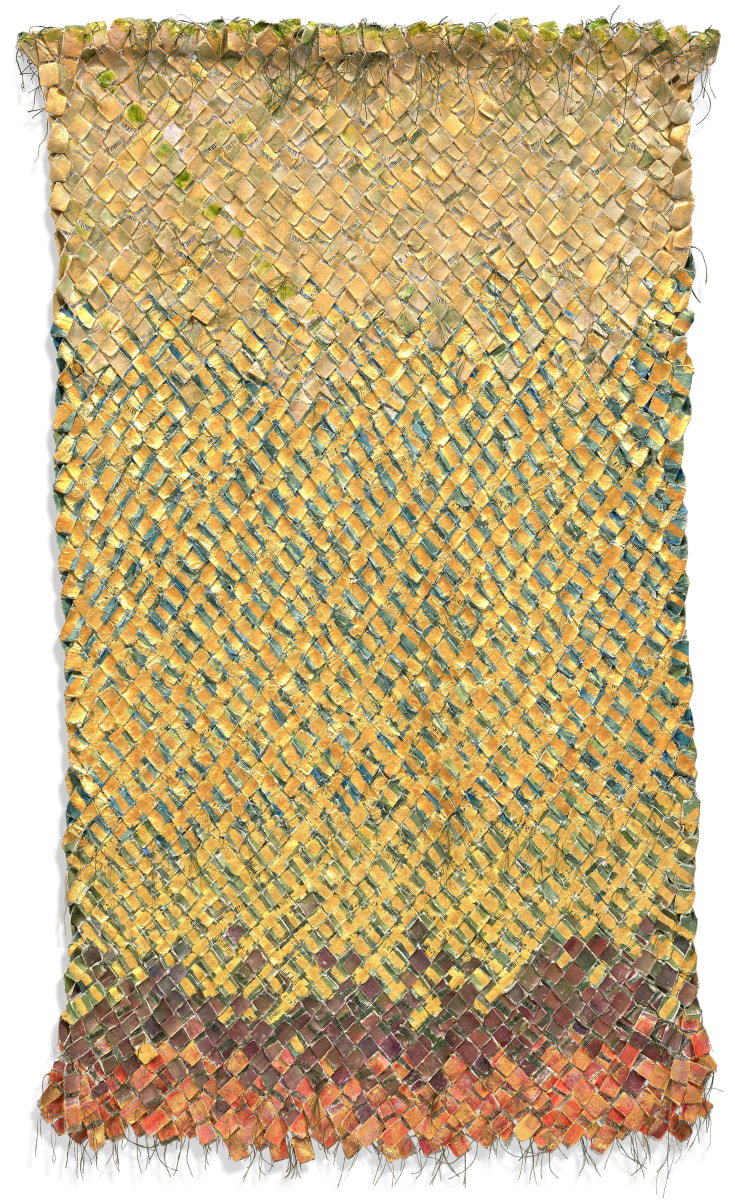
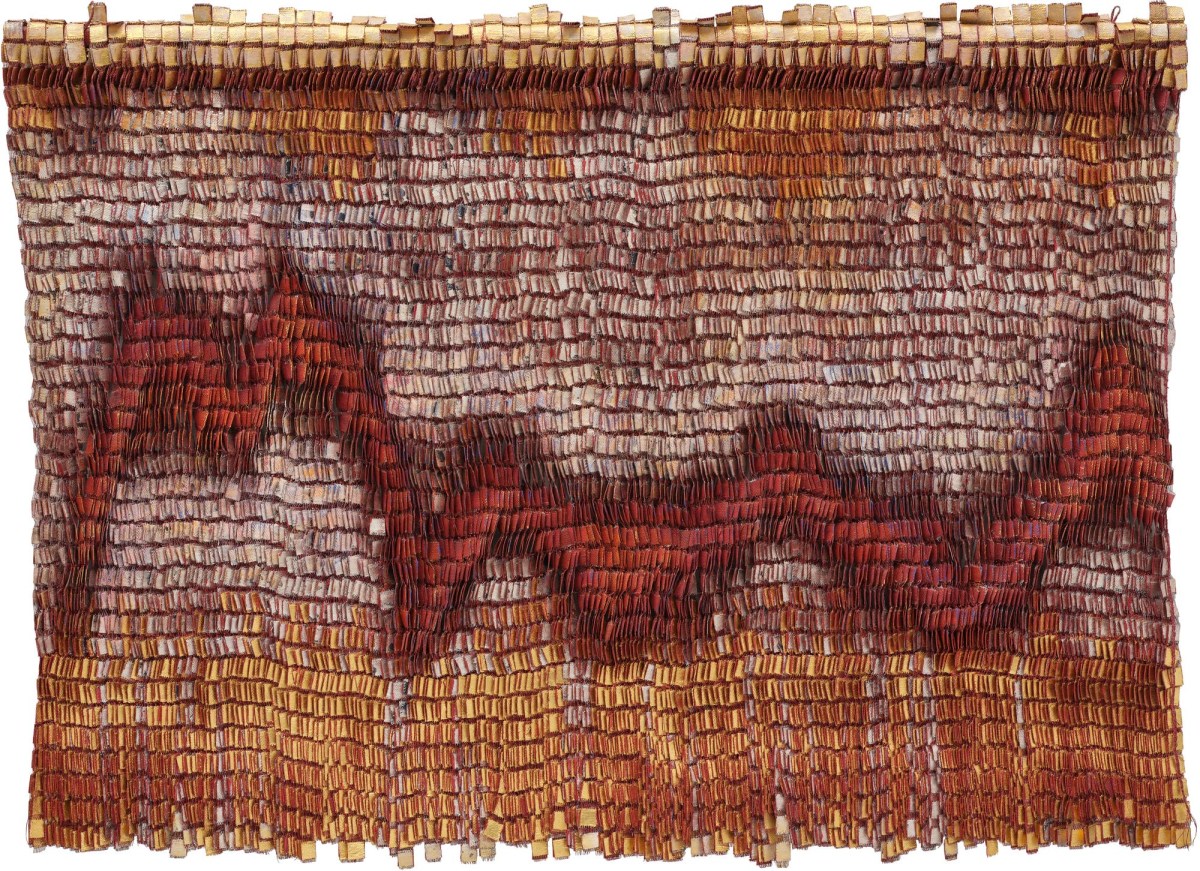
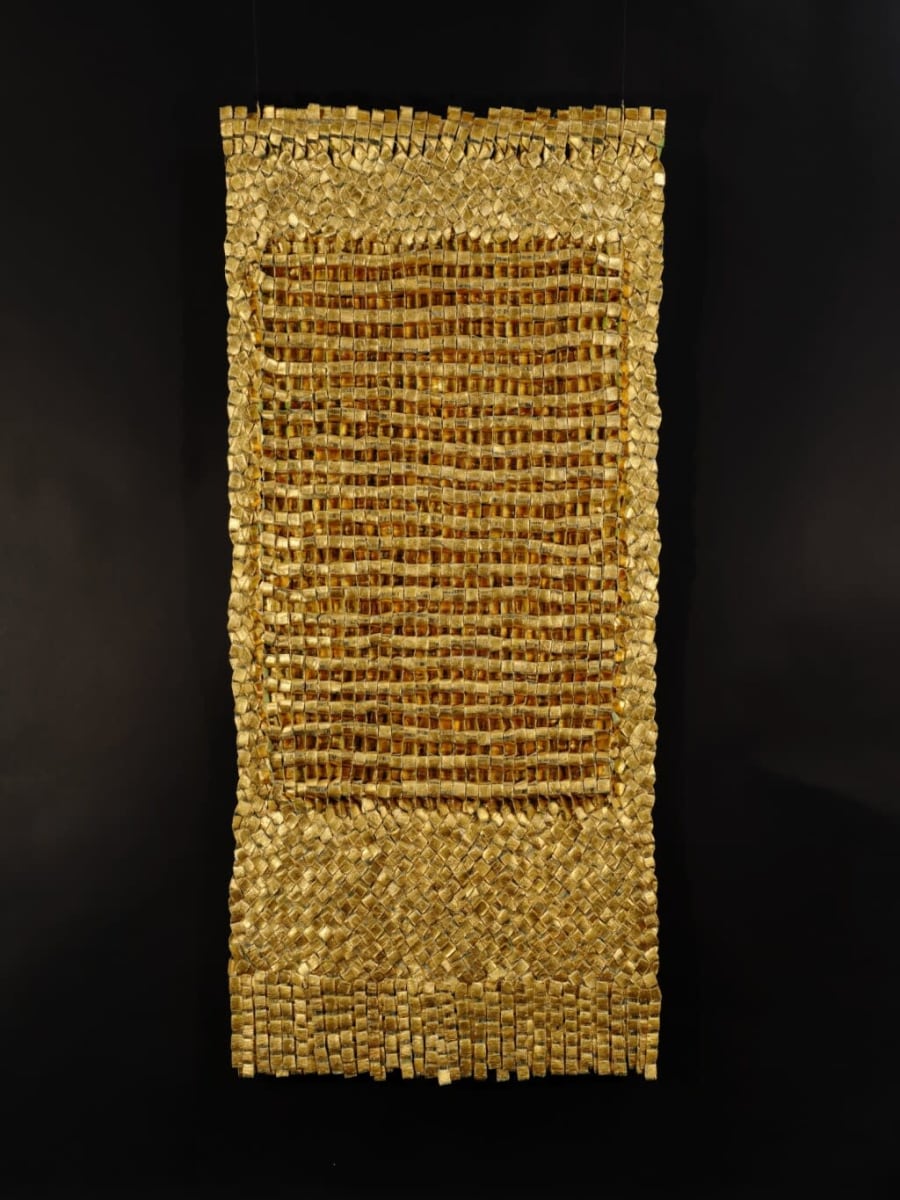
Large-scale abstract fiber constructions that behave simultaneously as painting, sculpture, installation and architecture. Hand-woven linen, cotton, horsehair and Japanese-paper strips are built into lattices and grids, coated in gesso and acrylic and surfaced with gold, silver or palladium leaf, so the works read at a distance as shimmering mosaics, adobe walls, chainmail or gilded Baroque altarpieces and at close range as accumulations of individually handled units.
Evolution
1955–65: architectural commissions and early experimental weaving. Mid-1960s–70s: monumental off-loom wool and horsehair walls; international breakthrough via Lausanne. 1980s: gold leaf and the Alquimias — the shift from textile to luminous object. 1990s–2000s: Estelas, Umbra and Imagen perdida; increasingly architectural and immersive installation. 2010s: Brumas and Bosques dematerialise the plane into suspended thread fields, while Nudos extend into vertical sculpture.
Influences
Bauhaus-derived modernism absorbed at Cranbrook; pre-Columbian textile and metalwork traditions; Colombian vernacular architecture and Baroque colonial gilding; Indian basket weaving; abstract geometry.
Visual language
Light is treated as a material: surfaces modulate and reflect ambient light, and hanging works such as the Estelas and Brumas float free of the wall, dissolving object into atmosphere. Frayed selvedges and exposed unit assembly are deliberately retained, countering mechanical uniformity with handmade irregularity.
Signature series
- Muros / woven walls (1960s–70s) — wool and horsehair, monumental; El Gran Muro (1976), Muro en rojo
- Alquimias (Alchemies), from the 1980s — gold leaf on woven linen, the breakthrough series
- Estelas (Stelae), 1996–2018 — gold-leaf panels hung as suspended monoliths recalling ritual objects, memory traces and geological strata
- Brumas (Mists) and Bosques (Forests), from around 2013 — geometric forms hovering within diaphanous free falls of thread
- Pueblos — shifting weave patterns producing rippling volume and metaphorical landscape (Pueblo H, Pueblo X)
- Umbra, Imagen perdida, Imagen Paisaje, Nudos (knots), Riscos, Rios, Cestas lunares, Escritos, Tablas
Themes and subjects
- Alchemy and transmutation — base fiber turned to gold
- Memory, landscape and place — the Colombian sabana, adobe walls, tile roofs, geological strata
- Pre-Columbian goldwork and the El Dorado myth, and by extension the colonial plunder of gold and its reappearance in Baroque church interiors
- Ritual, the sacred and the meditative — works framed as stelae, monoliths and offerings
- Process, labour and materiality; the reclamation of weaving from craft into fine art, carrying an implicit feminist argument
Movements and periods
Fiber Art and the Lausanne Biennial generation; post-war and contemporary Latin American abstraction; post-minimalist process art; the American studio craft movement (the Met explicitly calls her a leading artist of the post-war studio craft movement); contemporary textile abstraction as reframed by 'Woven Histories' and 'Weaving Abstraction'.
Techniques and mediums
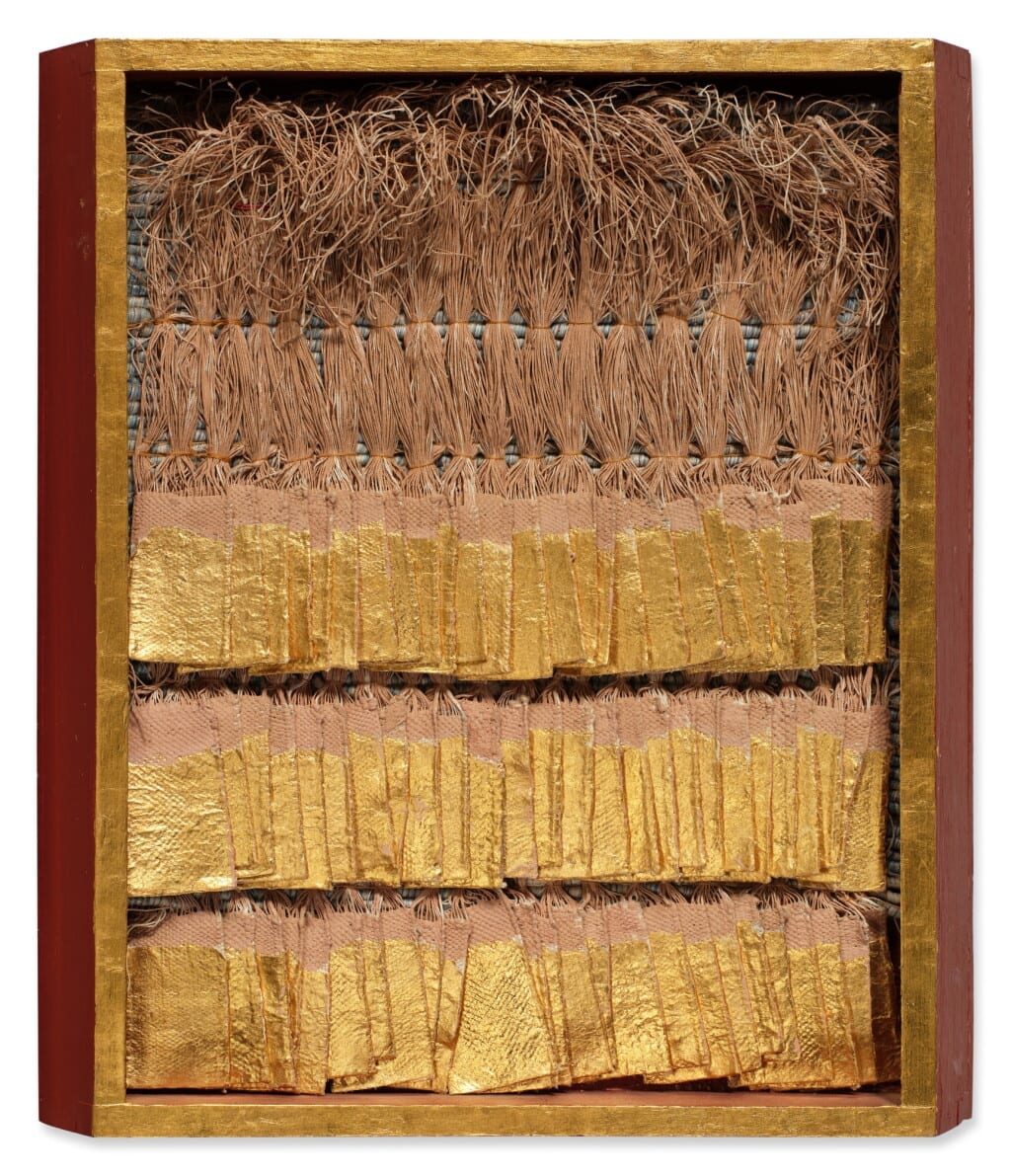
Hand-weaving on and off the loom; strip weaving and interlocking of painted elements; wrapping and knotting; gesso ground; acrylic paint; gold, silver and palladium leaf applied before or after weaving; linen, cotton, wool, horsehair, Japanese paper, sometimes mounted on wood or panel.
Fingerprint verification
Confirmed
The existing Egon fingerprint holds on nearly every axis. Sources confirm gilding/gold leaf as the signature technique; mixed media and sculpture classifications; contemplative, reverent and serene moods; themes of process and materiality, spirituality and the sacred, nature and the organic, and ritual; warm and monochromatic gold palettes; and the formal terms flatness, planarity, all-over and monumental scale. The Anni Albers / Sheila Hicks lineage read is supported — she is consistently placed in the Fiber Art movement alongside Hicks.
Disagreements and extensions
- 'Decorative' as a stylistic register is descriptively defensible but is contested by the literature — the critical consensus is precisely that she moved fiber OUT of the decorative/craft category into sculpture, installation and architecture. Treat it as a surface read, not a period label.
- The 1990–2010 period bracket badly under-represents the career, which runs from the early 1960s to around 2018–2020. The 1970s wool-and-horsehair works (El Gran Muro 1976; Hojarasca barbas de piedra 1973; Muro en rojo, 700 x 830 cm) are a materially different and separately traded body of work.
- 'Minimalist' is only partly right — post-minimalist and process-based is more accurate, with a maximalist material and chromatic sensibility in the Alquimias and Brumas.
- ADD architecture: her architectural-drafting training is repeatedly cited as the structural basis of the work, and 'woven wall' is the artist's and the Met's own framing.
- ADD silver leaf and palladium leaf alongside gold — the Met's Umbra 30 is silver leaf; palladium appears in the Lisson Los Angeles material.
- ADD suspended and free-hanging three-dimensional works (Nudos, Estelas, Brumas) — substantial parts of the oeuvre are not wall-planar at all, which qualifies the 'flatness / planarity' reading.
Signature works verification
Egon's centroid works (Alquimia 62, Pueblo H, Escrito V and two Christie's-catalogued lots) match the market's own hierarchy — Pueblo H is the auction record and the Alquimia and gold-leaf panel families are the most sought-after. Additions from research: Imagen perdida 27 and Imagen Paisaje I (both $1m+ results) commercially, and El Gran Muro (1976) and the Brumas art-historically.
Critical Reception
Research updated
Academic discourse
Positioned within scholarship on post-war Latin American abstraction and on the reassessment of fiber as fine art. The core literature is museum-published (MFAH/Arnoldsche 2020, Fondation Cartier 2024, forthcoming Pulitzer/Cooper Hewitt 2026); peer-reviewed engagement (CAA Reviews) exists but is thinner than the exhibition literature. Catalogue scholarship by Matthew Drutt and Juan Carlos Moyano Ortiz situates her weavings as breaking the barrier of threads and fibers to make sculptural 'woven walls' at unprecedented scale.
Critical reception
Summary
Consistently positive and now expanding from craft and design coverage into mainstream art criticism. She is routinely described as one of the most important textile artists of her generation and a pioneer of the Fiber Art movement that established textiles as a fine-art medium in the 1960s; the Fondation Cartier framed its 2024 retrospective as demonstrating her fundamental contribution to the avant-garde of the 1960s, 70s and 80s.
Key reviews and features
- Art in America / ARTnews — 'Fabric of Impulse: Fiber Artist Olga de Amaral Melds Artistic Spontaneity with Slow Craft', a full feature tied to 'To Weave a Rock' at Cranbrook and the Lisson New York show (2021–22); notes the retrospective's title came from an assignment she set students at Haystack in 1967 and traces gold leaf as a signature material adopted in the 1980s. A tier-1 magazine feature — Lisson separately lists an 'Olga de Amaral featured in Art in America' item.
- Artforum — Artguide entry for 'Olga de Amaral: The Elements' at Lisson New York, positioning her as a vital force in sculpture, installation and painting rather than only textiles; Artforum also published K. L. H. Wells on textile exhibitions in Washington, New York and Chicago (September 2024).
- CAA Reviews — scholarly review of 'Olga de Amaral: To Weave a Rock' (exhibition and Arnoldsche catalogue). The most critical voice found: it faults the exhibition for largely eschewing engagement with the history of Colombia and for not reproducing wall labels in Spanish — substantive art-historical critique rather than promotional coverage.
- The Costume Society (Dr Babette Radclyffe-Thomas) — 'Textiles as language', review of the Fondation Cartier retrospective.
- The New York Times (gallery coverage, July 2024); The New Yorker and ARTnews on the 2024 Venice Biennale; The Washington Post (May 2024) on the textile turn; Hyperallergic ('In Weaving Abstraction, Textiles Travel Through Space and Time', May 2024; 'A Fiber-Forward Vision of Modern Art', July 2024); Vogue on her London presentation; Artsy, 'Abstract Weaving is Having a Moment' (March 2024); Grace Glueck, New York Times, on the Met's studio-craft display (12 January 2007).
Editorial recognition signals
An Art in America feature, Artforum coverage, repeated Artsy market editorials and inclusion in Phaidon survey literature. She does not appear on 'artists to watch' or 'new talent' lists — at 93 she instead appears in 'rediscovery' and record-setting editorial framings, the appropriate late-career analogue, and her official site maintains a dense running press archive.
Publications and media
Coverage spans art-market press (artnet News appraisal by Eileen Kinsella, June 2025; earlier artnet market analysis quoting dealer Agnès Monplaisir; Artsy market editorials; HENI record reports), mainstream press (NYT, New Yorker, Washington Post, Vogue) and specialist craft/design press.
News record verification
Event
Artsy, '5 Themes That Will Define the Art Market in 2026' — quoted as saying renewed interest revived previously overlooked artists such as Emmi Whitehorse, Ione Saldanha and Olga de Amaral, all of whom went on to set auction records.
Date flag
The stored date of 20 April 2024 for an article about themes defining the market in 2026 is internally implausible and should be treated as an extraction error. The substance is nonetheless verified by Artsy's own November 2025 reporting and by HENI.
My classification
DISAGREE WITH THE LABEL. This is MARKET / SEGMENT COMMENTARY, not an artist milestone. De Amaral is named only as one of three examples inside a broader thesis about the repricing of previously overlooked artists; nothing in the quote is an event in her career. The genuine milestones, independently verified, are the two 2025 auction records: Phillips, 13 May 2025 ($1.16/1.17m) and Christie's, 19 November 2025 ($3.12m).
- Our provisional label
- Artist Milestone
Independent verification
Confirmed by Artsy ('16 New Auction Records Set in November 2025'; 'Olga de Amaral and Firelei Báez set new auction records at Christie's sale'), HENI news reports on both records, and artnet News' June 2025 appraisal.
Gallery & Representation
Research updated
Fair presence
- Art Basel 2022 and 2023 (Lisson)
- TEFAF New York 2022 (Lisson)
- Ongoing presence at major international fairs via Lisson
Representation
Primary
- Tier
- Tier 1 international mega-gallery
- Since
- 2021, announced ahead of the 'To Weave a Rock' retrospective
Detail
Alex Logsdail announced the signing; the artist cited Lisson's commitment to artists whose work resists neat categories and blurs painting, sculpture and installation. First presentations: East Hampton (August 2021) and 'The Elements', Lisson New York (November–December 2021) — both reportedly sold out quickly. Most recent: a focused survey at Lisson Los Angeles, 14 November 2025 – January 2026, her first LA solo in almost a decade, spanning the early 1970s to 2018.
- Gallery
- Lisson Gallery
- Locations
- New York, London, Shanghai (representation announced 2021); also presented in East Hampton and Los Angeles
- Verified on gallery site
- Yes
Representation history
A long career sustained through specialist craft/fiber dealers and Paris-based Galerie Agnès Monplaisir; the 2021 move to Lisson is the decisive commercial transition and coincides precisely with the market's repricing.
Secondary and historical
Galerie Agnès Monplaisir, Paris
Role
Long-term European dealer and advocate; seven-plus solo exhibitions including 'Cortex of Our World'; reports selling privately at levels in excess of auction records for large works
- Tier
- Established specialist gallery
Galería Duque Arango, Medellín, Colombia
- Role
- Regional secondary-market dealer, publishes collector-facing material on the artist
- Tier
- Regional
Allrich Gallery, San Francisco
- Role
- Historical — handled work in the 1980s, recorded in Art Institute of Chicago provenance
- Tier
- Historical
Geographic reach
Historically Americas-dominant — Phillips deputy chairman Vivian Pfeiffer noted her long-standing strength in the Americas — now genuinely global: gallery reach across New York, London, Los Angeles and Shanghai; museum reach across France, the United States, Canada, Italy and Colombia.
Sources & research notes
Egon’s artist research combines historical auction records, recent sales, institutional history, critical reception and gallery information. Researched auction records and auction highlights are identified separately.
Read prices with their work, sale date, currency and stated basis. Egon’s market assessments are distinct from reported auction results.
Reference: Egon, “Olga de Amaral: Market Intelligence & Investment Profile.”
Research bibliography · 41 sources
Sources recorded for this artist’s research. This bibliography does not assign every source to an individual claim.
- Olga de Amaral Biography – artnet
- Olga de Amaral – Wikipedia
- Olga De Amaral's Art For Sale, Exhibitions & Biography | Ocula
- Olga de Amaral: To Weave a Rock – Graham Foundation
- Olga de Amaral's Auction Record Jumps 150% With $3.12m Sale – HENI
- Olga de Amaral's Auction Record Jumps 67% With $1.17m Sale – HENI
- 16 New Auction Records Set in November 2025 – Artsy
- Olga de Amaral and Firelei Báez set new auction records at Christie's sale – Artsy
- Olga de Amaral's Sumptuous Works Are in Hot Demand, as Textile Art Gains Market Momentum – Artnet News
- Prices rising for Olga de Amaral's artworks – artnet News
- Gallerist Agnes Monplaisir on the Spiritual Work of Olga de Amaral – artnet News
- Olga de Amaral – Auction Results and Sales Data | Artsy
- Olga de Amaral – Art & Prints for Sale | Artsy
- Olga De Amaral Sold at Auction Prices – Invaluable
- Olga de Amaral | Collection of the Fondation Cartier pour l'art contemporain
- Fondation Cartier Celebrates 40th Anniversary with Olga de Amaral Retrospective – Cranbrook Academy of Art
- Olga de Amaral: A Landmark Retrospective at Fondation Cartier – Selections Arts Magazine
- Textiles as language: Olga de Amaral at the Fondation Cartier – The Costume Society
- Announcing representation of Olga de Amaral – Lisson Gallery
- Olga de Amaral | 2021 | East Hampton | Lisson Gallery
- Olga de Amaral | The Elements | 2021 | New York | Lisson Gallery
- News – Olga de Amaral | Lisson Gallery
- Olga de Amaral | November 2025 – January 2026 | Los Angeles | Lisson Gallery
- Pulitzer Arts Foundation and Cooper Hewitt Announce 'Olga de Amaral: Weaving the Infinite'
- Olga de Amaral – Institute of Contemporary Art, Miami
- Olga de Amaral – Umbra 30 – The Metropolitan Museum of Art
- Olga de Amaral – Alquimia 13 (Alchemy 13) – The Metropolitan Museum of Art
- Farallón Granate (Garnet Rock Ridge) – The Art Institute of Chicago
- Alquimia III (Alchemy III) – The Art Institute of Chicago
- Olga de Amaral | MoMA
- Sotheby's lot essay – Olga de Amaral (museum comparables; Drutt and Moyano Ortiz citations)
- News | Olga de Amaral | Official Site (press archive)
- Olga de Amaral: The Elements – Artguide, Artforum International
- Olga de Amaral: To Weave a Rock – CAA Reviews
- Fabric of Impulse: Fiber Artist Olga de Amaral Melds Artistic Spontaneity with Slow Craft – Art in America
- Olga de Amaral: To Weave a Rock – Cranbrook Art Museum
- Olga de Amaral's exhibition – Meer (ICA Miami)
- Everything an Art Collector Should Know About Olga de Amaral – Galería Duque Arango
- Olga de Amaral Art for Sale – Galería Duque Arango
- Olga de Amaral: Textile Art Legacy – Galería Duque Arango
- 5 Themes That Will Define the Art Market in 2026 – Artsy
Research updates by section
These dates show when Egon’s research sections were updated. Source retrieval dates, where supplied above, refer to individual evidence notes.
Ranking updated . Research sections follow their own update dates.
This is what the market knows about Olga de Amaral. What Egon can also tell you: whether Olga de Amaral fits your portfolio — based on your existing holdings, budget, and investment timeline.
Get personalized analysisActive market signals
Inside Egon
Signal timeline & strength analysis
Gallery moves, auction records, institutional acquisitions, price milestones — tracked over 90 days
Full signal timeline, strength analysis, and alert configuration for Olga de Amaral.
Collector demographics & buyer analysis
Geographic distribution, institutional vs. private buyers, collector profiles, and secondary market activity
Who is collecting Olga de Amaral? Geographic distribution, institutional vs. private buyers, and collector profile analysis.
Personalized acquisition strategy
Optimal entry points, comparable pricing analysis, timing recommendations, and portfolio fit assessment
Personalized acquisition strategy for Olga de Amaral based on your budget, timeline, and collection goals.
Go deeper with personalized intelligence
You now have Egon's market assessment of Olga de Amaral. The next question is personal: does this artist belong in your collection? Egon analyzes collection fit based on your aesthetic thesis, existing holdings, budget, and investment goals — delivering acquisition strategies no public index can provide.