Sol LeWitt
Blue-chip





Egon investment scores
Market position
Auction record in Egon’s database
Highest result in Egon’s own auction database — sales at Christie’s, Sotheby’s, Phillips and Bonhams from 2025 onward; coverage is not exhaustive and earlier records may exceed it.
- Pricing
- Works on Paper
- Trailing 12-month average approx. $16,962 (MutualArt). Small 1970s graphite/ink sheets typically $5,000-$40,000; large autograph gouaches (Brushstrokes, Irregular Forms, 1990s-2000s) roughly $50,000-$250,000+ by scale and date.
- Temporal Context
- Pre-2014: top of market largely $300k-$900k for major structures. 2014-2015: successive records (Wavy Brushstroke 2014; corner pieces 2015). 2023: record $1,633,000 (1 x 2 Half Off). 2024-2026: top lots concentrated in the $440k-$600k band for hanging structures and premier wall-drawing certificates; mid-market gouaches $50k-$150k; works on paper averaging under $20k; prints under $10k for common editions.
- Paintings Gouaches
- Trailing 12-month painting average approx. $55,532 (MutualArt).
- Primary Market Note
- Estate-controlled primary market. Prices are not publicly disclosed - contact Paula Cooper Gallery (New York) or Pace Gallery for current pricing on estate material, structures and wall drawing certificates.
- Unique vs Editioned
- Pricing above distinguishes unique works (structures, gouaches, working drawings, wall-drawing certificates) from the very large editioned print corpus, which sets the sub-$10,000 entry tier.
- Prints and Multiples
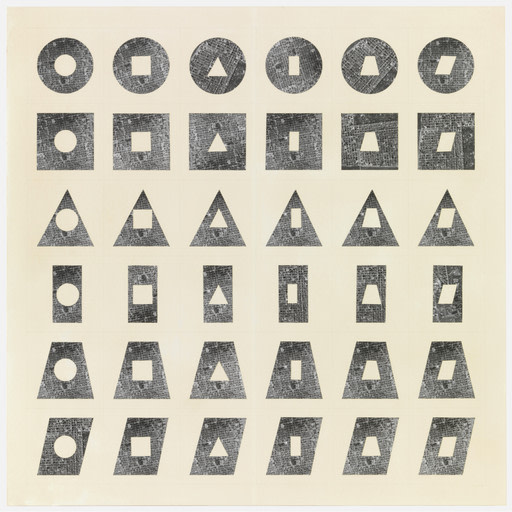
- Common or later editions typically GBP 2,000-5,000 ($2,500-6,500); rarer or particularly significant prints upwards of GBP 20,000. Portfolio record: Six Geometric Figures and All Their Combinations (1980), 63 screenprints, over GBP 60,000 at Christie's New York 2022. Full Open Cube in Colour on Colour linocut sets have made upwards of GBP 40,000. Single-work print record approx. GBP 39,631 (Christie's, Feb 2024).
- Structures Sculpture
- Mid-scale cube/modular works $50,000-$250,000 (8 Part Cube $48,640, May 2026); major hanging structures and corner pieces $400,000-$1.63M.
- Wall Drawing Certificates
- Sold as certificate plus instruction set. Historical auction range from $35,250 (Wall Drawing #767, 1994, Christie's New York 2001) to $254,500 (Wall Drawing #41, 1970, Phillips de Pury New York 2009). Wall Drawing #1112 (2003) achieved $444,500 at Christie's, May 2026 - evidence of an upward re-rating for certificate-based works.
- Liquidity
- Depth
- Exceptional depth across tiers from sub-$3,000 prints to $1.6M sculptures - among the most liquid postwar names, with entry points at nearly every budget level
- Sell Through
- ~74% in the tracked 2025-2026 sample; strong for estate-quality unique material, softer for high-volume editions
- Annual Volume
- Very high - hundreds of lots offered annually across major houses, regional salerooms and dedicated print sales; approx. 5,561 lifetime auction lots recorded. Egon partial database logs 53 lots from 2025 onward at the four majors, plus 15 upcoming.
- Comparables
- Judd (top lot $12.8m, May 2026) > Flavin ~ Andre ($1.1m, May 2026) ~ LeWitt ($1.63m record, 2023) > Tuttle / Sandback / Mangold
- Collector Base
- Profile
- Institutional collections form the deepest single constituency, followed by long-horizon private connoisseurs of Minimal/Conceptual art, architecture and design collectors, and a very broad print-collecting base
- Demand Pattern
- Emerging Asian institutional and collector attention following MOT Tokyo (2025-26) and Amorepacific Seoul (Sept 2026) - the first major presentations in Japan and Korea and a plausible new demand channel
- Named Collectors
- Henry S. McNeil Jr., Philadelphia (Tylenol heir; owned at least a dozen LeWitt drawings over the decades, with wall drawings installed in family bedrooms; collection consigned to Christie's 2026); Elton John (Straight Lines in All Directions, sold Feb 2024); Deborah Ronnen, Rochester (lender to MASS MoCA); the LeWitt Collection, Chester, Connecticut (family holdings; major donor to Yale University Art Gallery and Wadsworth Atheneum); Dia Art Foundation
- Primary Market
- Managed by the LeWitt Estate through Paula Cooper Gallery (New York) and Pace Gallery, with Massimo De Carlo in Europe/Asia. Supply is deliberately paced; the January-February 2026 Paula Cooper exhibition of 1960s works signals estate willingness to release scarce early material.
- Auction History
- Record
- Auction record: $1,633,000 for '1 x 2 Half Off' (1991), Sotheby's New York, 2023 (approx. GBP 1.1M). Earlier benchmarks include Corner Piece No. 2 at $881,000 and Corner Piece No. 4 (1976) at Sotheby's New York, November 2015 - the same sculpture having sold for approx. GBP 329,280 in 2007, a documented multi-cycle appreciation.
- Market Scale
- MutualArt indexes approximately 5,561 LeWitt lots at auction, with realized prices spanning roughly $1 to $1,633,000 depending on size and medium - one of the deepest secondary markets of any postwar American artist.
- Top of Market Character
- The top-10 results are dominated by three-dimensional works (modular structures, corner pieces, hanging structures, 1966-1995), with two painted 1995 works indicating collector appetite for autograph 2D pieces. 'Wavy Brushstroke' (1995) set the then-record at Sotheby's New York, November 2014, at more than double its high estimate.
- Bought in and Negative Returns
- Hanging Structure 24 D realized $444,500 in May 2026 versus $596,900 at Sotheby's in 2023 - a c.25% negative return over three years, showing that trophy-level LeWitt sculpture can re-trade below prior peaks. In the McNeil evening sale, five lots (LeWitt, Carl Andre, Dan Flavin, Donald Judd, Richard Tuttle) carried third-party guarantees and hammered below low estimate with little competitive bidding. Egon partial database (2025 onward, four major houses): 53 lots, 26 sold, ~74% sell-through, 15 upcoming; recent range $1,536-$444,500, average hammer approx. $111,891.
- Recent Notable Results 2024 2026
- Straight Lines in All Directions (1996), unique work from the Elton John collection - Christie's New York, February 2024, approx. GBP 39,631, meeting high estimate; record for a single LeWitt print
- Open Cube in Colour on Colour (2003) - June 2024, approx. GBP 22,000
- Oct 2025 day-sale flow: Horizontal Brushstrokes (2003), gouache on paper 153.5 x 223 cm, Christie's Oct 16 2025; Irregular Form (1998), gouache, Sotheby's Oct 1 2025; Circle & Lines (1972), graphite and ink, Sotheby's Oct 17 2025
- May 20, 2026 - Christie's 'Defined Space: The Collection of Henry S. McNeil Jr.': Hanging Structure 24 D (1991), painted wood 302.9 x 61.6 x 61.6 cm, sold $444,500 (above low estimate); Wall Drawing #1112, Square with Broken Bands of Color (2003), sold $444,500, exceeding high estimate
- May 2026 - Sotheby's: Untitled (lot 217) $121,600 and 8 Part Cube $48,640, both exceeding high estimate
- Apr 2026 - Phillips: Untitled $3,096, exceeding high estimate (editions/works-on-paper tier)
- May 2026 - Bonhams offered Untitled (2004) gouache 57.3 x 76.2 cm and Squiggly Brushstrokes (1997) gouache 153.7 x 153.7 cm
- Market Position
- Peer Set
- Donald Judd, Dan Flavin, Carl Andre, Robert Ryman, Robert Mangold, Richard Tuttle, Fred Sandback, Richard Artschwager
- Segment Dynamics
- Minimalism as a segment was stress-tested in May 2026: the Henry S. McNeil Jr. collection was marketed by Christie's as the greatest private collection of Minimalism in existence and the most important since the 2006 Judd Foundation sale, targeted above $30m across 12 evening lots plus design and day-sale material. The outcome was split - outperformance for the Judd stack and Andre corner, guarantee-dependent below-low-estimate hammers for several other lots including LeWitt.
- Relative Standing
- LeWitt sits a tier below Judd at the very top - Judd's untitled 1969 plexiglass and copper stack hammered $10.6m ($12.8m with fees) at Christie's in May 2026 - and roughly level with or above Carl Andre, whose 66 Copper-Carbon Corner hammered $880,000 ($1.1m with fees) against a $500,000 high estimate in the same sale. LeWitt's advantage over peers is breadth of medium and price accessibility; the constraint at the top is that his dematerialized, re-executable wall drawings cap trophy pricing relative to unique-object makers.
- Investment Outlook
- Risks
- Documented negative return on re-traded sculpture (-25% on Hanging Structure 24 D, 2023 to 2026); heavy reliance on third-party guarantees at the top end in 2026; very large edition supply dampens appreciation in the low tier; wall-drawing ownership carries installation cost and an authentication/consignment litigation precedent (Steinkamp v. Rhona Hoffman Gallery over the Wall Drawing #448 certificate)
- Positives
- Canonical art-historical status; permanent 35-year MASS MoCA installation sustaining public visibility; deep multi-tier liquidity; first-ever major Asian museum surveys opening new collector geography; certificate-based wall drawings re-rating upward (Wall Drawing #1112 at $444,500, above high estimate, May 2026)
- Trajectory
- Stable blue-chip with flat-to-modestly-positive long-run trend at the top and firm mid-market; near-term catalysts skew positive via the Seoul exhibition and disciplined estate-managed supply
Institutional presence
Museum of Modern Art, New York
Metropolitan Museum of Art, New York (confirmed via museum API data)
Solomon R. Guggenheim Museum, New York
Whitney Museum of American Art, New York
San Francisco Museum of Modern Art - one of the leading repositories; acquired over 30 works in December 2000 including nine wall drawings and structures plus 26 working drawings, joining Steel Structure (1975-76), Incomplete Open Cubes (1974), Wall Drawing #132 (1972) and Wall Drawing #377 (1982)
National Gallery of Art, Washington DC
Art Institute of Chicago (confirmed via museum API data)
Dia Art Foundation, New York
Cleveland Museum of Art (confirmed via museum API data)
Smithsonian Institution (confirmed via museum API data)
Yale University Art Gallery (gifts of the LeWitt Collection, Chester)
Wadsworth Atheneum, Hartford
MASS MoCA, North Adams (long-term installation)
Brooklyn Museum
Lyman Allyn Art Museum, New London CT
- Biennials
- Venice Biennale (incl. 1988 Italian Pavilion)
- Documenta, Kassel
- Various international triennials and site-specific commissions in Europe, Latin America (Fundacion PROA, Buenos Aires) and Asia
- Exhibitions
- Upcoming
- Sol LeWitt: Open Structure, Amorepacific Museum of Art, Seoul - opening September 1, 2026; expanded version of the MOT exhibition developed with the LeWitt Estate and MOT; first large-scale solo exhibition in Korea, presenting wall drawings, geometric three-dimensional sculptures, paintings and drawings
- Ongoing estate program at Paula Cooper Gallery, New York and Pace Gallery
- 15 upcoming lots logged in the Egon auction database across the four major houses
- Major Retrospectives
- Museum of Modern Art, New York, 1978 (comprehensive traveling retrospective)
- Sol LeWitt: A Retrospective, SFMOMA, 2000, traveling to MCA Chicago and the Whitney Museum
- Sol LeWitt: A Wall Drawing Retrospective, MASS MoCA, 2008-2043
- Sol LeWitt: 17 Wall Drawings, Fundacion Botin, Santander
- Career Defining Group Shows
- Primary Structures, Jewish Museum, New York, 1966 - the exhibition that signalled the start of Minimalist art
- Seminal Conceptual art exhibitions of 1968-70 organized within the Lippard/Siegelaub circle
- Venice Biennale 1988 - wall drawing engulfing the Italian Pavilion interior
- Documenta participations
- Solo Museum and Gallery Recent
- Sol LeWitt: Open Structure, Museum of Contemporary Art Tokyo (MOT), December 25, 2025 - April 2, 2026 - first substantial survey of his art at a public museum in Japan, encompassing wall drawings, structures, works on paper and artist's books
- Sol LeWitt: Works from the 1960s, Paula Cooper Gallery, New York, January 15 - February 28, 2026
- Works on view at the Albertina, Vienna (2026)
- Sol LeWitt: Artist and Collector at Play, Lyman Allyn Art Museum, with loans from the LeWitt Collection, Chester
- Institute of Contemporary Art, Miami (2021)
- The Modern Institute, Glasgow (2018)
- Historic solos incl. Stedelijk Museum Amsterdam (1984), Brooklyn Museum (1985), Harvard University Art Museums (1985), Konrad Fischer Dusseldorf (1984)
- Publications
- 'Paragraphs on Conceptual Art', Artforum 5:10, Summer 1967, pp. 79-83
- 'Sentences on Conceptual Art', 1969
- Additional Artforum contributions incl. December 1979
- Sol LeWitt, exh. cat., MoMA, New York, 1978
- Sol LeWitt: A Retrospective, exh. cat., SFMOMA, 2000
- Sol LeWitt: A Wall Drawing Retrospective, MASS MoCA / Yale University Press, 2009
- Print catalogue raisonne numbering used in the trade (Krakow/Witkin, e.g. Bands of Lines in Four Directions (Vertical), Krakow/Witkin 1994.04)
- Alexander Alberro and Blake Stimson (eds.), Conceptual Art: A Critical Anthology, MIT Press (reprints Paragraphs on Conceptual Art)
- Sol LeWitt: Open Structure, MOT Tokyo / Amorepacific, 2025-26
- Museum Collections
- Scale
- 289 works identified across the sampled museum APIs alone; true global institutional holdings run into the thousands once prints and artists' books are counted
- Tier 1 US
- Museum of Modern Art, New York
- Metropolitan Museum of Art, New York (confirmed via museum API data)
- Solomon R. Guggenheim Museum, New York
- Whitney Museum of American Art, New York
- San Francisco Museum of Modern Art - one of the leading repositories; acquired over 30 works in December 2000 including nine wall drawings and structures plus 26 working drawings, joining Steel Structure (1975-76), Incomplete Open Cubes (1974), Wall Drawing #132 (1972) and Wall Drawing #377 (1982)
- National Gallery of Art, Washington DC
- Art Institute of Chicago (confirmed via museum API data)
- Dia Art Foundation, New York
- Cleveland Museum of Art (confirmed via museum API data)
- Smithsonian Institution (confirmed via museum API data)
- Yale University Art Gallery (gifts of the LeWitt Collection, Chester)
- Wadsworth Atheneum, Hartford
- MASS MoCA, North Adams (long-term installation)
- Brooklyn Museum
- Lyman Allyn Art Museum, New London CT
- Tier 1 International
- Tate, UKCentre Pompidou, ParisStedelijk Museum, AmsterdamVan Abbemuseum, EindhovenModerna Museet, StockholmCastello di Rivoli, TurinMuseo Nacional Centro de Arte Reina Sofia, MadridMACBA, BarcelonaVictoria & Albert Museum, London (confirmed via museum API data)Albertina, Vienna (works currently on view, 2026)Harvard University Art MuseumsMultiple Europeana-indexed European museums
- Site Specific Permanent Installations
- MASS MoCA holds 105 wall drawings spanning 1969-2007 across nearly an acre of specially built interior walls over three stories of a historic mill building, installed to LeWitt's own specifications and scheduled to remain 2008-2043; additional permanent wall drawings in museums, universities and public buildings worldwide
- Awards and Recognition
- Note
- LeWitt distrusted and avoided the limelight and did not cultivate personal honors; his recognition is concentrated in institutional retrospectives, commissions and teaching rather than named prizes. No major prize (e.g. Praemium Imperiale, Wexner Prize) was verified in this research pass.
- Items
- Retrospectives at MoMA (1978) and SFMOMA (2000) function as the strongest institutional honors in his record
- Teaching appointments: Museum of Modern Art (1964-67), Cooper Union (1967-68), School of Visual Arts and New York University (1969-70)
- Co-founder, Printed Matter, Inc. (1976) - lasting institutional legacy in artists' publishing
- Venice Biennale Italian Pavilion commission, 1988
- MASS MoCA's construction of a dedicated 30,000 sq ft, three-floor building to house his wall drawing retrospective - an honor with few parallels for a contemporary artist
Career & Biography
- Identity
- Birth
- September 9, 1928, Hartford, Connecticut, USA
- Death
- April 8, 2007, New York, NY
- Estate
- The LeWitt Estate, Chester, Connecticut; rights administered by Artists Rights Society (ARS), New York
- Gender
- Male
- Full Name
- Sol LeWitt (Solomon LeWitt)
- Nationality
- American
- Residences Over Career
- Hartford CT (childhood); New York City (1950s-1970s); Spoleto, Italy (house purchased 1975, based there into the late 1980s); Chester, Connecticut (late 1980s-2007, primary residence and site of the LeWitt Collection)
- Personal Life
- Married Carol Androccio in 1982; two daughters, Sofia and Eva. Active member of a Reform congregation in Chester, Connecticut.
- Career Timeline
- 1949: BFA Syracuse University
- 1950-53: US Army service, Korea/Japan
- mid-1950s: graphic design work in NY, incl. I.M. Pei's office
- c.1960: works at MoMA, New York; meets core circle of future Minimal/Conceptual artists
- 1964-67: teaches at MoMA; 1967-68 Cooper Union; 1969-70 School of Visual Arts and New York University
- 1965: first solo exhibition, John Daniels Gallery, New York
- 1966: included in 'Primary Structures', Jewish Museum, New York - the show that signalled the start of Minimalism
- 1967: publishes 'Paragraphs on Conceptual Art' in Artforum (Summer 1967, 5:10, pp.79-83), the foundational text of Conceptual art
- 1968: first wall drawing executed at Paula Cooper Gallery, New York (parallel graphite lines on a white wall)
- 1969: publishes 'Sentences on Conceptual Art'
- 1971: begins dividing time between New York and Italy; 1975 buys house in Spoleto
- 1976: co-founds Printed Matter, Inc., New York, publisher/distributor of artists' books
- 1978: MoMA, New York organizes first major traveling retrospective
- late 1970s-80s: Spoleto period - study of Giotto, Filippo Lippi, Masaccio, Fra Angelico; shift to India/color ink wash, saturated color, irregular geometric forms
- mid-1980s onward: cinder-block/stacked concrete structures
- 1988: wall drawing engulfs the Italian Pavilion interior at the Venice Biennale
- 1990s: introduces acrylic to wall paintings (1996); paints curvilinear gouaches (Wavy/Squiggly/Horizontal Brushstrokes) by his own hand
- 2000: 'Sol LeWitt: A Retrospective' organized by SFMOMA (traveled to MCA Chicago and Whitney Museum)
- 2007: dies in New York
- 2008-2043: 'Sol LeWitt: A Wall Drawing Retrospective', MASS MoCA - 105 wall drawings across nearly an acre of purpose-built wall over three floors
- 2025-26: 'Sol LeWitt: Open Structure', Museum of Contemporary Art Tokyo (MOT), Dec 25 2025-Apr 2 2026, first substantial museum survey in Japan; expanded version opens at Amorepacific Museum of Art, Seoul, September 1, 2026
- Education and Training
- Early
- Youth art classes at the Wadsworth Atheneum, Hartford, Connecticut
- Degree
- BFA, Syracuse University, 1949
- Post Degree
- US Army service in Korea and Japan during the Korean War (designed posters); later took illustration classes in New York
- Formative Employment
- Graphic designer for magazines and in the office of architect I.M. Pei (mid-1950s); worked at the Museum of Modern Art, New York (c.1960), where he met Dan Flavin, Robert Ryman, Robert Mangold and Lucy Lippard
- Studio Practice and Philosophy
- Method
- Separation of conception from execution: LeWitt authored instructions, diagrams and signed certificates; wall drawings are installed by trained draftspeople and can be re-executed, destroyed and re-made at any site
- Collecting
- With his wife Carol assembled a collection of well over 8,000 works by predecessors and contemporaries; generous lender/donor, especially to the Wadsworth Atheneum, Yale University Art Gallery and Lyman Allyn Art Museum
- Late Autograph Works
- From the 1990s LeWitt personally painted the curvilinear gouaches (Wavy/Squiggly/Loopy/Horizontal Brushstrokes, Irregular Forms) - autograph status is a documented price driver, cited as a key factor in the 2014 Wavy Brushstroke record
- Materials Progression
- Graphite lines (1968-70s) - colored pencil and India/colored ink washes (late 1970s-80s) - acrylic paint from 1996 (colors LeWitt described as 'raucous and vulgar'); structures in painted wood, baked-enamel steel, painted aluminum and concrete block
- Public and Community Role
- Legendary mentor and facilitator for other artists; co-designed Congregation Beth Shalom Rodfe Zedek in Chester, CT with architect Stephen Lloyd; avoided the limelight and resisted personality-driven readings of his work
- Influences Context Contemporaries
- Influences
- Eadweard Muybridge's serial photography; constructivist/rationalist geometry; architectural drafting practice (I.M. Pei office); Italian early Renaissance fresco painters (Giotto, Masaccio, Fra Angelico, Filippo Lippi) after his move to Spoleto
- Contemporaries Peers
- Dan Flavin, Donald Judd, Carl Andre, Robert Ryman, Robert Mangold, Eva Hesse, Hanne Darboven, Mel Bochner, Robert Smithson, Richard Tuttle, Richard Artschwager; critic/curator allies Lucy Lippard and Seth Siegelaub
- Art Historical Position
- Founding figure of both Minimalism and Conceptual art; his writings supplied Conceptual art's theoretical charter - the idea as the machine that makes the art
Artistic Profile
- Style
- Core
- Rule-governed geometry executed with deliberately impersonal clarity: the cube and its permutations, the line in four directions (vertical, horizontal, diagonal left, diagonal right), grids, arcs, bands, isometric forms and 'incomplete open cubes' - variation generated by exhaustive combinatorial logic rather than by composition
- Late Shift
- From monochrome graphite austerity to raucous saturated acrylic color and loose curvilinear brushwork LeWitt described as 'controlled movement'
- Signature Move
- Separation of idea from execution; the certificate and instruction set constitute the work, the installation is a performance of it, repeatable and erasable at any site
- Surface Character
- Flat, opaque, matte application with minimal textural incident; all-over patterning without hierarchy or climax; pronounced planarity and suppressed spatial recession
- Evolution
- 1960s transition from figuration on a flat painted plane to seriality in three-dimensional structures and wall drawings (the explicit subject of Paula Cooper's January-February 2026 exhibition) - 1968-70s reductive graphite wall drawings and open modular cubes - late 1970s-80s ink wash, color and irregular forms during the Italian period, plus cinder-block structures from the mid-1980s - 1990s-2000s acrylic saturation, curvilinear autograph brushstroke gouaches, hanging structures
- Influences
- Upstream
- Eadweard Muybridge, Constructivism, architectural drafting (I.M. Pei office), Italian trecento and quattrocento fresco painting (Giotto, Masaccio, Fra Angelico, Filippo Lippi) studied during the Spoleto years
- Downstream
- Instruction-based, generative and algorithmic art broadly; John Baldessari, Lawrence Weiner, Hanne Darboven, Felix Gonzalez-Torres and contemporary code-based practice
- Visual Moods
- Contemplative, austere, serene, meditative - confirming Egon's emotional signals; the post-1996 color work adds a celebratory, almost festive chromatic register not captured in the current fingerprint
- Visual Language
- Diagram, grid and wall as ground; line as the irreducible unit; systematic exhaustion of a finite rule-set; color deployed in flat bands, washes or ROYGBIV progressions rather than as modeling; scale calibrated to architecture
- Signature Series
- Wall Drawings #1 to c.#1,260 (1968-2007)Incomplete Open Cubes (1974)Modular Structures / Open CubesCorner PiecesHanging StructuresBands of Lines in Four DirectionsIrregular Forms / Irregular RectanglesWavy / Squiggly / Horizontal / Loopy Brushstrokes gouaches (1990s-2000s)Six Geometric Figures and All Their CombinationsArtists' books
- Themes and Subjects
- System, permutation and seriality as subject matterThe idea as the machine that makes the art; dematerialization of the art objectAuthorship, delegation and instructionImpersonality and the removal of expressive egoTime, sequence and progression (debt to Muybridge)Architecture, wall and site as ground and supportProcess and materiality; pure abstraction - confirming Egon's collector.themes signals
- Movements and Periods
- Movements
- Conceptual art (founding figure)Minimalism (founding figure)Systems / serial artPost-painterly abstraction (late gouaches)
- Period Labels
- PostwarLate ModernContemporary
- Period Brackets
- 1960-1970: modular structures, first wall drawings, transition from figuration to seriality
- 1970-1990: ink wash, color, Italian/Spoleto period, irregular and isometric forms
- 1990-2007: acrylic wall drawings, autograph curvilinear gouaches, cinder-block and hanging structures
- Fingerprint Check
- CONFIRMS Egon's consistent tags 'Minimalism', 'Late Modern', 'Postwar' and the 1970-1990 bracket. AUGMENTS: 'Conceptual art' is missing from the consistent movement signals and should be added - it is at least as central as Minimalism to his identity and is the movement his own writings founded.
- Techniques and Mediums
- Books
- Extensive artists' books; co-founder of Printed Matter, Inc.
- Prints
- Etching, aquatint, screenprint, linocut and woodcut - a very large and important editioned corpus (Six Geometric Figures and All Their Combinations; Straight Lines in All Directions; Irregular Rectangles; Forms Derived from a Cubic Rectangle; Open Cube in Colour on Colour; Five Geometric Figures in Five Colors)
- Structures
- Painted wood, baked-enamel steel, painted aluminum, concrete and cinder block; open modular cube lattices, corner pieces, hanging structures, towers, pyramids
- Wall Works
- Graphite and colored pencil (1968-c.1980); India and colored ink wash (c.1980-1996); acrylic paint (1996-2007); executed by trained assistants from signed certificates and diagrams
- Works on Paper
- Graphite, pen and ink, colored pencil, and large-scale gouache on paper (autograph from the 1990s)
- Fingerprint Verification and Disagreements
- Confirmed
- Minimalism, Late Modern, Postwar, 1970-1990 period tags
- flatness, negative space, picture plane, planarity as formal terms
- contemplative, austere, serene moods
- process and materiality, pure abstraction as collector themes
- all-over interlocking rhythm without climax or resolution
- signature works 'Untitled (Vertical Brushstrokes)', 'Tangled bands', 'Cross' and 'Bands of Lines in Four Directions (Vertical) (Krakow/Witkin 1994.04)' are consistent with the documented late gouache and print corpus
- Disagreements and Gaps
- PALETTE: the fingerprint's 'low-key / monochromatic / muted palette' signal reflects a works-on-paper and early-graphite sample. From 1996 onward LeWitt's wall drawings and gouaches are emphatically high-chroma - he described those colors as 'raucous and vulgar'. A high-saturation primary/secondary color axis should be added to the palette signature.
- MOVEMENT TAGS: 'Conceptual art' is absent from the consistent signals and should be the primary movement label.
- EXEMPLAR REVIEW: the narrative derived from a 'Pliage' exemplar (folded canvas, Supports/Surfaces, Hantai-adjacent, Dansaekhwa-adjacent) does not correspond to any documented LeWitt technique. LeWitt never worked in pliage. This exemplar and the 'Pliage' signature work should be flagged for attribution review as likely misassigned.
- MEDIUM COVERAGE: 'technical.mediums: painting' understates the corpus - wall drawing (site-executed), three-dimensional structures, printmaking and artist's books are all central and should be represented.
- AUTHORSHIP: the fingerprint does not encode the delegated-execution/certificate dimension, which is the single most distinctive attribute of the artist and materially affects both attribution and valuation.
Critical Reception
- Academic Discourse
- Core debates: authorship and delegation (who 'makes' a wall drawing); the legal and ontological status of the certificate (litigated in Steinkamp v. Rhona Hoffman Gallery over Wall Drawing #448); systems/serial aesthetics versus Minimalist objecthood; and the tension between his rationalist rule-sets and the intuitive chromatic exuberance of the late work.
- Critical Reception
- Reception Arc
- Scholarship notes that his structures and wall drawings dominated his reception for most of his career, becoming the two pillars that best demonstrated his artistic ideology - a framing recent curators have challenged in favor of an expanded view including artist's books, photography, gouaches and his role as collaborator and collector.
- Market Criticism
- Journal of Art Market Studies scholarship examines the paradox of the wall drawings: dematerialized works whose exchange value is nonetheless sold as certificate and instruction set, described as a peculiar pure form of capitalism in which the collector purchases not a commodity but the right to call an idea into being.
- Critical Consensus
- Uniformly canonical. There is no meaningful revisionist attack on his art-historical standing; debate concerns interpretation and the ontology of the work rather than quality or importance.
- Foundational Status
- LeWitt is not merely a subject of criticism but an author of it: 'Paragraphs on Conceptual Art' (Artforum, Summer 1967, 5:10, pp.79-83) and 'Sentences on Conceptual Art' (1969) are the founding theoretical texts of Conceptual art and are anthologized in Alberro and Stimson's Conceptual Art: A Critical Anthology (MIT Press). He also published further features in Artforum, including December 1979.
- Artist to Artist Reception
- John Baldessari's 13-minute video 'Singing Sol LeWitt' recites the Sentences on Conceptual Art - an index of LeWitt's standing among fellow artists and of his influence on scepticism about artistic originality.
- Recent Criticism 2025 2026
- The MOT Tokyo survey (Dec 25, 2025 - Apr 2, 2026) was announced and covered by e-flux in January 2026 and framed internationally as the first substantial survey of his art at a public museum in Japan, presented as an overview of a practice that radically transformed the terms of artistic production. Hospitality and lifestyle press framed it as a study in how rules generate freedom. Korean press (Kyunghyang Shinmun, August 2026) positioned the Seoul iteration among the autumn's blockbuster museum shows alongside Do Ho Suh and Georg Baselitz.
- Publications and Media
- Art Press
- Artforum (as author and subject), e-flux, ARTnews, Artnet News, The Art Newspaper, Puck, Apollo, Daily Art Magazine, ArtDaily, Berkshire Fine Arts
- Scholarly Position
- Standard inclusion in every survey of postwar American art and a syllabus staple in Conceptual art teaching; subject of a growing revisionist literature on his Italian period, artists' books, photography and collecting practice.
- Recent Editorial Signals
- Artnet News (Eileen Kinsella, March 25, 2026) and The Art Newspaper (March 25, 2026) both led coverage of the $30m Henry S. McNeil Jr. Minimalist consignment with LeWitt named among the headline artists; The Art Newspaper's May 21, 2026 sale report analyzed the guarantee-dependent performance of the LeWitt lot; HENI News (May 2026) covered the 25% negative return on Hanging Structure 24 D; e-flux published the Open Structure announcement in January 2026, reported by MutualArt as his most recent major article coverage.
Gallery & Representation
- Fair Presence
- Estate material is shown regularly by Paula Cooper, Pace and Massimo De Carlo at Art Basel, Art Basel Miami Beach, Art Basel Hong Kong, Frieze and TEFAF; strong print-dealer presence at the IFPDA Print Fair and specialist editions fairs
- Representation
- International and Secondary
Location Notes Gallery Tier Milan / London / Hong Kong / Paris Handles LeWitt in Europe and Asia; maintains dedicated artist page Massimo De Carlo Tier 1-2 Dusseldorf / Berlin Historic European dealer from the 1960s; presented Skulpturen von Sol LeWitt, 1984 Konrad Fischer Galerie Tier 2 Zurich Long historic relationship (Wall Drawings and Drawings, 1984) Annemarie Verna Galerie Tier 2 Chicago Historic dealer; defendant in a documented certificate/consignment dispute over Wall Drawing #448 Rhona Hoffman Gallery Tier 2 Boston Print specialist; source of the Krakow/Witkin print numbering used in the trade Krakow Witkin Gallery Tier 2 Glasgow Solo presentation, 2018 The Modern Institute Tier 2 New York / Chicago / Los Angeles / Rome / Bari Formed the dealer network during his lifetime, particularly dense in Italy during the Spoleto years Historic dealers: John Daniels Gallery (first solo, 1965), Dwan Gallery, John Weber Gallery, Donald Young Gallery (Chicago), Light Gallery (NY), Galleria Mario Pieroni (Rome), Marilena Bonomo (Bari), Ugo Ferranti (Rome), Daniel Weinberg Gallery (LA) Historic - Primary Estate Representation
Location Notes Gallery Tier New York (534 and 521 West 21st Street) Historic gallery - site of LeWitt's first wall drawing in 1968; represents The LeWitt Estate; mounted 'Sol LeWitt: Works from the 1960s', January 15 - February 28, 2026; institutional partner on the MOT Tokyo and Amorepacific Seoul exhibitions Paula Cooper Gallery Tier 1 New York and global (formerly PaceWildenstein) Long-standing representation dating to the PaceWildenstein era; maintains a full artist page and exhibition chronology and an active estate program Pace Gallery Tier 1
- Geographic Reach
- United States and Western Europe (Italy, Germany, Switzerland, Netherlands, Spain, UK) historically; newly and significantly East Asia via MOT Tokyo (2025-26), Amorepacific Seoul (2026) and Massimo De Carlo Hong Kong; also Latin America via Fundacion PROA, Buenos Aires
- Representation History
- Paula Cooper Gallery from 1968 and continuing with the estate; PaceWildenstein/Pace from the 1990s; European network anchored by Konrad Fischer, Annemarie Verna and Italian dealers during the Spoleto period; no destabilizing representation changes - the estate has maintained continuity with both Tier 1 galleries
This is what the market knows about Sol LeWitt. What Egon can also tell you: whether Sol LeWitt fits your portfolio — based on your existing holdings, budget, and investment timeline.
Get personalized analysisActive market signals
Inside Egon
Signal timeline & strength analysis
Gallery moves, auction records, institutional acquisitions, price milestones — tracked over 90 days
Full signal timeline, strength analysis, and alert configuration for Sol LeWitt.
Collector demographics & buyer analysis
Geographic distribution, institutional vs. private buyers, collector profiles, and secondary market activity
Who is collecting Sol LeWitt? Geographic distribution, institutional vs. private buyers, and collector profile analysis.
Personalized acquisition strategy
Optimal entry points, comparable pricing analysis, timing recommendations, and portfolio fit assessment
Personalized acquisition strategy for Sol LeWitt based on your budget, timeline, and collection goals.
Go deeper with personalized intelligence
You now have Egon's market assessment of Sol LeWitt. The next question is personal: does this artist belong in your collection? Egon analyzes collection fit based on your aesthetic thesis, existing holdings, budget, and investment goals — delivering acquisition strategies no public index can provide.