Jean-Michel Basquiat
Blue-chipEgon research · Artist market profile
The market, in context.
Explore Jean-Michel Basquiat’s auction history alongside the exhibitions, collections and gallery relationships behind the market.
Institutional research
Collections & exhibitions
Read holdings, exhibition history and their qualifications in context.
Read the institutional research →

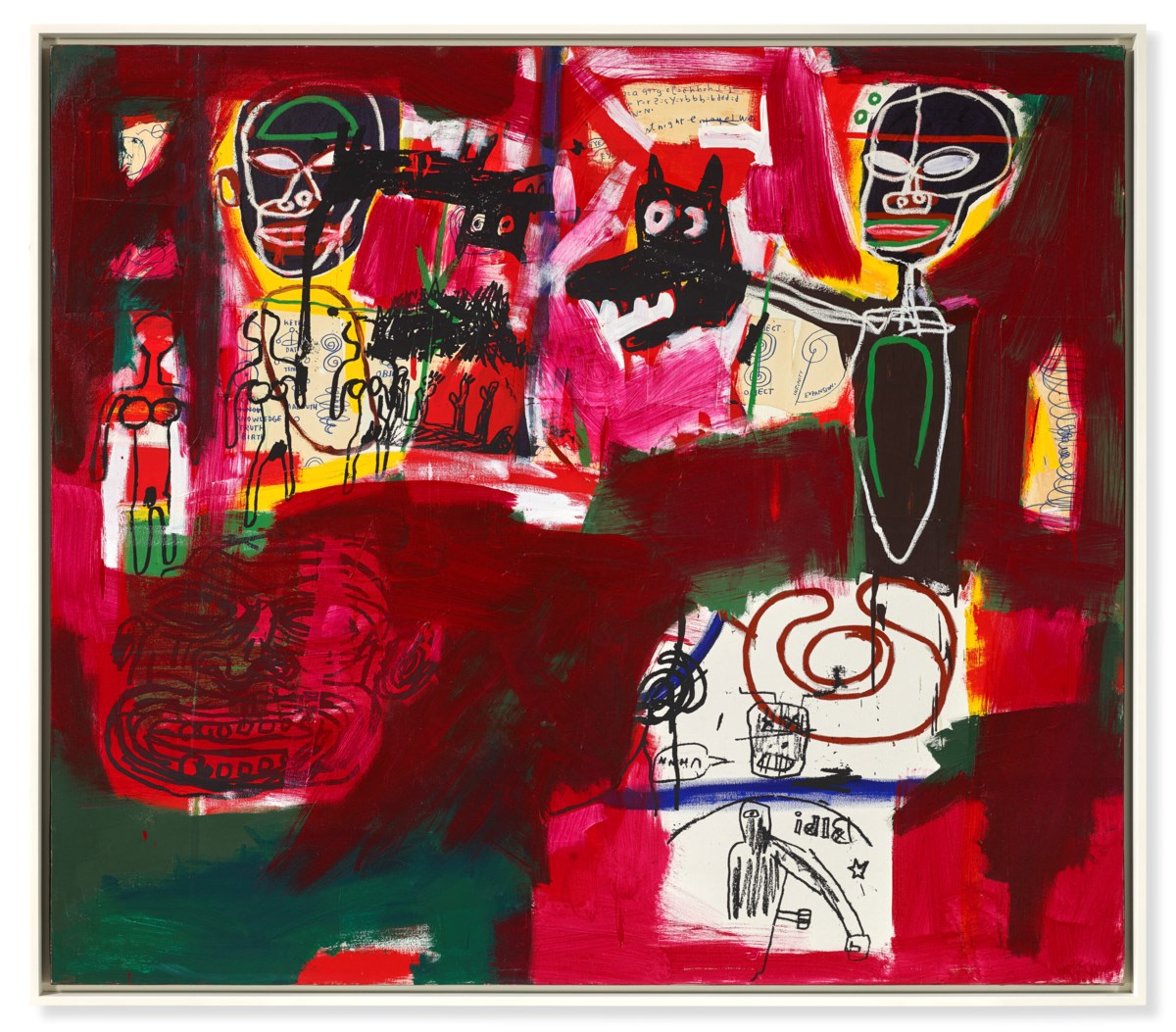


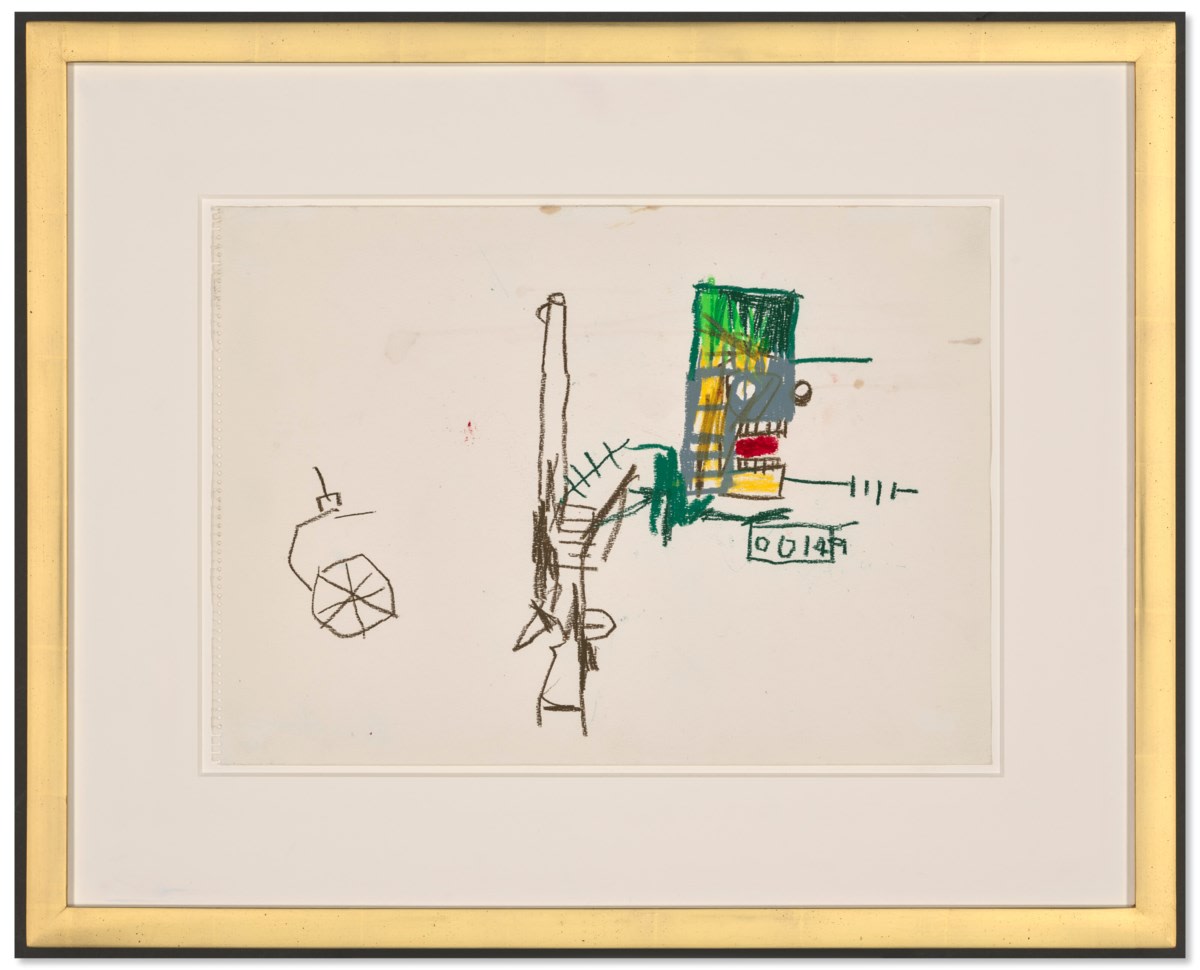


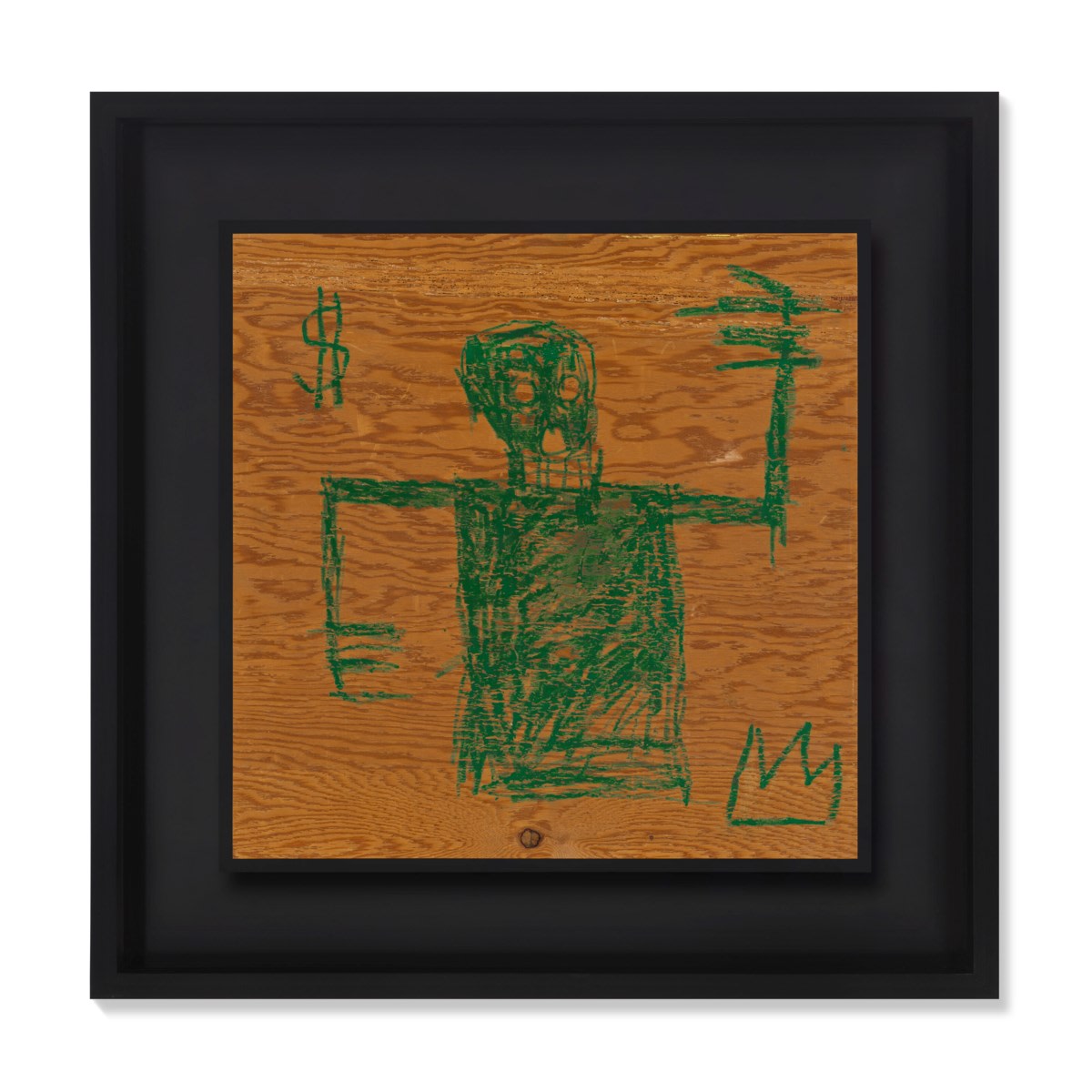


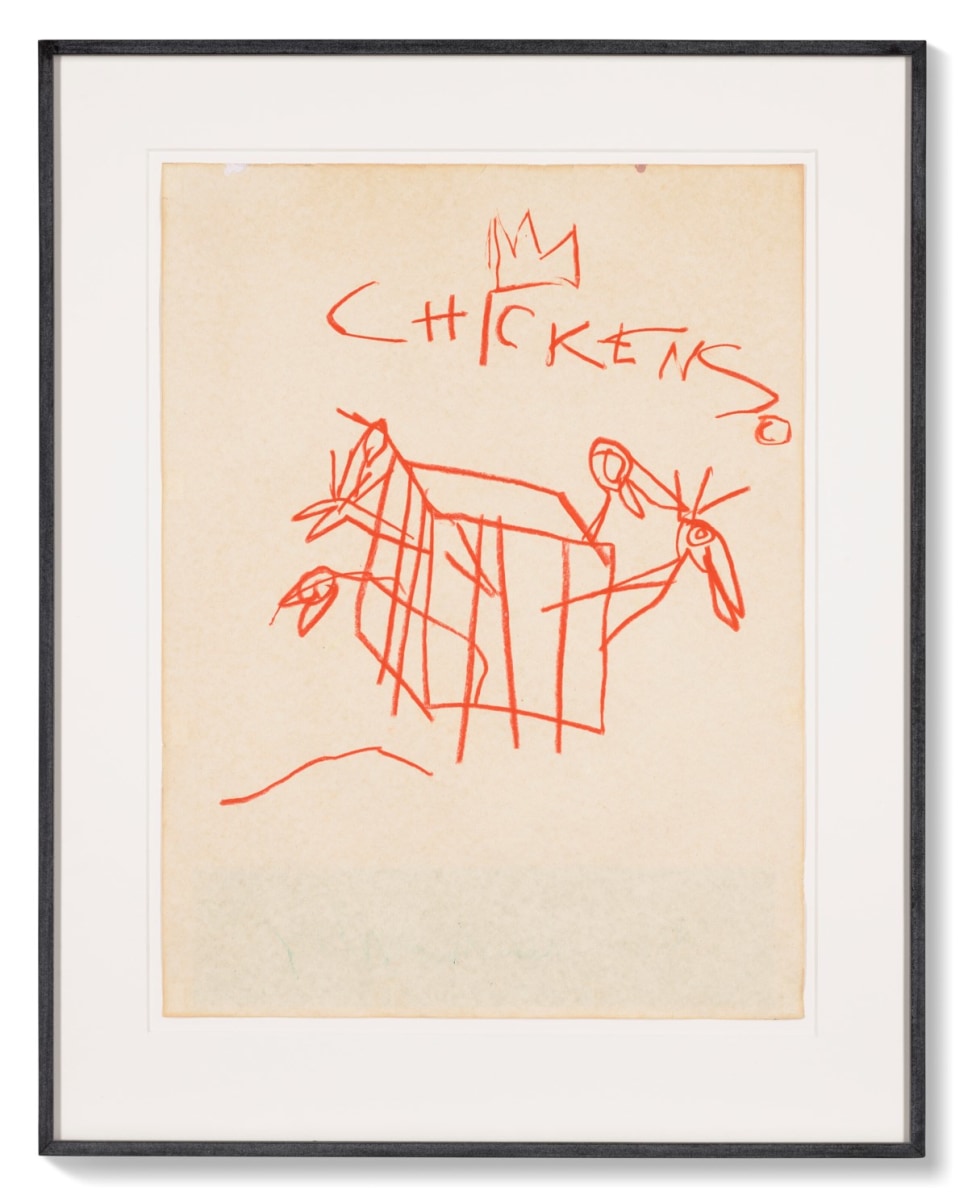











Egon investment scores
Market position
Research updated
Auction record context
Untitled (1982), the 'skull' painting - $110.5m, Sotheby's New York, 18 May 2017, bought by Yusaku Maezawa; at the time the most expensive work by an American artist at auction. The record still stands: Artnet reported in March 2026 that nothing has yet beaten it, and Masterworks notes the record has stood unbeaten for eight years.
Pricing
Primary market
No primary market - the artist died in 1988 and the estate does not release new work. Only estate-authorised print editions and licensing (Artestar) constitute anything resembling primary supply. Blue-chip secondary dealers (Gagosian, Van de Weghe, Acquavella, Nahmad, Lévy Gorvy Dayan) transact privately at undisclosed prices; 'price on request' is the norm for private-treaty Basquiats.
Temporal context
- 1990
- Asbestos sold for $37,500
- 2013
- Museum Security $14.6m (Christie's London)
- 2022
- Turnover fell roughly 50% with the wider postwar/contemporary correction
- 2016 2017
- Repricing phase - Untitled (Devil) $57.3m (2016), skull $110.5m (2017)
- 2021 peak
- Annual auction turnover reached roughly $439.6m (Guy Hepner, citing auction data) - the artist's high-water mark
- 2023 2024
- Continued softening; double-digit declines reported across major-house contemporary sales; print turnover fell from a 2022 peak of £3.1m/17 lots
2025 H1 2026
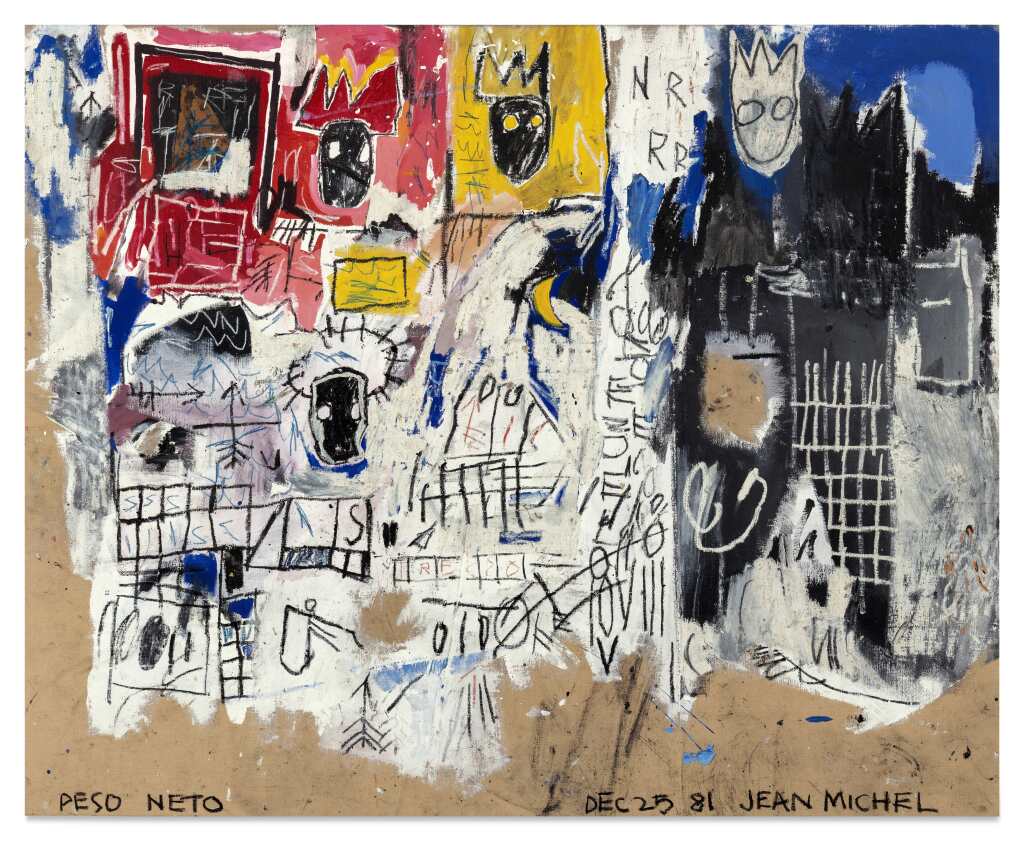
Recovery at the top. Crowns (Peso Neto) $48.3m (Nov 2025) and Museum Security $52.7m (May 2026); print market £1m from 18 lots in 2025 and £435,500 across 11 lots through Q2 2026
- 1984 comparator
- The 1982 skull sold at Christie's in 1984 for $19,000 - the same canvas made $110.5m in 2017
By work type current 2025 26
Works on paper
$300,000-$7m depending on date, scale and exhibition history (Asbestos $6.54m; Sans titre (Per Capita) $448,818; Law Offices - Notary Public $870,400)
- Prints and editions
- Estate editions typically £15,000-£40,000; lifetime signed 1983 screenprints are the outlier tier, with Untitled (black) above £3m
- Major 1981 83 canvases
- $25m-$110m; $45-55m is the current clearing band for a fresh, exhibited example (Crowns $48.3m; Museum Security $52.7m)
- Recorded 2025 26 spread in egon data
- $21,930 - $52,717,500; average hammer across recorded lots ~$12.3m, heavily skewed by the two 2026 evening-sale trophies
- Secondary canvases and 1984 88 paintings
- $2m-$15m, with visible estimate pressure; a March 2026 Christie's 'Untitled' sold below estimate at $2.89m
Liquidity
Volume
One of the most liquid postwar names in the world. Egon's partial database alone logs 44 lots at the four major houses since 2025; including regional houses, prints and multiples, total annual lot counts run into the hundreds. MyArtBroker records 18 print lots in 2025 and 11 through Q2 2026 for the print market alone; 2023 quarterly data showed 44 works in Q4 alone.
Market depth
Deep and global - New York, London, Hong Kong and Paris all clear Basquiat material. Guarantees and irrevocable bids are routinely deployed on top lots (Crowns was guaranteed), supporting headline prices but compressing consignor upside.
Supply constraint
Masterworks notes supply is permanently fixed at roughly 1,000 paintings and 2,000 drawings; approximately 85-90% are in private hands (Guy Hepner), which sustains turnover.
Comparables
Within the artist: 1981-83 canvases with exhibition history (documenta 7, Nosei, LA period) are the premium comparables - Crowns (Peso Neto), Museum Security, In This Case. Late works and unexhibited drawings trade at a steep discount and carry the buy-in risk.
Collector base
Composition
Ultra-high-net-worth finance, tech and entertainment capital plus Asian collectors; strong celebrity and fashion-adjacent demand unusual for a postwar artist, adding a non-art-market demand layer and a corresponding fashion-cycle risk.
Named collectors
- Kenneth C. Griffin (Citadel) - Boy and Dog in a Johnnypump, Untitled (1982) skull, and ten works lent to PAMM 2026-27
- Yusaku Maezawa - Untitled (1982) skull (2017-2024), Untitled (Devil)
- Peter Brant and Stephanie Seymour - In Italian (1983), ex-Warhol
- Jay-Z and Beyoncé
- Leonardo DiCaprio, Lenny Kravitz, Kim Kardashian, Tommy Hilfiger, Adam Clayton (U2)
- Tiffany & Co. - Equals Pi (1982), displayed at the Fifth Avenue flagship
- John Sayegh-Belchatowski (consignor of Museum Security)
- Vicki and Kent Logan (fractional/promised gifts to Denver Art Museum)
- Sheldon H. Solow (fractional and promised gift to MoMA)
Auction history
Record
Untitled (1982), the 'skull' painting - $110.5m, Sotheby's New York, 18 May 2017, bought by Yusaku Maezawa; at the time the most expensive work by an American artist at auction. The record still stands: Artnet reported in March 2026 that nothing has yet beaten it, and Masterworks notes the record has stood unbeaten for eight years.
Private sales
- Boy and Dog in a Johnnypump (1982) - over $100m privately to Kenneth C. Griffin in 2020 (previously Peter Brant), promptly lent to the Art Institute of Chicago
- Untitled (1982, skull) - Maezawa to Griffin in 2024, reportedly around $200m per Artnet/Kenny Schachter; unverified by either party and to be treated as trade reporting, not a confirmed transaction price
Bought in and risk
Egon's partial database records 44 lots since 2025 with 36 sold and 8 unresolved/passed; the platform cautions that unsettled lots skew toward passes, so no sell-through rate should be quoted from it. Buy-in risk sits in the mid-market: drawings, works on paper and late (1986-88) canvases pass or sell under estimate far more often than 1981-83 canvases. Two of the five most recent recorded lots sold below estimate - evidence of exactly this two-speed pattern.
Other landmark results
- Untitled (Devil) (1982) - $57.3m, Christie's New York, 2016 (Maezawa)
- In This Case (1983) - $93.1m, Christie's New York, May 2021
- Warrior (1982) - HK$323.6m / ~$41.9m, Christie's Hong Kong, March 2021
- Crowns (Peso Neto) (1981) - $48.34m, Sotheby's New York, 18 November 2025; first time at auction, 38% above the $35m low estimate, backed by a house guarantee; the $35-45m estimate was reported as the highest ever placed on a 1981 Basquiat
- Museum Security (Broadway Meltdown) (1983) - $52.7m with fees, Sotheby's New York, 14 May 2026, the fifth-most-expensive Basquiat at auction; consignor reported by ARTnews as John Sayegh-Belchatowski, who had bought it for $14.6m at Christie's London in 2013
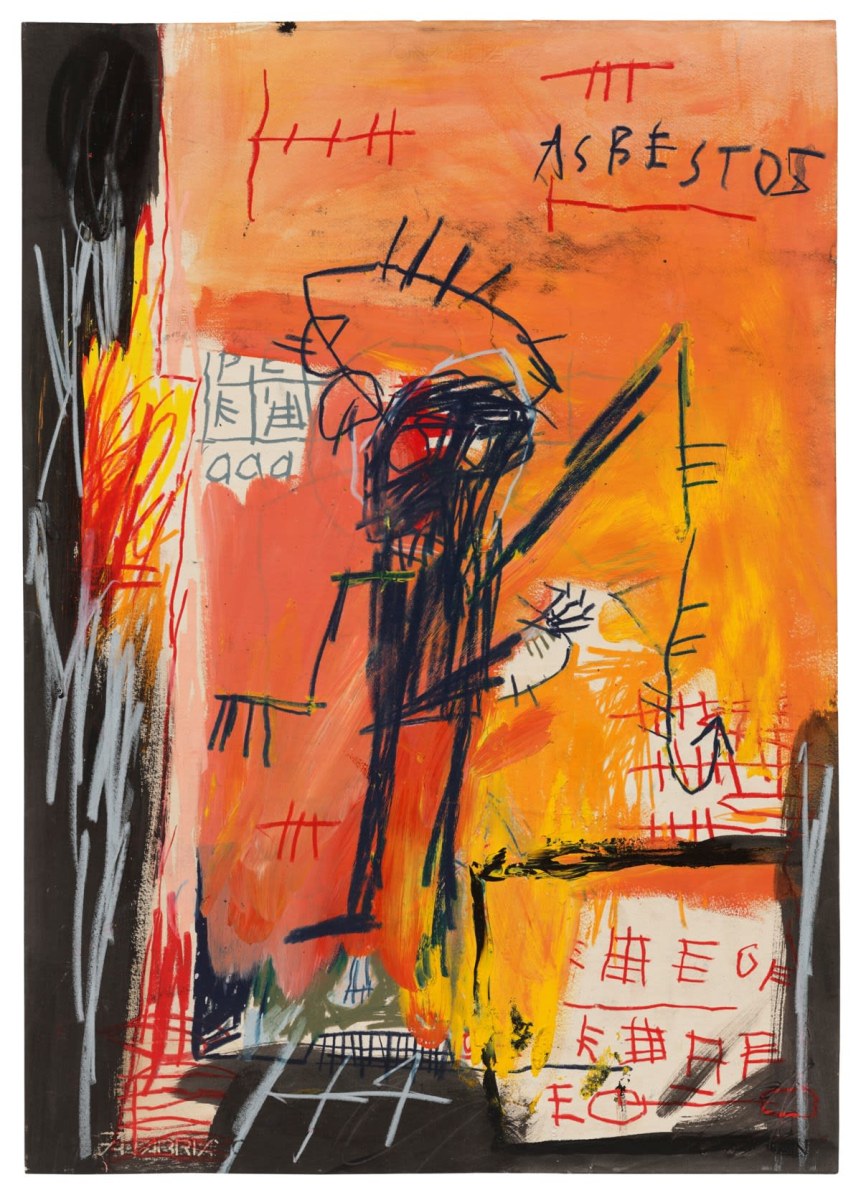
- Asbestos (c.1982, oil and oilstick on paper) - $6.54m, Christie's New York, 20 May 2026, above a $5m high estimate; the same work sold for $37,500 at Sotheby's in 1990 (approximately 15% annualised return per HENI)
- Untitled (black), screenprint - over £3m, Christie's 2022: the all-time Basquiat print record
- Back of the Neck - £922,408, William Doyle, 2023
Market position
Peer set
Warhol, Rothko, de Kooning, Twombly, Richter - the sub-$150m postwar trophy tier. Basquiat is the benchmark for the 1980s market and the most valuable American artist at auction.
Structural read
Masterworks characterises the market as matured into a top-heavy, two-speed structure in which the best early canvases hold and lesser material faces genuine price pressure. Egon's own recent-lot data supports that reading precisely.
Relative dynamics
In May 2026 Basquiat's Museum Security led Sotheby's Now & Contemporary evening sale at $52.7m while Christie's marquee sale was topped by Richter and Judd - he retains headline-lot status but no longer monopolises it. Broader context: Christie's May 2026 two-session sale totalled $1.1bn with the S.I. Newhouse collection alone at $630.8m; 2025 global totals at the three major houses reached $4.55bn, up 11.1% year on year - the first growth year since 2022.
Investment outlook
Structurally secure, cyclically mature. The 2017 record has stood eight years, which bears are correct to flag; but the reading of a flat record with a rising floor for quality is consistent with 2025-26 evidence (Crowns 38% over low estimate; Asbestos more than double low estimate). Expect continued bifurcation: fresh-to-market 1981-83 canvases are supply-constrained and should hold or advance; secondary-quality material, late works and unexhibited paper are exposed. Authentication risk is a live structural issue - the Basquiat Authentication Committee was dissolved in 2012 and there is no completed catalogue raisonné, so provenance chains back to Nosei, Boone, Bischofberger or Gagosian carry a documented premium.
Institutional presence
Research updated
Exhibitions
Posthumous major
- Jean-Michel Basquiat retrospective, Whitney Museum of American Art, 1992, curated by Richard Marshall - the first museum retrospective
- Basquiat, Brooklyn Museum, 2005 (travelling; Franklin Sirmans among the curators)
- Fondation Beyeler, Basel, 2010 (Museum Security was exhibited there)
- Basquiat: Boom for Real, Barbican Art Gallery, London, 2017-18, travelled to Schirn Kunsthalle Frankfurt
- Egon Schiele / Jean-Michel Basquiat, Fondation Louis Vuitton, Paris, 2018-19
- Guggenheim Bilbao; Musée d'Art Moderne de Paris; Montreal Museum of Fine Arts (2018-19)
- King Pleasure, family-organised, New York/Los Angeles, 2022-23
- Basquiat x Warhol: Painting Four Hands, Fondation Louis Vuitton, Paris, 2023
- Basquiat: Signs - Connecting Past and Future, Dongdaemun Design Plaza Museum, Seoul, 23 Sept 2025 - 31 Jan 2026, ~70 paintings and drawings, marking the 60th anniversary of JoongAng Ilbo
Lifetime landmarks
- Times Square Show, New York, 1980 (group)
- New York/New Wave, P.S.1, 1981 (group)
- Galleria d'Arte Emilio Mazzoli, Modena, 1981 (first solo)
- Annina Nosei Gallery, New York, March 1982 (first US solo; Crowns (Peso Neto) was unveiled here)
- documenta 7, Kassel, 1982 - youngest artist ever included; Crowns (Peso Neto) shown
- Whitney Biennial, 1983 - among the youngest artists ever included
- An International Survey of Recent Painting and Sculpture, MoMA reopening, 1984
- Warhol/Basquiat Paintings, Tony Shafrazi Gallery, 1985
- Kestner-Gesellschaft, Hannover, 1986 (first European museum survey)
Current and upcoming
Headstrong - Basquiat on Paper
- Note
- Presented as the first comprehensive exhibition devoted to his depictions of the human head
- Dates
- opened January 2026
- Venue
- Louisiana Museum of Modern Art, Humlebæk, Denmark
Basquiat: Figures, Signs, Symbols
Note
Ten works (nine paintings and one sculpture) from the Kenneth C. Griffin Collection with support from Griffin Catalyst, including the $110.5m Untitled (1982); largest presentation of the artist in Florida to date; opens as Miami hosts the FIFA World Cup. Director Franklin Sirmans framed it as a chance to revisit Basquiat not as a market phenomenon or pop icon.
- Dates
- 25 June 2026 - 6 June 2027
- Venue
- Pérez Art Museum Miami
- Biennial participation
- documenta 7 (1982); Whitney Biennial (1983); Venice Biennale Aperto (1988)
Publications
Scholarship
- Jordana Moore Saggese, Reading Basquiat: Exploring Ambivalence in American Art (University of California Press)
- Jordana Moore Saggese (ed.), The Jean-Michel Basquiat Reader: Writings, Interviews and Critical Responses, University of California Press, March 2021, in the Documents of Contemporary Art series edited by Jack Flam
- Richard Marshall (ed.), Jean-Michel Basquiat, Whitney Museum of American Art, 1992
- Dieter Buchhart's exhibition catalogues (Barbican, Fondation Louis Vuitton, Brant Foundation)
- Phoebe Hoban, Basquiat: A Quick Killing in Art
Catalogue raisonne
NO completed catalogue raisonné. The Enrico Navarra / Richard D. Marshall multi-volume catalogues (1996 and expanded editions) function as the de facto reference - the 1982 skull painting graced the cover of the 1996 catalogue raisonné volume. The Estate's Authentication Committee was dissolved in 2012; the market now relies on the ongoing scholarly catalogue project run with the estate, specialist opinion at the major houses, and lifetime provenance documentation.
Scholarship caveat
Saggese notes that sustained study has been inhibited by the absence of a dedicated archive and by restricted access to specific works, with most existing scholarship taking the form of limited-circulation exhibition catalogues and the artist's papers divided between private collections and the estate - a real constraint on independent, non-commercially-sponsored scholarship.
- Trade publications
- Assouline released a $1,400 collector's monograph in November 2025 - a luxury-publishing event, not scholarship.
Museum collections
Untitled (1981)
- Tier
- First-rank
Reading
Donor-initiated and only fractionally accessioned - not a curatorial purchase. Published in MoMA Highlights since 1980 (2007), indicating curatorial endorsement of the work's canonical status.
- Institution
- Museum of Modern Art, New York
- Credit line verbatim
- Fractional and promised gift of Sheldon H. Solow
Hollywood Africans (1983)
- Tier
- First-rank (American art)
- Reading
- Offered and accepted, 1984 - a lifetime acquisition, exceptionally early.
- Accession
- 84.23
- Institution
- Whitney Museum of American Art, New York
- Credit line verbatim
- Gift of Douglas S. Cramer
Untitled (1982), oil stick and ballpoint pen on paper
- Tier
- First-rank (American art)
- Reading
- CURATORIAL INITIATION - committee-directed purchase.
- Accession
- 91.16
- Institution
- Whitney Museum of American Art, New York
- Credit line verbatim
- Purchase, with funds from Mrs. William A. Marsteller, The Norman and Rosita Winston Foundation, Inc. and the Drawing Committee
Untitled (1980), enamel, spray paint and oil stick on enameled metal
- Tier
- First-rank (American art)
- Reading
- Offered and accepted.
- Accession
- 97.95
- Institution
- Whitney Museum of American Art, New York
- Credit line verbatim
- gift of an anonymous donor
Untitled (1986), graphite, colored pencils and watercolor on paper, 29 3/4 x 42 in., Modern and Contemporary Art department (object 486080)
- Note
- Egon's museum-API sweep name-matched a floor of works across the Met and Smithsonian; Wikidata separately records 4 at the Met.
- Tier
- First-rank / encyclopedic
- Institution
- Metropolitan Museum of Art, New York
- Credit line verbatim
- credit line not published on the object page consulted
View 11 more records
Untitled (1981), oil stick on paper, acc. 2001.691
- Tier
- Strong regional / second tier
- Reading
- Fractional/promised - not yet a completed acquisition.
- Institution
- Denver Art Museum
- Credit line verbatim
- Collection of Vicki and Kent Logan, fractional and promised gift to the Denver Art Museum
Smithsonian Institution, Washington DC
- Note
- Holdings confirmed via Egon's public-API sweep; specific objects and credit lines not resolved.
- Tier
- First-rank national
- Credit line verbatim
- credit line not published in the data available
Museum Boijmans Van Beuningen, Rotterdam
- Note
- 4 works recorded in Wikidata (community aggregate, a floor not a verified count)
- Tier
- Major European
- Credit line verbatim
- credit line not published in the data available
Princeton University Art Museum
- Note
- 3 works recorded in Wikidata
- Tier
- Major university museum
- Credit line verbatim
- credit line not published in the data available
The Broad, Los Angeles
- Note
- 2 works recorded in Wikidata; Eli and Edythe Broad were early and significant Basquiat buyers
- Tier
- Private foundation museum - NOT first-rank for acquisition purposes (does not accession into a public collection)
- Credit line verbatim
- credit line not published in the data available
Bayerische Staatsgemäldesammlungen (Bavarian State Painting Collections), Munich
- Note
- 2 works recorded in Wikidata
- Tier
- First-rank European state collection
- Credit line verbatim
- credit line not published in the data available
Fondation Gandur pour l'Art, Geneva
- Note
- 1 work recorded
- Tier
- Private foundation
- Credit line verbatim
- credit line not published in the data available
The Museum of Art, Kōchi, Japan
- Note
- 1 work recorded
- Tier
- Regional Japanese public museum
- Credit line verbatim
- credit line not published in the data available
Musée d'Art Contemporain de Marseille (MAC)
- Note
- 1 work recorded
- Tier
- Municipal contemporary museum
- Credit line verbatim
- credit line not published in the data available
Art Institute of Chicago
- Note
- Displayed Boy and Dog in a Johnnypump on long-term loan from Kenneth C. Griffin. Recorded so it is not mistaken for a holding.
- Tier
- First-rank / encyclopedic
- Credit line verbatim
- not applicable - LOAN, not an acquisition
Brant Foundation, Greenwich/New York
- Note
- Extensive Basquiat holdings shown in 2019
- Tier
- Private foundation - not a public accessioning museum
- Credit line verbatim
- not applicable
Credit line summary
Of the five credit lines actually published and verified, ONE is an unambiguous curatorial purchase (Whitney 1991, Drawing Committee funds), TWO are individual/anonymous gifts, and TWO are fractional-and-promised gifts (MoMA, Denver). This is the normal acquisition pattern for an artist whose market outran museum budgets almost immediately - museums bought the drawings and were given the paintings. Where no credit line was published it is recorded as such and never inferred.
Awards and recognition
No conventional prize or fellowship record - the career was too compressed and too commercial for that circuit. Recognition instead takes the form of art-historical canonisation: the 1992 Whitney retrospective, inclusion in standard survey accounts of 1980s American art, and a US Postal Service commemorative stamp series (2024). Absence of prizes should not be read as weak validation for this artist.
Career & Biography
Research updated
Identity
- Birth
- 22 December 1960, Brooklyn, New York (Getty ULAN: 1960, New York)
- Death
- 12 August 1988, Great Jones Street, New York - heroin overdose, aged 27 (Getty ULAN: 1988)
- Gender
- male
Aliases
- SAMO© (with Al Diaz, 1977-79)
- Samo
- Ulan ID
- 500093239
- Heritage
- Haitian father (Gérard Basquiat), Puerto Rican mother (Matilde Andrades); trilingual English/Spanish/French
- Full name
- Jean-Michel Basquiat
Nationality
American. NOTE: the Getty ULAN structured 'nationality' field supplied to us reads 'Austrian', which contradicts Getty's own biography text ('American painter and sculptor, 1960-1988') and every other source consulted. Treated as a ULAN field error; the authoritative Getty biography (American) is used.
- Current location
- Deceased 1988; estate administered from New York (Estate of Jean-Michel Basquiat; rights licensed by Artestar, New York, and ADAGP/ARS)
Career timeline
- 1977-79
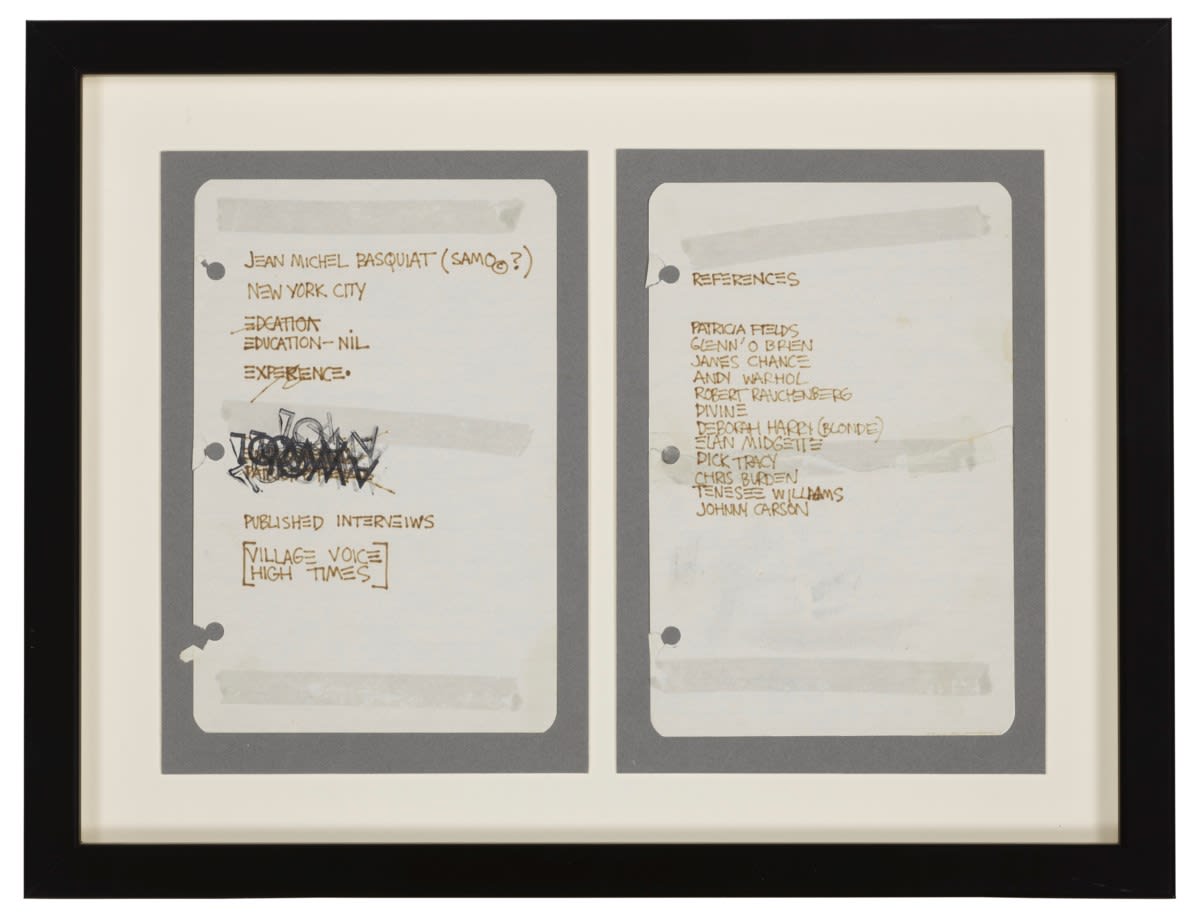
- SAMO© graffiti-text campaign in SoHo/Lower East Side with Al Diaz; Village Voice coverage 1978
- 1979-80
- Co-founds the noise/experimental band Gray; appears on Glenn O'Brien's TV Party; sells painted sweatshirts and postcards
1980-81
Included in the Times Square Show (1980) and 'New York/New Wave' at P.S.1 (1981); René Ricard's Artforum essay 'The Radiant Child' (Dec 1981) launches critical reputation
- 1981
- First one-man show, Galleria d'Arte Emilio Mazzoli, Modena, Italy
1982
First US solo show, Annina Nosei Gallery, New York (March); Nosei installs him in a SoHo loft-studio; leaves Nosei that summer for Bruno Bischofberger as worldwide dealer; at 21 becomes the youngest artist to exhibit at documenta 7, Kassel
View 7 more records
1983
Youngest artist in the Whitney Biennial; extended period working in Los Angeles (Larry Gagosian) producing the celebrated 1983 canvases including 'Museum Security (Broadway Meltdown)' and 'Hollywood Africans'; Bischofberger initiates the Warhol/Clemente collaborations
- 1984
- Moves from Annina Nosei to Mary Boone Gallery; included in MoMA's reopening 'International Survey of Recent Painting and Sculpture'
1985
Basquiat-Warhol collaboration exhibition, Tony Shafrazi Gallery, New York (poorly reviewed; strains the friendship); New York Times Magazine cover feature
- 1987
- Death of Andy Warhol; escalating heroin dependency and withdrawal from the scene
- 1988
- Solo shows in Paris and New York; dies 12 August at 27
- 1992
- First museum retrospective, Whitney Museum of American Art, curated by Richard Marshall - begins posthumous canonisation
- 2005-present
- Brooklyn Museum retrospective (Franklin Sirmans among the curatorial team); sustained international touring; market repricing from 2016 onward
Studio practice
Worked on the floor and against walls with television, music and books running simultaneously; oil stick, acrylic, spray enamel and collaged xerox applied to raw or minimally primed canvas, found doors, windows and tied-stick supports. Assistants (notably Stephen Torton, who built stretchers and supports) contributed to fabrication - Torton is credited in Artnet reporting as a likely figure depicted in 'In Italian' (1983).
Education and training
- Formal
- No art-school training. Attended Saint Ann's School, Brooklyn, and later City-As-School, Manhattan; left secondary school without graduating.
Formative
Childhood museum-going in New York (junior membership at the Brooklyn Museum) and study of Gray's Anatomy after a childhood car accident; PAMM notes his work was shaped in part by a childhood spent visiting museums in New York City and draws on Renaissance anatomical studies.
- Self taught
- Widely characterised as self-taught: Artsy describes him as a self-taught painter who embraced graffiti before committing to a studio practice.
Social political engagement
Work is a sustained commentary on race, Black heroism and erasure, colonialism, policing and commodification. The Whitney's reading of 'Hollywood Africans' notes phrases such as 'Sugar Cane', 'Tobacco' and 'Gangsterism' alluding to the limited roles available to Black actors in old Hollywood; Basquiat explained his crossing-out device by saying he crossed out words so viewers would see them more.
Personal events shaping work
Childhood car accident and the gift of Gray's Anatomy; parents' separation and mother's institutionalisation; homelessness/couch-surfing 1978-80; relationship with Suzanne Mallouk; Warhol's death in 1987; heroin addiction.
Influences and contemporaries
Influences
- Cy Twombly (calligraphic scrawl)
- Robert Rauschenberg and Jean Dubuffet
- Picasso and Franz Kline
- Gray's Anatomy; Leonardo's anatomical studies
- Bebop and jazz (Charlie Parker, Dizzy Gillespie, Thelonious Monk)
- Hip-hop, boxing, Caribbean and African diasporic history
- Burroughs-style cut-up and appropriated street signage
Getty related artists note
Getty ULAN relational records (influenced-by / colleague-of / worked-with / assisted-by IDs) are consistent with the Warhol, Haring and studio-assistant relationships documented above; individual ULAN IDs not resolved within search budget.
Contemporaries and collaborators
- Andy Warhol (collaborations 1983-85)
- Keith Haring
- Francesco Clemente
- Rammellzee and Toxic (depicted in 'Hollywood Africans')
- Al Diaz (SAMO)
- Glenn O'Brien
- Madonna, Debbie Harry, Fab 5 Freddy - downtown New York network
Artistic Profile
Research updated
Style
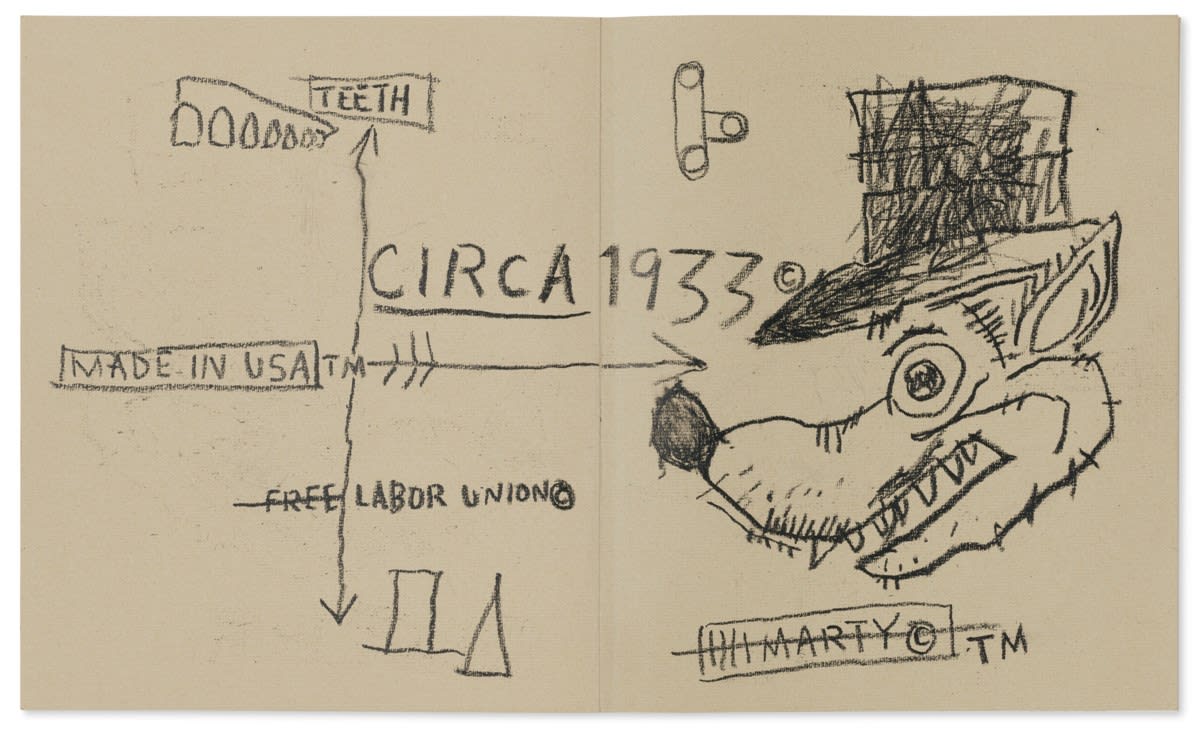
A high-velocity graphic figuration built from scrawled oil stick and brushed acrylic on raw or roughly primed canvas, in which drawing, painting and writing are undifferentiated. Frontal, symmetrical, flattened figures - crowned heads, skulls, skeletal athletes and griots - sit against saturated high-key grounds and are surrounded by an all-over field of words, lists, arrows, tallies, anatomical labels, copyright symbols and crossings-out. Cy Twombly's calligraphic line merged with graffiti vernacular and the visual grammar of street signage, comics and reference books. The picture plane is treated as a page and a wall simultaneously.
Evolution
- 1980-81
- Transition from street to studio; raw canvas, emergent lexicon of crowns, halos and tallies (Crowns (Peso Neto), December 1981)
1982-83
The peak. Large-scale canvases, skulls and crowned heads, saturated grounds, the Los Angeles group (Hollywood Africans, Museum Security). Highest-valued period in the market by an order of magnitude.
- 1984-85
- Warhol collaborations; silkscreen and xerox enter the surface; more architectural, sign-like compositions
- 1986-88
- Denser text fields, ochre and olive palettes, African and Griot subject matter, some late thinning of the surface. The market's weakest period.
- 1977-80 SAMO
- Text-only aphoristic graffiti on SoHo walls; postcards, painted clothing; the band Gray
Influences
- Cy Twombly
- Jean Dubuffet and art brut
- Robert Rauschenberg (combines, transfer)
- Picasso; Franz Kline
- Gray's Anatomy and Leonardo's anatomical drawings
- Bebop and jazz; hip-hop; boxing
- Haitian and Puerto Rican diasporic visual culture; Aztec and African sources
Visual language
- Three-pointed crown; halo
- Skull and exploded/x-rayed head
- Skeletal athlete, boxer, griot
- Copyright symbol, trademark and tally marks
- Crossed-out words as a device of visible erasure
- Grids, diagrams, arrows and list-making
- Raw exposed canvas as an active ground
Themes and subjects
- Black heroism and canonisation - athletes, boxers, jazz musicians, griots, saints; the crown as an instrument of elevation
- Race, colonial history and erasure - sugar cane, tobacco, slavery, 'What is Bwana?'; the crossed-out word making the erased visible
- Money, commodification and value - 'peso', 'PRICELESS ART', 'FIVE CENTS'; a running commentary on his own commodification
- Anatomy, mortality and the body - skulls, exposed skeletons, viscera and organ labels drawn from Gray's Anatomy
- Policing, surveillance and authority - 'FBI', 'SHERIFF', museum guards
- Empire and the Western canon - repeated 'ROME', antiquity, art-historical citation
- Autobiography - self-portraiture as crowned figure, birth-date digits, depictions of Rammellzee, Toxic and studio assistants
Movements and periods
- Neo-Expressionism (primary)
- Graffiti art / post-graffiti and the East Village scene
- Downtown New York post-punk / No Wave
- Late Modern to Contemporary, 1977-1988
- Retrospectively read within Black diasporic and Afro-Atlantic art history
Techniques and mediums
- Acrylic and oil stick on canvas (the signature combination)
- Oil stick, wax crayon, graphite, coloured pencil, watercolour and ballpoint on paper
- Spray enamel on canvas, doors, windows, metal and found supports
- Xerox photocopy collage; silkscreen (with Warhol, 1984-85)
- Assemblage on tied-stick and slat supports built by studio assistants
- Sculpture (rare - one is included in the 2026 PAMM show)
- Editions: lifetime signed screenprints (1983) and posthumous estate screenprint editions; offset lithographic exhibition posters
Fingerprint verification
Confirmed
- Neo-Expressionism and Late Modern/Contemporary period labels (1970-1990 bracket) - correct and matched by all sources
- Gestural and naïve registers - corroborated by the oil-stick-on-raw-canvas descriptions
- Moods confrontational, exuberant, anxious - consistent with the Whitney's and Sotheby's readings
- Themes identity, race, the body, fragmented narrative, urbanism - directly corroborated; Sotheby's reading of Crowns (Peso Neto) identifies 'peso' as a condemnation of capitalism and racial inequity
- Saturated, warm, high-key palettes with primary colours - correct
- Formal terms flatness, all-over composition, figure-ground, picture plane - correct; the all-over reading is especially apt for the 1983 text-dense canvases
Extensions and corrections
- The fingerprint's medium tags ('drawing', 'oil') UNDERSTATE the material record. The defining medium is ACRYLIC AND OIL STICK ON CANVAS (Hollywood Africans and Museum Security are both acrylic and oil stick). Also required: enamel and spray paint on enameled metal (Whitney, 1980); graphite, coloured pencil and watercolour on paper (Met, 1986); xerox collage; found-object supports. Recommend adding: acrylic, oil stick, spray enamel, xerox collage, mixed media on paper.
- The 'varied / coherence 0.51' dispersion is CORRECT and should not be treated as a weakness - the corpus genuinely spans autograph canvases, works on paper, offset exhibition posters and estate screenprints. The Phillips exemplar identified as a 1985 offset lithographic boxing-format poster is a MULTIPLE, not an autograph work; pooling it with the canvases is a material driver of the low coherence. Recommend segregating the print/poster sub-corpus before computing coherence.
- DISAGREEMENT / MISSING: TEXT AND LEXICON is absent from the fingerprint and is central to the artist - words, lists, crossings-out, copyright symbols, tallies, anatomical labels. Museum Security alone carries 'PRICELESS ART', 'YEN', 'FIVE CENTS', 'BLACK', 'GRIOT', 'TAR', 'ASBESTOS', 'FBI', 'SHERIFF', 'ROME', 'Hooverville' and 'Papa Doc'. Also missing: the THREE-POINTED CROWN and HALO, the SKULL/HEAD, and the GRID/DIAGRAM.
- MISSING period sub-brackets: the market and the literature distinguish 1980-81 (raw canvas, emergent lexicon), 1982-83 (peak - skulls, crowns, LA canvases), 1984-85 (Warhol collaborations, silkscreen and xerox) and 1986-88 (denser text, ochre/olive palettes, African and Griot subject matter).
Signature series and works
- Untitled (1982) - the skull; auction record $110.5m
- Boy and Dog in a Johnnypump (1982)
- Hollywood Africans (1983) - Whitney Museum
- Museum Security (Broadway Meltdown) (1983)
- Crowns (Peso Neto) (1981)
- In This Case (1983)
- Irony of a Negro Policeman (1981)
- Untitled (Skull) / Untitled (Devil) (1982)
- Riding with Death (1988)
- The Warhol collaboration canvases (1984-85)
Note on egon signature works list
Egon's centroid list ('Untitled', 'Untitled', 'Untitled V from The Figure Portfolio', 'Thin in the Old', 'Untitled (Indian Head)') is skewed toward paper and estate editions because those dominate lot counts. It is a valid read of the TRADED corpus but NOT of the art-historically or financially significant corpus - the works listed above are.
Critical Reception
Research updated
Academic discourse
Positioned in the literature at the intersection of Neo-Expressionism, Black diasporic studies and the semiotics of appropriation. Standard framings: the artist as archivist/copyist of text; the crown and halo as devices of Black canonisation; the crossed-out word as a theory of erasure; the tension between street-origin myth and a highly literate studio practice. Access constraints (no dedicated archive, dispersed papers) remain the principal brake on deeper scholarship.
Critical reception
Lifetime
Rapid elevation followed by backlash. René Ricard's 'The Radiant Child' (Artforum, December 1981) is the founding critical text and effectively made his reputation. By 1985 the Warhol collaboration show at Tony Shafrazi was poorly received and coverage turned to the persona rather than the painting; Judd Tully's account records that Basquiat died in 1988 after a brutal diet of drugs and hurtful reviews.
Current position
The 2005 Brooklyn retrospective, Dieter Buchhart's European exhibitions and Jordana Moore Saggese's UC Press scholarship have substantially professionalised the discourse; the argument has shifted from whether Basquiat is a major artist to how to read his textual and diasporic sources. Franklin Sirmans' framing of the 2026 PAMM show - revisiting Basquiat not as a market phenomenon or pop icon - is itself a statement about where the criticism now wants to go.
Posthumous debate
The critical literature has been contested rather than settled. Artforum's 'Royal Slumming: Jean-Michel Basquiat Here Below' argues that the critical literature has been rather uncritical, drifting into anecdote and elegy, with little art-historical comparison offered. Greg Tate's 1989 Village Voice essay 'Nobody Loves a Genius Child' framed the problem as a structural deficit of academically supported scholarship around Black visual culture. Richard Marshall, curating the 1992 Whitney retrospective, said openly that a misconception about the whole body of his work had overshadowed the art itself and should be rectified.
Persistent critique
Two critiques recur and remain live: (1) that the 'primitivism' reading flattened his intellectual sources; (2) that market spectacle has outpaced art-historical analysis. Both are arguments about reception, not about standing.
Publications and media
Editorial recognition
- René Ricard, 'The Radiant Child', Artforum, December 1981 - the canonical discovery text
- New York Times Magazine cover feature, 10 February 1985 ('New Art, New Money')
- Sustained coverage in Artnet News, ARTnews, The Art Newspaper and Artsy through 2025-26 around the Crowns, Museum Security and PAMM events
Film and popular culture
- Downtown 81 (filmed 1980-81)
- Julian Schnabel, Basquiat (1996)
- Tamra Davis, Jean-Michel Basquiat: The Radiant Child (2010)
- Extensive fashion and product licensing (Uniqlo, Coach, Tiffany & Co.) via Artestar
News record verification and reclassification
- Egon labelled the Artsy piece on the $110m painting going on view in Miami as 'Price Trend'. THE QUOTE DISAGREES: it is primarily an EXHIBITION/LOAN announcement (PAMM, June 2026) that secondarily reports a private sale. Verified independently against ARTnews and PAMM's own press release. RECLASSIFY as Exhibition + Private-Sale Report.
- Egon labelled the Assouline $1,400 collector's book item as 'Auction Record'. THE QUOTE DISAGREES: it is a PUBLICATION/MERCHANDISING event; auction figures ($48.3m Crowns) appear only as background context. RECLASSIFY as Publication.
- The item dated '18 May 2017' is the same Artsy article as the 2024 one, with the 2017 record date mis-assigned as a publication date. The underlying fact - $110.5m at Sotheby's, 18 May 2017, to Maezawa, then the most expensive work by an American artist - is VERIFIED and correct.
- The two March 2026 items (Artsy '$5 million in May'; Artnet '$14.5 Million... Could Fetch $45 Million') are auction-related but are PRE-SALE PREVIEWS, not records. Outcome now known: the work sold for $52.7m with fees on 14 May 2026 - above the $45m estimate but NOT a record, and only the fifth-highest Basquiat at auction. The '$14.5m' prior figure is more precisely $14.6m at Christie's London, 2013.
- NET: Egon's provisional grouping of four 'Auction Record' events OVERSTATES the record signal. Basquiat set NO auction record in this window; the 2017 record stands unbroken after eight years.
Gallery & Representation
Research updated
Fair presence
Basquiat material is a fixture of the Art Basel / Art Basel Miami Beach / Frieze Masters / TEFAF secondary-market stands of the dealers above, typically as a single trophy consignment rather than a booth programme.
Representation
Status
Deceased artist; no living representation. The Estate of Jean-Michel Basquiat controls the work; copyright and licensing are administered by Artestar, New York (and ADAGP Paris / ARS New York for reproduction rights) - this appears in the rights line of every museum record consulted.
Provenance premium
Works with documentation traceable to Nosei, Boone, Bischofberger or Gagosian price at a premium; works without that lifetime primary-market chain are materially harder to place given the 2012 dissolution of the Authentication Committee.
Lifetime representation history
- Annina Nosei Gallery, New York (1981-82)
- Bruno Bischofberger, Zurich (worldwide dealer from summer 1982)
- Larry Gagosian, Los Angeles (1982-83)
- Mary Boone Gallery, New York (1984-86)
- Tony Shafrazi Gallery (1985 Warhol collaboration show)
- Vrej Baghoomian Gallery, New York (1988)
De facto secondary market leaders
Gagosian
- Tier
- Tier 1 mega-gallery
Evidence
Larry Gagosian dealt Basquiat during his lifetime (the 1982-83 Los Angeles period) and continues to mount major loan exhibitions - 'Jean-Michel Basquiat: Venus', rue de Castiglione, Paris, 17 October 2024 - 11 January 2025, pairing Basquiat with Torlonia antiquities. Trade coverage describes long-standing involvement in placing and exhibiting major works.
- Locations
- New York, Paris, London, Beverly Hills, Hong Kong, Basel, Rome, Athens
Nahmad Contemporary, Van de Weghe, Acquavella, Lévy Gorvy Dayan, Skarstedt
- Note
- Regular private-treaty and selling-exhibition activity; prices undisclosed - contact the dealer for current pricing
- Tier
- Tier 1 secondary-market dealers
- Locations
- New York / London
Geographic reach
Truly global. Auction clearance in New York, London, Paris and Hong Kong; museum exhibitions in the US, UK, France, Switzerland, Germany, Denmark, Canada, Spain, Japan and South Korea within the last decade. The Seoul DDP show (2025-26) and Louisiana, Denmark (2026) confirm continued Asian and Nordic demand.
Sources & research notes
Egon’s artist research combines historical auction records, recent sales, institutional history, critical reception and gallery information. Researched auction records and auction highlights are identified separately.
Read prices with their work, sale date, currency and stated basis. Egon’s market assessments are distinct from reported auction results.
Reference: Egon, “Jean-Michel Basquiat: Market Intelligence & Investment Profile.”
Research bibliography · 47 sources
Sources recorded for this artist’s research. This bibliography does not assign every source to an individual claim.
- This Basquiat Last Sold for $14.5 Million. Now It Could Fetch $45 Million - Artnet News
- Basquiat at $100M+: Has the Market Peaked or Is There Room to Run? - Masterworks Academy
- Basquiat Leads Sotheby's $178.5m The Now & Contemporary Sale - HENI News
- Jean-Michel Basquiat's Crowns (Peso Neto) To Star in Sotheby's Contemporary Art Evening Sale - FAD Magazine
- Basquiat Crowned | Property from a Distinguished European Collection - Sotheby's
- Jean-Michel Basquiat Market 2026: Predictions - Guy Hepner
- How To Buy Jean-Michel Basquiat Art In 2026 - MyArtBroker
- Jean-Michel Basquiat Market Watch 2023 - MyArtBroker
- A Seller's Guide To Jean-Michel Basquiat - MyArtBroker
- Who Owns a Jean-Michel Basquiat? - MyArtBroker
- Art Market Analysis Spring 2026: Trends, Sales, Auctions - Merrill / Bank of America
- Jean-Michel Basquiat. Untitled. 1981 - MoMA
- Jean-Michel Basquiat | Hollywood Africans - Whitney Museum of American Art
- Jean-Michel Basquiat | Untitled (1982) - Whitney Museum of American Art
- Jean-Michel Basquiat | Untitled (1980) - Whitney Museum of American Art
- Shaping a Collection: Five Decades of Gifts - Whitney Museum
- Jean-Michel Basquiat - Untitled (1986) - The Metropolitan Museum of Art
- Untitled (1981) - Denver Art Museum
- Perez Art Museum Miami Announces 2026 Exhibitions
- Basquiat: Figures, Signs, Symbols - Perez Art Museum Miami
- PAMM Announces Basquiat: Figures, Signs, Symbols
- Exhibitions - Jean-Michel Basquiat (estate site)
- Basquiat: Figures, Signs, Symbols - PAMM (estate site)
- Jean-Michel Basquiat: Venus, rue de Castiglione, Paris - Gagosian
- The Basquiat Works That Defined the Market - The Luxury Playbook
- The Art Of Verification: Authenticating Basquiat's Artistic Legacy - AMM
- Basquiat's 'Museum Security' leads Sotheby's New York contemporary evening sale at US$52.7m - The Value
- Richter and Judd works top Christie's sale of post-war and contemporary art - The Art Newspaper
- This month's blockbuster auctions in New York could bring upwards of $2.5bn - The Art Newspaper
- Jean-Michel Basquiat Work Sells for $6.54m to Deliver a 15% Annualized Return - HENI
- A $35 M. Warhol, a $45 M. Basquiat, and More: Who's Selling The Top Works in the May Sales? - ARTnews
- Record-Breaking $110.5 M. Basquiat Painting, Now Owned by Ken Griffin, to Go on View in Miami - ARTnews
- Billionaire Collector Ken Griffin's Basquiat Buying Spree Continues - Artnet News
- Hedge Fund Manager Ken Griffin Buys Jean-Michel Basquiat Painting for More Than $100 Million - Artsy
- Record-breaking $110 million Basquiat painting to go on view at Miami museum show in June - Artsy
- Major new Jean-Michel Basquiat collector's book released from Assouline - Artsy
- Jean-Michel Basquiat - Artsy artist page
- Royal Slumming: Jean-Michel Basquiat Here Below - Artforum
- Jean-Michel Basquiat and 'The Art of (Dis)Empowerment' - American Suburb X
- Jordana Moore Saggese - Department of Art History and Archaeology, University of Maryland
- The Legacy of Jean-Michel Basquiat - Judd Tully
- Jean-Michel Basquiat - Encyclopedia.com
- 21 Facts: Jean-Michel Basquiat - Sotheby's
- Jean-Michel Basquiat: Transcript, Bibliography, & Photos - Unruly Figures
- Artist Biography: Jean-Michel Basquiat - ArtMajeur Magazine
- BASQUIAT | Property from the Collection of Yusaku Maezawa - Phillips
- Which Celebrities Collect Basquiat? - Guy Hepner
Research updates by section
These dates show when Egon’s research sections were updated. Source retrieval dates, where supplied above, refer to individual evidence notes.
Ranking updated . Research sections follow their own update dates.
This is what the market knows about Jean-Michel Basquiat. What Egon can also tell you: whether Jean-Michel Basquiat fits your portfolio — based on your existing holdings, budget, and investment timeline.
Get personalized analysisActive market signals
Inside Egon
Signal timeline & strength analysis
Gallery moves, auction records, institutional acquisitions, price milestones — tracked over 90 days
Full signal timeline, strength analysis, and alert configuration for Jean-Michel Basquiat.
Collector demographics & buyer analysis
Geographic distribution, institutional vs. private buyers, collector profiles, and secondary market activity
Who is collecting Jean-Michel Basquiat? Geographic distribution, institutional vs. private buyers, and collector profile analysis.
Personalized acquisition strategy
Optimal entry points, comparable pricing analysis, timing recommendations, and portfolio fit assessment
Personalized acquisition strategy for Jean-Michel Basquiat based on your budget, timeline, and collection goals.
Go deeper with personalized intelligence
You now have Egon's market assessment of Jean-Michel Basquiat. The next question is personal: does this artist belong in your collection? Egon analyzes collection fit based on your aesthetic thesis, existing holdings, budget, and investment goals — delivering acquisition strategies no public index can provide.