Salvador Dalí
Blue-chipEgon research · Artist market profile
The market, in context.
Explore Salvador Dalí’s auction history alongside the exhibitions, collections and gallery relationships behind the market.
Institutional research
Collections & exhibitions
Read holdings, exhibition history and their qualifications in context.
Read the institutional research →







Egon investment scores
Market position
Research updated
Auction record context
Portrait de Paul Éluard (1929), oil on board — £13.4m / c. $21.5-21.7m at Sotheby's London, 10 February 2011; at the time the highest price for any Surrealist work at auction. Artnet lists the sold price as $21,743,952; MutualArt records realised prices up to c. $21.74m for paintings.
Auction highlights
Scroll horizontally if needed →
| Work | Result | Venue and date |
|---|---|---|
| Dix Recettes d'Immortalité (illustrated portfolio) | $4,445, below estimate | Sotheby's, August 2026 |
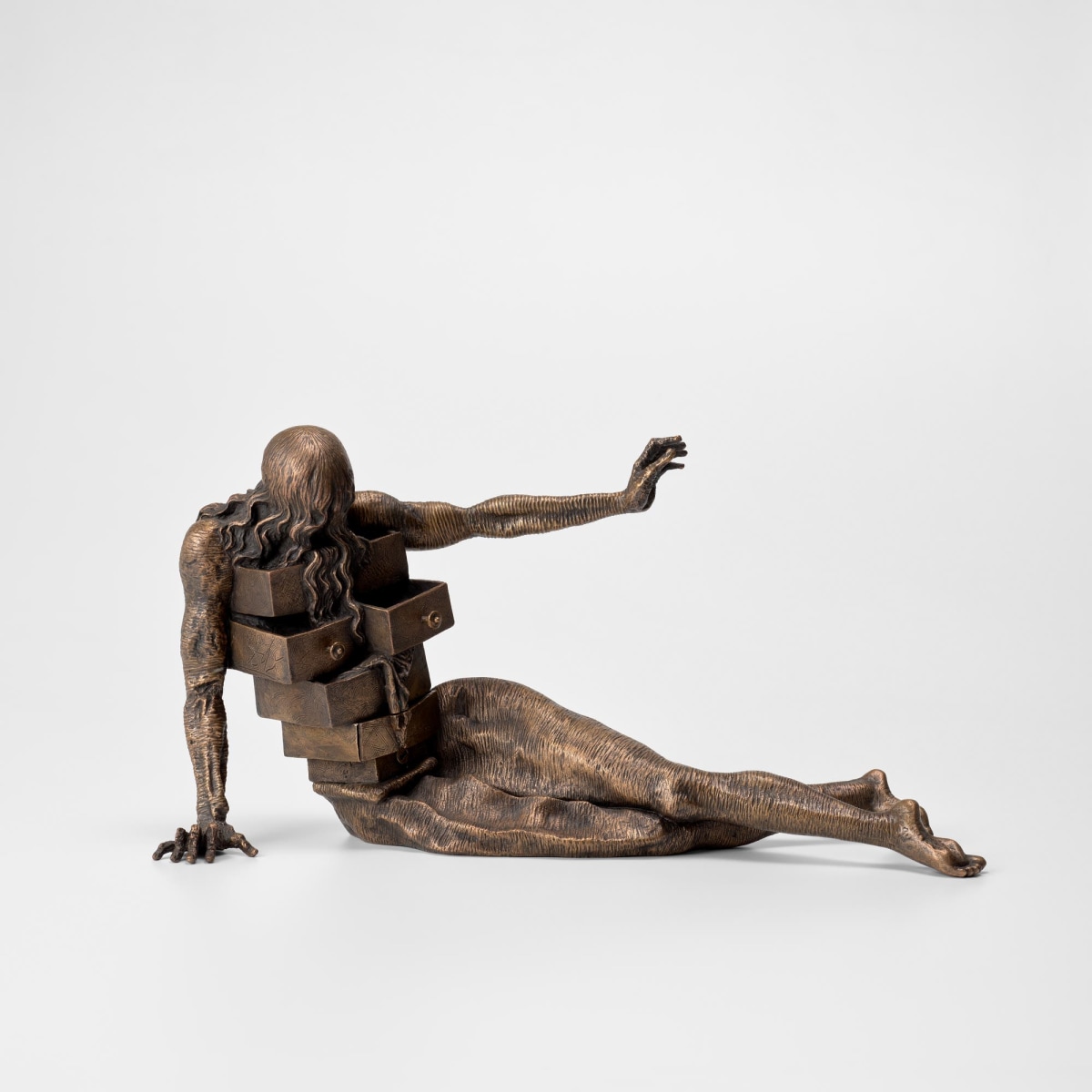
| Vénus de Milo aux tiroirs (1946), painted bronze with pompoms | $640,000, above estimate | Sotheby's, May 2026 |
| Polyphème | $192,000, exceeded high estimate | Sotheby's, April 2026 |
5 further auction entries on record for Salvador Dalí — inside Egon.
Pricing
Works on paper
c. $10,000-$500,000 for autograph sheets; category record c. $2.35m. Intact illustration series (e.g. the Marquis de Sade suite) can reach seven figures
Temporal context
2011 established the $21.7m record; 2013-2021 top-lot band roughly $5m-$10m; 2024-2026 activity is broad rather than record-chasing, with most public results between $1,200 and $2m and a database-recorded high of $4.198m in the window. No new painting record since 2011.
- Post 1940 paintings
- c. $200,000-$3m; late and studio-assisted works trade at a steep discount to the Surrealist decade
- Jewellery and objects
- Six figures and above for documented Dalí-designed pieces; a distinct collecting category
Unique versus multiples note
The wide quoted ranges conflate categories. Unique 1929-39 oils and the vast editioned print output are effectively two different markets sharing one name.
- Bronzes and editioned sculpture
- c. $50,000-$650,000 — Vénus de Milo aux tiroirs at $640,000 in May 2026 is the current benchmark
- Prints portfolios illustrated books
- $500-$25,000 typically; oversupplied and forgery-plagued (Dix Recettes d'Immortalité at $4,445, August 2026)
- Major surrealist period paintings 1929 1939
- $3m-$22m; extremely thin supply — only a handful of record-quality 1929-39 canvases have appeared in fifteen years
Liquidity
- Depth
- Global across New York, London, Paris, Hong Kong and Spain, plus a very large regional and online print trade.
Volume
Exceptionally deep — MutualArt indexes 64,215 Dalí artworks offered at auction; hundreds of lots clear monthly worldwide, overwhelmingly prints, multiples, illustrated books and bronzes.
- Stratification
- Liquidity is highly stratified: unique Surrealist-period paintings are scarce and slow; multiples are near-commodity liquid but low value.
Comparables
Against Magritte, Dalí trades at a substantial discount at the apex despite far greater public recognition — the recognition premium sits in the licensing and print economy rather than in top-lot pricing. Against Ernst, Delvaux and Fini he remains the volume leader by a wide margin.
Risk factors
- FORGERY IS THE DEFINING RISK. Dalí is routinely described as the most-faked artist in the world. The 'blank sheet' problem — sheets signed in advance and later printed with unauthorised images — corrupts a large part of the print market.
- Commentary notes he signed no prints after 1980, and that the two mills supplying most Dalí print paper added an infinity symbol to their watermarks after 1980 — so an infinity-watermarked Rives or Arches sheet bearing his signature is a forgery.
- Authentication rests on two references: Robert and Nicolas Descharnes for paintings and Albert Field's The Official Catalog of the Graphic Works of Salvador Dali (1996) for prints. Material outside them requires forensic scrutiny, and reliance on a gallery's or auction house's reputation alone is explicitly described as insufficient protection.
- Enormous editioned supply caps low-end appreciation and dilutes scarcity.
- Reputational and political controversy periodically suppresses curatorial enthusiasm relative to Magritte and Ernst.
- The top-end record has not advanced since 2011 — the apex is stable rather than rising.
Collector base
Recent
- Pauline Karpidas, London — collection dispersed at Sotheby's, 17-18 September 2025
- The Dalí Museum, St. Petersburg — an active institutional bidder that bought Bacchanale directly at Bonhams in March 2026
- Global private base with visible Asian demand — a March 2026 Sotheby's Dalí illustration drawing catalogued bilingually in Chinese made $1.92m
Supply event
The Karpidas sale (c. 250 lots, pre-sale estimate above £60m/$81m, the highest ever placed on a single collection at Sotheby's Europe) saw 23 Surrealist lots realise $41.1m against a $37.5m estimate, with roughly 75% of material fresh to the market.
Historic patrons
- Edward James — the decisive 1930s patron whose Dalís seeded Tate and Museum Boijmans Van Beuningen
- A. Reynolds and Eleanor Morse, Cleveland — their collection became The Dalí Museum, St. Petersburg
- Elsa Schiaparelli — owned Necrophiliac Spring, documented hanging in her Paris home in a Mark Shaw photograph published in Life, November 1953
- Chester Dale — US collector associated with the religious pictures in Washington and New York public collections
Primary market
None. The artist died in 1989 and the Fundació Gala-Salvador Dalí is a non-selling heritage body that also administers copyright (ARS in the US, DACS in the UK). All acquisition is secondary — auction or specialist Modern/Surrealism dealers. No 'contact the gallery for pricing' applies.
Auction history
All time record
Portrait de Paul Éluard (1929), oil on board — £13.4m / c. $21.5-21.7m at Sotheby's London, 10 February 2011; at the time the highest price for any Surrealist work at auction. Artnet lists the sold price as $21,743,952; MutualArt records realised prices up to c. $21.74m for paintings.
- Works on paper record
- c. $2.35m (MutualArt category record)
Bought in and failure data
Egon records 9 unsold of 38 lots in the partial 2025-26 window. Bonhams' 2025 Paris Surrealism sale sold 54% by lot — evidence that mid-market Surrealist material is bought selectively, not indiscriminately.
Egon partial database 2025 onward
- Lots
- 38
- Sold
- 29
- Caveat
- Partial coverage of four houses from 2025; sell-through withheld because ~10% of lots are unsettled and unsettled lots skew to passes.
- Recent range
- $1,200 - $1,920,000
- Upcoming lots
- 3
- Highest recorded
- $4,198,000
- Recent average hammer
- $332,972
Other benchmarks cited by dealers
- c. £8m, Sotheby's New York, 16 November 2021
- £5.4m, Christie's New York, 6 May 2014
- just over £5m, Sotheby's New York, 19 June 2013
- Spectre du soir sur la plage, Sotheby's New York, 14 November 2017
- Prior record broken the same week
- Étude pour 'Le miel est plus doux que le sang' — c. £4m, Christie's London, 9 February 2011 (held the record for one day)
Market position
Peer group
- René Magritte
- Max Ernst
- Joan Miró
- Man Ray
- Leonora Carrington
- Yves Tanguy
- Paul Delvaux
- Leonor Fini
Segment tailwind
Surrealism is in a measurable upcycle: Bonhams' dedicated Paris Surrealism sale grew from €1m (55 lots, 2025) to €1,372,206 (76 lots, 2026); Paris auction week 2025 raised €182m ($212m) across six Christie's and Sotheby's sales, up 30% year on year; the Karpidas Surrealist group beat estimate.
Relative standing
The most publicly recognised Surrealist but no longer the price leader — Magritte has decisively overtaken him at the apex. Dalí's brand strength is monetised at the low end, in prints and licensing, rather than in top-lot pricing.
Investment outlook
Stable blue-chip with a genuine segment tailwind. Best risk-adjusted exposure is autograph 1929-39 oils and documented Surrealist-period drawings, where supply is scarce and Surrealism demand is strengthening. Bronzes and objects are firm (Vénus de Milo aux tiroirs above estimate, May 2026). Prints and illustrated books are a value trap without Field-catalogue documentation. Expect continued mid-market breadth rather than a new record until a 1929-38 masterwork of Éluard calibre is released.
Institutional presence
Research updated
Exhibitions
Historic landmarks
- Galeries Dalmau, Barcelona — first solo exhibition, 1925
- Julien Levy Gallery, New York — 1930s solo shows that built his American market
- The Museum of Modern Art, New York — Salvador Dalí retrospective, 1941-42
- Tate Modern, London — Dalí & Film, 1 June - 9 September 2007
- Suntory Museum, Osaka — Dalí: multifaceted, centenary exhibition, 8 March - 6 May 2007, cat. no. 54
- Fondation Beyeler, Riehen/Basel — Surrealism in Paris, 2 October 2011 - 29 January 2012 (a private foundation, named but not counted as a collecting institution)
- Centre Pompidou, Paris — Dalí, 21 November 2012 - 25 March 2013; head curator Jean-Hubert Martin, curators Montse Aguer, Jean-Michel Bouhours, Thierry Dufrêne
- Museo Nacional Centro de Arte Reina Sofía, Madrid — Dalí. Todas las sugestiones poéticas y todas las posibilidades plásticas, 27 April - 2 September 2013, with loans from MoMA, Philadelphia, Tate and the Musées royaux de Belgique and around thirty works never previously seen in Spain
- Freud Museum, London — Freud, Dalí and the Metamorphosis of Narcissus, 2018, built around the Tate loan
- Teatre-Museu Dalí, Figueres — long-running programme since 1974, including Dalí: Stereoscopic images (2016-17), Salvador Dalí / Robert Whitaker 1967-1972 (2018-22), Dalí: 'I am Surrealism!' (2020-21), The Divine Comedy illustrated by Dalí (2021-22)
Upcoming opportunities
- Bonhams Cornette de Saint Cyr Paris annual Surrealism sale — 5th edition expected spring 2027; the most consistent venue for Dalí mid-market material
- Christie's The Art of the Surreal evening sale, London — the venue for top-tier Dalí paintings
- Egon records three upcoming Dalí lots as of August 2026
- Christie's Daily included Dalí in an August 2026 round-up of best London exhibitions for 2026 (per MutualArt's press index)
Recent and current 2025 2026
- Fundació Gala-Salvador Dalí — The Awakening of the Myth: Gala Dalí, 18 March 2025 - 7 January 2026
- Teatre-Museu Dalí, Figueres — temporary exhibition, 17 September 2025 - 22 February 2026
- Victoria and Albert Museum, London — Schiaparelli: Fashion Becomes Art, 28 March - 8 November 2026 (some listings give 1 November), including Necrophiliac Spring (1936) shown in the UK for the first time; V&A curators surfaced a Mark Shaw photograph published in Life in November 1953 showing the painting in Schiaparelli's Paris home. Curator of paintings and drawings: Rosalind McKever.
- The Dalí Museum, St. Petersburg — The Architecture of The Dalí, 2 May 2026 - 18 April 2027, curated by Peter Tush with Sarah Lynch
- Bacchanale (1939) exhibition trail before sale: Madrid 2023, used as a performance backdrop 2024, exhibited Milan 2025, then Bonhams Paris March 2026 and now The Dalí Museum
Publications
- Robert and Nicolas Descharnes — the authoritative catalogue raisonné of the paintings and the standard authentication reference
- Albert Field, The Official Catalog of the Graphic Works of Salvador Dali, Salvador Dali Archives Ltd., 1996, ISBN 0-9653611-0-1 — the standard print reference
- Fundació Gala-Salvador Dalí online catalogues raisonnés (catalogues.salvador-dali.org) covering paintings and heritage objects with full exhibition and bibliography records
- Dalí's own writings: The Secret Life of Salvador Dalí (1942); Métamorphose de Narcisse (Éditions Surréalistes, Paris, 1937); The Tragic Myth of Millet's Angelus
- Museum catalogues from Centre Pompidou (2012), Reina Sofía (2013) and Tate (2007)
- Peer-reviewed papers published by The Dalí Museum, e.g. Mallen on the Narcissus myth in Picasso and Dalí
Museum collections
The Museum of Modern Art, New York
Note
MoMA's provenance record states the work was purchased from Julien Levy in 1934 by an anonymous friend of the Museum as a gift. MoMA also holds The Angelus of Gala (1935) and Illumined Pleasures; credit lines for those not verified here.
- Tier
- First-rank
- Key work
- The Persistence of Memory, 1931, oil on canvas, acc. no. 162.1934
- Credit line verbatim
- Given anonymously
Tate (Tate Modern), London
- Note
- A curatorial purchase, not a gift; formerly in the Edward James collection. Tate also holds Autumnal Cannibalism and Mountain Lake.
- Tier
- First-rank
- Key work
- Metamorphosis of Narcissus, 1937, oil on canvas, T02343
- Credit line verbatim
- Purchased 1979
Museo Nacional Centro de Arte Reina Sofía, Madrid
- Note
- Dalí bequeathed his estate to the Spanish State in 1989, giving Reina Sofía and the Figueres foundation exceptional national depth.
- Tier
- First-rank (national)
- Key works
- Two Figures (1926, inv. AS11135), El gran masturbador (1929), Muchacha en la ventana, Endless Enigma
Credit line verbatim
Salvador Dalí Bequest, 1990 (as published for Two Figures, 1926, in a Dalí Museum scholarly paper — secondary source, not verified against the museum's own record)
Philadelphia Museum of Art
- Note
- Held within the Louise and Walter Arensberg holdings; exact wording not verified. Lent to the 2013 Reina Sofía retrospective.
- Tier
- First-rank
- Key work
- Soft Construction with Boiled Beans (Premonition of Civil War), 1936
- Credit line verbatim
- credit line not published in sources consulted
Centre Pompidou / Musée national d'art moderne, Paris
- Note
- Organised the 2012-13 Dalí retrospective.
- Tier
- First-rank
- Key work
- Partial Hallucination: Six Apparitions of Lenin on a Piano, 1931
- Credit line verbatim
- credit line not published in sources consulted
View 6 more records
Musées royaux des Beaux-Arts de Belgique, Brussels
- Tier
- First-rank (national)
- Key work
- The Temptation of St Anthony, 1946
- Credit line verbatim
- credit line not published in sources consulted
Museum Boijmans Van Beuningen, Rotterdam
- Tier
- First-rank (national/modern)
- Key work
- Couple with their heads in the clouds, 1936, ex-Edward James, in Dalí's own frame design
- Credit line verbatim
- credit line not published in sources consulted
The Dalí Museum (Salvador Dalí Museum), St. Petersburg, Florida
- Note
- An actively purchasing institution — the strongest available form of validation evidence.
- Tier
- Single-artist museum; first-rank for this artist
Key works
Founded on the A. Reynolds and Eleanor Morse collection; holds Bathers (c. 1928) and the major late masterworks; acquired Décor de théâtre pour Bacchanale (1939) in March 2026
Credit line verbatim
No museum-published credit line issued yet for Bacchanale; Bonhams' press release and Artforum confirm the museum bought it at auction for €254,400 on 26 March 2026 — a direct institutional purchase, i.e. curatorial initiation
Fundació Gala-Salvador Dalí — Teatre-Museu Dalí (Figueres), Casa-Museu Portlligat, Castell Gala Dalí (Púbol)
- Tier
- Artist foundation / national heritage complex
Key works
The world's largest holding, spanning early experiments, Surrealism, nuclear mysticism, science-related work and jewellery; Teatre-Museu opened 1974 and was conceived by the artist himself
- Credit line verbatim
- Artist's own foundation holdings and state bequest — no acquisition credit line applies
Victoria and Albert Museum, London
- Tier
- First-rank
- Key work
- Not an owner in this instance — exhibited the privately owned Necrophiliac Spring (1936) in 2026
- Credit line verbatim
- n/a — loan, not acquisition
Further holdings reported in the general literature
- Tier
- Mixed
Key works
The Metropolitan Museum of Art, New York (Crucifixion (Corpus Hypercubus)); National Gallery of Art, Washington (The Sacrament of the Last Supper); Kelvingrove, Glasgow (Christ of St John of the Cross); Wadsworth Atheneum; Spanish national and Catalan collections
- Credit line verbatim
- credit lines not verified in this research cycle — do not treat as published
Awards and recognition
- Created Marqués de Dalí de Púbol by King Juan Carlos I of Spain, 1982
- Gold Medal of the Generalitat de Catalunya, 1982
- Foreign associate member, Académie des Beaux-Arts (Institut de France), 1979
- Time magazine cover, 14 December 1936
- Estate bequeathed to the Spanish State, 1989 — an exceptional form of state cultural recognition; the Fundació Gala-Salvador Dalí was established in 1983 under his own direction
Career & Biography
Research updated
Identity
- Born
- 11 May 1904, Figueres, Catalonia, Spain
- Died
- 23 January 1989, Figueres, Spain (aged 84)
- Gender
- Male
- Status
- Deceased — legacy administered by the Fundació Gala-Salvador Dalí (Figueres) and the Spanish State
- Full name
- Salvador Domingo Felipe Jacinto Dalí i Domènech, Marqués de Dalí de Púbol
- Nationality
- Spanish (Catalan)
Alternate names
- Salvador Dali
- Salvador Dalí i Domènech
- Salvador Felipe Jacinto Dalí y Domenech
Primary locations during career
- Figueres and Cadaqués/Port Lligat (Catalonia)
- Madrid (1922-26)
- Paris (1929-late 1930s)
- United States, principally New York and California (1940-48)
- Port Lligat and Púbol, Catalonia (1948-1989)
Personal life
Gala (Elena Ivanovna Diakonova), previously married to Paul Éluard, became his partner in 1929 and served as model, muse and business manager; the work's subject matter and its commercial machinery both revolved around her. Her death in 1982 effectively ended his production.
Career timeline
- 1919-1925: first exhibitions in Figueres and Barcelona (Galeries Dalmau solo show 1925); Impressionist, Cubist, Purist phases
- 1929: enters the Paris Surrealist circle; co-creates Un Chien Andalou with Buñuel; meets Paul Éluard and Gala at Cadaqués — the year of Portrait de Paul Éluard, later his auction record. Press accounts note he met Éluard in Paris in 1929 while assisting Buñuel on the film
- 1930s: formulates the 'paranoiac-critical method'; The Persistence of Memory (1931, MoMA), Soft Construction with Boiled Beans (1936, Philadelphia), Metamorphosis of Narcissus (1937, Tate), which he took to his 1938 meeting with Freud in London
- 1930s: collaborations with couturière Elsa Schiaparelli (Tears Dress 1938, Lobster Dress); Schiaparelli owned Necrophiliac Spring (1936)
- 1934-1939: conflict with André Breton and break with the Surrealist group; Breton's anagram 'Avida Dollars'
- 1939: paints Bacchanale, a monumental thirteen-panel stage set for the Ballets Russes de Monte-Carlo ballet choreographed by Léonide Massine at New York's Metropolitan Opera
- 1940-1948: United States years — MoMA retrospective 1941-42; Hollywood work with Hitchcock (Spellbound) and Disney; extensive commercial design
- 1948-1970s: return to Spain; 'Nuclear Mysticism' — religious, scientific and optical subjects; large-scale editioned print, sculpture and jewellery output
- 1974: opens the Teatre-Museu Dalí, Figueres, conceived and designed by the artist and regarded as his final total work
- 1982: death of Gala; created Marqués de Dalí de Púbol by King Juan Carlos I
- 1983-1989: declining health at Torre Galatea, Figueres; death 1989; estate bequeathed to the Spanish State
Studio practice
Worked principally from Port Lligat on the Costa Brava after 1948, in a studio built into a fisherman's cottage. Meticulous, slow oil technique on small-to-medium panels and canvases in the Surrealist decade; large-scale canvases in the nuclear-mystical period. From the 1960s, heavy delegation and licensing in prints, sculpture, jewellery and objects — the structural origin of today's forgery problem.
Education and training
- Municipal Drawing School, Figueres, under Juan Núñez (1910s-early 1920s)
- Real Academia de Bellas Artes de San Fernando, Madrid, 1922-1926 — expelled before final examinations; lived at the Residencia de Estudiantes where he met Federico García Lorca and Luis Buñuel
- Self-directed study of Old Master technique (Vermeer, Velázquez, Raphael), Freudian psychoanalysis from the late 1920s, and nuclear physics/Catholic mysticism after 1945
Influences and context
- Note
- Artnet's artist page groups him with Breton, Ernst, Magritte, Man Ray and Picasso — the same cluster in which his work is marketed at auction.
Formative influences
- Old Master illusionism (Vermeer, Velázquez, Raphael)
- Italian Metaphysical painting (de Chirico, Carrà)
- Cubism and Purism
- Freud's The Interpretation of Dreams
- The Catalan landscape of Cadaqués, Port Lligat, Rosas and Cap de Creus
- After 1945: nuclear physics, DNA, Catholic mysticism, optics and stereoscopy
Contemporaries and associates
- André Breton
- Max Ernst
- René Magritte
- Man Ray
- Joan Miró
- Pablo Picasso
- Luis Buñuel
- Federico García Lorca
- Paul Éluard
- Edward James (patron)
- Elsa Schiaparelli
- Walt Disney
- Alfred Hitchcock
Public persona and controversy
Deliberate self-mythologising media persona. His commercial appetite — with Gala negotiating advertising contracts at scale — drew Breton's 'Avida Dollars' jibe, and his political accommodations under Franco alienated former Surrealist colleagues. Commentators link the money-orientation directly to the industrial print operation behind the fakes crisis.
Artistic Profile
Research updated
Style
Core
Hyper-precise academic illusionism — Old Master modelling, sharp focus, deep perspectival recession — deployed to render impossible, dream-logic content. Vast empty Catalan coastal plains under raking light, minute figures, long cast shadows, and objects that soften, hollow out, split open or double as something else.
Signature devices
- Soft or melting form — limp watches, soft self-portraits
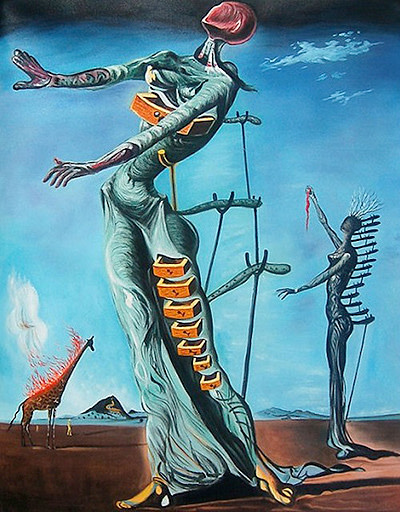
- The anthropomorphic chest of drawers and the drawer-torso figure, a Freudian body-as-container
- Crutches and prosthetic props
- Double and paranoiac images that read two ways simultaneously
- Ants, eggs, lobsters, telephones, bread, rhinoceros horns, elephants on spindle legs
- After 1945: levitating and atomised particles, DNA helices, hypercube geometry, Gala as Madonna
Paranoiac critical method
His own term for a systematic self-induced delirium harnessed to produce simultaneous readings of a single image. Metamorphosis of Narcissus (1937, Tate) is the textbook demonstration — the kneeling youth at the left mirrored at the right by a fossil-like hand holding an egg from which the narcissus blooms.
Evolution
1918-1928 rapid stylistic tourism through Impressionism, Cubism and Purism → 1929-1939 the great Surrealist decade, small-format, jewel-precise, psychosexually charged → 1940-1948 American years of portraiture, theatre, film and commerce → 1948-1970 large nuclear-mystical religious and scientific canvases → 1970s optical and stereoscopic experiments with heavy licensing → after 1980 no authentic new signing, a fact with direct authentication consequences.
Influences
Absorbed
- Vermeer and Velázquez for technique
- de Chirico and Carrà for metaphysical space
- Freud for content
- Millet's Angelus as an obsessional motif
- Catalan Romanesque and Renaissance religious painting
- Nuclear physics and the Watson-Crick double helix after 1953
Transmitted
- Post-war Pop and commercial imagery
- Photorealism and Magic Realism
- Contemporary Surrealist revivalism and the current market appetite for figurative dream imagery
- Fashion's continuing Surrealist vocabulary, traceable directly from Schiaparelli's Tears Dress (1938) to the present-day Schiaparelli house
Visual language
A fixed grammar of horizon, shadow and metamorphosis applied across radically different media. What holds the output together is iconography, not facture — which is precisely why an aggregate visual fingerprint reads as incoherent.
Signature series
- The Persistence of Memory, 1931, MoMA
- The Great Masturbator, 1929, Reina Sofía
- Portrait de Paul Éluard, 1929 — the auction record
- Soft Construction with Boiled Beans, 1936, Philadelphia
- Metamorphosis of Narcissus, 1937, Tate
- Necrophiliac Spring, 1936, private collection, V&A loan 2026
- Décor de théâtre pour Bacchanale, 1939, The Dalí Museum from 2026
- Crucifixion (Corpus Hypercubus), 1954, and The Sacrament of the Last Supper, 1955
- Vénus de Milo aux tiroirs and the anthropomorphic-cabinet family — confirming the fingerprint's Personnage aux tiroirs centroid
- Illustrated-book cycles: Divine Comedy, Les Chants de Maldoror, Marquis de Sade
Themes and subjects
- Dream, hallucination and the unconscious, explicitly Freudian — he read The Interpretation of Dreams as a student in Madrid in the early 1920s and described it as a capital discovery
- Desire, impotence, castration anxiety, putrefaction and death
- Gala as muse, madonna and organising presence
- The Catalan landscape of Cadaqués, Port Lligat, Rosas and Cap de Creus as a fixed stage — Necrophiliac Spring (1936) is set on the beach at Rosas
- Myth and allegory — Narcissus, Bacchus, William Tell — confirming the fingerprint's 'myth and allegory' and 'the body' collector themes
- After 1945: Catholic mysticism, the atom, DNA, optics and the fourth dimension
- The Spanish Civil War and premonitions of violence — Soft Construction with Boiled Beans, 1936
Movements and periods
- Surrealism — the canonical association, 1929 to c.1939
- Preceded by Impressionist, Pointillist, Cubist, Purist and de Chirico-inflected Metaphysical phases, 1918-1928
- Classicism and 'Nuclear Mysticism', 1945-c.1970 — religious and scientific subjects
- Late optical, stereoscopic and holographic experiments, 1970s
- Period label: Modern. This confirms the Egon fingerprint's 'Modern' period tag and its Surrealism / Surrealist / Symbolist registers.
Techniques and mediums
- Oil on canvas and on small panels or board — the core of the value market
- Tempera and oil on canvas at architectural scale for stage design: Bacchanale (1939), thirteen separate panels all painted by Dalí, over 20 m high by 30 m wide
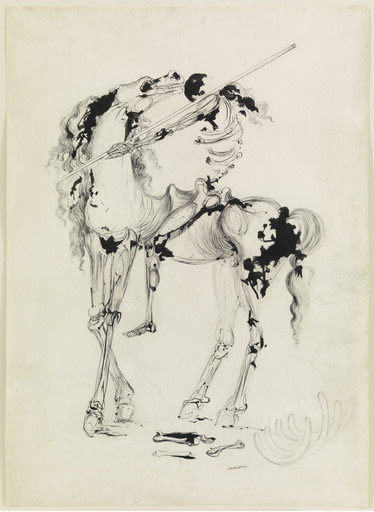
- Pen and ink with selective wash, graphite, watercolour and gouache on paper
- Etching, lithography, drypoint, wood engraving and illustrated books — Divine Comedy, Les Chants de Maldoror, Marquis de Sade, Don Quixote — in vast editions
- Bronze and painted bronze sculpture, frequently late-life or posthumously editioned: Vénus de Milo aux tiroirs, Le cabinet anthropomorphique
- Gold and gemstone jewellery designed with Carlos Alemany — biomorphic, marine-derived forms in cast and chased gold with pearls and cabochons
- Film, photography, holography, stereoscopy, fashion collaboration, interior and object design
Fingerprint verification
Confirmed
- Surrealism / Surrealist and Symbolist registers, Modern period label
- Drawing and ink as recurring technical tags — the pen-and-ink illustration corpus is genuinely a major output category and now a seven-figure one (a Marquis de Sade illustration drawing made $1.92m in March 2026)
- Uncanny and reverent as paired moods — they map onto the two halves of the career, Surrealist unease and nuclear-mystical devotion
- Collector themes 'the body' and 'myth and allegory' are accurate and central
- The Personnage aux tiroirs centroid is correct: the drawer-figure is one of his three or four most reproduced inventions
Explained
The low coherence score (0.39, n=48) reflects BREADTH, not unreliability, exactly as the fingerprint's usage note states. The auction corpus mixes at least five formally unrelated output categories — Surrealist oils, pen-and-ink illustration, editioned bronzes, haute-joaillerie jewellery, and graphic portfolios — that share iconography but almost no facture. The two narrated exemplars prove the point: a gold-and-gemstone necklace and an achromatic drawer-figure drawing have nothing formally in common.
Extension
Two axes are missing from the fingerprint and should be added: (1) DEEP PERSPECTIVAL RECESSION with a low horizon and raking single-source light, present in almost every significant painting and the most reliable single formal marker of an autograph Dalí composition; (2) MICRO-SCALE FACTURE — the Surrealist masterworks are physically tiny (The Persistence of Memory is 24.1 x 33 cm), which is itself diagnostic and commercially relevant.
Disagreement noted
The 'warm palette' consistent signal is a CATEGORY ARTEFACT, drawn from the gold jewellery and bronze lots. It does not describe the canonical paintings, which run on a cool blue-ochre Catalan coastal register with warm accents. Do not treat warm palette as an artist-level signature.
Critical Reception
Research updated
Academic discourse
Continuous and independent of the market: Freud-and-Dalí psychoanalytic scholarship, Catalan cultural studies, film studies (Un Chien Andalou, Spellbound, Destino), science-and-art literature on the nuclear-mystical period, and the Fundació's own catalogue and heritage-object research programme.
Critical reception
Rehabilitation
The Centre Pompidou (2012-13) and Reina Sofía (2013) retrospective, curated by Jean-Hubert Martin with Montse Aguer, Jean-Michel Bouhours and Thierry Dufrêne, explicitly re-argued Dalí as thinker, writer and world-maker rather than showman, and drew exceptional attendance — the pivotal recent scholarly repositioning.
The split verdict
Critical opinion has long divided between the 1929-39 Surrealist decade, near-universally esteemed, and the post-1940 output, where commercialism, self-promotion and political accommodation drew hostility. Breton's coinage 'Avida Dollars' remains the shorthand, and commentators tie the money-orientation directly to the print operation that made him the most faked artist in the world.
Art historical standing
Canonical. Dalí is inseparable from any survey of Surrealism and of twentieth-century modernism; the paranoiac-critical method, the Freudian iconography and The Persistence of Memory are standard teaching material. His absence from an account of the period would be conspicuous.
Current curatorial reading
The 2026 V&A treatment situates him within the art-fashion crossover: Necrophiliac Spring, owned by Schiaparelli, is presented as the source of the Tears Dress (1938) with its trompe l'oeil rips — Dalí read as a designer of twentieth-century visual culture as much as a painter.
Publications and media
- Extensive mainstream and fashion-press amplification around the 2026 V&A show (AnOther Magazine, Vogue), evidence of continuing crossover cultural reach rather than scholarship
- Trade authentication literature: Descharnes for paintings, Field for graphics, plus appraisal-sector commentary on the blank-sheet forgery crisis
Egon news record verification
- Item
- ARTnews, 3 March 2026 — 'Salvador Dalí's Largest Ever Painting Heads to Auction'
Verdict
LABEL WRONG. This is a pre-sale announcement, and the work went on to make €254,400 — roughly 1.3% of Dalí's $21.7m record. Nothing about the event is a record. The ARTnews summary also gives the dimensions as 65 x 10 feet, which conflicts with Artsy (65 x 98 ft), Artnet (65 x 100 ft) and Bonhams/Artforum (over 20 m high by 30 m wide); the 10-foot figure appears to be an error.
- Egon label
- Auction Record
- Item
- Artnet News, 27 February 2026, updated 27 March 2026 — 'Salvador Dalí's Largest Work Snapped Up by Florida Museum'
Verdict
PARTIALLY CORRECT. The piece does carry genuine segment data — Bonhams' 2025 Surrealism sale at €1m with 54% sold by lot, €1.5m of consignments for 2026, and Paris auction week 2025 up 30% to €182m — but its principal content is a sale announcement and then a museum acquisition.
- Egon label
- Price Trend
- Item
- Artforum, 27 March 2026 — 'Dalí Museum Acquires Dalí's Largest Work'
Verdict
CORRECT, and independently confirmed by Bonhams' own press release and by Artnet. The single most significant institutional event of the period: a museum purchasing at auction, i.e. unambiguous curatorial initiation.
- Egon label
- Museum Acquisition
- Item
- Artsy, 19 March 2026 (updated 26 March), corroborated by The Art Newspaper, 19 March 2026 — Necrophiliac Spring at the V&A
Verdict
LABEL WRONG. It is a single-work loan into a monographic fashion exhibition about Elsa Schiaparelli (Schiaparelli: Fashion Becomes Art, V&A, 28 March - 8 November 2026), not a Dalí retrospective. It remains a real first-rank institutional exhibition event: the painting's UK debut, having been sparingly shown since its 1936 New York debut and last exhibited in Surrealism in Paris at the Fondation Beyeler in 2011.
- Egon label
- Retrospective
- Item
- Artsy, 4 March 2026 — 'Salvador Dalí's largest-ever painting heads to auction in Paris'
- Verdict
- LABEL WRONG. An auction preview quoting the €200,000-300,000 estimate that the sale then met.
- Egon label
- Retrospective
Editorial and media recognition
Note
'Artists to watch' framing is not applicable to a canonical deceased master; the relevant editorial signal is sustained tier-1 coverage, which is continuous.
Items
- MutualArt's press index records Dalí features in Daily Art Magazine, FAD Magazine, Art in America and Christie's Daily, the most recent being Christie's Daily's August 2026 round-up of London exhibitions for 2026
- Time magazine cover, 1936
- Life magazine, November 1953 — Mark Shaw photograph of Necrophiliac Spring in Schiaparelli's Paris home, rediscovered as V&A curatorial research in 2026
- An unusually large trade and appraisal literature devoted specifically to Dalí authentication, itself a reflection of the scale of the forgery problem
Gallery & Representation
Research updated
Fair presence
Present through Modern and Surrealism dealers at TEFAF Maastricht, Art Basel (Modern sections), Frieze Masters and Art Basel Paris — never via a single representing gallery.
Representation
Status
No living-artist gallery representation — Dalí died in 1989. The legacy is administered by the Fundació Gala-Salvador Dalí, Figueres, a non-commercial heritage foundation that also manages copyright through DACS (UK) and Artists Rights Society, New York (US), and contributes to authentication discourse.
- Primary gallery
- None — deceased artist, no primary market
Secondary market channels
Sotheby's
- Role
- Holds the 2011 artist record; handled the Karpidas dispersal in September 2025 and multiple 2026 Dalí lots
- Tier
- Tier 1 auction
- Locations
- London, New York, Paris, Hong Kong
Christie's
- Role
- The Art of the Surreal evening sale is the flagship venue for Surrealist masterworks
- Tier
- Tier 1 auction
- Locations
- London, New York, Paris
Bonhams / Bonhams Cornette de Saint Cyr
Role
Fourth annual Surrealism sale, Paris, 26 March 2026, led by Bacchanale; Emilie Millon is International Director of Impressionist & Modern Art. Bonhams expanded in Paris with a renovated saleroom in 2021.
- Tier
- Tier 2 auction with a dedicated Surrealism franchise
- Locations
- Paris, London
Phillips
- Role
- Occasional multiples and works on paper
- Tier
- Tier 1-2 auction
- Locations
- London, New York
Specialist private dealers and print galleries
Role
A very large print and multiples trade of highly variable quality; trade commentary warns that relying on a gallery's or auction house's standing alone is insufficient protection against Dalí forgeries
- Tier
- Mixed
- Locations
- Global
Geographic reach
Fully global. Europe with Paris rising as a Surrealism centre; North America (New York plus a dedicated Florida museum); Asia, evidenced by a Sotheby's Dalí illustration drawing catalogued bilingually in Chinese that made $1.92m in March 2026; Spain and Catalonia as the heritage core.
Representation history
Historically Galeries Dalmau (Barcelona, 1925), Galerie Pierre Colle (Paris, from whom MoMA's Persistence of Memory passed to Julien Levy), and Julien Levy Gallery (New York, 1930s), which established his American market.
Sources & research notes
Egon’s artist research combines historical auction records, recent sales, institutional history, critical reception and gallery information. Researched auction records and auction highlights are identified separately.
Read prices with their work, sale date, currency and stated basis. Egon’s market assessments are distinct from reported auction results.
Reference: Egon, “Salvador Dalí: Market Intelligence & Investment Profile.”
Research bibliography · 40 sources
Sources recorded for this artist’s research. This bibliography does not assign every source to an individual claim.
- Salvador Dalí's Largest Work Snapped Up by Florida Museum — Artnet News
- Bonhams: The largest work by Dalí acquired by The Dalí Museum at Bonhams Surrealist Auction in Paris
- Dalí Museum Acquires Dalí's Largest Work: A Monumental Surrealist Ballet Set — Artforum
- Salvador Dalí's Largest Ever Painting Heads to Auction — ARTnews
- Salvador Dalí's largest-ever painting heads to auction in Paris — Artsy
- Salvador Dali Work Returns to Auction — HENI News
- The Dalí Museum in Florida acquires Salvador Dalí's largest work of art — Finestre sull'Arte
- Dali painting sells for record $21.5m — ABC News
- Dali painting fetches record $21.5m as Bacon sizzles in London auction — MutualArt
- The Portrait That Set Salvador Dali's Auction Record — HENI News
- Salvador Dalí has a record-breaking week at London auction houses — Catalan News
- Salvador Dalí Value: Top Prices Paid at Auction — MyArtBroker
- Salvador Dalí — Artnet artist page
- Salvador Dalí | 64,215 Artworks at Auction — MutualArt
- Salvador Dalí — Auction Results and Sales Data — Artsy
- Salvador Dalí Sold at Auction Prices — Invaluable
- Forgotten Dalí Painting, Bought for $200, Just Sold for 300 Times More — Artnet News
- Salvador Dalí painting behind Schiaparelli's Tears Dress to make London debut — Artsy
- Dalí painting that inspired Schiaparelli dress to be shown in UK for first time — The Art Newspaper
- Schiaparelli: Fashion Becomes Art at the V&A — AnOther Magazine
- What kind of relationship did Elsa Schiaparelli and Salvador Dalí have? — Vogue Adria
- Salvador Dalí. The Persistence of Memory. 1931 — MoMA collection record
- MoMA Collection Highlights — press materials
- The Myth of Narcissus: Themes of Life & Death in Picasso & Dalí — The Dalí Museum
- Metamorphosis of Narcissus — Fundació Gala-Salvador Dalí catalogue
- Dalí at Reina Sofía — METALOCUS
- Freud, Dalí and the Metamorphosis of Narcissus — Freud Museum London
- Dalí — Centre Georges Pompidou exhibition record
- Dalí exhibitions — Fundació Gala-Salvador Dalí
- Dalí Theatre-Museum — Visit Figueres
- The Architecture of The Dalí — Salvador Dalí Museum
- Salvador Dali — Art Prints and the great Dali art fraud — Artelino
- Dali, or Not Dali, That is the Question — Bernards Appraisal Associates
- Why Salvador Dalí is the most faked artist in the world — The Hustle
- Dali Signature: How to Identify and Authenticate It
- How to Authenticate a Salvador Dali Artwork — Modern Artifact
- A Legendary Collector's $81 Million Trove of Surrealist Art Heads to Sotheby's — Artnet News
- Pauline Karpidas' Surrealist Collection to Be Sold by Sotheby's — ARTnews
- Pauline Karpidas: The London Collection Evening Auction — Sotheby's
- Sotheby's: Pauline Karpidas, a sale of surrealist works — The Frame Blog
Research updates by section
These dates show when Egon’s research sections were updated. Source retrieval dates, where supplied above, refer to individual evidence notes.
Ranking updated . Research sections follow their own update dates.
This is what the market knows about Salvador Dalí. What Egon can also tell you: whether Salvador Dalí fits your portfolio — based on your existing holdings, budget, and investment timeline.
Get personalized analysisActive market signals
Inside Egon
Signal timeline & strength analysis
Gallery moves, auction records, institutional acquisitions, price milestones — tracked over 90 days
Full signal timeline, strength analysis, and alert configuration for Salvador Dalí.
Collector demographics & buyer analysis
Geographic distribution, institutional vs. private buyers, collector profiles, and secondary market activity
Who is collecting Salvador Dalí? Geographic distribution, institutional vs. private buyers, and collector profile analysis.
Personalized acquisition strategy
Optimal entry points, comparable pricing analysis, timing recommendations, and portfolio fit assessment
Personalized acquisition strategy for Salvador Dalí based on your budget, timeline, and collection goals.
Go deeper with personalized intelligence
You now have Egon's market assessment of Salvador Dalí. The next question is personal: does this artist belong in your collection? Egon analyzes collection fit based on your aesthetic thesis, existing holdings, budget, and investment goals — delivering acquisition strategies no public index can provide.