Wifredo Lam
Blue-chipEgon research · Artist market profile
The market, in context.
Explore Wifredo Lam’s auction history alongside the exhibitions, collections and gallery relationships behind the market.
Institutional research
Collections & exhibitions
Read holdings, exhibition history and their qualifications in context.
Read the institutional research →









Egon investment scores
Market position
Auction record context
$9,603,800 — 'Omi Obini' (1943), Sotheby's New York, Impressionist & Modern Art Evening Sale, 29 June 2020 (est. $8–12M). At the time the second-highest price ever paid at auction for a Latin American painting, behind Diego Rivera's 'Los Rivales' ($9.7M, 2018). Buyer subsequently revealed as Eduardo F. Costantini, for MALBA. Still the public record as of September 2026; MyArtBroker's record-price page (9 January 2026) states the record in sterling as £6.7M and notes that half of his top ten results are works of 1943–50.
Auction highlights
Scroll horizontally if needed →
| Work | Result | Venue and date |
|---|---|---|
| Acide doux, d'Hommage à Picasso (print) | $596 (basis unknown) per our auction database; est. $466–698 | Sotheby's, 2026-06 |
| Portrait of Madame Nena Azpiazu (gouache on paper, 102.6 x 78.1 cm) | $762,000 premium-inclusive per our auction database; est. $300,000–400,000 (hammer basis) | Christie's New York, 2026-05-19 |
| Sans titre | $281,600 premium-inclusive per our auction database; est. $180,000–250,000 (hammer basis) | Sotheby's, 2026-05 |
8 further auction entries on record for Wifredo Lam — inside Egon.
Pricing
By work type
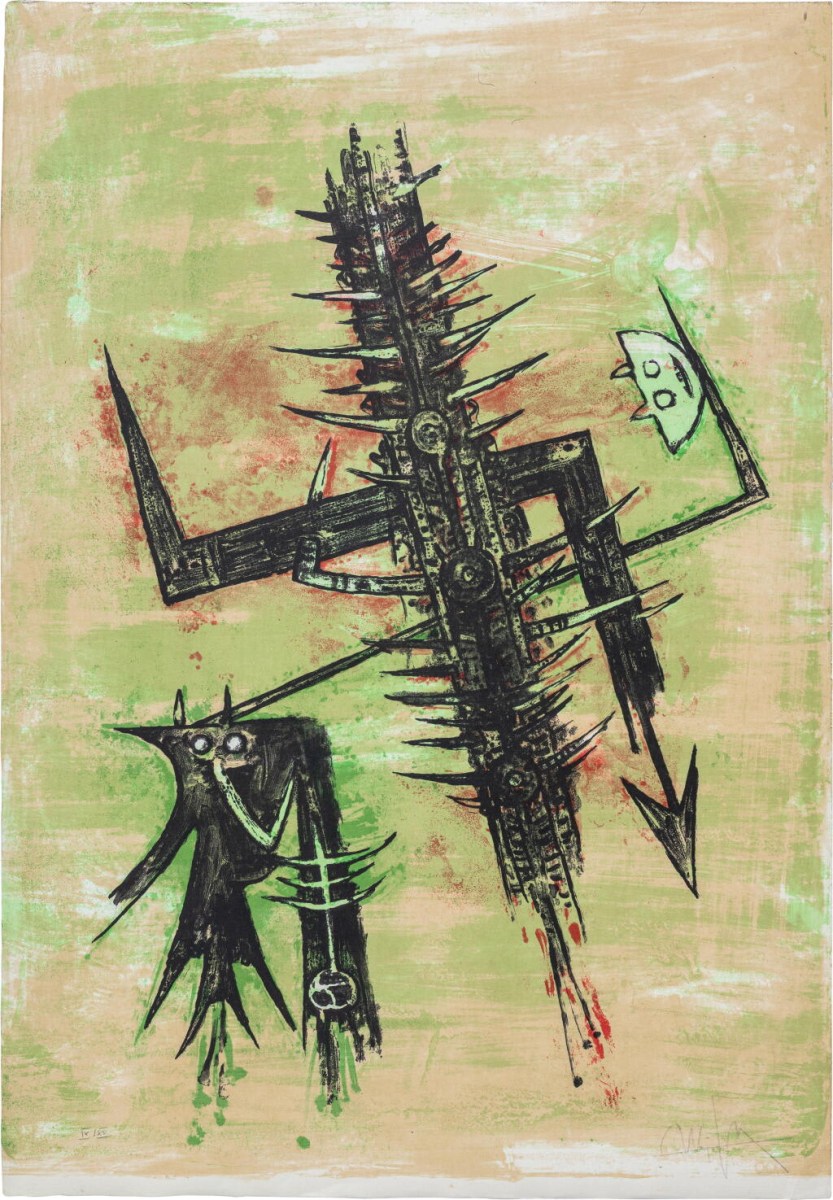
Prints and portfolios
$500–$15,000 per sheet; complete signed portfolios (Le Regard Vertical, Lames de Lam, Suite Prisunic, Pleni Luna, Flight) higher. The low tail is real and active: our auction database records 'Acide doux, d'Hommage à Picasso' at $596 (basis unknown) at Sotheby's, Jun 2026. Prints are NOT the value driver and must not be blended into painting price statistics
Small late oils 1970s
$40k–$250k at auction. Dealer retail comparison point: a 1972 oil, 'Three Figures' (provenance Cernuda Art, Coral Gables), listed on 1stDibs at $80,000 reduced from $100,000 when checked 21 Sep 2026 — an asking price, not a transaction
- 1950s 60s large canvases
- $1M–$5M (e.g. 'A Trois Centimètres de la Terre', €4.4M, 2017)
Ceramics 1970s albissola
typically $5k–$60k depending on form and provenance; European regional houses carry the flow (e.g. 'Assiette au poisson', 1962, Fidesarte Italia, May 2026)
- Drawings pastels untitled sheets
- $25k–$300k
Gouache and major works on paper
$150k–$800k+ — our auction database records 'Portrait of Madame Nena Azpiazu' (gouache on paper, 102.6 x 78.1 cm) at $762,000 premium-inclusive, Christie's, 19 May 2026, against a $300,000–400,000 hammer-basis estimate (bases not directly comparable). The same title appeared at Sotheby's Latin American Modern Art Evening Sale in 2017, so this is a re-offer of a known 1940s sheet
1940s havana period oil and charcoal
$4M–$10M — the value core of the market (The Jungle generation; Orisha/femme-cheval iconography). Both 1944 canvases surfacing in the current cycle ('Ídolo', 'L'esprit veillant') sit in this band
Temporal context
2026 ytd
Two-speed. Top of market: no new public painting record; the highest figure in our auction database remains the Nov 2025 Ídolo entry. Middle market on paper is firm to strong — our database's May 2026 Sotheby's/Christie's lots include $281,600 (est. $180k–250k), $166,400 (est. $80k–120k), $38,400 (est. $30k–50k) and $762,000 (est. $300k–400k), all premium-inclusive against hammer-basis estimates. The print/ceramic/regional tail runs continuously (Capitolium Art, Setdart, Fidesarte, Monarch, March–June 2026). Recent-sample statistics from our database (10 sold lots, sale dates within 730 days or unknown): range $596–$762,000, average $191,027, mixed bases — that average blends prints with major paper works and is NOT a painting price level
- Pre 2012
- Record below c.$2M; Lam traded as a regional 'Latin American' category name rather than as an international modernist
- 2012 2019
- Repricing phase — $4.5–5.2M for top 1940s–60s canvases; strong middle market $300k–1.5M
- 2020 2023
- $9.6M record set (2020); best 1940s Havana-period canvases $4–10M; second-tier canvases $1–3M; works on paper largely $30k–400k
2024 2025
Retrospective-year supply peak: Puck reported (16 Nov 2025) that nearly 20 Lam works came to auction in the single New York week coinciding with the MoMA retrospective, headed by 'Ídolo (Oyá)' on a $6–8M Sotheby's estimate
2024 2026
Sustained. Evening-sale 1940s canvases in $6–8M estimate territory (Ídolo, Nov 2025); important works on paper reaching $762,000 (Christie's, May 2026); ordinary small drawings/untitled sheets $29k–290k with a clear tendency to sell at or above estimate. Egon-recorded recent range $29,440–$7,370,000; recent average hammer c.$928,000 (skewed by one evening-sale lot)
Primary market note
No living-artist primary market. Dealer-side pricing exists via estate-collaborating and specialist galleries: Galerie Gmurzynska (Zurich/New York), which stages exhibitions in collaboration with the estate; Gary Nader Art Centre (Miami/New York), whose owned inventory supplied the 2021 Pace collaboration; and Cernuda Arte (Coral Gables), whose stock reaches retail platforms. Gmurzynska previously offered a 1939 Cubist-phase 'Figure' in the €500,000+ range at FIAC's online edition. Current dealer pricing is by request and largely unpublished; the visible exception is platform retail (1stDibs listing of a 1972 oil at $80,000 asking, checked 21 Sep 2026). Contact Gmurzynska, Gary Nader or Cernuda Arte for current pricing.
Liquidity
Depth
Christie's, Sotheby's, Phillips and Bonhams coverage plus a wide European regional tail (Capitolium Art, Setdart, Fidesarte, Gonnelli, French houses) and US regional houses (Monarch, Heritage). Geographic depth across New York, Paris, Hong Kong, Madrid, Milan and Latin America.
Volume
Very deep. Artnet indexes 4,446 Lam artworks; MutualArt indexes c.3,588 works at auction. Across all media well over 100 lots trade annually worldwide; at the four majors roughly 15–25 lots per year, and Puck counted nearly 20 lots in a single New York week in November 2025.
Assessment
Highly liquid for a mid-century modernist. A top canvas can be placed at evening-sale level in any given season; the works-on-paper, print and ceramic tail provides near-continuous price discovery; and the 2026 private-treaty sale of a major 1944 canvas to the National Gallery of Art shows the private channel absorbing trophy material as well.
Sell through and buy ins
From our auction database (2025 onward, four major houses): cached lot count 21, cached sold count 20, one upcoming lot. The canonical independent population gives 100% sell-through across 20 settled lots, with 95% of catalogued lots at least 90 days old having settled. That is a majors-only, post-2025 figure and must not be read as a historical sell-through rate; no large-scale historical buy-in data was located in open sources. Mid-market paper and unsigned/attributed material still pass with some regularity, and 'in the style of' catalogue language appears on aggregator platforms — an attribution-risk flag for sub-$50k buyers.
Comparables
Matta (records c.$5M), Tamayo (c.$7.2M), Rivera ($9.7M), Varo (c.$6.2M), Carrington (c.$3.3M+, with a £22.5M outlier for 'Les Distractions de Dagobert' in 2024). Frida Kahlo has decisively separated from the field — 'Diego y yo' realized $34.9M and a Kahlo at Sotheby's on 20 November 2025 was reported at $54.7M, described as a record for a work of Latin American art. Lam is priced an order of magnitude below Kahlo and within the Rivera/Tamayo/Varo band despite arguably the strongest current institutional narrative of the group.
Collector base
Named
- Eduardo F. Costantini (founder, MALBA, Buenos Aires) — buyer of 'Omi Obini' at $9.6M, destined for MALBA; bought the Lam and Remedios Varo's 'Armonía' for a combined $15.8M in the same 2020 sale
- Clarissa and Edgar Bronfman Jr. — lenders of 'Ogue Orisa' (1943) to MoMA
- Capriles Cannizzaro Family Collection — MoMA loan
- Gary Nader (Miami dealer/collector) — long-term inventory position
- Leonard A. Lauder — named in the National Gallery of Art credit line for 'L'esprit veillant' ('Gift of Funds from Leonard A. Lauder'), i.e. a funder of a museum purchase rather than the donor of an object
- Ramón and Nercys Cernuda (Miami) — collection of Cuban art featured in the 'Afrocubanismo' presentation; the related Cernuda Arte supplies Lam material to the retail market
- Mariita Srebnick and George Feldenkreis, Miami Beach — owners of 'L'esprit veillant' immediately before the 2026 NGA purchase (per NGA provenance)
- Betty and Isaac Rudman Collection, Santo Domingo and Miami; earlier Baron Berthold-Joseph (Berthie) and Gaëtane-Gilberte (Gigi) Urvater, Brussels, by 1957 — earlier owners of the same canvas (per NGA provenance)
Patterns
Latin American private museums and foundations; US collectors of Surrealism; Miami/Cuban-American collecting families with deep Lam holdings; a growing Asian buyer segment engaged by the Chinese-Cuban biography; and, newly evidenced in 2026, US national-museum buying at the top of the market. Trophy demand concentrates on 1942–47 Havana-period pictures.
Auction history
Record
$9,603,800 — 'Omi Obini' (1943), Sotheby's New York, Impressionist & Modern Art Evening Sale, 29 June 2020 (est. $8–12M). At the time the second-highest price ever paid at auction for a Latin American painting, behind Diego Rivera's 'Los Rivales' ($9.7M, 2018). Buyer subsequently revealed as Eduardo F. Costantini, for MALBA. Still the public record as of September 2026; MyArtBroker's record-price page (9 January 2026) states the record in sterling as £6.7M and notes that half of his top ten results are works of 1943–50.
Private sales
A major 1944 canvas, 'L'esprit veillant (The Watchful Spirit)', was purchased in 2026 by the National Gallery of Art, Washington, through Estudio Bonta (Bethesda, MD) from Mariita Srebnick and George Feldenkreis — a private-treaty transaction at the trophy level, price undisclosed. Its last recorded public appearance was Christie's New York, 23 November 1999, lot 23 (per the NGA provenance).
Record progression
- 2012 — 'Ídolo (Oyá/Divinité de l'air et de la mort)' (1944), Sotheby's New York Latin American sale: $4.56M — then a record, more than doubling the previous high; bought by a South American collector
- Dec 2012 — Sotheby's Paris: a c.2.5m-tall canvas sold, among the largest Lam canvases at auction (per MyArtBroker record-price survey)
- 2017 — 'A Trois Centimètres de la Terre' (1962): €4.4M / c.$5.2M
- June 2020 — 'Omi Obini' (1943): $9.6M — current record
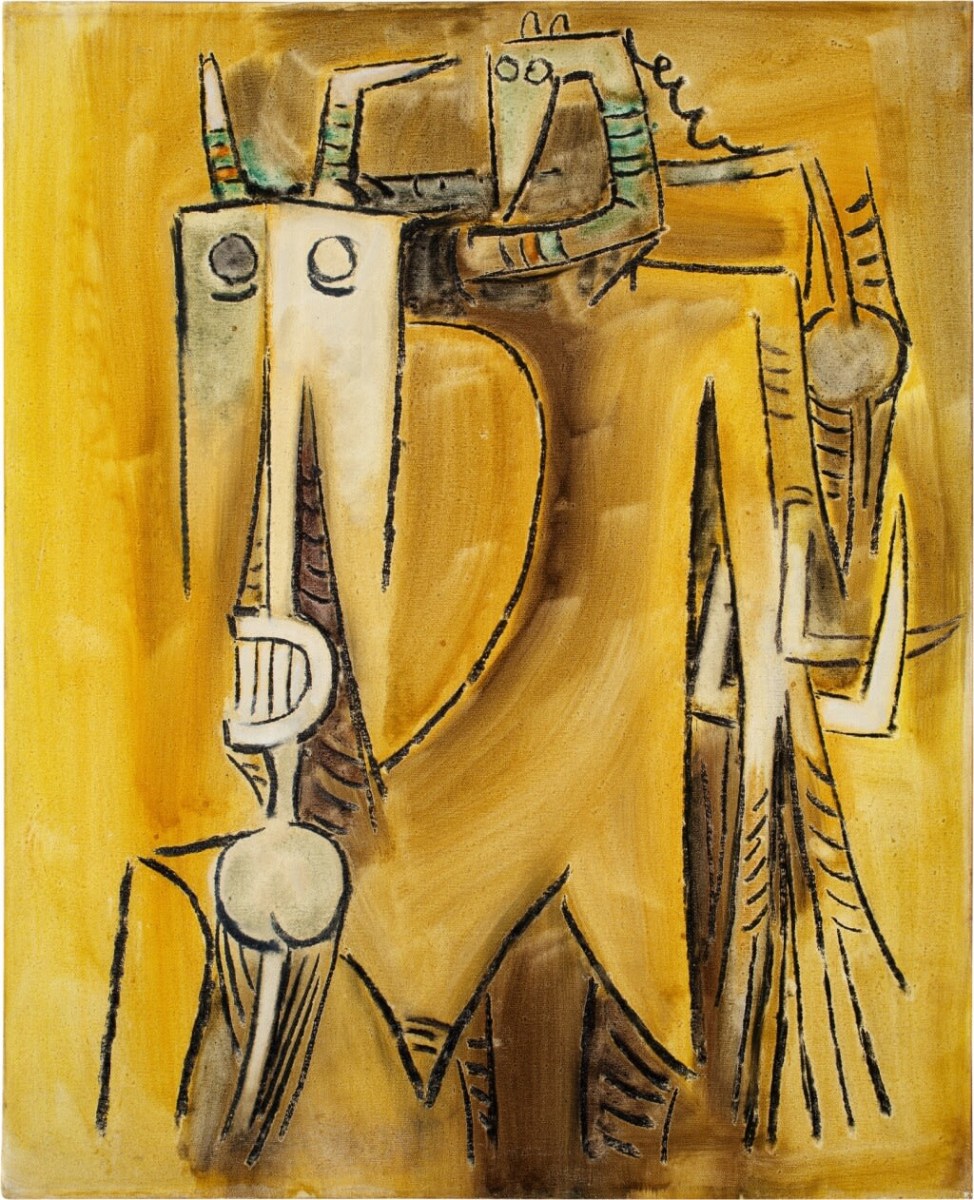
- 20 Nov 2025 — 'Ídolo (Oyá/Divinité de l'air et de la mort)' (1944), Sotheby's New York Modern Evening Auction, lot 110, est. $6–8M, 'Property of an Important North American Collection'. Egon's database records a top price of $7,370,000 in the covered period; on timing, estimate and lot profile this is almost certainly the Ídolo result, but the hammer/premium figure was NOT independently confirmed in the sources consulted — treat as inference, not verified fact. If correct it is c.+62% over the same picture's 2012 price across a 13-year hold.
- 2012 — 'Ídolo (Oyá/Divinité de l'air et de la mort)' (1944), Sotheby's New York Latin American sale: $4.56M — then a record, more than doubling the previous high; reported as c.$1M above the high estimate; bought by a South American collector
- June 2020 — 'Omi Obini' (1943): $9.6M — current public record
- 20 Nov 2025 — 'Ídolo (Oyá/Divinité de l'air et de la mort)' (1944, oil and charcoal on canvas, 157.3 x 127.6 cm), Sotheby's New York Modern Evening Auction, lot 110, 'Property of an Important North American Collection', est. $6,000,000–8,000,000. Our auction database records $7,370,000 (premium-inclusive) for this title at Sotheby's in Nov 2025 — the highest figure in our record for the artist. THAT FIGURE IS FROM OUR DATABASE AND WAS NOT INDEPENDENTLY CONFIRMED: the Sotheby's lot page checked 21 Sep 2026 shows 'Auction Closed' with results behind a login, and the trade reports of that evening (ARTnews, Artnet News, The Art Newspaper) that were checked led on van Gogh, Klimt and Kahlo without itemising the Lam. Auction closed is not proof of sale. If the database figure is correct it is c.+62% over the same picture's 2012 price across a 13-year hold, and still below the 2020 record.
Other notable results
- 'Présages' (1947) — top lot at Phillips' Latin American sale (May), $2.6M on a $2–3M estimate
- 'Femme avec un oiseau' — Sotheby's NY Modern Evening Auction, est. $800,000–1,200,000
- 'Sans titre (Femme fleurie)' — Sotheby's NY, est. $1.2–1.8M
- 'Fruits tropicaux' — Sotheby's Hong Kong Modern & Contemporary Evening, 5 April 2024, est. HK$6–10M (evidence of an active Asian bidding channel, reinforced by Lam's Chinese paternal ancestry)
- 'Femme avec un oiseau' — Sotheby's NY Impressionist & Modern Art Day Sale, 13 November 2019, est. $800,000–1,200,000
- 'Pleni Luna (Full Moon)' — complete set of ten colour lithographs, offered in the Urban S. Hirsch III Surrealist collection sale (Artsy price-database listing; price not retrieved)
Bought in and sell through
See liquidity.sell_through_and_buy_ins. Our database's 100% figure covers 20 settled lots at four major houses from 2025 onward and is not a historical rate. Unsettled lots skew toward passes, so no clean historical sell-through rate should be quoted.
Recent egon database lots 2026
- Sin título — $38,400, Sotheby's, May 2026 (below estimate)
- Sans titre — $166,400, Sotheby's, May 2026 (exceeded high estimate)
- Sans titre — $281,600, Sotheby's, May 2026 (above estimate)
- Portrait of Madame Nena Azpiazu (gouache on paper, 102.6 x 78.1 cm) — $762,000, Christie's, May 2026 (exceeded high estimate)
- Sans Titre — $29,440, Sotheby's, April 2026 (above estimate)
- Sin título — $38,400, Sotheby's, May 2026 (premium-inclusive vs $30,000–50,000 hammer-basis estimate)
- Sans titre — $166,400, Sotheby's, May 2026 (premium-inclusive vs $80,000–120,000 hammer-basis estimate)
- Sans titre — $281,600, Sotheby's, May 2026 (premium-inclusive vs $180,000–250,000 hammer-basis estimate)
- Portrait of Madame Nena Azpiazu (gouache on paper, 102.6 x 78.1 cm) — $762,000, Christie's, May 2026 (premium-inclusive vs $300,000–400,000 hammer-basis estimate)
- Sans Titre — $29,440, Sotheby's, April 2026
- Acide doux, d'Hommage à Picasso — $596, Sotheby's, June 2026 (basis unknown; est. $466–698)
- CORRECTION to the prior record: the earlier 'above/below estimate' labels on these lots are withdrawn where the recorded price is premium-inclusive and the estimate hammer-basis; those pairs are not directly comparable and no over/under figure should be asserted.
Market position
Peer set
Diego Rivera, Rufino Tamayo, Roberto Matta, Remedios Varo, Leonora Carrington, Frida Kahlo (far above), Fernando Botero. Within Surrealism proper his peers are Matta and Masson; within Caribbean/Black-diasporic modernism he has no priced equivalent.
Macro context
Operating into a firm modern market. Sotheby's November 2025 three-part modern/Surrealist evening sales in the new Breuer Building totalled $304.6M with fees against a $211.3–289.3M pre-sale estimate, led by a $62.7M van Gogh and a record Kahlo at $54.7M — the session in which the Lam Ídolo was offered. Christie's May 2026 two-session sale totalled $1.1bn with the S.I. Newhouse collection alone at $630.8M.
Segment dynamics
Latin American material now sells inside the majors' global Modern and Surrealist evening sales rather than in siloed regional auctions, raising the ceiling for the best works and exposing them to global bidding (dealers report first-time buyers from China, Japan and Russia alongside the US/Latin American old guard). Academic price-index work (Garay & Pulga, JEFAS 2025) treats Lam among the 'Big-5' Latin American artists and finds movement-level decomposition necessary to model his prices. The 2026 development to watch is institutional buying: the NGA purchase removes one of the few remaining privately held 1944 canvases from circulation.
Relative standing
Lam's $9.6M record sits near the top of the Latin American modernist field but is now an order of magnitude below Kahlo's reported $54.7M November 2025 result and just below Rivera's $9.7M. The repricing argument continues to rest on the gap between his art-historical centrality — now reinforced by MoMA and the National Gallery of Art — and his price level.
Investment outlook
Risks
- Concentration risk: the record depends on a small pool of 1940s masterpieces, most already institutionalized
- Attribution/authenticity risk in the low-to-mid market; rely on the Lou Laurin-Lam/Eskil Lam catalogue raisonné and SDO Wifredo Lam certification
- Post-retrospective air-pocket risk: retrospective-driven attention typically supports prices 18–36 months, after which fresh top-quality supply determines whether the level holds
- Cuban-provenance and export-history complications on works with Havana ownership chains
- Concentration risk, intensifying: the record depends on a small pool of 1940s masterpieces, and each institutional placement (MoMA, MALBA, now NGA) permanently removes one from supply. Fewer trophies means fewer chances to set a new public record and greater dependence on single-lot outcomes
- Attribution/authenticity risk in the low-to-mid market; rely on the Lou Laurin-Lam/Eskil Lam catalogue raisonné and SDO Wifredo Lam certification. Confirm in writing what any certification actually opines on — a catalogue entry is not automatically an authentication opinion, and one body's remit does not exclude other qualified expertise
- Opacity at the top: the single most important recent result (Nov 2025 Ídolo) is not publicly confirmed, so the current trophy level rests on a database figure rather than an open print. Underwrite at the 2020 $9.6M record and the $6–8M published estimate, not at $7.37M as a settled fact
- Post-retrospective air-pocket risk: the MoMA show closed 11 April 2026. Retrospective attention typically supports prices 18–36 months from opening (i.e. into roughly mid-2027 on a November 2025 start), after which fresh top-quality supply determines whether the level holds
Trajectory
Upward and institutionally reinforced, but with no new public painting record in this cycle. The 2025–26 MoMA retrospective remains the most consequential market catalyst in the artist's posthumous history; the August 2026 National Gallery of Art purchase of a 1944 canvas from a named acquisition fund is the strongest institutional follow-through since, and it is a purchase, not a gift.
Opportunity
Works on paper and 1950s–60s canvases remain the value pocket. The May 2026 pattern at Christie's and Sotheby's — several paper lots clearing well above their hammer-basis estimate ranges even after allowing for buyer's premium — suggests this tier is repricing first. Prints, ceramics and the regional-house tail remain inexpensive and are not a proxy for the painting market; do not blend their prices into painting statistics.
What would change the view
A publicly reported result above $9.6M; a second first-rank museum purchase; a confirmed travelling venue for the MoMA retrospective; or, negatively, a passed evening-sale 1940s canvas in the 2026–27 New York seasons.
Institutional presence
Research updated
Upcoming
The MoMA retrospective closed on 11 April 2026 (MoMA's date, reconfirmed on its exhibition page 28 Sep 2026; the estate chronology gives 12 April). No travelling venue or new monographic museum exhibition was found in the sources checked through 28 Sep 2026. That is an absence in those sources, not proof no tour exists. Current and upcoming group exhibitions per the estate chronology (wifredolam.org, modified 18 May 2026, re-checked 28 Sep 2026): (1) Warsaw, Muzeum Sztuki Nowoczesnej, 'Surrealizm i Antyfaszyzm', 12 June 2026 – 10 January 2027, continuing the Lenbachhaus Munich show (14 Oct 2024 – 15 Mar 2025); (2) Lausanne, Plateforme 10 – Musée Cantonal des Beaux-Arts, 'Ted Joans. Black Flower', 9 October 2026 – 28 February 2027, opening in eleven days. Recently closed: Barbican, 'Project a Black Planet' (11 June – 6 Sept 2026). MutualArt's venue count, including 'Afrocubanismo', remains aggregator-level and unverified.
Exhibitions
Biennials
RESOLVED in part (previously 'not verified'). The estate chronology lists: 60th Venice Biennale, 'Stranieri Ovunque' (20 April – 24 November 2024); 35th São Paulo Bienal (5 September – 10 December 2023), a special room of nine major works from 1943–51 curated by Manuel Borja-Villel; 23rd São Paulo Bienal (1996), Salas Especiais; 18th São Paulo Bienal (1985), Cuban pavilion 'Sala Wifredo Lam'; 1995 Kwangju Biennale; 7th Havana Biennial (2000) work-on-paper presentation. One auction-house biography reports retrospectives at Kunsthalle Basel in 1966–67; this is still not verified (the Gmurzynska biography instead names Moderna Museet, Palais des Beaux-Arts Brussels and Stedelijk for the post-1964 retrospectives). The Centro de Arte Contemporáneo Wifredo Lam in Havana, named for him, organises the Havana Biennial.
Group and ongoing
- MACBA, Museu d'Art Contemporani de Barcelona — Lam works on view (per MutualArt venue tracking)
- 'Project a Black Planet' — Barbican pan-African art survey announced March 2026, a context in which Lam is repeatedly cited
- 'Surrealism Beyond Borders' — The Metropolitan Museum of Art, New York; Lam included (flagged in Pace's exhibition materials)
- 'Afrocubanismo: Highlights from the Ramón and Nercys Cernuda Collection' — on view September 2026 per MutualArt; venue/dates not retrieved; solo-vs-group classification unresolved
- c.12 exhibitions including Lam on view worldwide as of September 2026 (MutualArt count; venues not individually verified)
- 'Surrealizm i Antyfaszyzm' — Muzeum Sztuki Nowoczesnej, Warsaw, 12 June 2026 – 10 January 2027 (continuation of 'But Live Here? No Thanks. Surrealism and Anti-Fascism', Lenbachhaus, Munich, Oct 2024 – Mar 2025) — group; per estate chronology
- 'Ted Joans. Black Flower' — Plateforme 10 / Musée Cantonal des Beaux-Arts de Lausanne, 9 October 2026 – 28 February 2027 — group; per estate chronology
- 'Project a Black Planet. The Art and Culture of Panafrica' — Art Institute of Chicago (15 Dec 2024 – 30 Mar 2025) → MACBA, Barcelona (6 Nov 2025 – 19 Apr 2026) → Barbican, London (11 June – 6 Sept 2026) — touring group survey; CLOSED. The legacy entry 'MACBA — Lam works on view' refers to this tour
- 'Paris Noir – Circulations artistiques et luttes anticoloniales, 1950–2000' — Centre Pompidou, Paris, 19 March – 30 June 2025 — group
- 'Surréalisme' — Centre Pompidou, Paris, 4 September 2024 – 13 January 2025 — group (Surrealism centenary)
- 'Picasso for Asia, a Conversation' — M+, Hong Kong, 15 March – 13 July 2025 — group
- 'City of Others: Asian Artists in Paris, 1920s–1940' — National Gallery Singapore, 2 April – 17 August 2025 — group
- 'Surrealism and Us: Caribbean and African Diasporic Artists since 1940' — Modern Art Museum of Fort Worth, 10 March – 28 July 2024 — group
- 'Surrealism Beyond Borders' — Metropolitan Museum of Art, New York, 11 October 2021 – 30 January 2022 (listed by the estate as 'Surrealism and Beyond') — group
- 'Afro Modern: Journeys through the Black Atlantic' — Tate Liverpool, 29 January – 25 April 2010 — group
- 'Crosscurrents of Modernism: Four Latin American Pioneers (Rivera, Torres-García, Lam, Matta)' — Hirshhorn Museum and Sculpture Garden, Washington DC, 11 June – 7 September 1992 — group exhibition (not evidence of a Hirshhorn holding)
- 'Latin American Artists of the Twentieth Century' — Seville → Centre Pompidou → Museum Ludwig Cologne → MoMA, 1992–93 — touring group
- 'Varian Fry. Les chemins de l'exil' — Mémorial de Caen (Mémorial cité des mémoires), 18 June 2025 – 4 January 2026 — group; per estate news page
- 'A terra, o fogo, a água e os ventos – Por um Museu da Errância com Édouard Glissant' — Instituto Tomie Ohtake, São Paulo, 3 September 2025 – 25 January 2026 — group; per estate news page
- 'Après la fin. Cartes…' — Centre Pompidou-Metz — group; dates not captured in the snippet (estate news page)
Landmark historical
- 2015–16 international retrospective cycle: Centre Pompidou, Paris (2015); Museo Nacional Centro de Arte Reina Sofía, Madrid; Tate Modern, London (2016)
- 1939 — Perls Gallery, New York (with Picasso) — first US showing
- 1942 — 'First Papers of Surrealism', New York (organized by Breton, installed by Duchamp)
- 1942 — MoMA, 'New Acquisitions: Latin American Art' (included 'Mother and Child', 1938)
- 1942–early 1950s — near-annual solos at Pierre Matisse Gallery, New York
- 1947 — 'Bloodflames' (Nicolas Calas), New York — 'Le Présent éternel (Hommage à Alejandro Caturla)' suspended from the ceiling
- More than 100 solo exhibitions worldwide across the career and posthumously
- 1966–67 — retrospectives reported at Kunsthalle Basel (auction-house biography; unverified)
- 1939 — Galerie Pierre (Pierre Loeb), Paris — first Paris solo show; 'Mother and Child' bought there by Alfred Barr for MoMA (first Lam in any museum, per Artsy)
- mid-1960s — retrospectives at Moderna Museet, Stockholm; Palais des Beaux-Arts, Brussels; Stedelijk Museum, Amsterdam (Gmurzynska biography; exact years not retrieved)
- 1978 — retrospective, Ordrupgaard, Charlottenlund, and Henie Onstad, Høvikodden (estate chronology)
- 1979 — 'Wifredo Lam, La Jungle', Centre Pompidou, Paris, 14 Feb – 2 Apr (estate chronology)
- 1982–83 — posthumous retrospective: Museo Nacional de Arte Contemporáneo, Madrid → Musée d'Ixelles, Brussels → Musée d'Art Moderne de la Ville de Paris (estate chronology)
- 1988–89 — Kunstsammlung Nordrhein-Westfalen, Düsseldorf → Kunstverein Hamburg (estate chronology)
- 1992–93 — retrospective, Museo Nacional Centro de Arte Reina Sofía, Madrid → Fundació Joan Miró, Barcelona; also 'Wifredo Lam and His Contemporaries, 1938–1952', Studio Museum in Harlem (estate chronology)
- 2002–03 — 'Wifredo Lam: The Changing Image, Centennial Exhibition', Yokohama Museum of Art (estate chronology)
- 2007–09 — 'Wifredo Lam in North America': Haggerty Museum → Miami Art Museum → Museum of Latin American Art → Dalí Museum (estate chronology)
- 2014–15 — 'Wifredo Lam: Imagining New Worlds', McMullen Museum (Boston College) → High Museum of Art, Atlanta (estate chronology)
- 2015–17 — 'Wifredo Lam': Centre Pompidou (30 Sep 2015 – 16 Feb 2016) → Reina Sofía (5 Apr – 15 Aug 2016) → Tate Modern (14 Sep 2016 – 8 Jan 2017) (estate chronology; dates refine the legacy '2015–16' entry)
- 2016 — 'Wifredo Lam and the Poets', Beijing World Art Museum → Guangdong Museum of Art → Kunming (estate chronology)
Current and recent solo
- 'Wifredo Lam: When I Don't Sleep, I Dream' — The Museum of Modern Art, New York, 10 November 2025 – 11 April 2026. First comprehensive US retrospective; 130–150+ works spanning the 1920s–1970s (paintings, large-scale works on paper, collaborative drawings, illustrated books, prints, ceramics, archival material) with key loans from the Estate of Wifredo Lam, Paris. Curated by MoMA Director Christophe Cherix and Beverly Adams, Curator of Latin American Art, with Damasia Lacroze and Eva Caston. Included 'Grande Composition' (1949), on view for the first time since 1963
- 'Wifredo Lam & Pablo Picasso' — Galerie Gmurzynska, New York (595 Madison Avenue, Fuller Building), 23 April – 30 June 2026; c.50 works 1918–1978 including 'Étude pour La Jungle' (1943), works from Lam's estate and from his own collection of Indigenous/African art; staged in the same building as the Pierre Matisse Gallery where the two exhibited together 1940–46
- 'Les céramiques de Wifredo Lam' — Musée national des arts asiatiques–Guimet, Paris (with Asia NOW), 18 Oct 2022 – 24 Feb 2023; catalogue by Nicolas Trembley and Dorota Dolega-Ritter, preface Sophie Makariou
- 'Wifredo Lam: Homecoming' — Asia Society Hong Kong (22 March – 2 June); catalogue texts by Dorota Dolega-Ritter and Jacques Leenhardt
- 'Wifredo Lam, Outside In' — Singapore Tyler Print Institute (STPI), 22 May – 13 July
- 'Wifredo Lam Masterpieces' — Gary Nader Art Centre, Miami, 22 May – 31 October
- 'Wifredo Lam: Fire and Earth' — Galerie Gmurzynska, 5–31 March 2021
- 'Wifredo Lam: When I Don't Sleep, I Dream' — The Museum of Modern Art, New York, 10 November 2025 – 11 April 2026 (NOW CLOSED). First comprehensive US retrospective; 130–150+ works spanning the 1920s–1970s (paintings, large-scale works on paper, collaborative drawings, illustrated books, prints, ceramics, archival material) with key loans from the Estate of Wifredo Lam, Paris. Curated by MoMA Director Christophe Cherix and Beverly Adams, Curator of Latin American Art, with Damasia Lacroze and Eva Caston. Included 'Grande Composition' (1949), on view for the first time since 1963
- 'Wifredo Lam & Pablo Picasso' — Galerie Gmurzynska, New York (595 Madison Avenue, Fuller Building), 23 April – 30 June 2026 (CLOSED); c.50 works 1918–1978 including 'Étude pour La Jungle' (1943), works from Lam's estate and from his own collection of Indigenous/African art; staged in the same building as the Pierre Matisse Gallery where the two exhibited together 1940–46
- 'Wifredo Lam: Nouveau Nouveau Monde' — Galerie Gmurzynska, a six-decade survey presented in collaboration with the artist's estate (dates not established in the source checked; a commercial gallery retrospective, not a museum exhibition)
- 'Wifredo Lam Masterpieces' — Gary Nader Art Centre, Miami, 22 May – 31 October (per the estate's exhibition chronology)
- 'Wifredo Lam: The Imagination at Work' — Pace Gallery, New York, 10 November – 18 December (2021), organized with Gary Nader of Gary Nader Art Centre, with Pace Senior Director and Curator Andria Hickey and curatorial contributions by Dr Michaëla Mohrmann; catalogue texts by Kaira M. Cabañas, Alexander Alberro, Alexandra Chang, Samantha Noël and Mohrmann
- 'Wifredo Lam: nouveau Nouveau monde' — Galerie Gmurzynska, Zurich (9 June – 4 November 2018) and New York (15 December 2018 – 31 March 2019). Dates now established from the estate chronology; a commercial gallery survey with catalogue, not a museum exhibition
- 'Wifredo Lam, Outside In' — STPI – Creative Workshop & Gallery, Singapore, 22 May – 13 July 2025; prints and illustrated books; reviewed in Frieze
Publications
- 'Wifredo Lam: When I Don't Sleep, I Dream', ed. Beverly Adams and Christophe Cherix, MoMA, 2025 — hardcover, 266 pages
- Catalogue raisonné compiled by Lou Laurin-Lam and Eskil Lam — the authentication reference for the market
- Exhibition catalogues from Tate Modern / Reina Sofía / Centre Pompidou (2015–16); Guimet ceramics catalogue (2022); Asia Society Hong Kong catalogue
- Quantitative art-market scholarship treating Lam as a 'Big-5' Latin American artist (Garay & Pulga, Journal of Economics, Finance and Administrative Science, 2025)
- 'Wifredo Lam: When I Don't Sleep, I Dream', ed. Beverly Adams and Christophe Cherix, MoMA, 2025 — hardcover, 266 pages; catalogue excerpt published by MoMA, 13 November 2025
- Exhibition catalogues from Tate Modern / Reina Sofía / Centre Pompidou (2015–16); Guimet ceramics catalogue (2022); Asia Society Hong Kong catalogue; Pace/Gary Nader 2021 catalogue with five scholarly contributors
- John Yau, 'Please Wait by the Coatroom: Reconsidering Race and Identity in American Art' (2023) — the essay whose critique of MoMA framed reception of the 2025–26 retrospective
- Lowery Stokes Sims, 'Wifredo Lam and the International Avant-Garde, 1923–1982' (University of Texas Press, Austin, 2002) — scholarly monograph cited in the NGA object bibliography
- Lou Laurin-Lam, 'Wifredo Lam. Catalogue Raisonné of the Painted Work, volume I, 1923–1960' (Lausanne, 1996) — cited by NGA ('L'esprit veillant' = no. 44.83); a Smithsonian Libraries catalogue record also exists
- Max-Pol Fouchet, 'Wifredo Lam' (Barcelona, 1976) — monograph cited by NGA
- Dominique Tonneau-Ryckelynck, 'Wifredo Lam, œuvre gravé et lithographié, catalogue raisonné' (1993); second edition presented at Artcurial, Paris, 2016 — the print catalogue raisonné
- José Manuel Noceda, 'Wifredo Lam en las colecciones cubanas' (Centro Wifredo Lam) — held by Smithsonian Libraries (bibliographic record only)
- 'Sobre Wifredo Lam: ponencias de la conferencia internacional, I Bienal de La Habana' (1984) — conference proceedings; Smithsonian Libraries record
Museum collections
The Museum of Modern Art, New York
- Tier
- First-rank
Holdings
'The Jungle' (La Jungla), 1942–43, oil and charcoal on paper mounted on canvas, 239.4 x 229.9 cm, acc. 140.1945. Also 'Mother and Child' (1938/39, bought by Barr from Galerie Pierre in 1939, per Artsy the first Lam in any museum), other works acquired from 1939 onward (including 'Fata Morgana', 1941, per MoMA's artist page), and MoMA Library material (e.g. View magazine cover, vol. 5 no. 2, May 1945). MoMA's artist page lists 29 exhibitions and collection-gallery display from 4 Aug 2023 to 13 Oct 2025.
- Credit line
- Inter-American Fund (for 'The Jungle'); credit line unknown for 'Mother and Child' and other holdings
Status note
Confirmed holding. MoMA also organised the 2025–26 retrospective. ARTnews reported in September 2026 that The Jungle, long hung by the elevators, was given pride of place in the retrospective; that is display history, not an acquisition.
- Institution tier
- 1
Acquisition character
CURATORIAL INITIATION: bought from a named acquisition fund, not a donor gift. Lam became the first Cuban artist in MoMA's collection when Alfred Barr bought a painting in 1939; two more followed, including The Jungle in 1945
The Hispanic Society Museum and Library, New York
- Date
- bought at Sotheby's, December 2025; announced 6–8 April 2026
- Tier
- Specialist museum of national standing
Holdings
'Portrait of a Boy', 1927: the first painting by a Cuban artist to enter the institution's permanent collection; surfaced from a private collection in Cuenca, Spain
- Credit line
- credit line unknown
Status note
UPDATED 25 Sep 2026: Urgent Matter reports it was bought at a Sotheby's auction in December 2025 with support from eight named donors. The verbatim credit line was not retrieved.
- Institution tier
- 3
Acquisition character
CURATORIAL INITIATION (reported): a donor-funded museum purchase at auction, framed by the director as part of intentional collecting. It replaces the prior 'purchase-vs-gift not stated'
Tate (Tate Modern), London
- Tier
- First-rank
- Holdings
- Lam works in the collection; Tate Modern hosted the final leg of the 2015–17 retrospective (14 Sep 2016 – 8 Jan 2017)
- Credit line
- credit line unknown
- Status note
- Not re-queried in this pass. Prior record retained; an unreachable source is not evidence the holding has ended.
- Institution tier
- 1
Centre Pompidou / Musée National d'Art Moderne, Paris
- Tier
- First-rank
Holdings
At least 1 recorded (Wikidata floor). The Pompidou originated the 2015–17 retrospective, held the 1979 'La Jungle' presentation, and included Lam in 'Surréalisme' (2024–25) and 'Paris Noir' (2025)
- Credit line
- credit line unknown
- Institution tier
- 1
Museo Nacional Centro de Arte Reina Sofía, Madrid
- Tier
- First-rank
- Holdings
- 4 recorded (Wikidata floor). Reina Sofía hosted monographic retrospectives in 1992 and 2016
- Credit line
- credit line unknown
- Institution tier
- 2
View 14 more records
The Metropolitan Museum of Art, New York
- Tier
- First-rank
- Holdings
- At least 2 works confirmed by public-API name matching in the prior pass (a floor from 16 name-matched hits, not a total)
- Credit line
- credit line unknown
- Status note
- Lam was also included in the Met's 'Surrealism Beyond Borders' (11 Oct 2021 – 30 Jan 2022), an exhibition that is separate from the holding.
- Institution tier
- 1
Art Institute of Chicago
- Tier
- First-rank
Holdings
Confirmed by museum API in a prior pass; maintains an artist page (artic.edu/artists/14663). Note: AIC object 27038 is a 'Portrait of Wifredo Lam' by another artist, a sitter match that must not be counted as a Lam holding
- Credit line
- credit line unknown
- Status note
- Prior confirmation retained. AIC was also the first venue of 'Project a Black Planet' (Dec 2024 – Mar 2025), an exhibition, not a holding.
- Institution tier
- 2
Solomon R. Guggenheim Museum, New York
- Tier
- First-rank
- Holdings
- 2 recorded (Wikidata floor)
- Credit line
- credit line unknown
- Institution tier
- 1
Los Angeles County Museum of Art (LACMA)
- Tier
- First-rank
- Holdings
- 2 recorded (Wikidata floor)
- Credit line
- credit line unknown
- Institution tier
- 2
Neue Nationalgalerie, Berlin
- Tier
- First-rank
- Holdings
- 3 recorded (Wikidata floor)
- Credit line
- credit line unknown
- Institution tier
- 2
Israel Museum, Jerusalem
- Tier
- First-rank (national)
- Holdings
- 2 recorded (Wikidata floor)
- Credit line
- credit line unknown
- Institution tier
- 2
Cleveland Museum of Art
- Tier
- First-rank (encyclopedic)
- Holdings
- Confirmed by museum API in a prior pass
- Credit line
- credit line unknown
- Status note
- Not re-queried in this pass; prior confirmation retained.
- Institution tier
- 2
Smithsonian Institution
- Tier
- First-rank (national)
Holdings
UNRESOLVED. The Smithsonian records supplied in this pass are Smithsonian Libraries books and catalogues about Lam (catalogue raisonné, exhibition catalogues, Havana Biennial proceedings), not artworks
- Credit line
- credit line unknown
Status note
DOWNGRADED from 'confirmed via museum API in a prior pass' to UNRESOLVED (25 Sep 2026). The records checked are bibliographic, with Lam as subject or author, not creator. The Hirshhorn's 1992 'Crosscurrents of Modernism' was an exhibition. Do not infer a Hirshhorn or SAAM holding from the umbrella name. This is not a finding that no Smithsonian museum holds a Lam.
- Institution tier
- 2
Yokohama Museum of Art and Miyazaki Prefectural Art Museum, Japan
- Tier
- National/regional (Japan)
Holdings
1 each recorded (Wikidata floor), evidence of Asian institutional presence. Yokohama Museum of Art also staged the 2002–03 centennial retrospective
- Credit line
- credit line unknown
- Institution tier
- 3
Sprengel Museum, Hannover
- Tier
- Strong second-tier modern specialist
- Holdings
- 1 recorded (Wikidata floor)
- Credit line
- credit line unknown
- Institution tier
- 3
MALBA — Museo de Arte Latinoamericano de Buenos Aires
- Tier
- Leading Latin American museum (private foundation origin)
- Holdings
- 'Omi Obini' (1943), bought by founder Eduardo Costantini at Sotheby's in 2020 and brought to MALBA
- Credit line
- credit line unknown
- Institution tier
- 2
Acquisition character
Founder's auction purchase placed in a private-foundation museum. This is a real institutional placement, but not a curatorial acquisition by a public-collection department
Museo Nacional de Bellas Artes, Havana
- Tier
- National museum (Cuba)
Holdings
Significant national holdings; state cultural recognition in his country of birth. MNBA lent a collection-based Lam exhibition to the Museo de Arte Moderno, Mexico City, in 1978–79 (estate chronology)
- Credit line
- credit line unknown
- Institution tier
- 2
Europeana-aggregated European museums
- Tier
- Various
- Holdings
- Multiple records confirmed by API in a prior pass
- Credit line
- credit line unknown
- Status note
- An aggregator, not a single institution; not re-queried in this pass. Individual institutions and creator roles are unverified.
National Gallery of Art, Washington, DC
- Tier
- First-rank (national)
Holdings
'L'Esprit veillant (The Watchful Spirit)', 1944, oil on canvas, overall 153.67 × 124.46 cm (framed 179.07 × 153.67 cm), accession 2026.23.1; Laurin-Lam CR no. 44.83; inscribed lower right 'WilfredoLam [underlined]/1944'
- Credit line
- Patrons' Permanent Fund and Gift of Funds from Leonard A. Lauder
Status note
The most significant institutional event since the MoMA retrospective. The credit line and accession number are as published on the NGA object page (read via search on 21 Sep 2026) and reproduced identically by East City Art. A fetch on 25 Sep 2026 rendered the bibliography and inscription sections but not the credit line block, which is a rendering limit, not a contradiction.
- Institution tier
- 2
Acquisition character
CURATORIAL INITIATION: a museum purchase from a named permanent acquisition fund, supplemented by donated funds (money given, not the object). Bought in 2026 through Estudio Bonta, Bethesda, MD, from Mariita Srebnick and George Feldenkreis; announced 19–20 August 2026 in a group of about 190 works acquired since March 2026
Museum holdings note
Public-API name-matching gave a FLOOR of at least 103 candidate records across the queried sources. Those sources include Smithsonian name matches that, in the sample checked, are library books rather than artworks, so the figure is not a holdings count and must not be attributed to a single museum. The reliable signal is the museum NAMES with confirmed holdings: MoMA, the Met, Guggenheim, Tate, Pompidou, Reina Sofía, AIC, Cleveland, LACMA, Neue Nationalgalerie, Israel Museum, NGA, Hispanic Society, MALBA, MNBA Havana. Smithsonian is now unresolved. A museum not re-queried in this pass has not stopped holding work. Wikidata figures are a separate community-curated floor and are not additive.
Awards and recognition
- Guggenheim International Award (1964)
- Centro de Arte Contemporáneo Wifredo Lam, Havana — named in his honour
- Canonical status in the standard literature on Surrealism and on twentieth-century Latin American and Black-diasporic modernism
- Guggenheim International Award (1964; one auction-house biography gives 1961 — unresolved, see evidence_notes)
- Premio Marzotto, Milan (1965), per the Artnet biography
- Guggenheim International Award (1964): CONFIRMED against the 1964 award catalogue (archive.org) and the Artnet, Gmurzynska and Haus der Kunst biographies. The 1961 variant in a Setdart/Invaluable biography is contradicted; see evidence_notes
Institutional assessment 2026 09 25
The institutional validation score stays at 10. The accumulated evidence: monographic retrospectives at first-rank museums repeated over four decades (MAM Paris 1983; Kunstsammlung NRW 1988; Reina Sofía 1992 and 2016; Centre Pompidou 2015; Tate Modern 2016; MoMA 2025–26); curatorially initiated holdings at MoMA (named-fund purchases from 1939), the NGA (named-fund purchase, 2026) and the Hispanic Society (donor-funded purchase, 2025); holdings at the Met, Guggenheim, Tate, Pompidou, Reina Sofía, AIC and others; independent scholarship (Sims 2002, the Laurin-Lam catalogue raisonné, the print catalogue raisonné, museum catalogues); biennial presence (Venice 2024; São Paulo 1985, 1996, 2023); and presence in every standard survey of Surrealism and Latin American modernism. Leaving him out of such a survey would be conspicuous.
Career & Biography
Research updated
Identity
- Birth
- December 8, 1902, Sagua la Grande, Cuba
- Death
- September 11, 1982, Paris, France (aged 79)
- Gender
- Male
Heritage
Father a Chinese immigrant; mother of mixed African and Spanish descent (some sources add Indigenous ancestry). Tate describes his mother as descended from both Spanish conquistadors and enslaved Africans. This three-continent ancestry is central to his imagery and to current curatorial writing.
Known as
Wifredo Lam (Chinese: 林飛龍); the variant 'Wilfredo Lam' is common in auction and aggregator catalogues (e.g. Sotheby's artist URL 'wilfredo-lam'); the NGA-recorded inscription on 'L'esprit veillant' reads 'WilfredoLam'
- Full name
- Wifredo Óscar de la Concepción Lam y Castilla
- Nationality
- Cuban. Lived for long periods in Spain, France and Italy, and is routinely described as the model transnational 20th-century artist.
Getty ulan check
The Getty ULAN record held on file (ULAN 500006317: Cuban, male, born 1902 Sagua la Grande, died 1982 Paris; roles include painter, sculptor, ceramicist, printmaker, draftsman, illustrator, muralist) matches the dates, places, nationality and media established by independent sources (Artnet biography, Gmurzynska biography, Haus der Kunst artist page, Wikipedia, MoMA). The record's identity details are therefore accepted as corroborated. Its 'student of' and 'friend of' links were not resolved to named people in this pass.
Estate and current status
Deceased. The estate is administered by the Estate of Wifredo Lam / SDO Wifredo Lam, Paris (Eskil Lam). It lent extensively to the 2025–26 MoMA retrospective and works with Galerie Gmurzynska on dealer exhibitions. Official site: wifredolam.org. Its collective-exhibitions page was last modified 18 May 2026 and its personal-exhibitions page 1 November 2025; both were checked 25 September 2026.
Personal life
Note
Lou Laurin-Lam and Eskil Lam produced the catalogue raisonné and administer the estate. An early tragedy, the death of his first wife and newborn son (Gmurzynska biography), is often cited as shaping his existential turn.
Spouses
- Eva Piriz (m. 1929, d. 1931)
- Helena Holzer (1944–1950)
- Lou Laurin (1960–1982, three sons)
Career timeline
- 1902 — born Sagua la Grande, Cuba
- 1916 — moves to Havana; begins academic art training
- 1924–1938 — Madrid/Spain; academic and early modernist work; Spanish Civil War milieu
- 1938 — arrives in Paris with a letter of introduction from Salvador Dalí; seeks out Picasso, who becomes mentor and near-daily interlocutor; through Picasso meets Léger, Braque, Miró, Masson
- 1939 — joins the Surrealist circle around André Breton; first American showing (Perls Gallery, New York, with Picasso); Alfred Barr purchases a Lam for MoMA, making him the first Cuban artist in that collection
- 1940 — illustrates Breton's 'Fata Morgana'; flees to Marseilles
- 1941 — sails from Marseilles for Martinique with Breton, Masson, Claude Lévi-Strauss and other exiles; meets Aimé Césaire in Martinique; returns to Havana
- 1942 — included in MoMA's 'New Acquisitions: Latin American Art'; shown in Breton/Duchamp's 'First Papers of Surrealism'; introduced to Pierre Matisse
- 1942–43 — paints 'The Jungle' (La Jungla), acquired by MoMA in 1945
- 1942–early 1950s — near-annual solo exhibitions at Pierre Matisse Gallery, New York
- 1944 — trip to Haiti; vodou/Santería material deepens the iconography ('Ídolo (Oyá)')
- 1946 — New York visit; time with Duchamp, Cage, Gorky, Kiesler, Matta, Motherwell, Noguchi
- 1952 — returns to Europe; work moves toward greater abstraction
- early 1960s — returns to attenuated, tangled figuration (e.g. 'Les Invités', 1966)
- 1960s–70s — divides time between Paris and Albissola Marina, Italy; sustained ceramic and print production
- 1964 — Guggenheim International Award
- 1978 — stroke; final visits to Havana partly for medical treatment
- 1982 — dies in Paris
- 1944 — trip to Haiti; vodou/Santería material deepens the iconography ('Ídolo (Oyá)', 'L'esprit veillant')
- c.1960 — settles at Albissola Marina (Albisola Mare) on the Italian coast while retaining Paris (per auction-house biography; consistent with the Albissola ceramic production)
- 1964 — Guggenheim International Award (one auction-house biography instead dates the Guggenheim prize to 1961 and places Kunsthalle Basel retrospectives in 1966–67; both variants unverified against a primary source in this pass — see institutional_data.evidence_notes)
- 1918 — per the Haus der Kunst artist page, begins painting studies at the Escuela de Bellas Artes (San Alejandro), Havana, after briefly studying law. The stored timeline instead puts the move to Havana in 1916; both may be true (move 1916, art school 1918)
- 1923 — per Haus der Kunst, travels to Madrid to study under Fernando Álvarez de Sotomayor. The stored record gives 1924. The Brooklyn Rail (2026) frames his European formation as 'between 1923 and 1940' and says he lived in Spain for almost fifteen years. Treat 1923/24 as a source variant
- 1939 — first Paris solo show, at Galerie Pierre (Pierre Loeb). Alfred H. Barr Jr. bought 'Mother and Child' there for MoMA; per Artsy (Nov 2025) it was the first Lam to enter any museum collection anywhere
- c.1960 — sets up a studio at Albisola Mare on the Italian coast (Gmurzynska biography: 1960)
- 1964 — Guggenheim International Award. CONFIRMED by the Artnet biography, the Gmurzynska biography, the Haus der Kunst artist page and the digitised 1964 Guggenheim International Award catalogue on archive.org. The 1961 variant in a Setdart/Invaluable biography is contradicted (see institutional_data.evidence_notes)
- mid-1960s — after the Guggenheim award, major retrospectives at the Moderna Museet (Stockholm), the Palais des Beaux-Arts (Brussels) and the Stedelijk Museum (Amsterdam), per the Gmurzynska biography
- 1965 — Premio Marzotto, Milan (Artnet biography)
- 1979 — Centre Pompidou focus presentation 'Wifredo Lam, La Jungle' (14 February – 2 April), per the estate chronology
- 1983 — the Centro de Arte Contemporáneo Wifredo Lam opens in Havana, a year after his death (Bill Hodges Gallery biography)
Getty ulan check
The Getty ULAN record held on file (ULAN 500006317: Cuban, male, born 1902 Sagua la Grande, died 1982 Paris; roles include painter, sculptor, ceramicist, printmaker, draftsman, illustrator, muralist) matches the dates, places, nationality and media in independent sources (Artnet biography, Gmurzynska biography, Haus der Kunst artist page, Wikipedia, MoMA, Sotheby's and Phillips artist pages). The identity details are accepted as corroborated. Its 'student of' and 'friend of' links were not resolved to named people.
Education and training
Note
Formal Spanish academic training (the Prado copying tradition, classical portraiture) comes before, and underpins, the later modernist synthesis. The 1927 'Portrait of a Boy', acquired by the Hispanic Society in 2026, documents this academic phase from his Cuenca period. Start dates for his Havana and Madrid studies vary by source: Havana 1916 or 1918, Madrid 1923 or 1924.
Spain
Settled in Madrid in 1923 (Haus der Kunst) or 1924 (stored record) and stayed in Spain for about fifteen years. Studied with Fernando Álvarez de Sotomayor y Zaragoza, then director of the Museo del Prado, who also taught Salvador Dalí (Haus der Kunst corroborates the Dalí link).
Havana
Left Sagua la Grande for Havana (1916 in the stored record). Briefly studied law, then entered the Escuela de Bellas Artes de San Alejandro (1918 per Haus der Kunst).
Validation note 2026 09
Light validation pass only (section within TTL, checked 21 Sep 2026). No biographical fact contradicted; additions are the Albissola settlement date, the Sotomayor/Dalí detail, the canvas-vs-paper clarification, and two unresolved date variants flagged above.
Validation note 2026 09 25
Stale-section refresh (25 Sep 2026). No core identity fact was contradicted. The 1964 Guggenheim award is now confirmed against the award's own 1964 catalogue and three biographies, and the 1961 variant is rejected. The Havana and Madrid start dates are flagged as source variants. Additions: the 1939 Galerie Pierre solo show and first museum acquisition, the 1965 Premio Marzotto, the mid-1960s European retrospectives and the 1983 opening of the Havana centre.
Validation note 2026 09 28
Light validation only (section within TTL). No core identity fact contradicted. Wikipedia (page updated 19 Aug 2026) again gives born 8 Dec 1902 Sagua la Grande, died 11 Sep 1982 Paris, the spouses Eva Piriz (1929–31), Helena Holzer (1944–50) and Lou Laurin (1960–82, three sons), and the Guggenheim International Award. Auction-house wording on his ancestry varies. Sotheby's artist page says 'Cuban, Congolese and Chinese ancestry'. Phillips says 'mixed Chinese, European, Indian and African descent' and repeats the Álvarez de Sotomayor/Dalí teacher link. A 2026 Setdart catalogue note (via Invaluable) repeats the 1923 Madrid start date, which supports the 1923 variant already flagged in the timeline. The Getty ULAN identity details stay accepted as corroborated.
Influences and contemporaries
Mentors and peers
- Pablo Picasso (mentor/friend from 1938)
- André Breton
- Marcel Duchamp
- Joan Miró
- André Masson
- Fernand Léger
- Georges Braque
- Roberto Matta
- Aimé Césaire
- Claude Lévi-Strauss
- Pierre Matisse (dealer)
- Pierre Loeb (Galerie Pierre, first Paris dealer)
- Édouard Glissant (friend; Frieze reads Lam through Glissant's 'poetics of relation')
- Ghérasim Luca (collaborated on 'Apostroph' Apocalypse', 1966)
- Asger Jorn and the CoBrA circle (postwar associations, per Haus der Kunst)
Non western sources
Afro-Cuban Santería (his godmother was a Santería priestess), Yoruba/Orisha cosmology, Haitian vodou, African masks and sculpture, Caribbean plants
- New york 1946 circle
- Duchamp, John Cage, Arshile Gorky, Frederick Kiesler, Robert Motherwell, Isamu Noguchi
Studio practice and philosophy
Philosophy
Famously called his art 'an act of decolonization'. ARTnews (2026) attributes the phrase to remarks he made to the art historian Gerardo Mosquera. MoMA's 2025–26 framing says his painting expanded modernism to make room for Black diasporic culture.
Collaboration
Continuous collaboration with poets and work on illustrated books (Breton, Césaire, Carpentier, René Char, Ghérasim Luca, Jean-Dominique Rey and others) is central to the oeuvre, not a side activity. His last etchings, 'L'herbe sous les pavés' (1982), accompany five short stories by Jean-Dominique Rey (Frieze review of STPI 'Outside In', 2025).
Working methods
Signature 1940s method: oil and charcoal on paper mounted on canvas, at large scale. Puck (Nov 2025) says he preferred painting on paper, but the two best-documented 1944 pictures in the current cycle, 'Ídolo' (Sotheby's, Nov 2025) and 'L'esprit veillant' (NGA, 2026), are catalogued on canvas. The paper preference is a tendency, not a rule for the top works. He also worked in gouache and in pastel and charcoal. In the 1960s–70s he produced substantial ceramics (Albissola) and etchings and lithographs, including editions on Japanese washi, plus a small group of bronzes.
Political and social engagement
Sympathetic to the Republic in Spain; Artsy (2025) says he fought in the Spanish Civil War. Anti-colonial and Négritude affinities through Césaire. Sympathetic to the social ideals of the Cuban Revolution and returned to Cuba periodically after 1959 while living in Europe. Later exhibition framing ties him to Surrealism and anti-fascism (Lenbachhaus 2024–25, travelling to Warsaw 2026–27).
Artistic Profile
Research updated
Style
A hybrid figurative language in which the human body merges with plant, animal and mask forms into 'femme-cheval' (horse-headed woman) and Orisha-derived figures. Flattened, shallow picture space; interlocking vertical figures rising through a dense field of stems, leaves and blades; contour-led drawing over rubbed, semi-transparent grounds. A Cubist framework carrying non-European spiritual content: the synthesis is the signature, not any single motif. Aggregator commentary on the early Spanish work ('Vista de Ávila', 1932) notes a tension between figure and ground and an austerity taken from Spanish stone architecture that anticipates the mature flattening. The Brooklyn Rail (2026) stresses that what Lam took from Picasso's 'Demoiselles d'Avignon' was not what Picasso saw in it: a European formal language redirected to Afro-Caribbean ends. In the late prints, Frieze (2025) notes phoenix- and dragon-like figures and a register reminiscent of ukiyo-e, a Chinese/East Asian inflection that fits his paternal heritage.
Evolution
- 1920s — academic Spanish portraiture and figure painting ('Portrait of a Boy', 1927, Cuenca period)
- 1930s — assimilation of Matisse, then Picasso's Cubism; 'Figure' (1939) type works are overtly Cubist
- 1941–1950 — Havana return; the mature synthesis; oil-and-charcoal on paper mounted on canvas at mural scale; peak of both critical and market value
- 1952–early 1960s — return to Europe; larger, looser, more abstract fields
- 1960s — return to attenuated, linear, tangled figuration
- 1970s — Albissola ceramics, prints and illustrated books; smaller late oils
- 1920s — academic Spanish portraiture and figure painting ('Portrait of a Boy', 1927, Cuenca period; now Hispanic Society)
- early 1930s — Spanish landscape and townscape work (e.g. 'Vista de Ávila', 1932) with geometricised architecture
- 1941–1950 — Havana return; the mature synthesis; oil-and-charcoal on paper mounted on canvas at mural scale, and oil (with charcoal) on canvas for the 1944 group ('Ídolo', 'L'esprit veillant'); peak of both critical and market value
- 1970s — Albissola ceramics, prints and illustrated books; smaller late oils; a small bronze corpus also exists (shown by Pace/Gary Nader, 2021)
- 1938–39: Paris; Picasso contact produces mask-faced figures such as 'Mother and Child' (shown at Galerie Pierre, 1939; the first Lam acquired by any museum, MoMA)
- 1966: 'Apostroph' Apocalypse' etchings with Ghérasim Luca, printed on Japanese washi, made in the shadow of the Cuban Missile Crisis (Frieze)
- 1982: final etchings, 'L'herbe sous les pavés', for five stories by Jean-Dominique Rey, made in his last months
Influences
- Picasso (Cubist structure and the primitivist question, from 1938)
- Matisse (colour, cited in accounts of his formation)
- Spanish academic training under Álvarez de Sotomayor at the Prado
- African sculpture and masks — including works from Lam's own collection of Indigenous and African art, shown by Gmurzynska in 2026
- Santería practice (his godmother a priestess) and Haitian vodou
- Surrealist automatism via Breton and Masson
- Aimé Césaire and Négritude poetics
- Spanish academic training under Fernando Álvarez de Sotomayor at the Prado (also Dalí's teacher)
- Picasso's 'Les Demoiselles d'Avignon' (1907), cited by the Brooklyn Rail as especially liberating for Lam
- Édouard Glissant (friend; 'poetics of relation' as a critical lens, per Frieze)
- East Asian print tradition (ukiyo-e resonance noted by Frieze in the 1960s washi etchings)
Visual language
Mood
Contemplative and uncanny; ceremonial rather than narrative. In the late graphic work: phantasmic, 'corporeal, feral, armed' forms (Frieze on 'Apostroph' Apocalypse')
Palette
Earth tones and muted grounds (ochre, olive, bone, dusty cerulean) punctuated by black contour and occasional saturated accents. The celebrated 1943 canvases such as 'Omi Obini' are noticeably more colourful than the norm. The 1960s washi etchings use muted greys and ochres with flashes of crimson
Composition
Centralised, vertically oriented, with ambiguity between figure and ground, flatness and soft edges, from easel to mural scale. The 1944 canvases add a dramatic backward-arching central figure watched over by subsidiary heads, the compositional type described in Sotheby's cataloguing of 'Ídolo'. 'Grande Composition' (1949) sets the Santería horse-human at mural scale
Themes and subjects
- Afro-Cuban Santería and Yoruba Orisha cosmology (Oyá, Elegguá); Haitian vodou
- Colonial violence, the sugarcane plantation and slavery
- Metamorphosis, hybridity and mestizaje as identity
- Myth and allegory; the body; ritual and possession
- Tropical vegetation as psychic rather than descriptive space
- Poetry and collaboration (Breton, Césaire)
- Guardian and watching spirits (the 1944 'Watchful Spirit' type)
- Vodou dance and deity (e.g. 'Les Abalochas dansent pour Dhambala, dieu de l'unité', 1970, on the vodou serpent deity of unity)
- Apocalypse and Cold War anxiety in the 1960s graphic work ('Apostroph' Apocalypse', 1966)
Movements and periods
- Surrealism (formally joined the Breton circle, 1939)
- Cubism / post-Picasso figuration
- Latin American modernism
- Négritude and Afro-Caribbean modernism
- Late Modern, 1945–1970 bracket
- Precursor of decolonial and Black Atlantic art history
- Surrealism (formally joined the Breton circle, 1939; now read transnationally, per the Met's 'Surrealism Beyond Borders')
- Latin American modernism; Afrocubanismo
- Surrealism and anti-fascism (the framing of Lenbachhaus 2024–25 / MSN Warsaw 2026–27)
- Pan-African and Black Atlantic modernism (framing of 'Project a Black Planet', AIC/MACBA/Barbican 2024–26, and 'Paris Noir', Pompidou 2025)
Techniques and mediums
- Oil and charcoal on paper mounted on canvas (the classic 1940s support)
- Oil on canvas
- Gouache on paper, often at large scale
- Pastel and charcoal drawing — pigment rubbed into the paper tooth with black contour drawn over
- Etching, aquatint, lithography; illustrated books and portfolios (Lames de Lam, Le Regard Vertical, Suite Prisunic)
- Ceramics (Albissola Marina, 1970s) — plates and vessels, engraved and glazed
- Oil and charcoal on canvas (e.g. 'Ídolo', 1944, 157.3 x 127.6 cm) and oil on canvas (e.g. 'L'esprit veillant', 1944, 153.7 x 124.5 cm) — the 1944 group is on canvas, so 'works on paper' is a tendency of the oeuvre, not a rule for the top pictures
- Gouache on paper, often at large scale (e.g. 'Portrait of Madame Nena Azpiazu', 102.6 x 78.1 cm)
- Etching, aquatint, lithography; illustrated books and portfolios (Lames de Lam, Le Regard Vertical, Suite Prisunic, Pleni Luna, Flight)
- Ceramics (Albissola Marina, 1960s–70s) — plates and vessels, engraved and glazed (e.g. 'Assiette au poisson', 1962)
- Bronze sculpture — rare; presented by Pace with Gary Nader in 2021
- Etching with aquatint on pearl Japan (washi) paper, e.g. 'Apostroph' Apocalypse' Plate VI, 1966, 51 × 76 cm
- Oil on cardboard (early abstract work, e.g. 'Untitled (Abstract)', 1937)
Fingerprint verification
Extended
Adds to the prior extension: (a) printmaking on Japanese washi as a distinct late technique, with a visible East Asian formal resonance that current criticism ties to his Chinese paternal heritage (Frieze 2025); (b) the 1938–39 Picasso-inflected mask-figure phase ('Mother and Child') as a separate sub-style, which may explain part of the fingerprint's 'varied' dispersion; (c) the early academic Spanish portraiture (1927) as another distinct sub-style, now in an institutional collection.
Confirmed
Surrealist register, the Late Modern / 1945–1970 bracket, drawing and pastel as frequent media, a contemplative and uncanny mood, themes of myth and allegory, the body and identity, earth-toned and muted palettes, centralised composition, flatness, figure-ground ambiguity and soft edges. All are supported by the sources and by the MoMA retrospective's own account. Re-checked 25 September 2026 against the Brooklyn Rail, ARTnews and Frieze coverage: nothing contradicts these signals.
Disagreement noted
DISAGREEMENT with the stored fingerprint, RESTATED AND UNCHANGED after the 25 Sep 2026 pass. Its first aesthetic narrative reads one tier-1 exemplar as a near-blank 'degree-zero' sheet comparable to Rauschenberg's Erased de Kooning or Manzoni's Achromes. Nothing in the scholarly, curatorial or critical literature checked (MoMA 2025–26, Brooklyn Rail, ARTnews, Frieze, Sims 2002 as cited by NGA) supports a conceptual blank-page practice by Lam. That exemplar is far more likely a faint or lightly marked drawing, a poor reproduction, or a low-value studio sheet, and it should NOT be treated as an artist-level signature. Reading it as a deliberate degree-zero gesture would inflate attribution confidence for thin, weakly marked sheets, which is exactly the part of the Lam market with the most attribution risk (aggregator platforms carry lots catalogued 'in the style of' Lam). The second narrative (post-Picasso Cubist figuration merged with Afro-Caribbean totemic imagery, dry pastel and charcoal, multi-eyed mask faces) is accurate and should be weighted as the true centre. The 'varied / coherence 0.54–0.55' dispersion label reflects genuine breadth: six decades spanning academic portraiture, Spanish landscape, Cubist and Picasso-inflected figuration, mature hybrid painting, ceramics, bronze, and prints including washi etchings.
Signature series and works
- 'The Jungle' (La Jungla), 1942–43 — MoMA
- 'Omi Obini', 1943 — MALBA
- 'Ídolo (Oyá/Divinité de l'air et de la mort)', 1944
- 'Le Présent éternel (Hommage à Alejandro Caturla)', 1944
- 'Grande Composition', 1949
- 'La Brousse / The Bush', 1958
- 'A Trois Centimètres de la Terre', 1962
- 'Les Invités (The Guests)', 1966
- The femme-cheval / Orisha personage series, 1940s–60s
- 'Le Couple' series and untitled pastel/charcoal sheets
- 'Ídolo (Oyá/Divinité de l'air et de la mort)', 1944 — offered Sotheby's New York, Modern Evening Auction, 20 November 2025
- 'L'esprit veillant (The Watchful Spirit)', 1944 — National Gallery of Art, Washington (acquired 2026, acc. 2026.23.1)
- 'Bélial, empereur des mouches', 1947
- 'Mother and Child', 1938/39: MoMA (bought by Barr at Galerie Pierre, 1939)
- 'Les Abalochas dansent pour Dhambala, dieu de l'unité', 1970: shown in the MoMA retrospective (courtesy McClain Gallery)
- 'Apostroph' Apocalypse', 1966: etching suite with Ghérasim Luca
- 'L'herbe sous les pavés', 1982: final etchings with Jean-Dominique Rey
- 'Portrait of a Boy', 1927: Hispanic Society Museum & Library (acquired Dec 2025)
Critical Reception
Research updated
Critical reception
Current
- The 2025–26 MoMA retrospective was received as a major event and, in Hyperallergic's framing, as an overdue correction — its review ran under the headline 'Wifredo Lam No Longer Waits by the Coatroom', invoking John Yau's essay 'Please Wait by the Coatroom' on Lam and MoMA's historic marginalization of him
- Aruna D'Souza, writing in 4Columns, characterized the show as less an art-historical corrective than an 'institutional corrective' addressing MoMA's own curatorial lapses — noting that after Barr's 1939 purchase and two further acquisitions the museum's engagement with Lam effectively stopped for decades
- Apollo Magazine previewed it as long overdue, observing that the 2015 surveys in London, Paris and Madrid had no US counterpart until now
- Arte Al Día published both a preview and a substantial review framing the exhibition around dream and decolonization and reconstructing Lam's 1940s New York reception
- The 2025–26 MoMA retrospective was received as a major event and, in Hyperallergic's framing, as an overdue correction — its review (9 December 2025) ran under the headline 'Wifredo Lam No Longer Waits by the Coatroom', invoking John Yau's essay 'Please Wait by the Coatroom' on Lam and MoMA's historic marginalization, and noting that an edition of Yau's book was on sale in the museum shop
- Artsy ran 'Six Iconic Artworks from Wifredo Lam's MoMA Retrospective' (Maxwell Rabb, 13 November 2025) — a collector-facing curatorial explainer
- Puck's market column (16 November 2025) framed the retrospective plus a heavy auction week as the moment a 'hard-to-categorize' painter achieved global recognition — market analysis rather than criticism
- Artforum (20 August 2026) covered the National Gallery of Art acquisition of 'L'Esprit veillant' within its report on the NGA's new acquisitions, describing the painting as celebrated and tying it to Lam's return to Cuba
- ARTnews (4 September 2026) used the repositioning of MoMA's 'The Jungle' — long hung by the elevators, then given pride of place in the retrospective — as shorthand for the institutional rise of Latinx and Latin American art at an El Museo del Barrio / Aspen Conexión convening
- The Brooklyn Rail (ArtSeen, February 2026) offered a counterweight to the purely decolonial reading. It stresses how far Lam's 1923–1940 European training, and his personal reading of Picasso's 'Demoiselles d'Avignon', shaped the mature Afro-Caribbean work
- ARTnews placed the MoMA retrospective in its 'Defining Artworks of 2025' (updated May 2026) as evidence of Surrealism's increasingly inclusive canon, highlighting 'Grande Composition' (1949) and its Santería horse-human figure
- Frieze (2025) reviewed STPI's 'Wifredo Lam, Outside In', framing the prints and illustrated books through Glissant's 'poetics of relation'. This is critical attention to the graphic oeuvre, which the market treats as the low end
Historical
Lam's critical standing was built in the 1940s through Breton, Césaire and Pierre Matisse, then partly eclipsed in the English-language canon by the postwar dominance of Abstract Expressionism. Before 1979 his US critical attention was largely tied to the Matisse gallery shows and Surrealist circles. Revisionist scholarship of the last two decades (global modernism, decoloniality, Black-diasporic studies) has restored him to the centre. Lowery Stokes Sims's 2002 monograph and the 1992 Studio Museum in Harlem exhibition were key US milestones in that recovery.
Trajectory note 2026 09
Five months after the retrospective closed, coverage has moved from exhibition reviews to reporting that consolidates the canon (the NGA and Hispanic Society acquisitions, Latinx-art convenings, year-end 'defining artworks' lists). Critical debate now centres on how to balance the European-formation reading (Brooklyn Rail) against the decolonial and Black-diasporic reading (MoMA, Hyperallergic, 4Columns), not on whether he is canonical. No negative critical turn was found in the sources checked.
Art historical positioning
Placed in three canons at once. Surrealism: Breton's circle, 'Fata Morgana', the Met's 'Surrealism Beyond Borders', the Pompidou's 2024 centenary 'Surréalisme' and the Lenbachhaus/Warsaw 'Surrealism and Anti-Fascism'. Latin American modernism: alongside Rivera, Tamayo and Matta. Black Atlantic and decolonial art history: 'The Jungle' is read as a founding statement, reinforced by 'Paris Noir' (Pompidou 2025) and 'Project a Black Planet' (AIC/MACBA/Barbican 2024–26). MoMA's 2025 framing, that his paintings expanded modernism to make room for Black diasporic culture, shows this reading is now the institutional one. His description of his art as an 'act of decolonization' (said to Gerardo Mosquera) remains a standard citation.
Publications and media
Scholarship
MoMA 2025 catalogue (Adams/Cherix, 266 pp.); the Laurin-Lam/Eskil Lam catalogue raisonné of the painted work (vol. I 1923–1960, Lausanne 1996); the Tonneau-Ryckelynck print catalogue raisonné (1993; second edition 2016); Lowery Stokes Sims, 'Wifredo Lam and the International Avant-Garde, 1923–1982' (Austin, 2002); Max-Pol Fouchet, 'Wifredo Lam' (Barcelona, 1976); José Manuel Noceda, 'Wifredo Lam en las colecciones cubanas'; the Guimet ceramics catalogue; the Asia Society Hong Kong catalogue; the Pace/Gary Nader 2021 catalogue (dealer-published); and peer-reviewed art-market economics (Garay & Pulga, JEFAS 2025). The museum and academic parts of this literature are independent of commercial sponsorship and continue to grow.
Egon news record verification
Re-checked 25 Sep 2026. (1) 'Rare Wifredo Lam Portrait Lands in New York' (Hyperallergic, 8 Apr 2026), labelled Museum Acquisition: CORRECT. Independent confirmation from Urgent Matter (6 Apr 2026) adds that the painting was bought at a Sotheby's auction in December 2025 with support from named donors, i.e. a museum purchase. (2) The NGA acquisitions report (The Art Newspaper, 19 Aug 2026), labelled Museum Acquisition: CORRECT; the NGA object page confirms the accession. (3) 'El Museo del Barrio and Aspen Conexión Look at the Rise of Latinx Art' (ARTnews, 4 Sep 2026), labelled Museum Acquisition: INCORRECT. It is discourse and display-history coverage of a work MoMA has owned since 1945. The news record also still omits the MoMA retrospective, the Brooklyn Rail review and the ARTnews 'Defining Artworks of 2025' entry.
Tier 1 coverage last 24 months
- Hyperallergic — MoMA retrospective review; and 'Rare Wifredo Lam Portrait Lands in New York' (8 April 2026) on the Hispanic Society acquisition
- 4Columns — Aruna D'Souza on the MoMA retrospective
- Apollo Magazine — retrospective preview
- Artsy — 'How Wifredo Lam's Unique Strand of Surrealism Seduced Collectors' (market analysis)
- ARTnews — Costantini revealed as buyer of the $9.6M Omi Obini
- Artnet News — Latin American auction market coverage citing Lam as a top lot
- Arte Al Día — preview and review
- FAD Magazine (March 2026) — Barbican pan-African exhibition announcement referencing Lam
- Hyperallergic — 'Wifredo Lam No Longer Waits by the Coatroom' (9 December 2025), retrospective review; and 'Rare Wifredo Lam Portrait Lands in New York' (8 April 2026) on the Hispanic Society acquisition
- Artsy — 'Six Iconic Artworks from Wifredo Lam's MoMA Retrospective' (Maxwell Rabb, 13 Nov 2025); earlier 'How Wifredo Lam's Unique Strand of Surrealism Seduced Collectors' (Brendan Sainsbury, 2021)
- Puck — 'Wifredo Lam Retrospective Drives $6M Auction Estimates' (16 November 2025)
- The Art Newspaper — NGA acquisitions report (19 August 2026)
- Artforum — 'National Gallery of Art Announces New Acquisitions Across Fifty Years' (20 August 2026)
- ARTnews — Costantini revealed as buyer of the $9.6M Omi Obini; Sotheby's November 2025 modern sales report; El Museo del Barrio / Aspen Conexión convening (4 September 2026)
- Artnet News — Sotheby's November 2025 sale report; Latin American auction market coverage
- Arte Al Día — preview and review; 2020 record report
- The Brooklyn Rail: 'Wifredo Lam: When I Don't Sleep, I Dream', ArtSeen review, February 2026
- ARTnews: 'The Defining Artworks of 2025' (MoMA Lam retrospective entry; list updated 5 May 2026)
- Frieze: 'Wifredo Lam Collapses Past, Present and Future', review of 'Outside In', STPI Singapore, 2025
- Urgent Matter: 'Hispanic Society Museum acquires first Portuguese paintings, Wifredo Lam work' (Adam Schrader, 6 April 2026)
- HENI News: 'Wifredo Lam Work Sells for $133,400 to Deliver a 2% Annualized Return' (21 November 2025): market data
Gallery & Representation
Research updated
Fair presence
Present through dealers at the major fairs: FIAC and Art Basel (Gmurzynska; e.g. 'Lam / Basquiat', Art Basel 2015), Frieze Masters (Gmurzynska, 2013), Hong Kong (Gmurzynska, 2012), Art Basel Miami Beach and TEFAF-level modern presentations, and Asia NOW Paris (through the Guimet ceramics project). Lam is a standard modern-masters booth name, not an artist launched at fairs. No change detected in this pass.
Representation
Status
Deceased artist, so no primary representation in the living-artist sense. The Estate of Wifredo Lam / SDO Wifredo Lam (Paris), run by the family (Eskil Lam), controls loans, rights and authentication and is the effective gatekeeper. Re-checked 25 September 2026: no change in representation found; no gallery announcement of estate representation surfaced in searches.
Galleries
Galerie Gmurzynska
Role
The most active Lam dealer: 'Fire Tongues' ceramics (St. Moritz, 2012); 'Lam / Basquiat' (Art Basel, 2015); 'Wifredo Lam: nouveau Nouveau monde' (Zurich, 9 June – 4 Nov 2018; New York, 15 Dec 2018 – 31 Mar 2019, with catalogue); 'Fire and Earth' (2021); 'Wifredo Lam & Pablo Picasso' (New York, 23 April – 30 June 2026, with an April 2026 publication); plus fair offerings. The gallery's own 'Gallery' page describes it as having handled the estates of Yves Klein, Louise Nevelson, Wifredo Lam and Roberto Matta 'in some cases for several generations'. Wikipedia says the gallery 'works with' the Lam estate. That is a self-description; no exclusive estate mandate is confirmed by the estate. Its programme as of Sep 2026 (Zurich: Christoph Niemann, June – end of September 2026) lists no current Lam show.
- Tier
- 2
- Since
- at least 2012 (estate chronology lists Gmurzynska Lam shows from 2012)
- Status
- secondary
- Location
- Zurich (Paradeplatz 2) and New York (595 Madison Avenue, Fuller Building)
- Institution tier
- 2
Gary Nader Art Centre
Role
Deep owned stock. Mounted 'Wifredo Lam: A Tribute' (Coral Gables, 1993, as Gary Nader Fine Art) and 'Wifredo Lam Masterpieces' (Miami, 2024), and supplied the works for Pace's 2021 Lam exhibition
- Tier
- 1
- Since
- at least 1993
- Status
- secondary
- Location
- Miami and New York
Pace Gallery
Role
Hosted 'Wifredo Lam: The Imagination at Work' (10 Nov – 18 Dec 2021) with Gary Nader. A one-off joint exhibition of another dealer's stock; it does NOT establish representation of the artist or the estate
- Tier
- 2
- Since
- 2021
- Status
- former
- Location
- New York
- Institution tier
- 1
Cernuda Arte
Role
Cuban-art specialist; Lam works with Cernuda provenance appear on retail platforms (e.g. a 1972 oil at $80,000 asking on 1stDibs). The related Ramón and Nercys Cernuda collection supplies the 'Afrocubanismo' presentation
- Tier
- 0
- Status
- secondary
- Location
- Coral Gables, Florida
Estudio Bonta
Role
Named in the National Gallery of Art provenance as the intermediary for the museum's 2026 purchase of 'L'esprit veillant'. A private-sale broker, not an exhibiting gallery
- Tier
- 0
- Status
- secondary
- Location
- Bethesda, Maryland
View 7 more records
Pierre Matisse Gallery
- Role
- Historic dealer; near-annual solo shows from 1942 into the early 1950s; final 'Early Works 1942–1951' show June 1982
- Tier
- 2
- Since
- 1942
- Status
- former
- Location
- New York
Perls Gallery
- Role
- First US showing, 1939, with Picasso
- Tier
- 1
- Since
- 1939
- Status
- former
- Location
- New York
Galerie Maeght
- Role
- Postwar European dealer
- Tier
- 2
- Status
- former
- Location
- Paris
McClain Gallery
Role
Credited ('Courtesy of McClain Gallery') on the 1970 canvas 'Les Abalochas dansent pour Dhambala, dieu de l'unité' in Artsy's Nov 2025 MoMA coverage; relationship (owner, consignee, lender) not established
- Tier
- 1
- Since
- at least 2025
- Status
- secondary
- Location
- Houston, Texas
Bill Hodges Gallery
- Role
- 'Wifredo Lam, Agustín Cárdenas' exhibition with catalogue (9 Sept – 5 Nov 2021); secondary dealer
- Tier
- 0
- Since
- 2021
- Status
- secondary
- Location
- New York
Galerie Lelong (formerly Galerie Maeght Lelong)
- Role
- Main posthumous dealer of the late 1980s–1990s (Paris, New York, Zurich shows 1987–1996, per estate chronology)
- Tier
- 2
- Since
- 1987
- Status
- former
- Location
- Paris, New York, Zurich
Galerie Pierre (Pierre Loeb)
- Role
- First Paris solo show, 1939; MoMA's 'Mother and Child' bought there; probable early handler of 'L'esprit veillant'
- Tier
- 2
- Since
- 1939
- Status
- former
- Location
- Paris
Principal dealers
Galerie Gmurzynska
Role
Most active Lam dealer: 'Wifredo Lam: Fire and Earth' (2021), 'Wifredo Lam & Pablo Picasso' (April–June 2026) drawing on estate material, and fair offerings (a 1939 'Figure' at €500,000+ at FIAC online)
- Tier
- Tier 1 secondary-market blue-chip modern dealer
- Locations
- Zurich (Paradeplatz 2) and New York (595 Madison Avenue, Fuller Building)
Gary Nader Art Centre
- Role
- Long-standing Lam inventory; mounted 'Wifredo Lam Masterpieces'; Nader has traded Latin American art for 40 years
- Tier
- Leading Latin American specialist dealer
- Locations
- Miami and New York
Pace Gallery
- Role
- Has included Lam in group presentations ('The Imagination at Work') — occasional, not exclusive
- Tier
- Tier 1
- Locations
- New York
Galerie Gmurzynska
- Role
- Most active Lam dealer; exhibitions in collaboration with the estate; latest was 'Wifredo Lam & Pablo Picasso', April–June 2026
- Tier
- Tier 1 secondary-market blue-chip modern dealer (market-power read; not an institution tier)
- Locations
- Zurich (Paradeplatz 2) and New York (595 Madison Avenue, Fuller Building)
Gary Nader Art Centre
- Role
- Long-standing owned inventory; source of the Pace 2021 exhibition; 'Wifredo Lam Masterpieces'
- Tier
- Leading Latin American specialist dealer
- Locations
- Miami and New York
Pace Gallery
- Role
- 2021 collaborative exhibition with Gary Nader only — occasional, not representation
- Tier
- Tier 1 by market power; a named Tier 1 gallery under named-institutions-v1
- Locations
- New York
Cernuda Arte
- Role
- Retail-channel supply and collection lending
- Tier
- Regional specialist in Cuban art
- Locations
- Coral Gables, FL
Representation note
The work trades through three channels. (1) Auction: the four major houses for anything above roughly $100k, with a wide European and US regional network below that, where prints and attribution-qualified lots circulate. (2) Dealers selling by request at mostly undisclosed prices: Galerie Gmurzynska (exhibitions staged with the estate; describes itself as having handled the Lam estate over generations), Gary Nader Art Centre (deep owned stock), McClain Gallery (major canvases), and Cernuda Arte (Cuban-art specialist whose stock reaches retail platforms). Bonhams also exhibited modern Cuban painters including Lam at its new New York space in early 2026. (3) Private sales at trophy level, shown by the 2026 National Gallery of Art purchase brokered through Estudio Bonta. No gallery is confirmed as representing the artist or the estate under an exclusive mandate; the estate (SDO Wifredo Lam, Paris) authenticates and lends.
Historical representation
- Pierre Matisse Gallery, New York (from 1942, near-annual solos into the early 1950s)
- Perls Gallery, New York (1939, with Picasso)
- Galerie Maeght and other European dealers in the postwar decades
- Galerie Pierre Loeb, Paris (probable early handler of 'L'esprit veillant', per NGA provenance)
- Galerie Pierre (Pierre Loeb), Paris: first Paris solo show, 1939
- Galerie Lelong / Maeght Lelong, Paris–New York–Zurich: principal posthumous dealer, c.1987–1996 (estate chronology)
- Galerie Albert Loeb, Paris: shows in 1974, 1976 and 1987 (estate chronology)
Geographic reach
New York, Washington DC, Houston, Paris, Zurich, Madrid, London, Miami/Coral Gables, Havana, Buenos Aires, Hong Kong, Singapore, Yokohama, plus current and upcoming museum exhibitions in Warsaw (to Jan 2027) and Lausanne (Oct 2026 – Feb 2027). Dealer and institutional reach is genuinely global, with a distinct and growing Asian channel (Asia Society Hong Kong 2024, M+ 2025, National Gallery Singapore 2025, STPI 2025, Sotheby's Hong Kong evening sales).
Sources & research notes
Egon’s artist research combines historical auction records, recent sales, institutional history, critical reception and gallery information. Researched auction records and auction highlights are identified separately.
Read prices with their work, sale date, currency and stated basis. Egon’s market assessments are distinct from reported auction results.
Reference: Egon, “Wifredo Lam: Market Intelligence & Investment Profile.”
Evidence & qualifications
These notes preserve the sources, status and qualifications recorded in the research.
Sotheby's lot page documents 'Ídolo (Oyá/Divinité de l'air et de la mort)' (1944, oil and charcoal on canvas, 157.3 x 127.6 cm), Modern Evening Auction lot 110, New York, 20 November 2025, 'Property of an Important North American Collection', estimate 6,000,000–8,000,000 USD; page shows 'Auction Closed' and requires login to view results.
Market · Documented · Event: 2025-11-20 · Source retrieved: 2026-09-21
Estimate, medium, dimensions and consignor description are documented on the auction-house page. The realized price is NOT public there. Our internal auction database records $7,370,000 premium-inclusive for this title/house/month; that figure is ours, not Sotheby's, and remains unconfirmed externally. 'Auction Closed' is not proof the lot sold.
https://www.sothebys.com/buy/808bdefb-c21b-49d5-a9d9-9a0c5b2721c1/lots/60f32ef1-2ec4-4732-aabe-9df3f9d7d7b1Sotheby's three-part modern/Surrealist evening sales on 20 November 2025 totalled $304.6M with fees against a $211.3–289.3M pre-sale estimate, led by a $62.7M van Gogh and a record $54.7M Kahlo.
Market · Reported · Event: 2025-11-20 · Source retrieved: 2026-09-21
ARTnews sale report. The Lam lot was not itemised in the ARTnews or Artnet reports checked — which is precisely why the Lam result remains unconfirmed.
https://www.artnews.com/art-news/market/sothebys-surrealism-modern-auction-november-2025-new-york-1234762778/Nearly 20 Lam works were offered at auction in the New York week of November 2025 alongside the MoMA retrospective, headed by a $6M-estimate picture.
Market · Reported · Event: 2025-11-16 · Source retrieved: 2026-09-21
Trade-press market column; the lot count was not independently recounted across house catalogues.
https://puck.news/wifredo-lam-retrospective-drives-6m-auction-estimates/'L'esprit veillant' (1944) was purchased in 2026 by the National Gallery of Art through Estudio Bonta, Bethesda MD, from Mariita Srebnick and George Feldenkreis; last recorded public sale Christie's New York, 23 November 1999, lot 23.
Market · Documented · Event: 2026 · Source retrieved: 2026-09-21
Provenance read from the NGA object page content returned in search retrieval; a full page fetch was not completed because the fetch budget was exhausted. Purchase price undisclosed; the transaction month is not stated (announcement was August 2026).
https://www.nga.gov/artworks/233968-lesprit-veillant-watchful-spiritDealer/retail asking price: Wifredo Lam, 'Three Figures', 1972, offered on 1stDibs at $80,000 (reduced from $100,000), provenance Cernuda Art, Coral Gables.
Market · Reported · Source retrieved: 2026-09-21
An asking price on a retail platform, not a transaction; listing date unknown; no authentication status verified.
https://www.1stdibs.com/art/paintings/figurative-paintings/wifredo-lam-three-figures/id-a_4512891MyArtBroker states Lam's auction record as £6.7M for 'Omi Obini' (1943, 2020) and that half of his top ten results are works of 1943–50.
Market · Reported · Event: 2026-01-09 · Source retrieved: 2026-09-21
Secondary aggregator; the sterling figure is a currency conversion of the $9.6M USD result, not a separate sale.
https://www.myartbroker.com/artist-wifredo-lam/record-prices/wilfredo-lam-record-pricesNational Gallery of Art object record: Wifredo Lam, 'L'Esprit veillant (The Watchful Spirit)', credit line 'Patrons' Permanent Fund and Gift of Funds from Leonard A. Lauder', accession 2026.23.1; provenance includes probably Galerie Pierre Loeb, Paris; Urvater, Brussels, by 1957; Betty and Isaac Rudman Collection; Christie's New York 23 November 1999 no. 23; Mariita Srebnick and George Feldenkreis, Miami Beach; purchased 2026 through Estudio Bonta, Bethesda, MD, by NGA.
Institutional · Documented · Event: 2026 · Source retrieved: 2026-09-21
Credit line and provenance read from the NGA object page content returned in search retrieval; a full page fetch was not completed (fetch budget exhausted). The identical credit line and accession appear in East City Art's caption, which is consistent but derived from the museum's own release, not independent. Named-fund purchase = curatorial initiation under Rule 1.
https://www.nga.gov/artworks/233968-lesprit-veillant-watchful-spiritArtforum reported the NGA acquisition of Lam's 'L'Esprit veillant' (1944) among new acquisitions announced in August 2026, alongside the museum's first Ben Shahn painting.
Institutional · Reported · Event: 2026-08-20 · Source retrieved: 2026-09-21
Trade-press announcement coverage; confirms the event and date, not the credit line or price.
https://www.artforum.com/news/national-gallery-of-art-adds-new-roster-of-artists-1234757484/The Art Newspaper reported the NGA has acquired around 190 works since March 2026, including a major Wifredo Lam.
Institutional · Reported · Event: 2026-08-19 · Source retrieved: 2026-09-21
Announcement-based; the article does not itemise price or acquisition route for the Lam.
https://www.theartnewspaper.com/2026/08/19/national-gallery-art-us-acquisitions-wifredo-lam-marie-bracquemondOur news record's third flagged item — ARTnews, 'El Museo del Barrio and Aspen Conexión Look at the Rise of Latinx Art' (4 Sep 2026) — carries the provisional label 'Museum Acquisition'. THAT LABEL IS WRONG.
Institutional · Contradicted · Event: 2026-09-04 · Source retrieved: 2026-09-21
The quoted passage concerns a convening on Latinx art and refers in passing to the display history of MoMA's 'The Jungle' — a work MoMA has owned since 1945. That is discourse and display history, not an acquisition. Classify as critical/curatorial coverage. The first flagged item (Hispanic Society, Apr 2026) and the second (NGA, Aug 2026) ARE acquisitions and are correctly labelled.
https://www.artnews.com/art-news/news/el-museo-del-barrio-aspen-conexion-latinx-art-convening-1234797269/MoMA exhibition record: 'Wifredo Lam: When I Don't Sleep, I Dream', 10 November 2025 – 11 April 2026.
Institutional · Documented · Event: 2025-11-10 to 2026-04-11 · Source retrieved: 2026-09-21
Museum page. No travelling venue stated in the content retrieved; silence on the page is not proof no tour exists.
https://www.moma.org/calendar/exhibitions/5788An auction-house/aggregator biography (Setdart, via Invaluable) states Lam received the Guggenheim International Prize in 1961 and had retrospectives at Kunsthalle Basel in 1966–67.
Institutional · Unresolved · Source retrieved: 2026-09-21
Conflicts with the stored 1964 date for the Guggenheim award. Auction-house/aggregator biography is a weak source; neither variant was checked against the Guggenheim's or Kunsthalle Basel's own records in this pass. Recorded as unresolved; the existing 1964 entry has NOT been overwritten.
https://www.invaluable.com/artist/lam-wifredo-2kui1at33t/sold-at-auction-prices/MutualArt lists 12 Lam exhibitions on view worldwide in September 2026, including 'Afrocubanismo: Highlights from the Ramón and Nercys Cernuda Collection', which it labels a dedicated solo exhibition.
Institutional · Unresolved · Event: 2026-09 · Source retrieved: 2026-09-21
Aggregator venue tracking; individual venues and dates not verified. The 'solo' label is doubtful for a named-collection survey — treat as a group/collection show pending verification.
https://www.mutualart.com/Artist/Wifredo-Lam/33591E2950CCC55B/ExhibitionsExisting museum_collections entry 'The Hispanic Society Museum and Library': the 1927 'Portrait of a Boy' was bought at a Sotheby's auction in December 2025 with support from multiple named donors (Elizabeth and Roberto Goizueta, Celso González Falla, Marlene Alva, Mark Rosenberg, Victor and Natica Von Althan, José Rafael Fernández, Yvette Ostolaza, Cynthia Hudson). Director Guillaume Kientz framed it as part of an intentional collecting programme and called Lam 'a key figure in both Caribbean and modernist art histories'.
Institutional · Reported · Event: 2025-12 · Source retrieved: 2026-09-25
Trade press quoting the director. It establishes a museum PURCHASE funded by donors, i.e. curatorial initiation under Rule 1, which replaces the prior 'purchase-vs-gift not stated'. The verbatim museum credit line was not retrieved, so the holding keeps 'credit line unknown'.
https://www.urgentmatter.press/hispanic-society-museum-acquires-first-portuguese-paintings-wifredo-lam-work/Existing museum_collections entry 'National Gallery of Art': the NGA object page, fetched on 25 Sep 2026, shows a bibliography (Lam, Cahiers d'Art 1946; Waldberg, Quadrum 1957; Fouchet 1976 no. 365; Laurin-Lam CR 1996 no. 44.83; Sims 2002) and the inscription 'lower right: WilfredoLam [underlined]/1944'.
Institutional · Documented · Event: 2026 · Source retrieved: 2026-09-25
The fetched text rendered only the bibliography and inscription sections. The credit line ('Patrons' Permanent Fund and Gift of Funds from Leonard A. Lauder'), accession 2026.23.1 and provenance come from the page content returned in search on 21 Sep 2026, confirmed identically by East City Art. They were not visible in the 25 Sep fetch, which is a rendering limit, not a contradiction.
https://www.nga.gov/artworks/233968-lesprit-veillant-watchful-spiritGuggenheim International Award date: 1964 is confirmed. The digitised catalogue 'Guggenheim International Award, 1964' is on archive.org; the Artnet biography lists '1964 · Awarded the Guggenheim International Award'; the Gmurzynska and Haus der Kunst biographies agree. The Setdart/Invaluable claim of a 1961 Guggenheim International Prize is CONTRADICTED.
Institutional · Contradicted · Event: 1964 · Source retrieved: 2026-09-25
Resolves the prior 'unresolved' note in favour of 1964. The Kunsthalle Basel 1966–67 claim from the same Setdart biography remains unresolved: the Gmurzynska biography names Moderna Museet, Palais des Beaux-Arts Brussels and Stedelijk for the post-1964 retrospectives and does not mention Basel.
https://www.artnet.com/artists/wifredo-lam/biographyExisting museum_collections entry 'Smithsonian Institution': the Smithsonian records supplied in this pass are Smithsonian Libraries bibliographic items (the Laurin-Lam catalogue raisonné, a Caracas 1986 exhibition catalogue, Noceda's 'Wifredo Lam en las colecciones cubanas', Havana Biennial proceedings and catalogues). In these records Lam appears as subject or nominal author, not as creator of an accessioned artwork.
Institutional · Unresolved · Source retrieved: 2026-09-25
Library books about the artist are bibliographic evidence, not holdings. The Hirshhorn's 1992 'Crosscurrents of Modernism' exhibition (estate chronology) is an exhibition, not an accession. The prior 'confirmed via museum API' label is downgraded to unresolved pending a check against a specific Smithsonian art-museum object record (Hirshhorn, SAAM). This is not a finding that no Smithsonian museum holds a Lam.
Estate exhibition chronology (wifredolam.org collective exhibitions, modified 18 May 2026) lists Lam in the 60th Venice Biennale 'Stranieri Ovunque' (2024), the 35th São Paulo Bienal (2023, special room of nine works 1943–51, curated by Manuel Borja-Villel), 'Project a Black Planet' (AIC → MACBA → Barbican, 2024–26), 'Surrealizm i Antyfaszyzm' at MSN Warsaw (to 10 Jan 2027) and 'Ted Joans. Black Flower' at Plateforme 10 Lausanne (9 Oct 2026 – 28 Feb 2027).
Institutional · Documented · Event: 2023–2027 · Source retrieved: 2026-09-25
The estate is an interested party, but an exhibition chronology is a primary factual record. Individual venue pages were not checked. These are group exhibitions and loans, not acquisitions.
https://www.wifredolam.org/news-exhibitions/collective-exhibitions/Estate personal-exhibitions chronology confirms monographic museum shows across five decades: MAM Paris / Madrid / Ixelles (1982–83), Kunstsammlung NRW (1988), Reina Sofía (1992), Yokohama Museum of Art (2002–03), High Museum (2015), Pompidou → Reina Sofía → Tate Modern (2015–17) and MoMA (2025–26).
Institutional · Documented · Event: 1982–2026 · Source retrieved: 2026-09-25
The page was last modified 1 Nov 2025 and the retrieved text was truncated before 1972, so pre-1972 entries (including any Kunsthalle Basel show) were not read.
https://www.wifredolam.org/news-exhibitions/personal-exhibitions/Artsy (Maxwell Rabb, 13 Nov 2025): 'Mother and Child' was in Lam's first Paris solo show, at Galerie Pierre in 1939; Alfred H. Barr Jr. bought it from the gallery for MoMA, the first of Lam's works to enter any museum collection worldwide.
Institutional · Reported · Event: 1939 · Source retrieved: 2026-09-25
Editorial account consistent with MoMA's own framing. MoMA's credit line for 'Mother and Child' was not retrieved.
https://www.artsy.net/article/artsy-editorial-6-iconic-artworks-wifredo-lams-moma-retrospectiveEstate news and exhibitions page (modified 18 May 2026) additionally lists group loans to the Mémorial de Caen ('Varian Fry. Les chemins de l'exil', 18 Jun 2025 – 4 Jan 2026), Instituto Tomie Ohtake, São Paulo (Glissant 'Museu da Errância', 3 Sep 2025 – 25 Jan 2026) and Centre Pompidou-Metz ('Après la fin'), plus Trinity College Cambridge Wren Library displays of Jacques Dupin/Lam material.
Institutional · Documented · Event: 2025–2026 · Source retrieved: 2026-09-28
Estate chronology seen via search snippet; individual venue pages not checked. These are group exhibitions and loans, not acquisitions.
https://www.wifredolam.org/news-exhibitions/Existing museum_collections entry 'Smithsonian Institution': Sotheby's artist page states that Lam's work is represented in the collections of the Art Institute of Chicago, the Hirshhorn Museum and Sculpture Garden and the Museo Nacional de Bellas Artes, Havana.
Institutional · Reported · Source retrieved: 2026-09-28
An auction-house biography, i.e. an attributed claim by an interested party. It points to a Hirshhorn holding but does NOT confirm one; the Smithsonian entry stays UNRESOLVED pending a Hirshhorn object record. It is consistent with the existing AIC and MNBA entries.
https://www.sothebys.com/en/artists/wilfredo-lamWikipedia's list of works places 'Doble desnudo II – mujeres recostadas' (1937, pastel and gouache on paper on canvas) at the Pérez Art Museum Miami, 'Anamu' (1942, oil on canvas) at the Museum of Contemporary Art Chicago, and 'Satan' (1942, gouache on paper) at MoMA.
Institutional · Reported · Source retrieved: 2026-09-28
Community-edited; not verified against the PAMM, MCA Chicago or MoMA object records, so PAMM and MCA Chicago are NOT added to museum_collections. 'Satan' would be an additional work within the existing MoMA entry; credit line unknown.
https://en.wikipedia.org/wiki/Wifredo_LamMoMA exhibition page reconfirms 'Wifredo Lam: When I Don't Sleep, I Dream', Nov 10, 2025 – Apr 11, 2026; MoMA's artist page lists the 266-page catalogue edited by Beverly Adams and Christophe Cherix.
Institutional · Documented · Event: 2025-11-10 to 2026-04-11 · Source retrieved: 2026-09-28
No travelling venue stated in the content retrieved.
https://www.moma.org/calendar/exhibitions/5788Galerie Gmurzynska's 'Gallery' page states the gallery has handled the estates of artists including Yves Klein, Louise Nevelson, Wifredo Lam and Roberto Matta, 'in some cases for several generations'; its exhibitions page lists 'Wifredo Lam & Pablo Picasso', New York, April 23 – June 30, 2026, and no later Lam show.
Gallery · Reported · Event: 2026 · Source retrieved: 2026-09-28
Gallery self-description seen in search snippet (the leading verb was truncated); a full fetch failed. The estate has not confirmed it and no exclusive representation mandate is established, so status stays 'secondary'.
https://www.gmurzynska.com/galleryHyperallergic's review of the MoMA retrospective, headlined 'Wifredo Lam No Longer Waits by the Coatroom', frames the show against John Yau's 2023 book on race and identity in American art and notes the book on sale in the museum shop.
Critical · Documented · Event: 2025-12-09 · Source retrieved: 2026-09-21
Signed criticism, not scholarship; establishes reception, not institutional standing or collection holdings.
https://hyperallergic.com/wifredo-lam-no-longer-waits-by-the-coatroom/ARTnews (4 Sep 2026) refers to MoMA's 'The Jungle' having long hung by the elevators before receiving pride of place in the 2025–26 retrospective, in an article on an El Museo del Barrio / Aspen Conexión convening on Latinx art.
Critical · Reported · Event: 2026-09-04 · Source retrieved: 2026-09-21
Display-history claim within a convening report; not an acquisition. MoMA has owned the painting since 1945.
https://www.artnews.com/art-news/news/el-museo-del-barrio-aspen-conexion-latinx-art-convening-1234797269/Artforum's August 2026 acquisitions report describes Lam's 'L'Esprit veillant' (1944) as celebrated and created after the artist's return to Cuba.
Critical · Reported · Event: 2026-08-20 · Source retrieved: 2026-09-21
Museum-announcement-derived reporting; establishes editorial attention to the acquisition, not independent scholarship.
https://www.artforum.com/news/national-gallery-of-art-adds-new-roster-of-artists-1234757484/The Brooklyn Rail reviewed 'Wifredo Lam: When I Don't Sleep, I Dream' in its February 2026 ArtSeen section. The review argues that Lam's art came out of sustained dialogue with the European tradition that Carpentier thought was in decline. It notes he spent almost fifteen years in Spain as an academic painter and became 'a truly twentieth-century artist' only after moving to Paris for Picasso in 1938.
Critical · Documented · Event: 2026-02 · Source retrieved: 2026-09-25
Signed criticism (the critic's name was not captured in the snippet). It establishes reception, and a Europe-weighted counter-reading to the decolonial framing, not institutional standing.
https://brooklynrail.org/2026/02/artseen/wifredo-lam-when-i-dont-sleep-i-dream/ARTnews 'The Defining Artworks of 2025' (list updated 5 May 2026) cites MoMA's Lam retrospective as a case of Surrealism's widening canon. It says the show presents Lam 'as a transformative figure rather than an exotic offshoot' and singles out 'Grande Composition' (1949).
Critical · Documented · Event: 2026-05-05 · Source retrieved: 2026-09-25
An editorial year-end list, not scholarship. It attributes the 'act of decolonization' phrase to remarks Lam made to Gerardo Mosquera.
https://www.artnews.com/list/art-news/news/most-important-artworks-1234762369/Frieze reviewed 'Wifredo Lam, Outside In' at STPI Singapore (2025). It reads Lam through Édouard Glissant's 'poetics of relation' and highlights 'Apostroph' Apocalypse' (1966), etchings made with Ghérasim Luca on Japanese washi that recall ukiyo-e.
Critical · Documented · Event: 2025 · Source retrieved: 2026-09-25
Review of a print-focused show at an institution that also operates as a gallery; it is evidence of critical attention to the graphic work.
https://www.frieze.com/article/wifredo-lam-outside-in-2025-reviewHyperallergic's review of the MoMA retrospective, headlined 'Wifredo Lam No Longer Waits by the Coatroom', frames the show against John Yau's 2023 book on race and identity in American art and notes the book was on sale in the museum shop.
Critical · Documented · Event: 2025-12-09 · Source retrieved: 2026-09-21
Signed criticism, not scholarship; it establishes reception, not institutional standing or collection holdings.
https://hyperallergic.com/wifredo-lam-no-longer-waits-by-the-coatroom/
Research bibliography · 70 sources
Sources recorded for this artist’s research. This bibliography does not assign every source to an individual claim.
- Who is Wifredo Lam? | Tate
- Wifredo Lam | The Art Institute of Chicago
- Lam, Wifredo, 1902-1982 | Art UK
- Wifredo Lam | Cuban Surrealist Painter, Modernist Artist | Britannica
- Wifredo Lam - Wikipedia
- How Wifredo Lam's Unique Strand of Surrealism Seduced Collectors | Artsy
- Eduardo Costantini Revealed as Buyer of Record-Breaking Wifredo Lam, Remedios Varo Works | ARTnews
- New auction record at Sotheby's for Wifredo Lam - Arte Al Día
- Wifredo Lam Value: Top Prices Paid at Auction | MyArtBroker
- $4.5 Million for Wifredo Lam Painting - Havana Times
- Cuban surrealist Lam painting tops auction at $4.5m | Repeating Islands
- Wifredo Lam | Art for Sale, Results & Biography | Sotheby's
- Wifredo Lam Sold at Auction Prices | Invaluable (fetched)
- Wifredo Lam | MutualArt
- Modern Evening Auction 2025 | Sotheby's (lot 110 Lam)
- Wifredo Lam. The Jungle. 1942-43 | MoMA
- Wifredo Lam: When I Don't Sleep, I Dream | MoMA
- Wifredo Lam at MoMA: Between Dream and Decolonization | Arte Al Dia
- Wifredo Lam: 'When I Don't Sleep, I Dream' - Retrospective at MoMA (review) | Arte Al Dia
- Wifredo Lam: When I Don't Sleep, I Dream | Apollo Magazine
- Wifredo Lam No Longer Waits by the Coatroom — Hyperallergic
- Wifredo Lam | 4Columns (Aruna D'Souza)
- Retrospective at MoMA | Wifredo Lam (official estate site)
- Personal exhibitions — Wifredo Lam (estate website)
- Rare Wifredo Lam Portrait Lands in New York — Hyperallergic
- Galerie Gmurzynska Opens Picasso and Lam Exhibition | NY Weekly
- Exhibitions - Galerie Gmurzynska
- Isabelle Bscher and Galerie Gmurzynska's Picasso & Wifredo Lam Exhibition | Our Culture
- New buyers fuel demand at Latin American auctions | Artnet News
- 2025 Latin American Art Forecast | Robin Rile Fine Art
- Categorizing world regional art prices by artistic movement: an analysis of Latin American art | JEFAS
- Wifredo Lam Prices - LiveAuctioneers
- Major Exhibition of Cuban Modernist Painter Wifredo Lam
- Ídolo (Oyá/Divinité de l'air et de la mort) | Modern Evening Auction | 2025 | Sotheby's
- 25 Highlights from The New York Sales Evening Auctions | Sotheby's
- Sotheby's Modern Art Sales Bring in $304.6 M. — ARTnews
- At $304.6 Million Sotheby's Tripleheader, Van Gogh and Kahlo Soar — Artnet News
- Record $236.3m Klimt leads Sotheby's first night of auctions in Breuer Building — The Art Newspaper
- Wifredo Lam Retrospective Drives $6M Auction Estimates — Puck
- Wifredo Lam Sold at Auction Prices (page 2) | Invaluable
- Wifredo Lam Sold at Auction Prices | Invaluable p.3
- Wifredo Lam, Three Figures (1972) — 1stDibs listing
- Wifredo Lam | Artnet (4,446 works indexed)
- Wifredo Lam — Auction Results and Sales Data | Artsy
- Wifredo Lam | Phillips
- L'Esprit veillant (The Watchful Spirit) by Wifredo Lam | National Gallery of Art
- US National Gallery of Art acquires paintings, sculptures and photographs spanning five centuries — The Art Newspaper
- National Gallery of Art Announces New Acquisitions Across Fifty Years — Artforum
- National Gallery of Art Expands Collection with Major Historical and Contemporary Acquisitions — East City Art
- El Museo del Barrio and Aspen Conexión Look at the Rise of Latinx Art — ARTnews
- Wifredo Lam Exhibitions: Current, Upcoming & Past Shows | MutualArt
- Wifredo Lam: The Imagination at Work | Pace Gallery
- Pace Gallery and Gary Nader Present 'Wifredo Lam: Imagination at Work' — Larry's List
- Wifredo Lam: Nouveau Nouveau Monde — Galerie Gmurzynska press release
- Wifredo Lam's Painting Sells for 9.6 Million at Sotheby's — CANY Blog
- Sotheby's 2017 Latin American Modern Art Evening Sale lot 18 (Portrait de Madame Nena Azpiazu)
- Exhibition — 'Wifredo Lam: When I Don't Sleep, I Dream' | Repeating Islands
- Wifredo Lam | Artnet | Page 9 (lot listings, fetched)
- HENI News: Wifredo Lam Work Sells for $133,400 to Deliver a 2% Annualized Return
- Wifredo Lam - Art & Prints for Sale | Artsy (recent auction results)
- Sotheby's Two Day Latin American Art Sale - Arte Al Día
- Sotheby's Latin American Art Auction - Arte Al Día
- Christie's Auction Banks On Wifredo Lam's $4 Million Masterpiece 'La Réunion' - CultureBanx
- Les Distractions de Dagobert - Wikipedia
- Collective exhibitions - Wifredo Lam (estate)
- News, exhibitions and resources - Wifredo Lam (estate)
- The Autumn 2026 Auction Season: What to Watch - MOMAA
- In Manhattan's Billionaires' Row, a renowned auction house makes a strategic move | CNN
- Gallery - Galerie Gmurzynska
- Galerie Gmurzynska - Wikipedia
Research updates by section
These dates show when Egon’s research sections were updated. Source retrieval dates, where supplied above, refer to individual evidence notes.
Ranking updated . Research sections follow their own update dates.
This is what the market knows about Wifredo Lam. What Egon can also tell you: whether Wifredo Lam fits your portfolio — based on your existing holdings, budget, and investment timeline.
Get personalized analysisActive market signals
Inside Egon
Signal timeline & strength analysis
Gallery moves, auction records, institutional acquisitions, price milestones — tracked over 90 days
Full signal timeline, strength analysis, and alert configuration for Wifredo Lam.
Collector demographics & buyer analysis
Geographic distribution, institutional vs. private buyers, collector profiles, and secondary market activity
Who is collecting Wifredo Lam? Geographic distribution, institutional vs. private buyers, and collector profile analysis.
Personalized acquisition strategy
Optimal entry points, comparable pricing analysis, timing recommendations, and portfolio fit assessment
Personalized acquisition strategy for Wifredo Lam based on your budget, timeline, and collection goals.
Go deeper with personalized intelligence
You now have Egon's market assessment of Wifredo Lam. The next question is personal: does this artist belong in your collection? Egon analyzes collection fit based on your aesthetic thesis, existing holdings, budget, and investment goals — delivering acquisition strategies no public index can provide.