Ganesh Pyne
Blue-chipEgon research · Artist market profile
The market, in context.
Explore Ganesh Pyne’s auction history alongside the exhibitions, collections and gallery relationships behind the market.
Recent auction highlight
$2,515,000
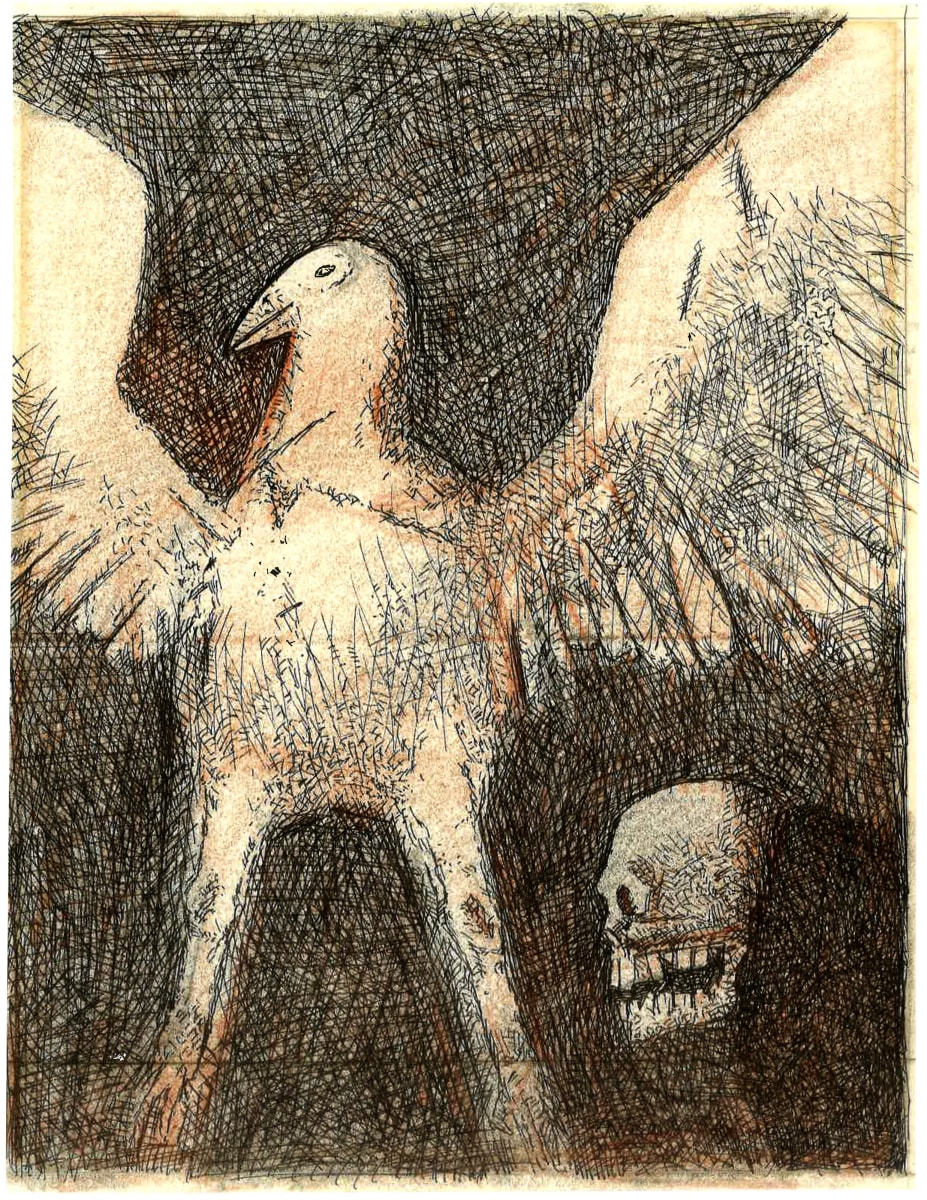
Encounter in the Twilight Zone
View the sale and market context →Institutional research
Collections & exhibitions
Read holdings, exhibition history and their qualifications in context.
Read the institutional research →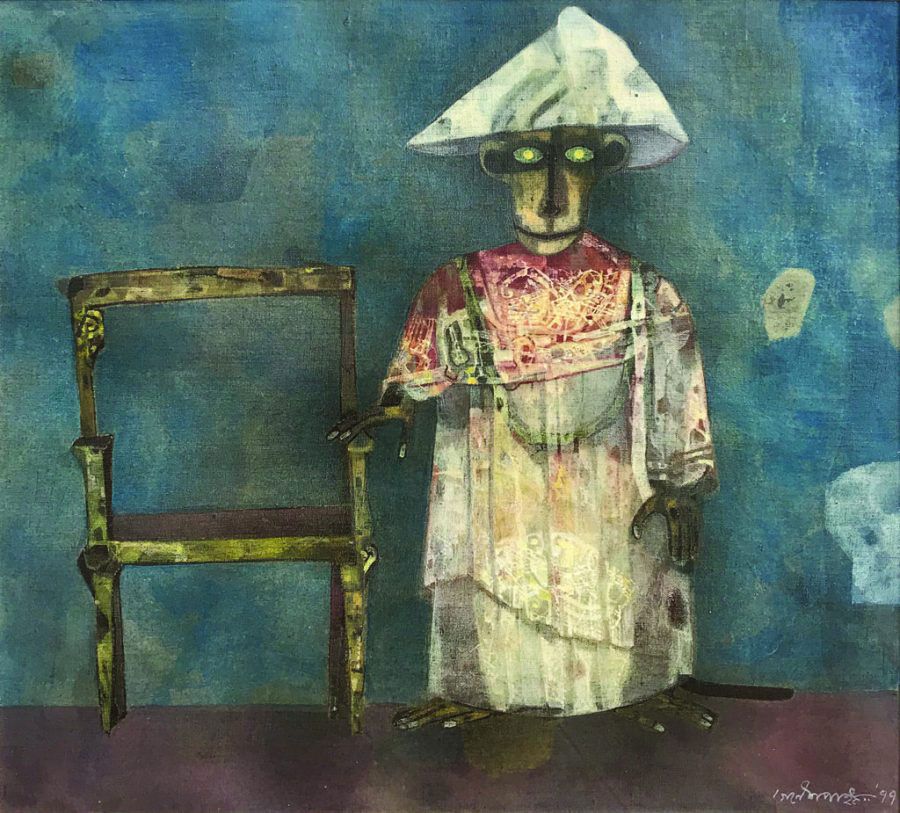






Egon investment scores
Market position
Research updated
Recent auction highlight
A result from Egon’s tracked auction sales; historical auction records are researched separately. Price including buyer’s premium.
Pricing
- Prints multiples
- No significant print/multiple market; values above refer to unique works.
- Strong temperas, other decades
- 2025: c. $700k-$800k (Sotheby's Untitled 1970). 2026 mid-tier: 'Woman and the Fountain' $178,209.
Regional/general-sale attributions
estimates as low as $3,000-$5,000 (e.g. Kodner Galleries, Sept 2024) — unvetted attributions, not comparable to Christie's/Sotheby's-catalogued material
- Smaller temperas, gouaches and late works
- typically $30,000-$200,000 depending on period, size and provenance
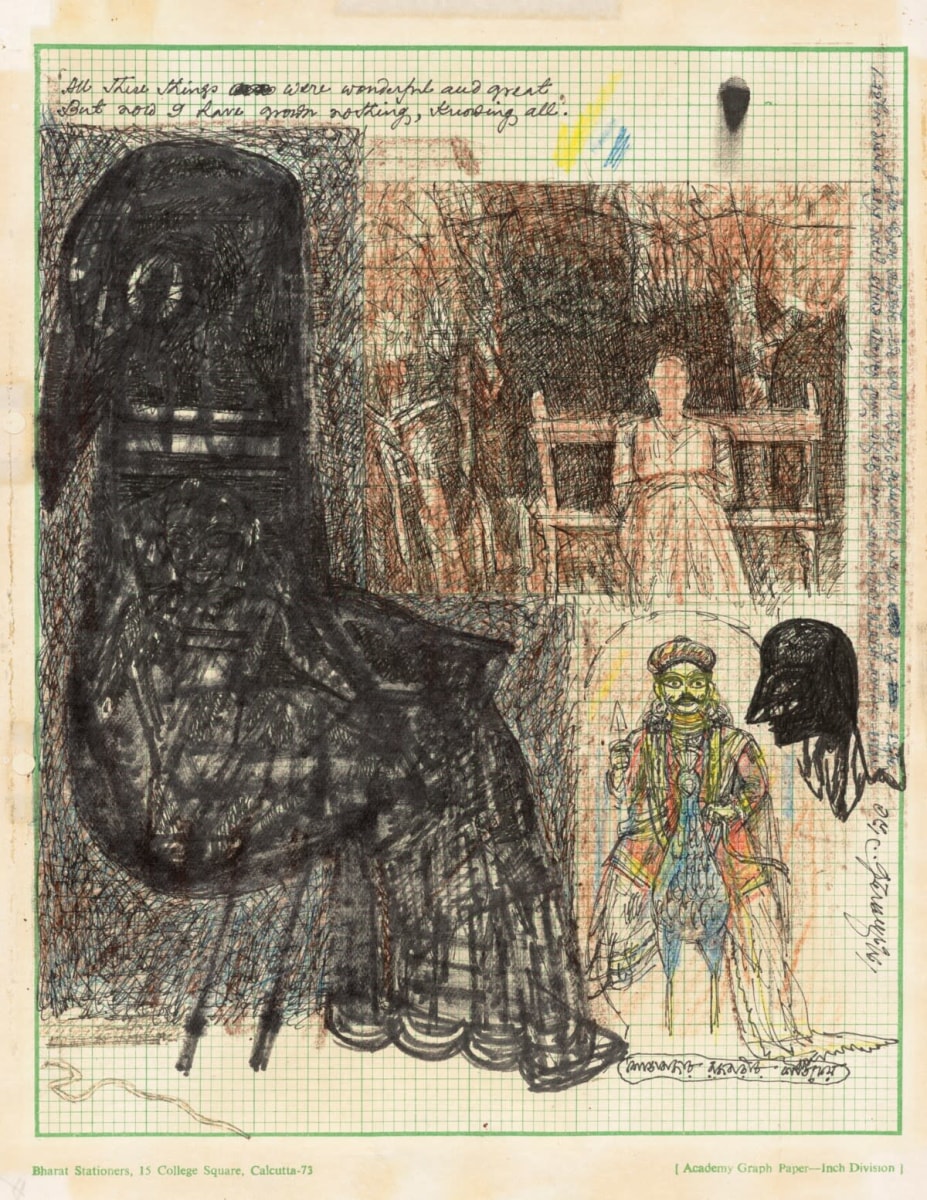
- Ink and mixed-media 'jottings' and studies
- $2,885-$11,032 in the June 2026 Christie's London sale — the accessible entry tier and the segment most exposed to authenticity risk
- Major 1970s temperas on canvas (canonical period, small scale)
- 2026: $2.2m-$5.2m at Christie's. This price tier did not exist before March 2026.
Liquidity
High for the South Asian modern segment: 300+ recorded auction lots historically; active offering across all four major houses plus Indian houses; a genuinely liquid drawings tier from c. $2,900. Depth is nonetheless concentrated into two or three dedicated South Asian sales a year and depends on episodic single-owner consignments.
Comparables
Above pyne
M.F. Husain (Gram Yatra $13.7m, 2025; Second Act $5.1m, Mar 2026); Raja Ravi Varma (Yashoda and Krishna $17.9m, Saffronart, Apr 2026); V.S. Gaitonde (1971 Untitled estimated £1.2-1.8m, London June 2026)
Below pyne
Bikash Bhattacharjee, Jogen Chowdhury, Ganesh Haloi and other Calcutta contemporaries; Madhvi Parekh ($444,500 record, 2025); Vivan Sundaram ($896,000, 2026)
Peer level
Tyeb Mehta (Gesture $3.98m, Mar 2026) — Pyne's £3.8m result now sits at or above this level, a decisive repositioning versus his pre-2025 standing
Collector base
Concentrated and sophisticated, largely South Asian and diaspora. Bidders in the room at Christie's London in June 2026 included Kiran Nadar (KNMA), Kito de Boer — described as one of Pyne's most prominent collectors — Taimur Hassan and Dara Mehta. Christie's Live bids came from China and Thailand as well as the US and India, indicating some broadening beyond diaspora hubs. Historic institutional-scale buyers: the Goodricke/Camellia corporate collection and Masanori Fukuoka's Glenbarra Art Museum, Japan. The Jane and Kito de Boer collection (c. 1,000 works) began with a Pyne — 'Lady Before the Pillar' (1993) — and over 150 works from it were sold at Christie's in 2020.
Primary market
No living-artist primary market. Estate/inventory material is handled by Indian galleries — Vadehra Art Gallery (New Delhi), CIMA (Kolkata), DAG, Akara Art (Mumbai), Sanchit Art and Dhoomimal Gallery (New Delhi). No gallery publishes prices — 'price not disclosed' throughout, indicating a dealer-controlled residual market. Contact Vadehra Art Gallery, CIMA or DAG for current inventory pricing.
Auction history
Sale context
Christie's London 11 June 2026 was the house's first dedicated South Asian sale in London since 2019: 93 lots, all sold, all above pre-sale estimates, £18.9m (c. $23.9-25.5m) — the most successful sale of its kind Christie's has staged in London. Market sources identify the consignor as the Kolkata-based Goodricke Group, majority-owned by UK-listed Camellia PLC, whose 2025 annual report (published 30 April 2026) disclosed disposal of UK assets including art. 26 Pyne works accounted for almost one-third of the sale's lots. The collection was formed largely at auction in the 1990s and early 2000s.
Bought in data
No systematic buy-in data located for 2025-26; the June 2026 Christie's London sale was white-glove (100% sold). Historical buy-in rates at Indian houses are not published — treat as a data gap.
Volume and depth
Artsy lists 306 past auction results. Our internal EGON database (Christie's/Sotheby's/Phillips/Bonhams, 2025 onward) records 35 lots — 31 sold, 4 upcoming, 100% settlement across the 7 settled lots at least 90 days old. Indian and regional houses (AstaGuru, Saffronart, Prinseps, DAG, Kodner, Material Culture, A.H. Wilkens, Bruneau) add material regularly, including a bound album of 26 pastel drawings offered at Material Culture, June 2026.
Conflicting figures flagged
PROVENANCE SPLIT, NOT RECONCILED: our internal EGON database records 'The Fisherman', Christie's, Jun 2026 at $5,121,085. Artnet News reports the same work at £3.8m ($4.9m). ARTnews reports $5.22m. Three provenances, three figures — differences likely reflect conversion date and premium treatment but this is NOT assumed. The £3.8m sterling figure is the common anchor across independent sources.
June 2026 secondary records
- Under the Red Cloud / The Amphibian (1970): £2.4m (c. $3.0m), c. 8x high estimate — Christie's London, 11 Jun 2026 (Artnet News; The Wire gives £2.37m)
- Woman the Serpent (1975): £2.4m — Christie's London, 11 Jun 2026 (likely depicting Manasa, the Bengali snake goddess)
- From our EGON database, same June 2026 Christie's sale: 'Woman and the Fountain' $178,209 (exceeded high estimate); 'Untitled (Studies for Night of the Rider)' $11,032; 'Untitled (Jotting)' at $6,789, $4,752 and $2,885 — the drawings tier
Market position
Principal beneficiary of the 2025-26 broadening of the South Asian market beyond the Bombay Progressives. Segment context: South Asian modern art auction sales exceeded $100m in 2025; Christie's NY March 2026 made $27.1m and Christie's London June 2026 made £18.9m with 100% sell-through.
Investment outlook
Risks
- SUPPLY CONCENTRATION: the market is fed by a handful of single-owner collections (Goodricke 2026, de Boer 2020). Concentrated consignment can both make and unmake price levels.
- FORGERY RISK — material and documented: ARTnews (2026) reported a surge in fakes accompanying the South Asian boom, using Pyne's $5.22m Fisherman result as its price context. There is no catalogue raisonné. Published provenance (e.g. inclusion in 'Ganesh Pyne: Revelations', 1999, documenting the Lawrie/Goodricke collection) is a material value driver, especially in the low-priced drawings tier.
- PRICE DISCONTINUITY: the 2026 plateau was established by three lots from one collection; buyers at $2m+ are underwriting an untested level.
- Thin calendar — meaningful liquidity exists in only two or three sales a year.
Positive
Extreme scarcity (c. 9-10 works a year over a c. 50-year career, mostly small format); a clearly canonical 1970s period; deep national-institutional standing that long preceded the market; and a newly demonstrated international bidding base. Four consecutive record breaks in fifteen months with lots selling at 7-10x high estimate.
Conclusion
Momentum is exceptional but the price base is young and provenance-dependent. Best risk-adjusted exposure: the jottings/drawings tier and mid-scale temperas carrying documented Goodricke, de Boer or Glenbarra provenance.
Temporal price context
- 2023
- $719,940 record (Winter Morning, AstaGuru)
- Jun 2026
- £3.8m / c. $4.9-5.2m — roughly a 7x increase in the record over fifteen months
- Mar 2025
- $787,400 (Sotheby's NY) — first record break of the current cycle
- Mar 2026
- $2.27m then $2.52m within a single Christie's NY session
- Pre-2023
- Record below $720,000; Pyne traded as a respected but second-tier name relative to Husain/Raza/Souza/Gaitonde/Tyeb Mehta
Institutional presence
Research updated
Exhibitions
Solo
- 'Ganesh Pyne: A Retrospective 1952-1998', Centre for International Modern Art (CIMA), Kolkata, 1998 — the principal retrospective of his lifetime (CIMA is a non-collecting art centre/gallery, not an accessioning museum)
- National Gallery of Modern Art, Mumbai, 2000 — his most significant museum solo
- 'Sketches', The Village Gallery, New Delhi, 1994
- 'Special Works', CIMA, Kolkata, 2005; Gallerie 88, 2005
- CIMA, Kolkata, 2010 and 2014
- Vadehra Art Gallery, New Delhi, 2013
- 'Germinal', solo show of jottings curated by Arun Ghose, India Art Fair 2014, New Delhi, presented by Sanchit Art (posthumous)
- Context: he held no solo exhibition until after age 50, preferring to show three works at a time with the Society for Contemporary Artists.
Significant group and biennials
- Commemorative Exhibition, First Indian Struggle for Independence, Academy of Fine Arts, Kolkata, 1957
- International Triennale, New Delhi, 1968
- Paris Biennale, 1969
- 'Modern Indian Paintings', organised by NGMA at the Hirshhorn Museum, Washington DC, 1982
- 'Chamatkara — Myth and Magic in Indian Art', curated by CIMA, Whiteleys Art Gallery, London, 1996
- 'Tryst with Destiny — Art from Modern India', Singapore Art Museum, 1997
- 'Image-Beyond Image' (Glenbarra Art Museum collection), touring NGMA New Delhi, Birla Academy Kolkata, Karnataka Chitrakala Parishath Bangalore, NGMA Mumbai, 1997
- 'Colour of Independence', CIMA with NGMA, New Delhi, 1997
- 'Portraits of a Decade', CIMA at Jehangir Art Gallery, Mumbai, 2004
- 'Inventing/Inverting Traditions', Grosvenor Vadehra, London, 2006-07
- 'Freedom 2008: Sixty Years After Indian Independence', CIMA, Kolkata, 2008
- 'Time Unfolded', Kiran Nadar Museum of Art, New Delhi, 2011
- 'Roots in the Air, Branches Below: Modern & Contemporary Art from India', San Jose Museum of Art, 2011
- 'Two Faces of Bengal Modernism: Ganesh Pyne & Lalu Prasad Shaw', New Delhi, 2016
- 'Paper Trails: Glenbarra Art Museum Collection', Vadehra Art Gallery, New Delhi, 15 April - 17 May 2025
Publications
- 'Ganesh Pyne: Revelations' (1999), prepared in collaboration with Goodricke, documenting the Lawrie and Goodricke collection — now provenance-critical
- Ella Datta, 'Ganesh Pyne: His Life and Times' (CIMA Gallery, Calcutta)
- Shiladitya Sarkar, 'Thirst of a Minstrel: The Life and Times of Ganesh Pyne' (Rupa & Co., November 2004)
- Ranjit Hoskote, 'Ganesh Pyne: A Pilgrim in the Dominion of Shadows' (Galerie 88, Kolkata, 2005)
- Sovon Som, 'Enchanted Space: The Private World of Ganesh Pyne'
- 'Memorialising Ganesh Pyne' (Mapin Publishing) — independent trade-publisher scholarship
- NO CATALOGUE RAISONNÉ located — a material gap given documented forgery activity in the segment
Credit line note
Indian public institutions (NGMA and its Mumbai/Bangalore branches, Birla Academy) do not publish object-level acquisition credit lines in accessible online catalogues, and no credit line was located for the Smithsonian name-match. Per the honest-gap rule every entry below reads 'credit line not published' — none is inferred or paraphrased. Per the historical-collecting caveat, the operative evidence for an artist of Pyne's generation is depth of national-institutional holding and state cultural recognition, not credit-line mechanics.
Museum collections
National Gallery of Modern Art (NGMA), New Delhi / national NGMA system
- Tier
- Tier 1 nationally — India's principal state modern-art museum
- Notes
- NGMA also organised exhibitions including Pyne and NGMA Mumbai gave him a solo exhibition in 2000.
- Holdings
- 6 works recorded in Wikidata (community aggregate; a FLOOR, not a holdings count)
- Credit line
- credit line not published
Smithsonian Institution, Washington DC
- Tier
- Tier 1 international (US federal, encyclopedic)
- Notes
- Provisional — name-match only; should be confirmed against the museum's object record before being relied upon.
- Holdings
- at least 1 work (public-API name-match; a floor, not verified against a full object record)
- Credit line
- credit line not published
Kiran Nadar Museum of Art (KNMA), New Delhi/Noida
Tier
PRIVATE museum — named but NOT counted as a first-rank public accessioning institution for scoring; nevertheless the largest South Asian modern collection in private hands (8,000+ works)
- Notes
- Kiran Nadar bid actively on Pyne material at Christie's London, June 2026.
- Holdings
- Pyne named among artists in KNMA collection exhibitions (2019 collection show; 'Time Unfolded', 2011)
- Credit line
- credit line not published
Glenbarra Art Museum, Himeji, Japan (founded 1991 by Masanori Fukuoka)
- Tier
- Private museum, Japan
- Notes
- Significant early foreign institutional-scale collecting of Pyne.
Holdings
Pyne in the collection and in its 1997 'Image-Beyond Image' touring exhibition; Glenbarra works on paper incl. Pyne shown at Vadehra, New Delhi, 15 Apr - 17 May 2025
- Credit line
- credit line not published
Birla Academy of Art & Culture, Kolkata
- Tier
- Regional Indian institution
- Holdings
- Associated with Pyne-era Bengal modernism and a venue for the 1997 Glenbarra tour; individual holding not verified
- Credit line
- credit line not published
Upcoming or current
No Pyne-specific museum exhibition announced. Segment-level opportunity: 'The Meeting Ground: Scenes from the KNMA Collection', Christie's King Street, London, 16 July - 21 August 2026 — c. 180 works by 67 artists from India, Pakistan, Bangladesh and Sri Lanka, curated by Akansha Rastogi with Preeti Bahadur, Avijna Bhattacharya, Premjish Achari and Srinivas Aditya Mopidevi; the first Christie's summer exhibition devoted to South Asia and KNMA's first London institutional showing. KNMA's new 100,000 sq m David Adjaye-designed museum near Delhi airport is targeted for the first half of 2028 (c. 60% complete as of May 2026). Our EGON database shows 4 upcoming Pyne lots.
Awards and recognition
- Raja Ravi Varma Award, Government of Kerala, 2011
- Lifetime Achievement Award, Star Ananda, Kolkata, 2008
- Abanindra Puraskar, Government of West Bengal, 2004
- Gagan-Abani Puraskar, Visva-Bharati University, 1997
- D.Litt., Kalyani University (per DAG)
- Subject of 'A Painter of Eloquent Silence: Ganesh Pyne' (dir. Buddhadeb Dasgupta, 1998), which won the National Film Award for Best Arts Film
- M.F. Husain publicly named him India's best painter in the 1970s — a peer endorsement, not institutional validation
Career & Biography
Research updated
Identity
- Birth
- 11 June 1937, Kolkata (Calcutta), West Bengal, India
- Death
- 12 March 2013, Kolkata, aged 75
- Gender
- male
- Full name
- Ganesh Pyne (Bengali: গণেশ পাইন)
- Nationality
- Indian (South Asian)
- Getty ulan ID
- 500122705
- Base of operations
- Kolkata for his entire life — lived and worked in the family house in Kabiraj Row, north Calcutta; deceased artist, estate-based market
- Getty baseline consistency
- All findings consistent with Getty ULAN (Indian painter, 1937-2013, painter/visual artist).
- Data gaps
- Marriage/family details and precise studio arrangements beyond the Kabiraj Row family mansion are not documented in accessible sources.
Career timeline
- 1946 — father dies; family caught in the Great Calcutta Killings and escorted to a safe zone at Calcutta Medical College. Trauma at age nine repeatedly cited as formative for the death-haunted imagery.
- 1950s — enrolls at Government College of Art & Craft; graduates 1959.
- early 1960s — works as a book illustrator and sketches for animation films at Mandar Mullick's studio, Kolkata; without money for colours, makes small pen-and-ink drawings (origin of the 'jottings' that still form the entry tier of his market).
- 1963 — joins the Society for Contemporary Artists, Kolkata, alongside Bikash Bhattacharjee, Shyamal Datta Ray, Dharmanarayan Dasgupta, Ganesh Haloi; shows three works at a time.
- 1968 — International Triennale, New Delhi.
- 1969 — Paris Biennale (first significant international exposure).
- 1970s — most productive decade; Naxalite-era violence in Calcutta feeds works such as 'Before the Chariot' and 'The Assassin'. M.F. Husain publicly ranks him the best painter in India.
- 1980s — withdraws from the art world, citing commercialism and rivalry among peers; becomes a recluse producing roughly nine or ten works a year.
- post-1987 — first solo exhibition only after age 50; he had previously refused solo shows.
- 1998 — 'Ganesh Pyne: A Retrospective 1952-1998', CIMA, Kolkata; Buddhadeb Dasgupta's documentary 'A Painter of Eloquent Silence: Ganesh Pyne' wins the National Film Award for Best Arts Film.
- 2000 — solo exhibition, National Gallery of Modern Art, Mumbai.
- 1990s-2000s — collected in depth by corporate and private collections (Goodricke/Camellia, Glenbarra Art Museum Japan, Jane and Kito de Boer).
- 2013 — dies in Kolkata; posthumous solos continue (Vadehra 2013, CIMA 2014, 'Germinal' jottings show at India Art Fair 2014).
- 2025-2026 — posthumous market re-rating: auction record broken four times in fifteen months, culminating in 'The Fisherman' (1979) at Christie's London, June 2026.
Personal and social
Reclusive, publicity-averse, refused to explain his work, rarely left Kolkata. Political engagement is indirect but real: the 1946 riots/Partition and the 1970s Naxalite period are the two historical events most cited as shaping his imagery.
Education and training
- Notes
- No formal training abroad; entirely Calcutta-formed.
- Honorary
- D.Litt. from Kalyani University (per DAG)
- Graduation
- Graduated 1959 (enrolled in the 1950s)
- Institution
- Government College of Art & Craft, Kolkata — the institution historically associated with the Bengal School
Influences and context
Contemporaries
Bikash Bhattacharjee, Ganesh Haloi, Shyamal Datta Ray, Jogen Chowdhury, Dharmanarayan Dasgupta (Society for Contemporary Artists, Kolkata); nationally the generation after the Progressive Artists' Group (Husain, Raza, Souza, Tyeb Mehta, Gaitonde)
Primary influences
Abanindranath Tagore and the Bengal School watercolour tradition (early work); Bengali folklore and his grandmother's tales; Rembrandtesque chiaroscuro; European Symbolism/Surrealism absorbed at a distance; Klee frequently cited by writers on his tempera surfaces
Art historical position
Bridge figure between the Bengal School lineage and Indian modernism; the leading Calcutta modernist of his generation, working outside the Bombay Progressives' idiom
Studio practice and working methods
Extremely low output (c. 9-10 finished works a year), small formats (canonical temperas c. 16 x 22 in / 40-56 cm). Worked through 'jottings' — small ink and mixed-media drawings functioning as a private visual diary and preparatory corpus. Built tempera surfaces from multiple translucent layers over a prepared ground to produce internal luminosity and phantom-like figures. From the 1990s kept a personal diary of copied poetry, used by researchers as a key to his iconography.
Artistic Profile
Research updated
Style
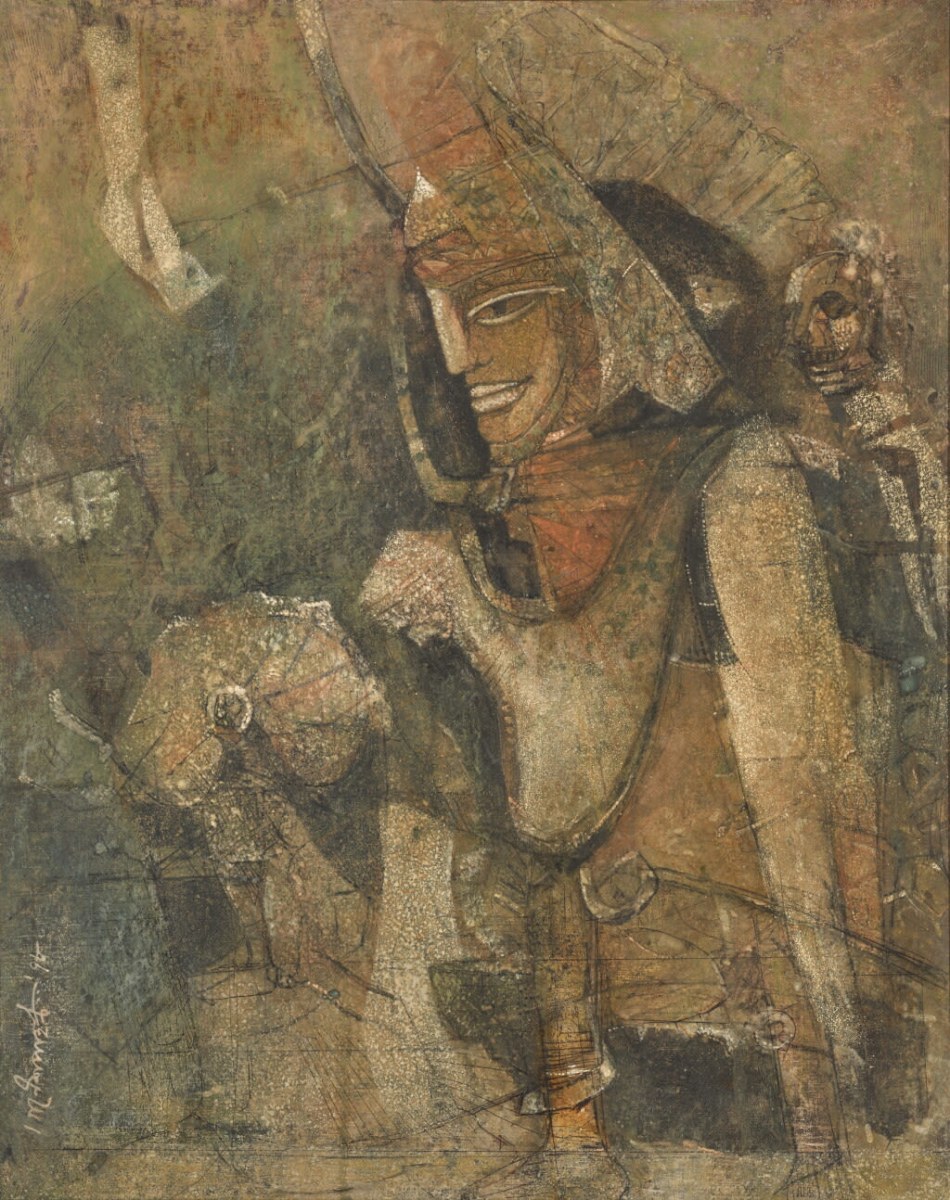
Small-format, low-key, interiorised paintings in which spectral figures, skulls, birds, horses, boats and decaying architecture emerge from a darkened but luminous ground. Flattened, frieze-like lateral compositions; figures as semi-transparent silhouettes; strong figure-ground compression; deliberate reserve and negative space. The layered tempera surface — translucent stratum on translucent stratum — produces a lit-from-within quality rare in Indian modernism.
Evolution
- 1950s-early 1960s: Bengal School watercolour idiom after Abanindranath Tagore; illustration and animation work; ink drawings born of poverty
- mid 1960s-1970s: mature tempera language emerges; darkest and most canonical period, sharpened by Naxalite-era violence — the works that now carry the market
- 1980s: withdrawal from the art world; output falls to c. 9-10 works a year; imagery becomes more hermetic
- 1990s-2013: continued small temperas and jottings; poetry diaries; late portraits in mixed drawing media (the bearded-elder type identified in the Egon narrative)
Influences
Abanindranath Tagore and the Bengal School; Rembrandt's chiaroscuro; Klee's small-scale poetic construction; European Symbolism and Surrealism; Bengali oral literature. He is in turn the reference point for later Kolkata figuration.
Visual language
Chiaroscuro as the organising principle; earth tones, ochre, sienna, olive-grey punctuated by cerulean and viridian accents; motifs of thresholds and crossings (fountains, wells, rivers, boats); the small moon disc; skeletal architecture rendered weightless through transparency.
Themes and subjects
- Death, mortality and decay
- Bengali folklore and fairy tale absorbed from his grandmother's storytelling
- Hindu myth and goddess iconography (Manasa, Devi)
- Memory, dream and the uncanny
- Violence and its aftermath — the 1946 Calcutta riots and the 1970s Naxalite period
- Solitary archetypes: fishermen, riders, minstrels, assassins
- Water, fountains, wells and thresholds as crossing-points
Movements and periods
- Bengal School of Art lineage (via Abanindranath Tagore)
- Indian modernism / post-Independence modernism
- Calcutta School / Society for Contemporary Artists
- 'Poetic surrealism' and 'dark surrealism' — critical descriptors rather than formal movements
- Postwar (1950s-2000s)
Techniques and mediums
- Tempera on canvas (often laid on card or mountboard) — the primary medium of major works
- Gouache and watercolour, especially in early Bengal School-inflected work
- Pen and ink drawings with dense cross-hatching — begun for economic reasons in the early 1960s, continued lifelong
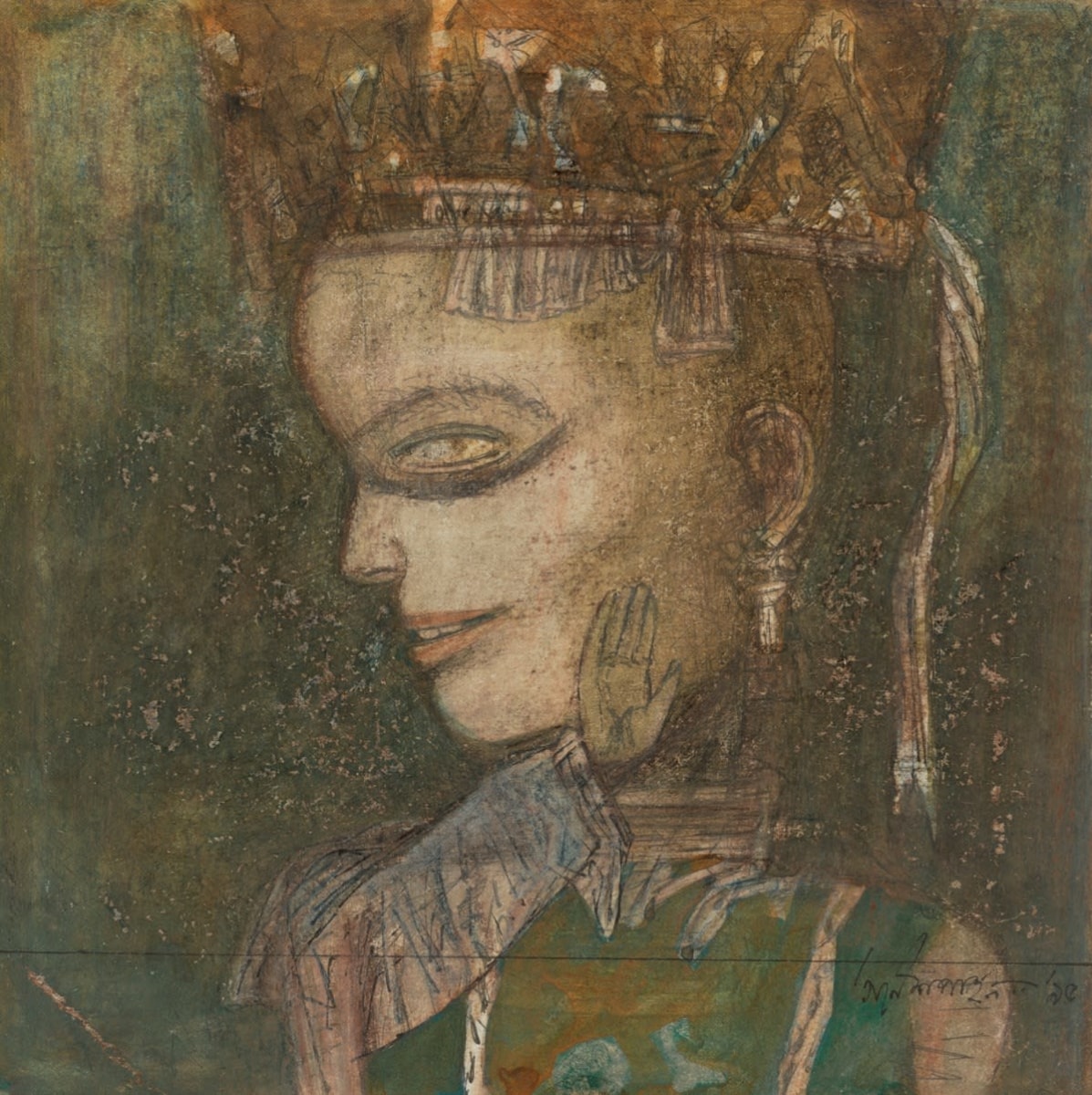
- Pastel/chalk underlay with ink over-drawing on off-white paper (late portrait drawings)
- Occasional oil on canvas with dry-brush scumbling and glazing
- 'Jottings' — small mixed-media sketches serving as private visual diary and compositional laboratory
Fingerprint verification
Extended
Sources add three elements the fingerprint under-weights: (1) TEMPERA ON CANVAS is the signature medium of his major works, built from multiple translucent layers to produce internal luminosity — not merely oil or drawing media; (2) DARKNESS AS STRUCTURE — chiaroscuro grounds out of which phantom, skeletal, semi-transparent figures emerge, described in the literature as dark surrealism; (3) an explicit iconographic programme drawn from Bengali folklore and Hindu myth, e.g. Manasa the snake goddess in 'Woman the Serpent' (1975).
Confirmed
The Egon fingerprint's core reads hold and are corroborated: gestural/representational register, postwar period label, ink and drawing media with cross-hatching and hatching, contemplative mood, narrative themes, earth-toned/muted/warm palette, figure-ground tension, asymmetrical balance, intimate scale and active negative space. Intimate scale is independently confirmed by the market record — the two works that broke his record in March 2026 measure only c. 16 x 22 inches.
Disagreement noted
DISAGREEMENT WITH THE FINGERPRINT'S FRAMING: the low coherence (0.50, n=32) is better explained as a MEDIUM SPLIT within one highly unified sensibility than as broad stylistic range — a large corpus of small ink/pastel jottings and portrait drawings on paper versus a small corpus of finished temperas on canvas. The drawings are preparatory and diaristic, not a separate style. Attribution work should compare against the correct medium tier rather than the aggregate centroid. Secondly, the fingerprint's 'post-Cubist planar decomposition' read is defensible for the fountain/architecture works but should not be generalised: Pyne's construction is layered-translucent rather than facetted-Cubist.
Signature series and works
- The Fisherman (1979) — current auction record
- Encounter in the Twilight Zone (1974)
- Crossing the Fountain (1974); Untitled (After Crossing the Fountain)
- Under the Red Cloud / The Amphibian (1970)
- Woman the Serpent (1975)
- Winter Morning (1971)
- Before the Chariot; The Assassin (Naxalite-period works)
- Devi (1968)
- The 'jottings' corpus
- Egon centroid works confirmed as genuine recurring motifs: Woman and the Fountain, Under the Tree, Sculpted Dancer — the fountain/well is a documented compositional family
Critical Reception
Research updated
Academic discourse
Positioned in the literature as the pivotal Calcutta modernist who metabolised the Bengal School (Abanindranath Tagore) into a private, death-haunted symbolist idiom, distinct from the Bombay Progressives' School-of-Paris orientation. Scholarship is real and multi-authored, but several key monographs were published by galleries (CIMA, Galerie 88); independent trade-publisher scholarship exists (Rupa & Co., Mapin). No catalogue raisonné.
Critical reception
Summary
Pyne is one of the most critically respected figures in modern Indian art and has been for five decades — his reputation preceded his market by roughly forty years, which is the defining feature of his case. He is consistently characterised as the exponent of a 'poetic surrealism' or 'dark surrealism' rooted in Bengali folklore and myth.
Key endorsements
- M.F. Husain, asked in the 1970s to rank India's painters, placed Pyne first — described by DAG and others as the moment his national reputation consolidated
- Ranjit Hoskote (poet-critic) framed him in monograph form as 'a pilgrim in the dominion of shadows'
- Ella Datta, who has covered the Indian art scene for over thirty years, wrote the standard biography
- Buddhadeb Dasgupta's 1998 documentary won a National Film Award for Best Arts Film — an unusual level of mainstream cultural recognition for a painter
Recent press 2025 2026
- The Art Newspaper, 15 June 2026 — 'Tea company's collection of South Asian Modern art soars at Christie's London'; a £3.8m Pyne led the Goodricke sale
- Artnet News (Richard Whiddington), 12 June 2026 — Christie's £18.9m London sale, anchored by three Pyne works
- The Art Newspaper, 2 April 2026 — record-season coverage noting two consecutive Pyne records at Christie's New York, then at $2.5m
- The Wire, April and June 2026 — detailed coverage of the record sequence and the Goodricke/Camellia dispersal
- ARTnews, 2026 — investigation into forgeries in the booming South Asian market, using the Pyne Fisherman result as its price context
- Artsy, March 2025 — coverage of the Sotheby's New York sale at which Pyne's record was first broken in this cycle
Editorial recognition
The 'artists to watch / new talent' category is not applicable — Pyne is a deceased modern master, not an emerging artist. The equivalent leading indicators are the trade-press market coverage above and the KNMA/Christie's institutional showcase of South Asian art in London (July-August 2026).
Publications and media
Five book-length treatments plus a National Film Award-winning documentary; his work has been reproduced on the cover of the Goodricke house magazine and documented in 'Ganesh Pyne: Revelations' (1999).
Egon news label verification
Our provisional label for the 15 June 2026 Art Newspaper item was 'Auction Record'. VERIFIED AND CORRECT — independently confirmed by Artnet News, ARTnews and The Wire: 'The Fisherman' (1979) set a world auction record for the artist at Christie's London on 11 June 2026. One caveat we add ourselves: the item is as much a single-owner-collection story (Goodricke/Camellia liquidating UK assets) as an artist story, and the sale's 100% above-estimate sell-through means the record should be read partly as a collection-provenance effect rather than as pure artist-level demand.
Gallery & Representation
Research updated
Fair presence
India Art Fair (New Delhi) is the principal fair venue for Pyne material; Sanchit Art has shown him in Dubai. Christie's Mumbai office displayed 15 lots from the 'Sublime Shadows' collection, 8-13 April 2026, ahead of the London sale — an India-first pre-sale strategy.
Representation
Status
Deceased 2013 — no primary representation. Estate and secondary inventory is distributed across several Indian galleries rather than held by an exclusive estate representative.
- Pricing transparency
- No gallery publishes prices for Pyne. Contact Vadehra Art Gallery, CIMA or DAG for current inventory pricing.
Effective market makers
Christie's (London, New York, and its Mumbai office), Sotheby's New York, plus AstaGuru, Saffronart and Prinseps in India — the auction houses, not the galleries, now set the price level.
Principal secondary galleries
Vadehra Art Gallery
- Role
- Held his 2013 solo; maintains an active artist page and biography; presented the Glenbarra Art Museum works on paper in 2025
- Tier
- Tier 1 Indian, strong international fair presence
- Location
- D-53 Defence Colony, New Delhi
- Verified on gallery site
- Yes
Centre of International Modern Art (CIMA)
- Role
- Organised the 1998 retrospective and solos in 2005, 2010 and 2014; published Ella Datta's monograph. Closest to a custodial gallery.
- Tier
- Tier 1 regional — Kolkata's leading modern gallery
- Location
- Kolkata
- Verified on gallery site
- No
DAG (Delhi Art Gallery)
- Role
- Maintains a Pyne artist page and trades his work
- Tier
- Tier 1 Indian modern dealer with international reach
- Location
- New Delhi / Mumbai / New York
- Verified on gallery site
- Yes
Akara Art
- Role
- Secondary market; artist page
- Tier
- Tier 2
- Location
- Mumbai
- Verified on gallery site
- Yes
Sanchit Art
- Role
- Presented the posthumous 'Germinal' jottings show at India Art Fair 2014; group shows including Dubai
- Tier
- Tier 2
- Location
- New Delhi
- Verified on gallery site
- Yes
Dhoomimal Gallery
- Role
- Secondary market; maintains the most detailed public exhibition chronology
- Tier
- Tier 2, historic
- Location
- New Delhi
- Verified on gallery site
- Yes
Galerie 88
- Role
- Historic dealer; published Ranjit Hoskote's 2005 monograph
- Tier
- Tier 2 regional
- Location
- Kolkata
- Verified on gallery site
- No
Geographic reach
Demand core: India (Delhi, Mumbai, Kolkata), London and New York diaspora collectors, UAE. Newly evidenced online bidding from China and Thailand at Christie's London, June 2026. Japan represented historically via the Glenbarra Art Museum.
Representation history
Shown almost exclusively through the Society for Contemporary Artists (Kolkata) from 1963 through the 1980s; CIMA became his principal gallery from the mid-1990s; Vadehra and the Delhi trade took a larger role from the 2000s and posthumously.
Sources & research notes
Egon’s artist research combines historical auction records, recent sales, institutional history, critical reception and gallery information. Researched auction records and auction highlights are identified separately.
Read prices with their work, sale date, currency and stated basis. Egon’s market assessments are distinct from reported auction results.
Reference: Egon, “Ganesh Pyne: Market Intelligence & Investment Profile.”
Research bibliography · 32 sources
Sources recorded for this artist’s research. This bibliography does not assign every source to an individual claim.
- Ganesh Pyne — Wikipedia
- Ganesh Pyne — Bengal Foundation
- Ganesh Pyne: Master of Dark Surrealism in Indian Art — Prinseps
- Indian tea company's art collection soars at Christie's London — The Art Newspaper
- Christie's London Sale Confirms Growing Appetite for South Asian Art — Artnet News
- Vaccine billionaire buys $17.9m Raja Ravi Varma, setting new record for Indian painting at auction — The Art Newspaper
- Christie's Hits Auction Records In London With an Indian Tea Company's Art — The Wire
- USD 18 Million Record Auction Price for Ravi Varma's 'Mona Lisa of Indian Art' — The Wire
- Sublime Shadows: South Asian Art From a Distinguished Collection — Deccan Chronicle
- 9 artists break auction records at Sotheby's South Asian sale — Artsy
- Ganesh Pyne — Auction Results and Sales Data — Artsy
- South Asian Art Market's Boom Has Brought a Surge in Fakes — ARTnews
- Ganesh Pyne Paintings & Artwork for Sale — Price Guide — Invaluable
- The Indian Art Market Comes of Age: Growth, Records and Investment — Aakriti Art Gallery
- Ganesh Pyne — Vadehra Art Gallery
- Paper Trails: Glenbarra Art Museum Collection — Vadehra Art Gallery
- Ganesh Pyne — Renowned Modern Indian Artist — Akara Art
- Ganesh Pyne: Artist Detail Information — Dhoomimal Gallery
- Ganesh Pyne — DAG
- Ganesh Pyne Artist: Modern Indian Art & Masterpieces — Sanchit Art
- Ganesh Pyne: A Dreamer of Darkness — Indigenous
- The Jane and Kito de Boer Collection — MAP Academy
- Christie's announces 'A Lasting Engagement', The Jane and Kito de Boer Collection — Luxebook
- The Meeting Ground: Scenes from the KNMA Collection — KNMA
- India's Kiran Nadar Museum to take over Christie's London headquarters this summer — The Art Newspaper
- India's Kiran Nadar Museum to stage major South Asian art exhibition at Christie's London — Artsy
- KNMA to bring South Asia's artistic voices to Christie's London — The Week
- KNMA, Noida — Kiran Nadar Museum of Art
- Kiran Nadar Museum of Art — BMW Art Guide
- Image-Beyond Image: Contemporary Indian Paintings From the Collection of Glenbarra Art Museum Japan — Asia Art Archive
- Memorialising Ganesh Pyne — Mapin Publishing
- Ganesh Pyne biodata — Indian Art Ideas
Research updates by section
These dates show when Egon’s research sections were updated. Source retrieval dates, where supplied above, refer to individual evidence notes.
Ranking updated . Research sections follow their own update dates.
This is what the market knows about Ganesh Pyne. What Egon can also tell you: whether Ganesh Pyne fits your portfolio — based on your existing holdings, budget, and investment timeline.
Get personalized analysisActive market signals
Inside Egon
Signal timeline & strength analysis
Gallery moves, auction records, institutional acquisitions, price milestones — tracked over 90 days
Full signal timeline, strength analysis, and alert configuration for Ganesh Pyne.
Collector demographics & buyer analysis
Geographic distribution, institutional vs. private buyers, collector profiles, and secondary market activity
Who is collecting Ganesh Pyne? Geographic distribution, institutional vs. private buyers, and collector profile analysis.
Personalized acquisition strategy
Optimal entry points, comparable pricing analysis, timing recommendations, and portfolio fit assessment
Personalized acquisition strategy for Ganesh Pyne based on your budget, timeline, and collection goals.
Go deeper with personalized intelligence
You now have Egon's market assessment of Ganesh Pyne. The next question is personal: does this artist belong in your collection? Egon analyzes collection fit based on your aesthetic thesis, existing holdings, budget, and investment goals — delivering acquisition strategies no public index can provide.